Part Two Assessment Of The Association Of Vitamin D And The Risk Of Tuberculosis Among End-Stage Kidney Disease Population
Jun 06, 2023
Results
Table 1 presents the demographic characteristics of the study population. This retrospective cohort study included 20,985 patients with chronic kidney disease and 20,985 with non-chronic kidney controls. Of the 20,985 patients with renal disease, 2780 (13.2%) patients were undergoing hemodialysis only, and 291 (1.4%) were undergoing both hemodialysis and peritoneal dialysis. In patients with kidney disease, 290 developed tuberculosis (incidence rate 2.05, 95% confidence interval (CI) 2.04–2.06 per 1000-person years), and 334 of the patients without kidney disease had TB (incidence rate 1.14 95% CI 1.14–1.15 per 1000-person years). In the study, sex and age were distributed equally between the CKD and non-CKD and were matched in the participant’s characteristics. Most of the participants lived in the northern region. A higher proportion of participants with CKD than those without CKD were diagnosed with hypertension (72.8% vs. 47.6%). Those with lipid disorders were more prevalent in the group with CKD than in the group with non-CKD (10,780, 51.4%).

Increased risk of development of tuberculosis was observed in our study (adjusted IRR 1.57 95% CI 1.33–1.86; Table 2). After 3 years of follow-up, the risk of tuberculosis in chronic kidney disease was higher (adjusted IRR 3.79 (2.55–5.62)). However, after more years of follow-up, no significance was observed (adjusted IRR 1.33 95% CI 0.96–1.84; p = 0.0824). The Kaplan–Meier curves for the incidence of tuberculosis in individuals with and without kidney disease differed significantly (log-rank test p < 0.0001) (Figure 2a).


Table 3 presents the demographic characteristics of the ESKD population. This retrospective cohort study included 3194 patients with ESKD and 3194 non-ESKD. Of the 3194 patients with ESKD, 2657 (83.2%) patients were undergoing hemodialysis only, 74 (2.3%) peritoneal dialysis, 271 (8.5%) both hemodialysis and peritoneal dialysis as well as 192 kidney transplant recipients (6.0%), respectively. Of patients with ESKD, 98 developed tuberculosis (incidence rate 4.08, 95% confidence interval (CI) 4.03–4.13 per 1000-person years), and 25 of the patients without kidney disease had TB (incidence rate 1.17, 95% CI 1.16–1.19 per 1000-person years). We also found that ESKD increases the risk of tuberculosis (adjusted IRR 3.67 95% CI 2.27–5.93). The Kaplan–Meier curves for the incidence of tuberculosis in individuals with and without ESKD differed significantly (log-rank test p < 0.0001; Figure 2b).

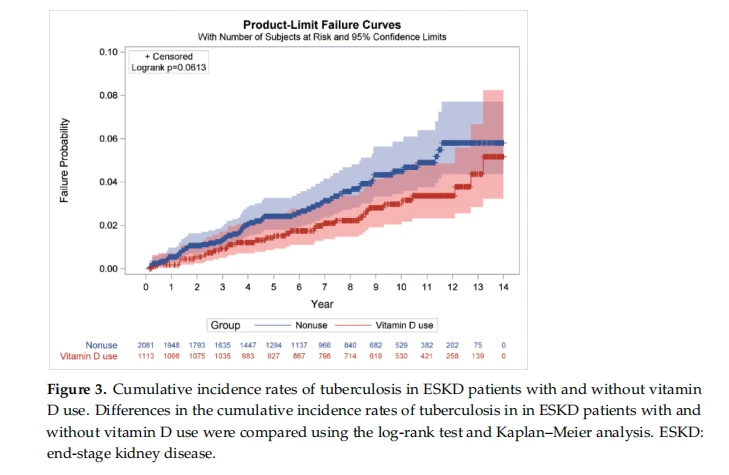
However, Vitamin D uses and dosages were not related to the reduced risk of tuberculosis in ESKD patients (Table 3). Vitamin D supplementation has no significance in ESKD (adjusted IRR 0.77, 95% CI 0.49-1.19; p = 0.2351). Moreover, we also observed that there was no dosage effect on ESKD patients (adjusted IRR > 0.56; p > 0.1783). Figure 3 shows the overall cumulative incidence of TB at the end of the follow-up period in ESKD patients with and without vitamin D use. The results show no significant differences in the cumulative incidence rate of tuberculosis between vitamin D use and non-use in the ESKDgroup log-rank test, p = 0.0613.
Discussion
This is a large cohort study conducted in 41,970 matched populations in Taiwan. The overall findings suggested that people with chronic kidney disease have a three-fold increased risk of developing tuberculosis compared with people without chronic kidney disease. The important finding is that tuberculosis occurs early in chronic kidney disease patients, when at less than 3 years follow-up, the incident rate ratio of the patient with tuberculosis has already increased to (adjusted IRR 3.79 95% CI 2.55–5.62; the incident ratio of patients with tuberculosis gradually decreases in the longer follow-up year. Moreover, an increased risk of development of tuberculosis was observed in ESKD patients. Our results revealed that vitamin D uses and dosages were not related to the reduced risk of tuberculosis in ESKD patients, which coincided with the Lin et al. study [22]. The relationship between vitamin D level and TB seems to be controversial in ESKD at this current period, as some studies have stated that vitamin D has anti-mycobacterial activities [23]. Therefore, we need more molecular studies to evaluate the roles of vitamin D in the risk of TB.

Click here to get the benefits of Cistanche
In a study performed in Taiwan, the incidence rate of TB was similar in CKD stage 1 and stage 2 [24]. However, our findings may suggest that, indeed, the alteration in immunity during CKD may increase the risk of tuberculosis. A study also found that TB was significantly higher among those with CKD than among those without CKD [25]. This usually occurs in advanced CKD patients because of the immunodeficiency status resulting from impaired T cells, B cells, neutrophils, monocytes, and natural killers. The study results suggest that with the increasing severity of CKD, there is also a progressive increase in the risk of tuberculosis. Many risk factors of tuberculosis are also comorbidities of CKD that may also have increased TB infection in this cohort; these comorbidities may include diabetes and hypertension, which was found to be more prevalent in the CKD group than the non-CKD group. The association between diabetes mellitus and tuberculosis is mostly observed in countries where there is a high incidence of TB and the incidence of diabetes mellitus is also increasing.
However, there are still no studies to elucidate on the real mechanism of the effect of diabetes mellitus as a risk factor for TB. Some studies have suggested impaired cellular immunity, impairment of alveolar macrophages in the lungs, low levels of interferon-gamma, pulmonary microangiopathy, and micronutrient deficiency [26].
The number of participants on hemodialysis was high in the ESKD, which might increase the incidence of TB; previous studies have suggested that patients with chronic kidney disease and on dialysis are at risk of active tuberculosis (Table 2). A study performed in India suggested that TB in dialysis is associated with a poor prognosis and high mortality due to the delay in diagnosis and adverse effects of anti-TB drugs [27,28]. A study conducted in Northern Taiwan on patients with long-term dialysis had a hazard ratio of 2.041 [24]. Some also suggest that even after kidney transplantation, the risk of tuberculosis is increased. Other cohort studies have found the IRR of TB to be 3.4 to 25.3 in dialysis patients compared to the general population. [29]. This is a very high risk for this patient, and they should be monitored closely for early diagnosis of tuberculosis. A study performed in Southern England found a higher incidence of TB in hemodialysis patients compared with patients on peritoneal dialysis. However, other studies found the risk is not different from those with peritoneal dialysis [30].

Cistanche pills
This study also shows that vitamin D drug use in patients is not effective in reducing the incidence of tuberculosis in ESKD (Table 4).

Host genetic susceptibility has been suggested as one of the most important explanations for inter-individual differences in tuberculosis (TB) risk. The vitamin D receptor gene is located at chromosome 12 (12q13.11) [31]. Vitamin D can be obtained from nutrition, and it can also be synthesized by the human body during sunlight exposure. This form of vitamin D is biologically inactive, and then it is delivered into the liver, where it undergoes hydroxylation to become 25-hydroxy vitamin D. From the liver, it is taken to the kidneys, where it undergoes another hydroxylation to become 1α-25-dihydroxy vitamin D. This active form of vitamin D affects the immune function and regulates the activity of the defense immune system. During a tuberculosis infection, vitamin D binds to the vitamin D receptor gene in macrophages, and this binding activates the synthesis of the antimicrobial peptide cathelicidin, which restricts M. tuberculosis intracellular growth in macrophages [32]. Vitamin D deficiency, which is commonly observed in ESKD [33], impairs monocyte function, reducing the production of cathelicidin, a peptide that is capable of destroying mycobacteria; hence, patients with CKD are given vitamin D supplementation to prevent the deficiency. The main issue with the long-term use of vitamin D derivatives in patients with impaired renal function is the risk of inducing or accelerating the progression of renal failure [34]. Due to dietary restrictions in patients with ESKD on dialysis, and the presence of comorbidities that may result in longer hospitalization and less exposure to natural sunlight, CKD patients usually require vitamin D supplementation, especially cholecalciferol- and calcifediol-based supplements [33]. There is also a significant role in patients with lipid disorders, who seemed to also have a protective benefit from acquiring tuberculosis. The mechanism of these two is still unknown; however, some studies have suggested that host lipids act as a major source of carbon and energy for Mycobacterium tuberculosis (M. tb), creating a favorable environment for it. They are important for the slow metabolizing population of the bacilli in the host [35]. Therefore, in our study, the findings suggest that the alteration in the lipids was beneficial for protection against M. TB survival in the host; however, the mechanism for this remains elusive and needs further investigations, since lipid disorders are supposed to make mycobacterium tuberculosis strive more in the host.

Standardized Cistanche and Cistanche tubulosa
The strength of this study was that it was performed using data from a large population-based database in Taiwan. Therefore, the findings are likely applicable to the general population. However, electronic health databases with coding errors could be a problem for NHIRD. Healthcare providers might resort to upcoding the diagnoses to more severe ones. Misclassification bias may thus become an issue if those diagnosis codes have not been properly validated. Although large data sets could potentially overcome this problem, the real impact of incorrect coding awaits further elucidation [36].
A limitation of our study is that database-driven studies have a greater potential for bias in observational studies. If we had combined multiple databases, the researcher would have been able to access more variables than those available in the NHIRD, such as physical examination results, laboratory data, stage of cancer, level of disability, quality of life, body mass index, smoking, marital status, education and household income, which were not included in our study [36]. Other important information was also unable to be obtained, such as hours of sun exposure and the use of sunscreen. Analysis from NHANES III (the Third National Health and Nutrition Examination Survey) reported an inverse association between BMI and 25(OH)D levels in persons with CKD [37]. In this study, laboratory data from our participants were not retrieved from the database, which may be of importance to validate the immunological status of our study participants. This study did not include biochemical indices of bone metabolism and markers of bone and mineral disorders in patients who were given vitamin D therapeutic intervention, which can affect the PTH [38]. However, in the case of suboptimal vitamin D levels and vitamin D deficiency in ESKD, vitamin D supplementation will be essential for those patients.

Cistanche extract
Conclusions
The study findings were that patients have an increased risk of early development of tuberculosis in chronic kidney diseases. Importantly, the risk was increased in end-stage kidney diseases (ESKD), and vitamin D supplementation use might not be helpful to reduce the incidence of tuberculosis in this group. This leaves a gap in the health system in the treatment guidelines of chronic kidney disease, and these patients should be screened routinely and carefully for early detection of TB infection. This study provides the current actual knowledge and addresses the questions regarding vitamin D supplementation in ESKD, and its clinical benefit remains elusive in the scientific community.
Reference
22. Lin, S.Y.; Chiu, Y.W.; Yang, H.R.; Chen, T.C.; Hsieh, M.H.; Wang, W.H.; Chen, Y.H. Association of vitamin D levels and risk of latent tuberculosis in the hemodialysis population. J. Microbiol. Immunol. Infect. 2021, 54, 680–686. [CrossRef] [PubMed]
23. Todoriko, L.D.; Toderika, Y.I.; Shevchenko, O.S.; Pidverbetska, O.V.; Pidverbetskyi, O.Y. The role of vitamin D deficiency in antituberculous protection. Infus. Chemother. 2021, 4, 38–44. [CrossRef]
24. Shu, C.C.; Wei, Y.F.; Yeh, Y.C.; Lin, H.H.; Chen, C.Y.; Wang, P.H.; Cheng, S.L.; Wang, J.Y.; Yu, C.J. The impact on incident tuberculosis by kidney function impairment status: Analysis of severity relationship. Respir. Res. 2020, 21, 51. [CrossRef] [PubMed]
25. Bardenheier, B.H.; Pavkov, M.E.; Winston, C.A.; Klosovsky, A.; Yen, C.; Benoit, S.; Gravenstein, S.; Posey, D.L.; Phares, C.R. Prevalence of Tuberculosis disease among adult US-bound refugees with chronic kidney disease. Immigr. Minor. Health 2019, 21, 1275–1281. [CrossRef]
26. Baghaei, P.; Marjani, M.; Javanmard, P.; Tabarsi, P.; Masjedi, M.R. Diabetes mellitus and tuberculosis facts and controversies. J. Diabetes Metab. Disord. 2013, 12, 58. [CrossRef]
27. Prasad, R.; Singh, A.; Balasubramanian, V.; Gupta, N. Extensively drug-resistant tuberculosis in India: Current evidence on diagnosis & management. Indian J. Med. Res. 2017, 145, 271–293. [CrossRef]
28. Segall, L.; Covic, A. Diagnosis of tuberculosis in dialysis patients: Current strategy. Clin. J. Am. Soc. Nephrol. 2010, 5, 1114–1122. [CrossRef]
29. Dobler, C.C.; McDonald, S.P.; Marks, G.B. Risk of tuberculosis in dialysis patients: A nationwide cohort study. PLoS ONE 2011, 6, e29563. [CrossRef]
30. Ostermann, M.; Palchaudhuri, P.; Riding, A.; Begum, P.; Milburn, H.J. Incidence of tuberculosis is high in chronic kidney disease patients in South East England, and drug resistance is common. Ren. Fail. 2016, 38, 256–261. [CrossRef]
31. Gao, L.; Tao, Y.; Zhang, L.; Jin, Q. Vitamin D receptor genetic polymorphisms and tuberculosis: Updated systematic review and meta-analysis. Int. J. Tuberc. Lung Dis. 2010, 14, 15–23. [PubMed]
32. Hu, Q.; Chen, Z.; Liang, G.; Mo, F.; Zhang, H.; Xu, S.; Wang, Y.; Kang, L.; Jin, T. Vitamin D receptor gene associations with pulmonary tuberculosis in a Tibetan Chinese population. BMC Infect. Dis. 2016, 16, 469. [CrossRef] [PubMed]
33. Zappulo, F.; Cappuccilli, M.; Cingolani, A.; Scrivo, A.; Chiocchini, A.L.C.; Nunzio, M.D.; Donadei, C.; Napoli, M.; Tondolo, F.; Cianciolo, G.; et al. Vitamin D and the Kidney: Two players, one console. Int. J. Mol. Sci. 2022, 23, 9135. [CrossRef] [PubMed]
34. Hamdy, N.A.; Kanis, J.A.; Beneton, M.N.; Brown, C.B.; Juttmann, J.R.; Jordans, J.G.; Josse, S.; Meyrier, A.; Lins, R.L.; Fairey, I.T. Effect of alfacalcidol on the natural course of renal bone disease in mild to moderate renal failure. BMJ 1995, 310, 358–363. [CrossRef]
35. Chang, D.P.S.; Guan, X.L. Metabolic versatility of mycobacterium tuberculosis during infection and dormancy. Metabolites 2021, 11, 88. [CrossRef] [PubMed]
36. Hsieh, C.Y.; Su, C.C.; Shao, S.C.; Sung, S.F.; Lin, S.J.; Kao Yang, Y.H.; Lai, E.C. Taiwan’s National health insurance research database: Past and future. Clin. Epidemiol. 2019, 11, 349–358. [CrossRef]
37. Navaneethan, S.D.; Schold, J.D.; Arrigain, S.; Jolly, S.E.; Jain, A.; Schreiber, M.J., Jr.; Simon, J.F.; Srinivas, T.R.; Nally, J.V., Jr. Low 25-hydroxyvitamin D levels and mortality in non-dialysis-dependent CKD. Am. J. Kidney Dis. 2011, 58, 536–543. [CrossRef] [PubMed]
38. Pagani, F.; Francucci, C.M.; Moro, L. Markers of bone turnover: Biochemical and clinical perspectives. J. Endocrinol. Investig. 2005, 28, 8–13.
Sithembiso Tiyandza Dlamini 1 , Kyaw Moe Htet 1 , Ei Chue Chue Theint 1 , Wei-Ming Li 2,3,4 , Hsin-Wen Chang 5,6, and Hung-Pin Tu 7,8,
1 Graduate Institute of Medicine, College of Medicine, Kaohsiung Medical University, Kaohsiung 80708, Taiwan
2 Department of Urology, Kaohsiung Medical University Hospital, Kaohsiung 80708, Taiwan
3 Department of Urology, School of Medicine, College of Medicine, Kaohsiung Medical University, Kaohsiung 80708, Taiwan
4 Department of Urology, Ministry of Health and Welfare, Pingtung Hospital, Pingtung 900, Taiwan
5 Department of Applied Psychology, Hsuan Chuang University, 48 Hsuan Chuang Rd., Hsinchu City 30092, Taiwan
6 Center for General Education, Hsuan Chuang University, Hsinchu City 30092, Taiwan
7 Department of Public Health and Environmental Medicine, School of Medicine, College of Medicine, Kaohsiung Medical University, 100 Shih-Chuan 1st Road, Kaohsiung 80708, Taiwan
8 Department of Medical Research, Kaohsiung Medical University Hospital, Kaohsiung 80708, Taiwan