Predicting Mitochondrial Dynamic Behavior in Genetically Defined Neurodegenerative Diseases Part 1
Jul 19, 2024
Abstract:
Mitochondrial dynamics encompass mitochondrial fusion, fission, and movement. Mitochondrial fission and fusion are seemingly ubiquitous, whereas mitochondrial movement is especially important for organelle transport through neuronal axons.
Mitochondria are a very important part of the cell. Mitochondria are like the "energy factories" of the cell, taking energy from food and converting it into adenosine triphosphate (ATP) for the cell to use. Mitochondria are vital to many aspects of the body, including the health of the heart and muscles and the repair of damaged cells.
However, one of the more novel and exciting areas related to the function of mitochondria is its relationship with memory. Some studies have shown that the function of mitochondria is not limited to providing the energy needed by the cell. They can also affect our cognitive functions, including our memory.
One study found that mitochondrial damage can lead to disrupted signaling related to memory. Researchers also found that by increasing the number of mitochondria and repairing damaged mitochondria, they can improve memory function in mice. These findings give us a good clue that there is a close relationship between mitochondrial function and memory.
The health of mitochondria is also crucial for long-term memory function in humans. Some studies have shown that as humans age, the function of mitochondria declines, and therefore, some cognitive conditions are also affected. This includes diseases such as dementia and Alzheimer's disease.
Of course, more research is needed to determine the exact role of mitochondria in human memory. However, the studies we mentioned above still provide people with some pretty important information. By protecting our mitochondria, we may be able to better protect our memory, which will help us better understand how to prevent and treat diseases related to cognitive function.
In short, mitochondria are an indispensable part of our body and they play a vital role in providing energy. Moreover, the latest research shows that mitochondrial function can also affect human memory. We should strengthen our understanding of mitochondrial function and protect it appropriately so that we can reduce the risk of memory-related diseases and live a healthier life. It can be seen that we need to improve memory. Cistanche can significantly improve memory because Cistanche has antioxidant, anti-inflammatory, and anti-aging effects, which can help reduce oxidative and inflammatory responses in the brain, thereby protecting the health of the nervous system. In addition, Cistanche can also promote the growth and repair of nerve cells, thereby enhancing the connectivity and function of neural networks. These effects can help improve memory, learning ability, and thinking speed, and can also prevent the occurrence of cognitive dysfunction and neurodegenerative diseases.

Click know 10 ways to improve memory
Here, we review the roles of different mitochondrial dynamic processes in mitochondrial quantity and quality control, emphasizing their impact on the neurological system in Charcot–Marie–Tooth disease type 2A, amyotrophic lateral sclerosis, Friedrich's ataxia, dominant optic atrophy, and Alzheimer's, Huntington's, and Parkinson's diseases.
In addition to mechanisms and concepts, we explore in detail different technical approaches for measuring mitochondrial dynamic dysfunction in vitro, describe how results from tissue culture studies may be applied to a better understanding of mitochondrial dysdynamism in human neurodegenerative diseases, and suggest how this experimental platform can be used to evaluate candidate therapeutics in different diseases or individual patients sharing the same clinical diagnosis.
Keywords: mitochondrial dynamics; neurodegenerative diseases; mitofusin.
1. Introduction
Aerobic life depends upon mitochondrial oxidative phosphorylation to generate ATP that fuels most biological processes.
The symbiotic relationship between host cells and mitochondria, whose bacterial ancestors invaded primitive unicellular organisms approximately 1.5 billion years ago [1,2], was central to the evolution of multicellular life on Earth.
This relationship is inextricable, as host organisms cannot survive without their resident mitochondria, and mitochondria have exported ~99% of their DNA to host nuclear genomes.
Orchestrating contextually appropriate behavior essential for metabolic homeostasis, mitochondrial biogenesis, and programmed replacement of senescent mitochondria (mitophagy) or cells (apoptosis) requires that mitochondria and host cells communicate while maintaining the autonomy of individual organelles that is a legacy of their bacterial progenitors.
Mitochondrial dynamism is a key component of this cell–organelle coordination [3]. Mitochondrial dynamics include mitochondrial fission, fusion, and motility [4,5].
At the observational level, these are distinct processes whose activity is determined by cell type and pathophysiological context. Thus, mitochondria in quiescent fibroblasts are part of highly interconnected networks wherein mitochondrial fusion and fission mediate continuous structural remodeling of the collective; directed subcellular transport of individual mitochondria is infrequent (~2%–4%).
However, before fibroblast mitosis and cytokinesis, the mitochondrial network undergoes fission-mediated fragmentation, enabling around half of the resulting individual organelles to be directed into each of the daughter cell precursors [6].
By contrast, mitochondria of cardiac and skeletal myocytes are seemingly static groups of individual organelles stationed between myofilaments; fusion and fission are infrequent [7,8].

In neurons, mitochondrial dynamism proceeds according to the subcellular location: mitochondria in neuronal soma exist as stationary perinuclear clusters, mitochondria within neuronal processes are either anchored in small clusters (~70%) or are actively undergoing antegrade or retrograde transport (~30%), and mitochondria within synaptic neuromuscular junctions tend to be stationary individual organelles [9,10].
The diversity of mitochondrial structure and differential application of mitochondrial dynamics according to cell type and subcellular location may explain why mitochondrial dynamic dysfunction most severely impacts the neurological system [1l].
Here, we provide an overview of mitochondrial dynamism and dynamic dysfunction as they relate to genetic neurodegenerative diseases and describe an approach to their evaluation in preclinical in vitro and in vivo experimental systems.
2. Mitochondrial Fusion, Fission, and Motility
Mitochondrial fission, fusion, and motility are readily observed as individual tangible processes. The molecular mechanisms and critical factors mediating mitochondrial dynamism are understood in great detail and were the subject of many detailed reviews [4,5,12,13].
Importantly, mitochondrial fission, fusion, and transport are physiologically and mechanistically interrelated and subject to coordinated control. The fission of healthy mitochondria is a means for organelle replication, recapitulating ancestral bacterial reproduction [14].
To numerically increase cell mitochondria, healthy parent organelles duplicate their mitochondrial genomes and undergo symmetrical replicative fission into two daughter mitochondria, each of which can become a member of the host cell mitochondrial collective by: 1.
"Growing" as an individual organelle through transcription and translation of its 13 protein-coding mitochondrial DNA (mtDNA) genes and incorporation of hundreds of nuclear-encoded mitochondrial proteins (collectively termed mitochondrial biogenesis); or 2.
Joining, by fusing with an existing interconnected mitochondrial network. Thus, replicative symmetric mitochondrial fission leads both to mitochondrial biogenesis and mitochondrial fusion (Figure 1).
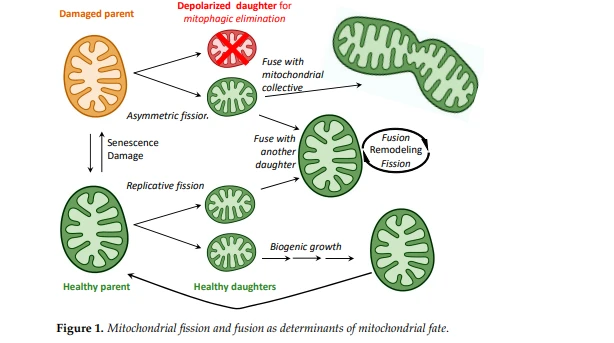
By contrast, asymmetric fission of an injured/senescent parent mitochondrion is the process of selective removal of damaged components through their segregation and separation into one of the daughter organelles; this daughter is ultimately removed and its constituent elements recycled [15].
After asymmetric fission, the larger healthy daughter mitochondrion can undergo either biogenic maturation or integrative fusion, just as the daughters of replicative fission.

However, the smaller daughter mitochondrion containing damaged elements and typically exhibiting dissipation of ∆Ψm (the inner membrane electrochemical proton gradient that drives respiratory complex function) is prevented from undergoing fusion and is instead targeted for removal via mitophagy (mitochondrial-specific autophagy).
Thus, asymmetric mitochondrial fission both enables and suppresses mitochondrial fusion, biogenesis, and mitophagy, depending upon the health status of the daughter mitochondria (Figure 1).
Accordingly, mitochondrial fission is essential to mitochondrial quantity control (via replicative fission and biogenesis) and mitochondrial quality control (via asymmetric fission and mitophagy).
For this reason, it might be predicted that interrupting or dysregulating mitochondrial fission would seriously impact mitochondrial homeostasis.
Consistent with this notion, an extremely rare, lethal, and multisystemic metabolic derangement was linked to damaging mutations of the critical mitochondrial fission protein, DRP1 [16–19], although dominant mutations in DNM1L gene can also cause dominant optic atrophy (DOA) with a relatively mild phenotype [20].
Mitochondrial fusion is central to postreplicative mitochondrial maturation and integration of daughter organelles into mitochondrial networks. Mitochondrial fusion is also a reparative mechanism that maintains the fitness of individual mitochondria.
This process is based on the concept of repair by cross-complementation [21] (Figure 1). For example, mitochondria contain multiple independent copies of their mtDNA genomes, which accumulate mutations over time.
If the mtDNA mutation burden is very high, asymmetric fission can be employed to sequester and eliminate the offending genomes (vide supra). However, when the mtDNA mutations are not sufficiently damaging to trigger asymmetric fission, impaired mitochondria can fuse and exchange genomes, thereby providing undamaged mtDNA templates for mutual repair [22].
The same concept of repair by complementation (or dilution) applies to mitochondrial proteins and membranes [23].
The pivotal role played by mitochondrial fusion in organelle maintenance is epitomized in cells dually deficient in the outer mitochondrial membrane fusion proteins mitofusin (MFN) 1 and 2, which not only exhibit mitochondrial fragmentation from unopposed fission but also mitochondrial depolarization (loss of ∆Ψm) from impaired fusion-mediated repair [24,25].
Mitochondrial motility, and especially directed transport through neuronal processes, is less completely understood than mitochondrial fission and fusion. Miro proteins on outer mitochondrial membranes interact in a calcium-dependent manner with Trak1/Milton adaptor proteins to couple mitochondria to dynein (retrograde trafficking) or kinesin-1 (antegrade trafficking) family motor proteins that transport mitochondria along cellular/axonal microtubules [26,27] (Figure 2 mitochondrial transport).

Figure 2. Mitochondrial function and motility are defined by subcellular location in neurons.
Schematic depicts neuronal soma to the left, axon in the center, and dendrites with synapses to the right. Inset shows Miro attaching a mitochondrion, via adaptor protein Trak1, to dynein or kinesin motor proteins for transport along axonal microtubules.
Here, local variations in cytoplasmic free calcium, as observed in physical axonal injury, regulate mitochondrial transport and destination [27,28].
Other pathophysiological determinants that either select mitochondria for transport or direct them to particular destinations are being defined, including the Disrupted In Schizophrenia 1 (DISC1) protein that modulates antegrade kinesin-mediated mitochondrial trafficking by interacting with GTP-bound Miro1 [29] and unidentified factors related to synapse number and activity [30].

What became clear is that a pathological shift in the balance between mitochondrial fission and fusion, frequently accompanied by a disturbance in mitochondrial trafficking, is a hallmark of many clinical and experimental neurodegenerative syndromes [4,10,31–34].
For more information:1950477648nn@gmail.com