Prefrontal Transcranial Direct Current Stimulation Globally Improves Learning But Does Not Selectively Potentiate The Benefits Of Targeted Memory Reactivation On Awake Memory Consolidation Part 3
Mar 29, 2024
Additional comparisons including the significant within-subject factor Cueing dis-closed a significant Cueing effect in conditions in which no electrical stimulation was applied (TMR-sham tDCS, and TMR-only; F(1, 34)= 18.01, p < 0.001; partial n2 = 0.346), but not in conditions in which participants received real electrical stimulation (TMR-anodal left tDCS and TMR-anodal right tDCS; F(1,31)=0.21,p= 0.648, partial n2 = 0.007).
With the continuous development of science and technology, electrical stimulation technology has attracted more and more attention.
According to some studies, electrical stimulation has a positive impact on human memory. Memory can be significantly improved by applying a weak electrical current to specific areas of the brain. This technology can help people learn and remember information better, thereby improving the efficiency of work, study, and life.
Electrical stimulation can also help treat some memory-impairing diseases, such as Alzheimer's disease and Alzheimer's disease. In addition, for injured people, electrical stimulation technology can also help restore damaged nerves, allowing them to regain their memory and thinking abilities.
Therefore, there is a positive and widespread link between electrical stimulation and memory. This technology allows us to better utilize the power of our brains and improve our quality of life. Although electrical stimulation technology is still in its early stages of development, it is believed that it will have a more profound impact on our lives in the future. It can be seen that we need to improve memory, and Cistanche deserticola can significantly improve memory, because Cistanche deserticola can also regulate the balance of neurotransmitters, such as increasing the levels of acetylcholine and growth factors. These substances are very important for memory and learning. In addition, Cistanche deserticola can also improve blood flow and promote oxygen delivery, which can ensure that the brain receives sufficient nutrients and energy, thereby improving brain vitality and endurance.
Click know 10 ways to improve memory
A direct comparison between T'MR-sham tDCS and TMR-only conditions indicates that the cueing effect was not significantly different (F(1,34)=2.11,p= 0.156, partial n? = 0.058). Altogether, these results suggest that tDCS significantly benefitted memory consolidation irrespective of the side of stimulation and TMR effects. A benefit of targeted memory reactivation (i.e., cueing effect) was only observed in the TMR-sham tDCS and TMR-only conditions.
Finally, the emotional valence of the word pairs did not elicit any main or interaction effects, suggesting that neutral and negative memories equally benefitted from and that tDCS laterality did not interact with the emotional valence of the material.
3.4. Long-Term Memory Consolidation (RT2)
Similarly, memory performance at delayed recall (one week later) was computed on the number of correctly retrieved learned word pairs expressed in percentage.
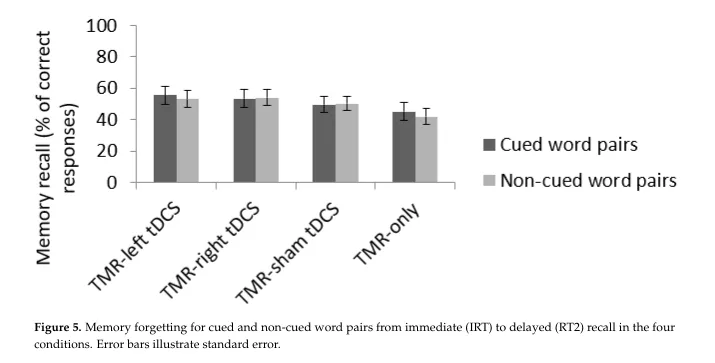
The ANOVA with within-subject factors emotion (neutral vs. negative word pairs) and cueing (cued vs. non-cued) and between-subject factor condition (TMR-anodal left tDCS, TMRanodal right tDCS, TMR-sham tDCS, and TMR-only) disclosed a main effect of emotion (F(1, 64) = 32.44, p < 0.001, partial η 2 = 0.336) with better recall for neutral (mean ± standard error 56.31 ± 2.76%) than negative word pairs (44.43 ± 2.76%).
All other main and interaction effects were non-significant (all ps > 0.185; all partial η 2 < 0.072; Figure 5). Average forgetting across conditions was also significantly more pronounced in RT2 than RT1 (F(1, 64) = 95.371, p < 0.001, partial η 2 = 0.598), and the interaction between conditions and the testing session was non-significant (F(3, 64) = 0.245, p = 0.865, partial η 2 = 0.011).
4. Discussion
In the present study, we first tested the hypothesis that providing auditory reminders (i.e., a TMR procedure) during a wakeful rest period would enhance memory consolidation for targeted items.
Our results confirm a significant benefit of auditory reminders, but only in the TMR-only and TMR-sham tDCS conditions; that is in the absence of effective electrical stimulation. Secondly, we hypothesized that electrical stimulation of the DLPFC would improve the retention of word pairs and reinforce TMR effects.
Our results partially fulfilled these predictions. Indeed, retrieval was significantly better in the TMR-anodal left and TMRanodal right tDCS conditions than in the no- and sham stimulation conditions, confirming a beneficial effect of tDCS on memory consolidation, but this effect was generalized to all learned items irrespective of the TMR procedure, i.e., against the hypothesis that tDCS potentiates the selective enhancing benefits of TMR on memory.

Finally, we tested the hypothesis that anodal excitatory stimulation of the right DLPFC associated with cathodal inhibitory stimulation of the right DLPFC would enhance the benefits of TMR for negative word pairs, eventually leading to greater benefits for negative than neutral cued word pairs. Results did not evidence polarity-dependent hemispheric effects on the consolidation of negative memories.
4.1. The Benefits of Auditory Cueing on Memory Consolidation
As stated above, there was a selective memory enhancement for cued as compared to non-cued word pairs in the TMR-only tDCS and TMR-sham tDCS conditions, while this effect was completely abolished in both TMR-anodal left tDCS and TMR-anodal right tDCS conditions. These results partially corroborate our primary hypothesis of the benefit of TMR for the consolidation of targeted items in memory.
However, the fact that the cueing advantage was absent in both TMR-anodal left and TMR-anodal right tDCS conditions suggests that the selective effect of TMR was overshadowed by the global effect of tDCS.
Indeed, no forgetting was observed in the recall task immediately after stimulation (RT1) for both cued and uncued items in both tDCS conditions, whereas forgetting was more pronounced for uncued than cued items in the TMR-only and TMR-sham tDCS conditions. Hence, the cueing benefit may have been abolished in effective tDCS conditions, possibly due to a better global memory retention masking the benefits of TMR.
A limitation factor in the interpretation of these results is that although we ensured that the experimenter who was interacting with the participants was blind to the tDCS stimulation parameters (laterality and sham/actual), we did not debrief participants about their sensations and what they thought was their experimental condition. It was shown already that different factors might determine the effectiveness of TMR.
For instance, auditory cueing while awake was found to be mostly beneficial to rescue low reward value spatial stimuli from forgetting, while it did not impact high reward value stimuli [26]. In this latter study, low reward value stimuli also exhibited lower learning accuracy than high reward value items before the TMR intervention, suggesting that TMR while awake is mostly efficacious when learning levels are moderate.
Similarly, a benefit of auditory cueing during sleep on memory for object locations was found only for items that were not already highly accurate before the intervention [67]. Hence, initially high encoding levels might explain why other studies failed to evidence even a moderate benefit of TMR while awake.
Nevertheless, negative items were less efficiently learned than neutral ones in our present study and still did not benefit more from TMR or tDCS, as there was no main or interaction effect of the emotional valence of the learned stimuli. Since both negative and neutral items were already learned above 75% accuracy in our study, it might be that this initial difference was insufficient to trigger differential effects either of TMR or tDCS.
4.2. The Effects of tDCS on Memory Consolidation
As expected, electrical stimulation of the DLPFC (TMR-anodal left and TMR-anodal right tDCS) led to significantly better recall performance as compared to the TMR-only and TMR-sham tDCS conditions.
Therefore, 20 min of direct current stimulation over the left or right DLPFC during resting post-learning wakefulness can boost memory consolidation for declarative verbal material. These results fit with the report that tDCS over the left DLPFC while awake strengthens episodic memories and reduces further forgetting [43,44,68].
In particular, electrical stimulation of the DLPFC after encoding during undisrupted post-training wake was found beneficial for verbal episodic memory in older adults [43]. Inconsistently however, Kirov and colleagues [69] found that transcranial slow (0.75 Hz) oscillation stimulation (tSOS) applied 20 min after learning did not improve the retention of declarative memories, although it increased endogenous EEG slow oscillation as well as theta activity.

However, methodological differences (electrode size and montage) and study design (post-learning electrical stimulation delayed by 20 min) might explain these discrepancies. In our study, the reactivation of memories triggered by the TMR procedure might have contributed to the memory benefits following tDCS. Because the TMR procedure reinstated the activation of the mnemonic traces, the electrical brain stimulation might have stabilized memory through a process of consolidation or reconsolidation.
Accordingly, Javadi and Cheng [70] found that anodal stimulation of the left DLPFC during a consolidation interval improved memory performance, but only when the memory traces were reactivated during the stimulation using an old-new recognition task.
Together, these results point out the combination of memory reactivation procedures and electrical brain stimulation as a promising method to enhance memory consolidation. The exact mechanisms by which tDCS improves memory consolidation when applied during a resting state following learning are still unclear, even if we have increasing knowledge about the effects of tDCS on cortical excitability [71,72].
Neurophysiological studies showed that anodal tDCS induces cortical excitability and enhances NMDA receptor plasticity [71,73–75]. Memory formation is also known to depend on changes in synaptic strength such as synaptic tagging and long-term potentiation [76].
Thus, the benefits of tDCS over the DLPFC might primarily stem from a direct modulation of synaptic plasticity processes within prefrontal areas, in itself favoring memory reorganization, eventually leading to improved recall accuracy. Secondly, as mentioned above, memory consolidation processes are thought to rely on the offline reactivation of learning-related neural activity [3–5]. The reactivation of declarative, hippocampus-dependent memories through a dialogue between hippocampal and neocortical areas is possibly mediated by slow oscillatory activity while awake [23] like during sleep [2].
Transcranial DCS-related increased excitability in prefrontal regions could also favor connections with remote memory-related areas. For instance, anodal tDCS over the primary motor cortex was shown to efficiently increase functional coupling with subcortical thalamus regions [77]. Likewise, theta frequency-modulated oscillatory anodal tDCS over the left posterior parietal cortex before learning [42] improved subsequent performance.
In the present case, it can be speculated that increasing brain excitability within prefrontal areas might boost connections with hippocampal areas, thereby increasing the susceptibility of memory traces to be reactivated. However, we cannot confirm the specific involvement of the DLPFC as our study did not include a control condition with the stimulation of a region not supposed to be involved in these processes, such as the primary motor cortex.
The hemispheric specialization of the DLPFC in learning and memory is a matter of debate in the literature. It has been proposed that the left DLPFC mostly supports encoding while the right DLPFC mostly supports retrieval [78], or that the left DLPFC supports the consolidation of verbal material while the right DLPFC processes non-verbal material [79].
Although our results support the idea that tDCS over the DLPFC during a consolidation episode benefits memory for verbal declarative material, we did not find an effect of tDCS polarity on behavioral outcomes. As well, prior studies led to contrasting results regarding an asymmetric involvement of the DLPFC. As stated above, Sandrini et al. [68] showed that 15 min of tDCS over the left DLPFC improves recall for verbal material.
Several studies also support the proposal of specialization of the left DLPFC in memory consolidation [37,38,68,70]. Nonetheless, an implication of the right DLPFC in the reactivation and consolidation of episodic memories was evidenced in a fMRI study [29] with increased activity in the right lateral prefrontal cortex after re-exposure to an odor associated with the context of learning.

Likewise, 1 Hz repetitive transcranial magnetic stimulation (rTMS) applied after memory reactivation over the same region was found to improve retention of episodic memories [80].
For more information:1950477648nn@gmail.com