Protecting Dopamine Neurons: How Cistanche Tubulosa Targets The Root Causes Of Parkinson's Disease
Aug 03, 2026
Parkinson's disease is the second most common neurodegenerative disorder after Alzheimer's, affecting over 10 million people worldwide. It is defined by the progressive loss of dopamine-producing neurons in the substantia nigra, a tiny region in the midbrain that controls movement. By the time tremor, rigidity, and slowness appear, 50–70% of these neurons are already dead. Current treatments-levodopa, dopamine agonists, deep brain stimulation-replace dopamine or modulate neural circuits, but they do nothing to stop the underlying neurodegeneration. For decades, researchers have searched for agents that could protect the vulnerable dopamine neurons themselves. An unlikely candidate is emerging from the desert: Cistanche tubulosa, whose active ingredients echinacoside and acteoside target four of the core pathological mechanisms driving Parkinson's-α-synuclein aggregation, mitochondrial failure, oxidative stress, and neuroinflammation.

The Four Pillars of Parkinson's Pathology
Parkinson's disease is not caused by a single molecular defect. It is the convergence of four interconnected pathological processes, each a potential target for intervention.
α-Synuclein aggregation is the pathological hallmark. Alpha-synuclein is a protein normally involved in synaptic vesicle trafficking. In Parkinson's, it misfolds and aggregates into toxic oligomers and fibrils, forming Lewy bodies inside neurons. These aggregates disrupt vesicular transport, impair proteasome and lysosome function, and ultimately trigger cell death. Pathological α-synuclein can spread from cell to cell in a prion-like manner, seeding new aggregates in previously healthy neurons and driving disease progression through the brain.
Mitochondrial dysfunction is central to dopamine neuron vulnerability. Dopamine neurons have exceptionally high energy demands-their long, unmyelinated axons require vast amounts of ATP to maintain ion gradients and fire action potentials. Their mitochondria are under constant oxidative stress from dopamine metabolism itself. In Parkinson's, mitochondrial complex I activity is impaired, reducing ATP production and increasing ROS leakage. Damaged mitochondria accumulate because mitophagy-the selective degradation of dysfunctional mitochondria-is compromised.
Oxidative stress is both cause and consequence. Dopamine metabolism generates hydrogen peroxide and dopamine quinones that damage proteins, lipids, and DNA. When antioxidant defenses falter, oxidative damage to complex I creates a vicious cycle of mitochondrial failure and further ROS production. The substantia nigra is particularly vulnerable because it contains high levels of iron, which catalyzes the production of hydroxyl radicals through Fenton chemistry.
Neuroinflammation driven by microglial activation accelerates the degenerative process. Microglia are the brain's immune cells. In Parkinson's, they become chronically activated, releasing a torrent of pro-inflammatory cytokines-TNF-α, IL-1β, IL-6-and reactive oxygen species. The NLRP3 inflammasome is a key mediator of this microglial activation. Fibrillar α-synuclein activates NLRP3 in microglia, triggering the release of IL-1β, which further activates surrounding microglia and directly damages dopamine neurons. This neuroinflammatory loop converts what might be a slowly progressive degeneration into an accelerating one.
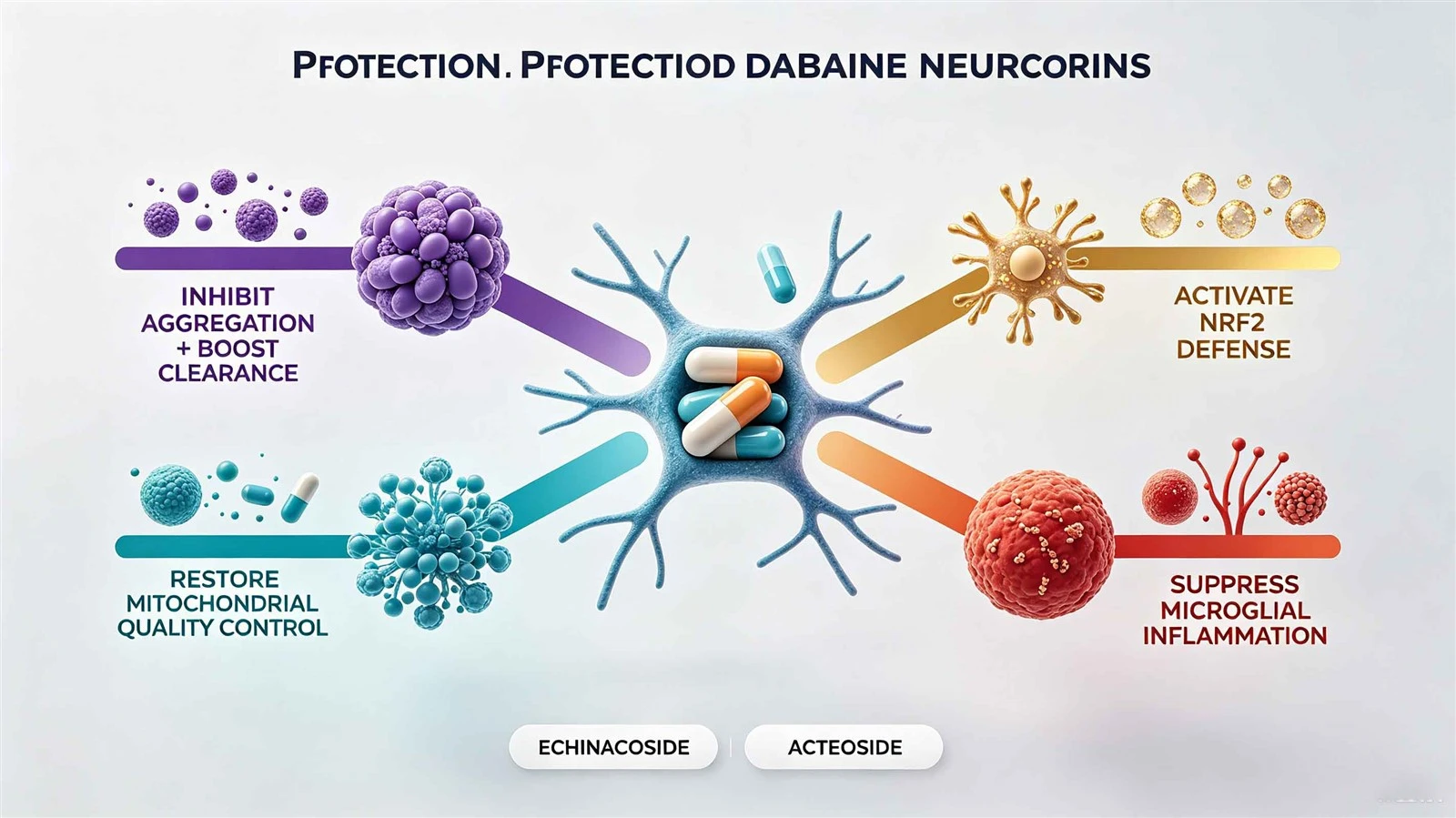
A therapeutic agent that could inhibit α-synuclein aggregation, restore mitochondrial quality control, neutralize oxidative stress, and suppress microglial NLRP3 activation would be targeting Parkinson's at its roots. Cistanche tubulosa's phenylethanoid glycosides are showing activity against each of these pillars.
How Cistanche Tubulosa Protects Dopamine Neurons
1. Inhibiting α-Synuclein Aggregation and Promoting Clearance
Acteoside has been shown in multiple in vitro studies to directly inhibit the fibrillization of α-synuclein. It binds to the monomeric form of the protein and stabilizes it in a non-toxic, natively unfolded conformation, preventing the formation of the β-sheet-rich oligomers that are toxic to synapses. More importantly, echinacoside enhances the cell's own clearance mechanisms. It upregulates autophagy-the lysosome-mediated degradation pathway-by increasing the expression of LC3-II and Beclin-1. Autophagy is the primary route for clearing aggregated proteins, and it is often impaired in Parkinson's. By boosting autophagic flux, echinacoside helps neurons clear accumulated α-synuclein before it can form toxic aggregates. This dual action-blocking aggregation and promoting clearance-addresses the proteinopathy at both ends.
2. Restoring Mitochondrial Quality Control
Dopamine neurons cannot survive without functional mitochondria, and mitochondrial failure is a central executioner in Parkinson's. Echinacoside protects mitochondria through several complementary mechanisms. It stabilizes mitochondrial membrane potential, preventing the opening of the permeability transition pore that triggers cell death. It activates the Nrf2 pathway, upregulating antioxidant enzymes that protect mitochondrial membranes from oxidative damage. And critically, it enhances mitophagy-the selective clearance of damaged mitochondria. By supporting the PINK1/Parkin pathway, echinacoside helps neurons identify and remove dysfunctional mitochondria before they can trigger apoptosis. Simultaneously, through AMPK/PGC-1α activation, it stimulates mitochondrial biogenesis, providing a supply of new, healthy mitochondria to replace those that have been cleared. This coordinated quality control-removing damaged mitochondria and replacing them with new ones-directly addresses one of the most fundamental defects in Parkinson's.
3. Activating Nrf2 to Defend Against Oxidative Stress
Echinacoside is a potent Nrf2 activator, and dopamine neurons are among the cells most responsive to Nrf2-mediated protection. When echinacoside activates Nrf2 in dopaminergic neurons, it upregulates a comprehensive panel of protective enzymes: superoxide dismutase, glutathione peroxidase, heme oxygenase-1, catalase, and NAD(P)H quinone oxidoreductase 1. These enzymes form a robust defense against the oxidative stress that is intrinsic to dopamine metabolism and amplified in Parkinson's. In the MPTP mouse model-the most widely used model of Parkinson's disease, which replicates the selective nigrostriatal degeneration seen in humans-echinacoside treatment significantly preserved tyrosine hydroxylase-positive neurons in the substantia nigra, maintained striatal dopamine levels, and improved motor performance on behavioral tests including rotarod and pole tests.
4. Suppressing Microglial NLRP3 Inflammasome Activation
The neuroinflammatory component of Parkinson's is driven largely by microglial NLRP3 activation. Fibrillar α-synuclein is a potent trigger of the NLRP3 inflammasome. Once activated, NLRP3 assembles the inflammasome complex, activating caspase-1, which cleaves pro-IL-1β into its mature, secreted form. IL-1β then activates surrounding microglia and directly damages dopamine neurons. Acteoside has been shown to suppress NLRP3 inflammasome activation through multiple mechanisms: it reduces NF-κB-driven priming of NLRP3 and pro-IL-1β, it scavenges the mitochondrial ROS that trigger inflammasome assembly, and it interferes with the formation of ASC specks-the visible aggregates that are the hallmark of inflammasome activation. By inhibiting this pathway, acteoside reduces the microglia-driven neuroinflammation that accelerates dopamine neuron death.
5. In Vivo Evidence: Protecting the Nigrostriatal Pathway
The most compelling evidence for Cistanche's anti-Parkinson's potential comes from whole-animal studies. In the classic MPTP mouse model, Cistanche extract treatment significantly preserved tyrosine hydroxylase-positive neurons in the substantia nigra and maintained dopamine transporter density in the striatum. Behavioral tests confirmed functional protection: treated animals showed better motor coordination, longer latency to fall in the rotarod test, and reduced bradykinesia. In the 6-OHDA rat model, echinacoside treatment reduced apomorphine-induced rotational behavior-a measure of dopamine depletion asymmetry-and preserved dopaminergic terminals in the striatum. The neuroprotective effect was accompanied by increased levels of BDNF and GDNF, two growth factors essential for dopamine neuron survival and function.
A comprehensive 2022 review in Frontiers in Pharmacology systematically summarizes these neuroprotective mechanisms, confirming that Cistanche tubulosa phenylethanoid glycosides act on α-synuclein, mitochondrial quality control, oxidative stress, and neuroinflammation-the full spectrum of Parkinson's pathology. (Frontiers in Pharmacology review on Cistanche tubulosa)

The Active Ingredients for Dopamine Neuron Protection
The anti-Parkinson's effects of Cistanche are driven by echinacoside and acteoside (verbascoside). Echinacoside is the primary mitochondrial protector, the Nrf2 activator, and the autophagy enhancer. Acteoside is the primary α-synuclein aggregation inhibitor, the NLRP3 inflammasome suppressor, and the NF-κB inhibitor. Both cross the blood-brain barrier and accumulate in brain regions relevant to Parkinson's, including the substantia nigra and striatum. A standardized extract containing 20–40% total phenylethanoid glycosides is essential to deliver the concentrations that research associates with these neuroprotective effects. The evidence-informed dose for neuroprotection is 400–600 mg daily.
Integrating Cistanche for Parkinson's Support
It must be stated clearly: Cistanche tubulosa is not a cure for Parkinson's disease, and it has not been tested in large-scale human trials for PD outcomes. The evidence comes from preclinical models-cells and animals-which provide mechanistic plausibility but do not guarantee clinical efficacy. Cistanche is best understood as a complementary, multi-targeted neuroprotective agent that may support dopamine neuron health when used consistently over the long term, in conjunction with conventional neurological care. For individuals with Parkinson's or at elevated risk-strong family history, REM sleep behavior disorder, occupational exposures-a daily dose of 400–600 mg of a standardized extract can be taken with a meal. It pairs well with a neuroprotective lifestyle: regular aerobic exercise (which boosts BDNF and GDNF naturally), a Mediterranean diet rich in polyphenols, and adequate sleep. Anyone with diagnosed Parkinson's should discuss supplement use with their neurologist, particularly to monitor for potential interactions with MAO-B inhibitors, COMT inhibitors, or dopamine agonists.
Our DopaGuard Cistanche Extract is sourced from authentic Cistanche tubulosa and standardized for a high concentration of echinacoside and acteoside-the active ingredients that research links to α-synuclein inhibition, mitochondrial quality control, and microglial modulation. Each batch is third-party tested for purity and potency.

Safety and Medical Context
Cistanche tubulosa is well tolerated with a two-thousand-year safety record. It does not cause dyskinesia, nausea, or the on-off fluctuations associated with levodopa. However, Parkinson's disease is a serious, progressive condition that requires the care of a neurologist. This botanical is a supportive ally, not a substitute for comprehensive neurological care.