The Difference Between Xinjiang Cistanche Tubulosa And Desert Cistanche Deserticola
Aug 03, 2026
Zhengben Qingyuan: The botanical origins of two types of 'Cistanche'
1. Desert Cistanche deserticola - traditional authentic product

Cistanche deserticola
Cistanche deserticola Ma., also known as "Oil Cistanche" or "Soft Big Yun", is a genuine Cistanche species that has been used for 2,000 years, dating back to the Shennong Bencao Jing. Mainly produced in desert areas such as Alxa League in Inner Mongolia, Bayannur, and the Hexi Corridor in Gansu Province, it parasitizes the roots of Haloxylon ammodendron. Haloxylon ammodendron is the flagship species of desert ecosystems, with roots reaching more than ten meters deep and capable of extracting groundwater in extremely arid environments. Desert Cistanche obtains nutrients and water from the roots of Haloxylon ammodendron and grows slowly for 3-5 years before it can be harvested and used as medicine.
Due to its long growth cycle, fragile ecology of its host, Haloxylon ammodendron, and long-term overexploitation, the wild desert Cistanche resources were once on the brink of depletion and were listed as a national second-class protected plant. Nowadays, the authentic desert Cistanche deserticola on the market is mostly artificially inoculated and cultivated, yet yields remain relatively limited, and prices remain high.
2. Guanhua Cistanche - the "Red Willow and Big Cloud" of Xinjiang
Cistanche tubulosa (Schrenk) Wight, commonly known as "Red Willow Big Yun" and "Hard Big Yun", is mainly produced in Hotan, Kashgar, Aksu and other areas on the southern edge of the Taklamakan Desert in Xinjiang. It parasitizes the roots of plants in the genus Tamarix (red willow, Tamarix spp.) and accumulates extremely rich active ingredients thanks to Xinjiang's unique light and heat resources - with over 2800 hours of sunshine throughout the year and a temperature difference of 15-20 ℃ between day and night.

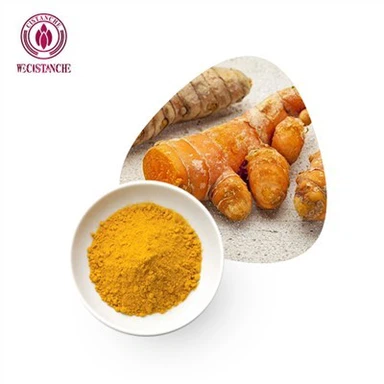
Cistanche tubulosa
The artificial cultivation technology of Cistanche deserticola was developed by Professor Tu Pengfei's team at Peking University after more than 30 years of research and breakthroughs. The team has overcome the technological bottleneck of large-scale cultivation of parasitic plants for the first time in the world, creating an innovative paradigm of "medicinal material production desert control industrial development" collaborative development, and transforming Cistanche deserticola from an endangered plant into a wide variety of traditional Chinese medicine. This achievement won the second prize of the National Science and Technology Progress Award in 2025. This breakthrough not only solves the resource dilemma, but also opens up a new path for local farmers in Xinjiang to increase their income and improve desert ecology.
Seeing is believing: intuitive identification of appearance and characteristics
For ordinary consumers, the most practical identification method is "look, touch, smell, taste". The two types of Cistanche deserticola have significant differences in appearance, and the following points can be mastered to preliminarily distinguish them.
1. Shape and texture
Desert Cistanche deserticola: It is flattened cylindrical, slightly curved, 3-15 cm long, and 2-8 cm in diameter. The surface is densely covered with tile shaped arranged fleshy scales, which are heavy, soft, slightly flexible, and not easy to break. The cross-section is brown in color, with light brown dotted vascular bundles arranged in wavy rings (commonly known as "chrysanthemum hearts"). After being dried, it still has a certain elasticity, commonly known as "soft big clouds".

Guanhua Cistanche: The stem is a regular cylindrical or quadrilateral shape, usually thick and robust, with a length of over 30 cm and a diameter of up to 10 cm. The surface scales are wide and sparse. Hard in texture, more brittle after drying, resembling lignification, commonly known as' hard big cloud '. The cross-section shows dense vascular bundles arranged in scattered or radial patterns, brown or brownish in color.

2. Odor and taste
Desert Cistanche has a mild aroma, a sweet and slightly bitter taste, and a soft and sticky texture when chewed, with a slight oiliness. Guanhua Cistanche has a slightly stronger aroma, a sweet taste followed by a slight astringency, a more pronounced bitter taste, and a less oily sensation than the former. This is also because the composition of the two is different - desert Cistanche polysaccharides and betaine have higher content, and the taste is sweeter; The content of phenylethanolic glycosides in Cistanche deserticola is extremely high, and the glycosides are mostly bitter.
Ingredient Competition: The "Dual Threshold" of Pharmacopoeia and the Content Advantage of Guanhua
If appearance is 'outside ', then the chemical composition is inside'. Both types of Cistanche deserticola contain active ingredients such as phenylethanoid glycosides (such as echinacroside and verbascoside), polysaccharides, cyclohexene terpenes, betaine, etc., but their content ratios differ significantly, which is also the material basis for their efficacy.
The "5-fold difference" of pharmacopoeia standards
The Chinese Pharmacopoeia sets lower limits for the total amount of echinacoside and verbascoside in both types of Cistanche deserticola, but the standards are completely different:
Desert Cistanche deserticola: The total amount of echinacroside and verbascoside shall not be less than 0.3%. Guanhua Cistanche: The total amount of echinacroside and verbascoside should not be less than 1.5% - five times the standard for desert Cistanche.
This standard difference itself indicates a key fact: the content of phenylethanoid glycosides in Cistanche deserticola is naturally much higher than that in desert Cistanche deserticola. The analysis and research of various medicinal herbs of Cistanche deserticola by Tu Pengfei's team using reverse-phase high-performance liquid chromatography confirmed that the chemical composition of Cistanche deserticola is similar to that of genuine Cistanche deserticola, and the content is significantly higher than the latter.
Of particular note is that desert Cistanche deserticola is rich in polysaccharides and betaine, which endows it with better "moistening" properties - a sweet and smooth taste and outstanding laxative effects; and Cistanche deserticola, with its phenylethanolic glycosides, is unparalleled, especially in terms of the content of echinaceae glycosides, which are far ahead. And phenylethanolic glycosides are the core pharmacological substances of Cistanche deserticola for tonifying the kidney and strengthening yang.

Phenylethanol glycoside is the main active component of Cistanche tubulosa
Click here to view Cistanche for Kidney disease products
【Ask for more】 Email:cindy.xue@wecistanche.com / WhatsApp: 0086 18599088692 / WeChat: 18599088692
Core focus: Deep analysis of the kidney tonifying effect of Cistanche deserticola
The Tu Pengfei team conducted a comparative study on the chemical composition, pharmacological effects, safety, and quality standards of the system, and finally clarified the key conclusion: desert Cistanche has a stronger effect in moisturizing the intestines and promoting bowel movements, while tube flower Cistanche has better effects in tonifying the kidneys, nourishing essence, anti-aging, anti Alzheimer's disease and Parkinson's disease, liver protection, and other aspects. This research achievement provides scientific guidance for precision medicine in clinical practice.
1. Phenylethanoid glycosides - the "ace ingredient" of Guanhua kidney tonifying
The effective ingredients in Cistanche deserticola that play a role in nourishing the kidney and strengthening yang are phenylethanolic glycosides, mainly including echinacoside, isoverbascoside, guanosine A, guanosine B, etc. Among them, echinacoside is the most abundant and extensively studied characteristic component.
The research conducted by Professor Zhang Xiaoying's team at Northwest A&F University over a period of 6 years has confirmed that echinacoside is the main active substance of Cistanche deserticola in resisting reproductive damage. This study used the environmental endocrine disruptor bisphenol A-induced male reproductive damage model to demonstrate that pineal glycoside can significantly improve sperm motility, quantity, and activity, reduce sperm deformity rate, and promote the secretion of testosterone (T) and luteinizing hormone (LH), thereby increasing androgen levels.
2. Molecular mechanism of Guanhua tonifying kidney: multi-target, multi-pathway
The kidney tonifying mechanism of pineal chrysanthemum glycoside has been elucidated at the molecular level, with its core being the regulation of the hypothalamic pituitary gonadal axis (HPG axis):

Echinoside, the main chemical component of Cistanche tubulosa

Acteoside, the main chemical component of Cistanche tubulosa
Target locking: Echinochlorin can be distributed into the brain, and its target has been confirmed to be the Androgen Receptor (AR), with binding sites at Met-894 and Val-713.
Promoting androgen synthesis: Pinecone glycoside enhances testosterone biosynthesis by stimulating the expression of key enzymes involved in androgen synthesis, including steroid synthesis protein (StAR), CYP11A1, CYP17A1, 3β-HSD, and 17β-HSD, thereby increasing sperm count and preventing oligozoospermia.
Bidirectional regulation of the endocrine system: On the one hand, pineal glycoside inhibits the entry of male receptors into the nucleus to initiate gene transcription and suppresses the negative feedback regulatory pathway of hormones; On the other hand, it promotes positive feedback regulation of hormones. This bidirectional regulation tends to normalize sex hormone levels, making it less likely to cause hormonal imbalances and toxic side effects.
Neurotransmitter regulation: Phenylethanoid glycosides, represented by echinacea glycosides, whose metabolites are mostly monoamine neurotransmitter analogues, can regulate the levels of neurotransmitters such as serotonin and norepinephrine, improving low libido and fatigue.