Why simultaneous pancreas and kidney transplantation is a superior choice for diabetic kidney disease patients than do kidney transplantation alone
Mar 19, 2022
Contact: joanna.jia@wecistanche.com / WhatsApp: 008618081934791
Part Ⅱ:Metabolic outcomes and renal function after simultaneous kidney/pancreas transplantation compared with kidney transplantation alone for type 2 diabetes mellitus patients
Yingxin Fu, Yu Cao, Hui Wang, Jie Zhao, Zhen Wang, Chunbai Mo, Xiaofeng Shi, Gang Feng & Wenli Song
SUMMARY
In this study, we aimed to compare the metabolic outcomes, renal function, and survival outcomes of simultaneous pancreas and kidney transplantation (SPK) and kidney transplantation alone (KTA) among end-stage kidney disease (ESKD) patients with type II diabetes mellitus (T2DM). Patients with ESKD and T2DM who underwent KTA(kidney transplantation alone)(n =85)or SPK(simultaneous pancreas and kidney transplantation)(n = 71) in a transplant center were retrospectively reviewed. Metabolic profiles, renal function, and survival outcomes were assessed repeatedly at different follow-up time points. Propensity score procedures were applied to enhance between-group comparability. The levels of renal and metabolic outcomes between SPK(simultaneous pancreas and kidney transplantation) and KTA(kidney transplantation alone) over time were examined and analyzed using mixed-model repeated-measures approaches. The median follow-up period was 1.8 years. Compared with KTA(kidney transplantation alone), SPK(simultaneous pancreas and kidney transplantation) resulted in superior metabolic outcomes and renal function, with lower levels of glycated hemoglobin(HbAlc;P= 0.0055), fasting blood glucose(P<0.001), triglyceride(P= 0.015), cholesterol(P= 0.0134), low-density lipoprotein (P= 0.0161), and higher estimated glomerular filtration rate (eGFR;P<0.001). SPK(simultaneous pancreas and kidney transplantation) provided better metabolic outcomes and renal function. The survival outcomes of the recipients and grafts were comparable between the two groups.

cistanche male benefits
CLICK HERE TO PART Ⅰ
Discussion
This study analyzed the characteristics and outcomes of patients with T2DM undergoing SPK(simultaneous pancreas and kidney transplantation) or KTA(kidney transplantation alone) between 2015 and 2020 in a transplantation center in China. The PSM procedure was adopted to minimize the imbalance between the two groups, and after PSM, the distribution of baseline characteristics was homogenous between the two groups. Renal function was significantly superior in the SPK(simultaneous pancreas and kidney transplantation) group with a median follow-up period of approximately 2 years. Regarding the metabolic profiles, the levels of HbAlc, blood glucose, LDL, triglyceride, and cholesterol were significantly higher in the KTA(kidney transplantation alone) group. Regarding survival outcomes, the three-year patient and graft survival rates were comparable between the two groups.

cistanche male benefits
The selection criteria for SPK(simultaneous pancreas and kidney transplantation) candidates with T2DM in this cohort were based on the Chinese Pancreas Transplantation Guideline [19], which were primarily based on the onset age of T2DM, BMI, risk of cardiovascular diseases, and insulin demand, and were consistent with those of other transplant centers, which generally focused on fasting C-peptide levels, BMI, age, insulin demand, and the absence of serious cardiovascular diseases [24-26]. However, besides age, BMI, and cardiovascular disease prevalence before transplantation that were similar between the two groups in our cohort, those from previous studies were quite divergent, in which the KTA(kidney transplantation alone) recipients were generally in worse conditions with older age, higher BMI, higher rate of cardiovascular diseases before transplantation, longer waiting time, or longer dialysis vintage than the SPK(simultaneous pancreas and kidney transplantation) group [10-12,27,28]. This was probably because of the prevalence of low BMI among T2DM patients in China [4]. A 2017 nationwide epidemiological survey reported that Chinese diabetic patients have a mean BMI of 24.9±5.2 kg/cm², notably lower than that in European populations [4,29]. From this perspective, SPK(simultaneous pancreas and kidney transplantation) would be promising for treating T2DM patients with ESKD in the Chinese population.
Table 4. Comparison of the complications between the SPK and the KTA group before and after PSM
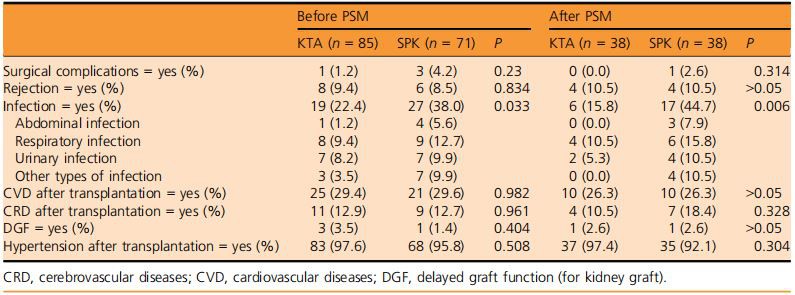
Few studies have specifically compared the metabolic outcomes and renal function between KTA(kidney transplantation alone) and SPK(simultaneous pancreas and kidney transplantation) among T2DM patients. Hau et al. [12] examined the short- and long-term effects on metabolic control and beta-cell function in T1DM and T2DM patients after SPK(simultaneous pancreas and kidney transplantation) and T2DM patients with KTA(kidney transplantation alone). However, a detailed comparison of the metabolic outcomes between the SPK(simultaneous pancreas and kidney transplantation) and KTA(kidney transplantation alone) groups has not been reported. The renal function comparison between SPK(simultaneous pancreas and kidney transplantation) and KTA(kidney transplantation alone) showed that creatinine level was higher in the KTA(kidney transplantation alone) group during the first three months and remained insignificant in the following years [12].In our study, the metabolic profiles of HbAlc, LDL, triglyceride, and cholesterol were consistently significantly higher in the KTA(kidney transplantation alone) group after transplantation, with baseline levels being identical. This might be explained by the fact that compared with the KTA(kidney transplantation alone) group, the SPK(simultaneous pancreas and kidney transplantation) recipients had better islet function, which effectively improved blood glucose and lipid metabolism, relieving symptoms of hypertension, and reduced the occurrence of cardiovascular diseases and hyperlipidemia[30]. There were no significant differences in results of metabolism-related complications such as cardiovascular disease, cerebral diseases, and hypertension after transplantation between both groups. Longer-term follow-up of this cohort will be important because the incidence of hyperglycemia-related complications might increase over time with T2DM.
Regarding the post-transplant complications, the infection rate in the SPK(simultaneous pancreas and kidney transplantation) group was higher than that in the KTA(kidney transplantation alone) group in this study. This could be explained by the recommended induction agent of ATG for SPK(simultaneous pancreas and kidney transplantation) [20,21,31]. The rate of DGF was significantly higher in the KTA(kidney transplantation alone) group. In previous studies, DGF was proven to occur more frequently in KTA(kidney transplantation alone) recipients, and DGF of the kidney was an independent risk factor for patient survival and kidney graft survival [10,12,28,32].
The survival outcomes of patients and grafts were comparable between the two groups. For kidney graft loss, there were numerically more patient death-censored renal graft losses in the SPK(simultaneous pancreas and kidney transplantation) group, even though the study was not powered for these comparisons. Margreiter et al. and Hau et al.[12,33]reported that the raw survival outcome of SPK(simultaneous pancreas and kidney transplantation) was significantly higher than that of KTA(kidney transplantation alone), with three-year survival rates of approximately 80% in the SPK(simultaneous pancreas and kidney transplantation) group and 70% in the KTA(kidney transplantation alone) group. After multivariable adjustment, Margre-iter et al.showed that there were no significant differences in survival outcomes. Alhamad et al.[11]reported that after adjusting for multiple factors with multivariable inverse probability of treatment weighted survival analyses, the survival outcome of SPK(simultaneous pancreas and kidney transplantation) was significantly higher. Except what was adjusted in the study by Alhamad et al, other covariates such as duration of DM, insulin amount before transplantation, donor sex, donors cause of death, waiting time, and metabolic variables such as cholesterol, triglyceride, and pretransplantation comorbidities should also be adjusted in future studies.
This study is the first attempt to compare metabolic outcomes and renal function after SPK(simultaneous pancreas and kidney transplantation) or KTA(kidney transplantation alone) in T2DM patients in China, which has the largest DM burden worldwide. Another advantage was that the study collected granular data on metabolic outcomes, which presented a comparison of the metabolic profiles of T2DM transplant recipients. However, this study has several limitations. The major limitation was the short follow-up period, which was not enough to observe the occurrence of the hard endpoints of treatments (e.g, chronic complications, patient death, and graft failure), as they usually take longer to be adequately monitored. Long-term follow-up is therefore warranted and is ongoing. Another limitation was the retrospective design of the study. Rigorous propensity score procedures(matching and weighting) were implemented to minimize confounding and bias and to enhance between-group comparability. However, some factors may still be missing or sub-optimally measured (ie., patients' economic status, which might impact their attitudes toward SPK(simultaneous pancreas and kidney transplantation)). A prospective study design with a randomized study design would strengthen this interpretation. Second, the sample size of the study was small, especially after PS, which limits the generalizability of the results. Future multicenter studies are necessary. However, considering that SPK(simultaneous pancreas and kidney transplantation) is a rare procedure with a median annual center volume of fewer than 10 transplants [34],evidence-based guidelines and protocols were not sufficient, and there might be a large between-center variation; therefore, an applicable multi-center design would be tricky.

Figure 5 Comparison of recipients’ and renal grafts survival rates between the SPK and KTA groups in the before-PSM cohort.
Conclusion
For T2DM patients with ESKD, SPK(simultaneous pancreas and kidney transplantation) can improve renal and metabolic outcomes compared with KTA(kidney transplantation alone), with a median follow-up of approximately 2 years. SPK(simultaneous pancreas and kidney transplantation) also provides comparable survival outcomes for both recipients and renal grafts with the KTA(kidney transplantation alone) group. Additionally, in clinical practice, for T2DM patients combined with ESKD, considering the postoperative metabolic function and renal function, SPK(simultaneous pancreas and kidney transplantation) would be a superior choice.

cistanche male benefits
REFERENCES
1. Saeedi P, Petersohn I, Salpea P, et al. Global and regional diabetes prevalence estimates for 2019 and projections for 2030 and 2045: results from the International Diabetes Federation Diabetes Atlas, 9(th)edition. Diabetes Res Clin Pract 2019; 157:107843.
2. Saran R, Robinson B, Abbott KC, et al. US renal data system 2019 annual data report: epidemiology of kidney disease in the United States. AmJ Kidney Dis 2020;75: A6.
3. USCDC. National Diabetes Statistics Report,2020.Atlanta, GA: Centers for Disease Control and Prevention, U.S. Dept. of Health and Human Services, 2020.
4. Hu C, Jia W. Diabetes in China: epidemiology and genetic risk factors and their clinical utility in personalized medication. Diabetes 2018;67:3.
5. Kelly WD,Lillehei RC,Merkel FK, Ide-zuki Y, Goetz FC. Allotransplantation of the pancreas and duodenum along with the kidney in diabetic nephropathy. Surgery 1967;61:827.
6. Gruessner AC, Laftavi MR, Pankewycz O, Gruessner RWG. Simultaneous pancreas and kidney transplantation—is it a treatment option for patients with type 2 diabetes mellitus? An analysis of the international pancreas transplant registry. Curr Diab Rep 2017;17:44.
7. Gruessner AC, Gruessner R.Pancreas transplantation for patients with type 1 and type 2 diabetes mellitus in the united states: a registry report. Gastroenterol Clin North Am 2018;47:417.
Note: the above is not a full reference list

cistanche male benefits