Study On The Extraction And Antioxidant Properties Of Flavonoids in Cistanche
Mar 08, 2022
For more information:ali.ma@wecistanche.com
Song Yang
(Anshan Product Quality Supervision and Inspection Institute, Anshan 114006, Liaoning)
Abstract: The total flavonoids in Cistanche were extracted by the "ultrasonic vibration method" and "Soxhlet extraction method", and their content and antioxidant properties were analyzed. The determination results showed that the content of total flavonoids in Cistanche extracted by ultrasonic vibration method was higher than that extracted by Soxhlet extraction method. The recovery rate determined by experiments is 96.85%-99.46%, the precision is high, and the sample solution is very stable within 2 h, which indicates that the UV-Vis spectrophotometry has high accuracy, small deviation, and easy control of experimental conditions. Analyzing and determining the antioxidant activity of flavonoids in Cistanche by fluorescence method, the clearance rate was 91.5%, indicating that the flavonoids in Cistanche have strong antioxidant properties. In the experiment, it was found that using fluorescence analysis to determine the antioxidant capacity of total flavonoids in the extract has the advantages of rapidness, simplicity, high sensitivity, and good reproducibility.
Keywords: Cistanche; Flavonoids; Ultrasound; Antioxidant
Chinese Library Classification Number: TQ028 Document Identification Code: A Article Number: 1004-0935 (2013) 01-0013-03

Cistanche
Click to organic Cistanche for anti-aging
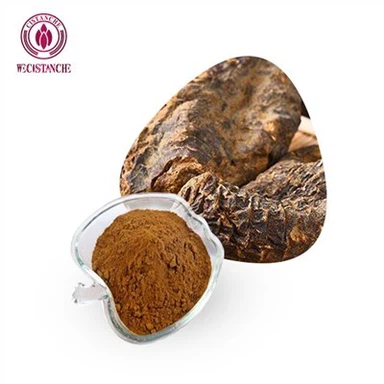
Cistanche is widely used as a tonic medicine. The research on the pharmacological effects and chemical components of Cistanche has made great progress in recent years. Inner Mongolia Alxa Cistanche Group has developed a series of Cistanche that nourishes yin and nourishes yang, moisturizes the intestines, enhances human immune function, regulates endocrine, and delays aging. Liquor, cistanche health liquid. In Japan, meat hernia is used as an ameliorating or therapeutic agent for sexual dysfunction and amnesia. In the United States, echinacea is also made into health products to improve the body's immunity. On this basis, we should conduct in-depth research on the active ingredients of its pharmacological effects and their mechanism of action. Under the premise of ensuring efficacy, we should improve traditional Chinese medicine preparations, improve the level of quality control, and develop definite curative effects, safe use, and controllable quality. New products of traditional Chinese medicine; on the other hand, we should also strengthen the research of Cistanche cultivation technology, realize the standardized planting and industrialized production of Cistanche, artificially plant cistanche and establish an industrialized cultivation base of cistanche and its host plants, and solve the problem of resource shortage. At the same time, environmental governance in the western desert area will be further realized. With the continuous in-depth research in various aspects, this traditional Chinese medicine of our country will surely be promoted to the international market and accelerate the modernization of Chinese medicine.

1 Experimental part
1.1 Experimental instrument
H, H, S, 21-type electric heating constant temperature water bath (Shanghai No. 5 Medical Instrument Factory); TG328A electro-optical analytical balance (Shanghai Tianping Instrument Factory); 40 mesh sieve (Zhejiang Hongxing Instrument Factory) KQ-250B ultrasonic extractor ( Kunshan Ultrasonic Instrument Co., Ltd.); Soxhlet Extractor (Zhejiang Hongxing Instrument Factory); Model 766-2 Far Infrared Radiation Drying (Shanghai Sunshine Instrument Co., Ltd.); Model HX-200A High-Speed Chinese Medicine Crusher (Xi'an Hardware, Zhejiang Yongkang) Medicine Factory); TU-1201 UV spectrophotometer (Beijing Puxi General Instrument Co., Ltd.); PHS-3C precision digital acidity meter (manufactured by Shanghai Tianda Instrument Co., Ltd.); Fluorescence spectrophotometer (VARIAN)
1.2 Experimental reagents and drugs
Cistanche (provided in the laboratory); absolute ethanol (analytical purity) (Shenyang Xinhua Reagent Factory); rutin (standard) (provided in the laboratory); 50 g/L sodium nitrite solution (homemade); 100g/L Aluminum nitrate solution (homemade); 40 g/L sodium hydroxide solution (homemade); PH=6.5 mixed phosphate solution: 0.1mol/L disodium hydrogen phosphate, 0.1mol/L potassium dihydrogen phosphate; benzoic acid Solution: 0.400 0 g benzoic acid (AR Shenyang Reagent Factory), dissolved in a mixed phosphate solution with pH = 9.5, dilute with water to 100 mL, and store in the dark for later use; Cu* solution: 1.0 x IO”g/mL; Hydrogen peroxide (AR, Shenyang No. 1 Reagent Factory): 30%; 0.1 MoVL mixed phosphate (disodium hydrogen phosphate, AR, Shenyang Xincheng Chemical Plant; potassium dihydrogen phosphate, AR, Shenyang Hefu Chemical Reagent Distribution ) Solution; The water is twice-distilled water.
1.3 Extraction of total flavonoids in Cistanche
1.3.1 Extraction of flavonoids from Cistanche deserticola (ultrasonic method)
Accurately weigh 2.000 g (passing a 40-mesh sieve) of Cistanche in a 100mL conical flask, add 95% ethanol reagent at room temperature at a solid-to-liquid ratio of 1:15, and perform ultrasonic extraction each time. After 30 minutes, perform suction filtration, recover the filter residue, add 95% ethanol reagent for ultrasonic shaking, suction filtration, ultrasonic extraction 3 times, combine the 3 filtrates to obtain the desired extract, add 95% ethanol reagent to make the volume constant Put it in a 100mL volumetric flask and set aside.
1.3.2 Extraction of flavonoids from Cistanche (Soxhlet extraction method) P]
Accurately weigh 10.000 Og (passed through a 40-mesh sieve) of eggplant puree, wrap it with defatted filter paper, tie one end, and put it into the extraction tube of the Soxhlet extractor. Add the 95% ethanol reagent of the extractant to the extraction bottle for approx. It is 1/2 of the volume, then install the Soxhlet extractor, use a constant temperature water bath slightly higher than the boiling point of the extractant (ethanol) for Soxhlet extraction for 4 hours, then cool, perform rotary evaporation, concentration, and use 95% ethanol reagent to determine Put it in a 100 mL volumetric flask and set aside.

Anti-aging
1.3 Determination of extracted material content and recovery rate experiment
1.3.1 Content determination and recovery experiment
Take six 25 mL volumetric flasks, draw 0.10, 0.20, and 0.30 mL from the meat Shuangrong sample liquid extracted by ultrasonic method into the first 3 volumetric flasks, add the same amount of sample liquid to the last 3 volumetric flasks, and then Add 1.0 mL of the standard solution of rutin respectively, add 1 mL of 50 g/L sodium nitrite solution to the 6 volumetric flasks, shake well, and let stand for 7 minutes; add 1 mL of 100 g/L aluminum nitrate solution , Shake well and let stand for 7 min; add 10 mL of 40 g/L sodium hydroxide solution, and also shake well and let stand for 7 min; dilute to the mark with 95% ethanol solution, shake well, and let stand for 15 min; The blank solution of the toner is a reference, the absorbance A is measured at 503 nm, and the concentration is calculated from the standard curve
Table 1 The content of flavonoids in Cistanche

Take six 25 mL volumetric flasks, draw 15 mL from the Soxhlet extraction method of striata: puree sample solution, and refill the volume in a 100 mL volumetric flask, and pipette 0.40, 0.50, and 0.60 mL from it. In 3 volumetric flasks, add the same amount of sample solution to the last 3 volumetric flasks, then add 1.0 mL of standard solution, add 1 mL of 50 g/L sodium nitrite solution, shake well, and let stand for 7 min; Then add 1 mL of 100 g/L aluminum nitrate solution, shake well, and let stand for 7 min; then add 10 mL of 40 g/L sodium hydroxide solution, shake well, and let stand for 7 min; dilute to the mark with 95% ethanol solution, Shake well, stand for 15 min, use the blank solution as a reference, measure the absorbance A at 503 nm, and calculate the concentration C from the standard curve.
1.3.2 Determination of stability experiment
Pipette 0.2 mL of sample solution, add 1 mL of sodium nitrite solution with 50 g/L of color reagent, shake well, and let stand for 7 min; add 1 mL of 100 g/L aluminum nitrate solution, shake well, and let stand for 7 min; add 10 mL of 40 g/L sodium hydroxide solution, and also shake well and stand for 7 min; dilute to the mark with 95% ethanol solution, shake well, and stand for 15 min; take the blank solution with the developer as a reference, And then measured with an ultraviolet-visible spectrophotometer, the time was set for 2 h, and it was found that the absorbance of the sample solution was stable within 2 h and remained basically unchanged.
Table 2 The content of flavonoids in Cistanche

1.4 Analysis of the antioxidant activity of flavonoids in Cistanche cistanche, catalytic kinetic fluorimetric determination of the scavenging rate of Chinese herbal medicine on hydroxyl free radicals
1.4.1 Experimental method
Add benzoic acid solution to a series of 25 mL colorimetric tubes, then add a certain amount of Co? + and hydrogen peroxide, in turn, dilutes with a mixed phosphate solution of pH=6.5 to a constant volume of 25 mL, shake well, and place in boiling water After standing in the bath for 45 minutes, the fluorescence intensity of each solution was measured.
1.4.2 Determination of the scavenging rate of the sample to hydroxyl radicals
Preparation of sample solution: Accurately weigh 1.000 Og of a sample with a particle size of 450 μm, and at room temperature, ultrasonically extract 3 times with 60 mL of absolute ethanol, using 20 mL of reagent each time, with a time interval of 10 min. Combine the 3 extractions Filter, and dilute the filtrate with absolute ethanol into a 100 mL volumetric flask.
Reagent preparation: Weigh 7.16 g of disodium hydrogen phosphate and add 200 mL of water to obtain a 0.1 mol/L solution; weigh 2.72 g of potassium dihydrogen phosphate and add 200 mL of water to obtain a 0.1 mol/L solution. Mix the two solutions and use a pH meter to prepare a mixed phosphate with pH = 6.5; weigh 0.400 0 g of benzoic acid (AR Shenyang Reagent Factory), dissolve it with a mixed phosphate solution with pH = 9.5, and dilute to volume with water WOmL, stored in the dark for later use; Weigh 0.1547 g Ci/ and dissolve it with] mol/L hydrochloric acid to prepare 100 mL of 1 mol/L Cu* solution. Prepare 30% hydrogen peroxide solution.
Take 0.2 ml of the sample solution into a 25 mL colorimetric tube, add benzoic acid, hydrogen peroxide, and Cu eyes in sequence, dilute to 25 mL with a mixed phosphate solution of pH = 6.5, shake well, and measure according to the clearance rate formula Obtain the scavenging rate of the sample to hydroxyl radicals.
1.4.3 Calculation results
Table 3 Calculation results

Conclusion: The flavonoids in Cistanche have strong antioxidant properties.

flavonoids in cistanche have an Anti-aging effect
2 Results and discussion
(1) Using "ultrasonic method" and "Soxhlet extraction method" to extract the total flavonoids in Cistanche deserticola, the comparison of these two methods shows that the ultrasonic method greatly shortens the extraction time and improves the extraction rate of effective ingredients. The utilization rate thus saves raw materials. On the contrary, the Soxhlet extraction method is time-consuming and laborious, and the extraction effect is not good. Therefore, the ultrasonic extraction of total flavonoids is the best extraction process, which has strong practical significance.
(2) The qualitative analysis of total flavonoids by UV spectroscopy showed that rutin is a very suitable standard product. The experimental calculation shows that the content of total flavonoids in Cistanche is very high, with high precision, and the recovery rate is 96.85% ~ 99.46 %, the sample remained stable within 2 h.
(3) The anti-oxidant analysis and determination of the total flavonoids in the Cistanche desert were carried out by fluorescence method. Conclusion: The calculated clearance rate was 91.5%, indicating that the cistanche paste itself has a strong antioxidant effect, which can scavenge free radicals and inhibit lipids. Oxidation, etc., is of great value in the research of anti-aging, carcinogenesis, inflammation, radiation tissue ischemia, and other diseases in the medical field.
References:
[1] Cheng Xiyu, Guo Bin, Ni Wen, Liu Chunchao. Research progress of Cistanche [J]. Research and Development of Natural Products, 2005, 17 (2): 235-240.
[2] Hou Dongyan, Hui Ruihua, et al. Spectral analysis of total flavonoids in honeysuckle and determination of antioxidant activity [J]. Analytical Test, 2004, 23 (11): 52-55.
[3] Zhou Gui, Deng Guanghui, Liang Dawen.'Study on the extraction of flavonoids from hawthorn leaves by ultrasonic method[J]. Journal of Southwest Agricultural University, 2005, 27 (5): 605-607.