Targeting The Roots Of Alzheimer's: How Cistanche Tubulosa Protects The Brain Through Multiple Mechanisms
Aug 10, 2026
Alzheimer's disease is the most common cause of dementia, affecting over 55 million people worldwide-a number projected to triple by 2050. It strips away memory, personality, and independence. Despite decades of research and billions of dollars in drug development, the treatments that exist provide only modest, temporary symptom relief. None halt the underlying neurodegeneration. This failure has driven interest in multi-targeted strategies-approaches that address not one, but several of the pathological processes that conspire to destroy the Alzheimer's brain. Cistanche tubulosa, through its active ingredients echinacoside and acteoside, is showing this multi-targeted profile in preclinical research. It does not cure Alzheimer's. But it may help address four of the disease's pathological pillars simultaneously, providing a broader foundation for neuroprotection than any currently approved single drug.
The Four Pathological Pillars of Alzheimer's
Alzheimer's disease is defined by four interconnected pathological features, each a potential target for intervention.
Cholinergic degeneration is the basis for the first generation of Alzheimer's drugs. Acetylcholine-producing neurons in the basal forebrain are among the first to die. Acetylcholine is essential for attention, learning, and memory. Acetylcholinesterase inhibitors like donepezil preserve existing acetylcholine but do not protect the neurons themselves.
Beta-amyloid plaques form when amyloid-beta peptides accumulate. Aβ oligomers are directly toxic to synapses, disrupting long-term potentiation-the cellular basis of memory. Anti-amyloid monoclonal antibodies have recently shown modest clinical benefit, but they target only this single pathway.
Neurofibrillary tangles of hyperphosphorylated tau protein form inside neurons, disrupting axonal transport and leading to cell death. Tau pathology correlates more closely with cognitive decline than amyloid burden.
Neuroinflammation is no longer viewed as a mere consequence but as a driver of disease progression. Chronically activated microglia release pro-inflammatory cytokines and reactive oxygen species that damage neurons. The NLRP3 inflammasome is a key mediator, triggered by amyloid-beta fibrils.
A botanical that could address all four pillars-cholinergic protection, amyloid inhibition, tau modulation, and neuroinflammation suppression-would be targeting Alzheimer's at its roots.
How Cistanche Tubulosa Targets Alzheimer's Pathology
1. Preserving Cholinergic Signaling
Echinacoside inhibits acetylcholinesterase, the enzyme that breaks down acetylcholine. By reducing AChE activity in the hippocampus and cortex, it preserves the acetylcholine essential for memory encoding. This mechanism is shared with donepezil, though echinacoside acts with a gentler profile. Beyond simply preserving acetylcholine, echinacoside protects the cholinergic neurons themselves. In animal models, it reduced neuronal loss in the basal forebrain and maintained choline acetyltransferase activity-the enzyme that synthesizes acetylcholine.
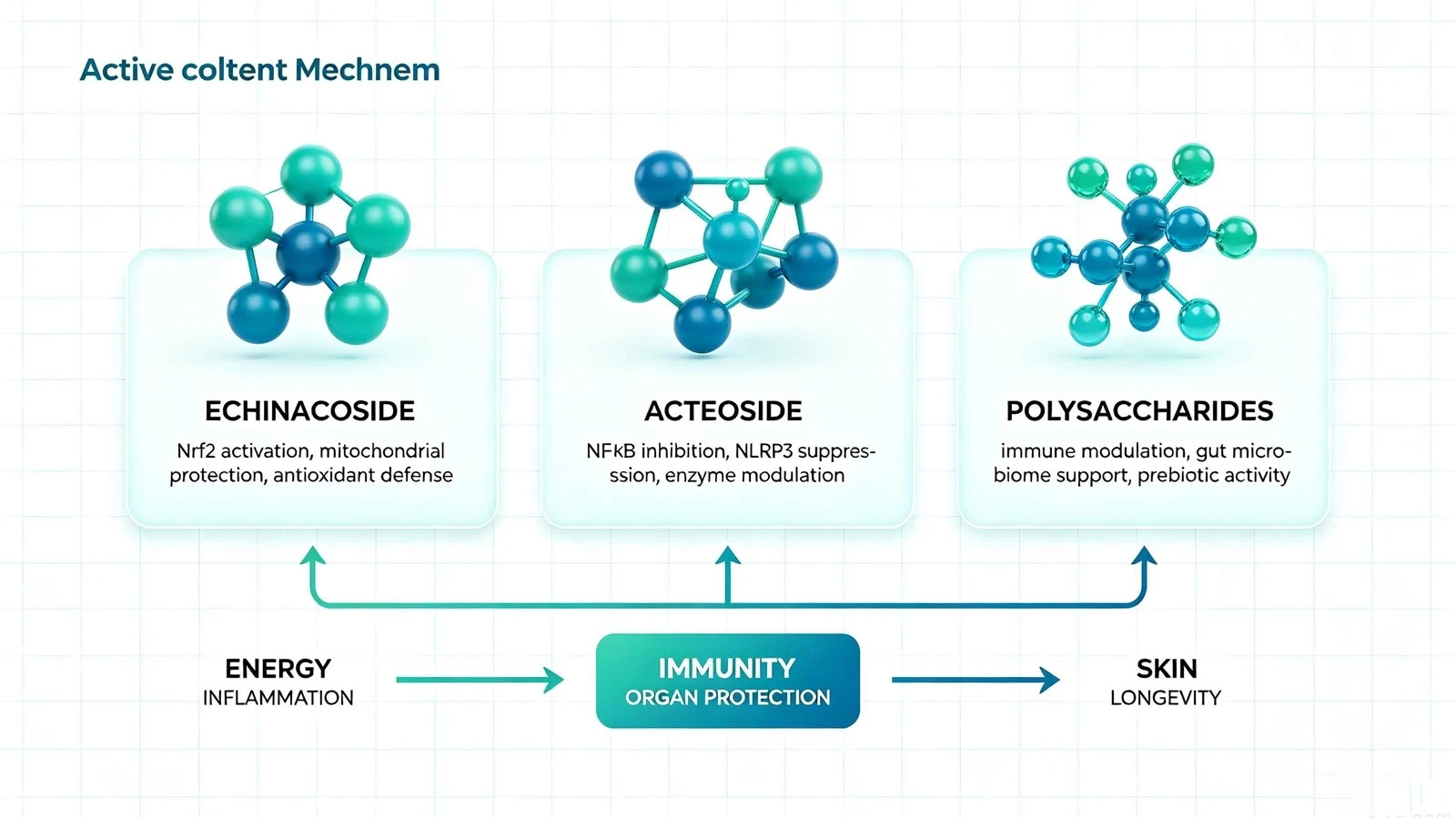
Echinacoside directly inhibits the fibrillization of Aβ into toxic oligomers and fibrils. It stabilizes Aβ in a non-toxic conformation and prevents β-sheet formation. When cultured hippocampal neurons are exposed to Aβ, echinacoside pretreatment preserves mitochondrial membrane potential, reduces ROS, and increases cell survival through Nrf2 activation. Acteoside complements this by suppressing the microglial inflammatory response to Aβ through NF-κB inhibition.
3. Reducing Tau Hyperphosphorylation
Tau hyperphosphorylation is driven by kinases including GSK-3β. Echinacoside inhibits GSK-3β activity, reducing abnormal tau phosphorylation. In a transgenic mouse model, Cistanche extract reduced hyperphosphorylated tau accumulation in the hippocampus and cortex, preserved synaptic proteins, and improved cognitive performance.
4. Suppressing Neuroinflammation Through NLRP3 Inhibition
Fibrillar Aβ activates the NLRP3 inflammasome in microglia, triggering IL-1β release that damages neurons. Acteoside suppresses this through multiple mechanisms: reducing NF-κB-driven priming of NLRP3, scavenging mitochondrial ROS that trigger inflammasome assembly, and interfering with ASC speck formation. By inhibiting this pathway, acteoside reduces the neuroinflammatory storm that amplifies Aβ toxicity and drives disease progression.
A comprehensive 2022 review in Frontiers in Pharmacology summarizes these multi-target neuroprotective mechanisms, confirming that Cistanche tubulosa phenylethanoid glycosides act on cholinergic, amyloid, tau, and neuroinflammatory pathways. (Frontiers in Pharmacology review on Cistanche tubulosa)
The Active Ingredients for Brain Protection
The anti-Alzheimer's effects are driven by echinacoside and acteoside. Echinacoside is the AChE inhibitor, Nrf2 activator, and Aβ aggregation inhibitor. Acteoside is the NF-κB and NLRP3 inhibitor. Both cross the blood-brain barrier. A standardized extract containing 20–40% total phenylethanoid glycosides is essential. The evidence-informed dose for neuroprotection is 400–600 mg daily.
Integration: A Preventive, Not a Cure
Cistanche is not a cure for Alzheimer's. Human clinical trials are lacking. The evidence comes from preclinical models. It is best understood as a preventive or supportive agent for those with family history, subjective cognitive decline, or mild cognitive impairment. It should be used alongside a neuroprotective lifestyle: a Mediterranean or MIND diet, regular aerobic exercise, cognitive stimulation, social engagement, and management of cardiovascular risk factors. Anyone with diagnosed Alzheimer's should discuss supplement use with their neurologist.
Our CogniProtect Cistanche Extract is sourced from authentic Cistanche tubulosa and standardized for a high concentration of echinacoside and acteoside. Each batch is third-party tested for purity and potency.