A Traditional Chinese Medicine (TCM) Perspective On Erectile Dysfunction (ED): What A 40-Patient Clinic Observation Suggests—And What It Doesn’t
Jul 23, 2026
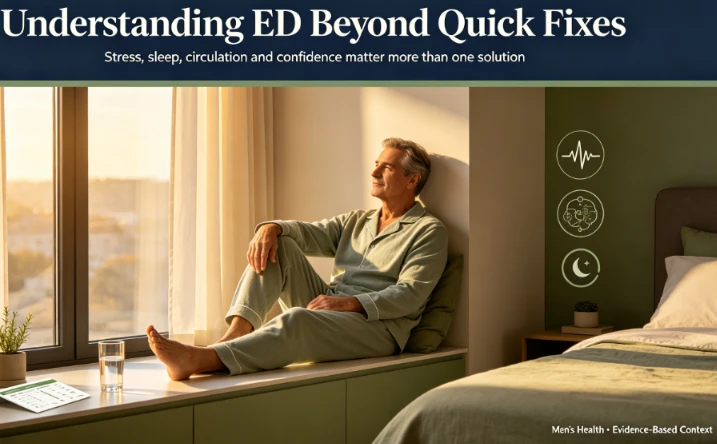
Erectile dysfunction (ED) refers to difficulty getting or keeping an erection firm enough for satisfactory sexual activity. Some men notice ED after long periods of stress, poor sleep, pornography overuse, or frequent masturbation; others experience ED alongside metabolic issues, cardiovascular risk, anxiety, or medication effects. In real life, ED is rarely "one cause, one fix."
This article translates and adapts a Chinese clinical write-up describing a 40-patient outpatient observation using a TCM pattern-based approach. The goal here is not to promise a miracle cure, but to help Western readers understand:
how TCM practitioners historically explained erection problems,
what results were reported in this specific case series,
how to interpret such data responsibly,
and how to consider herb-based support safely and realistically.

Quick disclaimer
If you have ED, especially if it's new, worsening, or associated with chest pain, diabetes, high blood pressure, depression, or low libido, you should see a licensed clinician. ED can be an early marker of cardiovascular disease.
The original text includes some ingredients that may be regulated, toxic, allergenic, or unsafe without professional supervision (for example, Strychnos nux-vomica / "Ma Qian Zi"). We do not recommend self-compounding or self-medicating with such substances.
What Western medicine says
An erection depends on blood inflow into erectile tissue and restriction of blood outflow, coordinated by nerves, hormones, and smooth muscle. If blood vessels don't dilate well, if anxiety triggers excessive sympathetic tone ("fight or flight"), or if blood doesn't stay trapped efficiently, erection quality drops. That's why drugs like PDE5 inhibitors (e.g., sildenafil) can work: they support blood-vessel signaling that improves erectile blood flow for many men.

What TCM says
The original Chinese text frames erection difficulty as related to patterns such as:
Kidney yang deficiency (low drive, cold intolerance, fatigue, weaker erections)
Kidney yin deficiency (irritability, poor sleep, dryness, "empty heat" symptoms)
Liver qi stagnation (stress, mood tension, performance anxiety)
Damp-heat in the liver channel (often described with irritation, heaviness, sometimes genitourinary discomfort)
Heart–spleen deficiency (worry, poor appetite, fatigue, weak "vitality")
Fear/fright injuring the kidney (anxiety-related, startle, insomnia)
Blood stasis / qi stagnation (circulation not "flowing," fixed discomfort, darker tongue signs in TCM)
In modern biomedical terms, many of these patterns overlap with combinations of stress physiology, sleep disruption, endothelial function, hormonal regulation, inflammation, and pelvic blood flow-though the mapping is not one-to-one.

The clinic observation described in the original text
Participants
40 outpatients (ages 22–65)
Age distribution:
22–30 years: 13 cases (32.5%)
31–40 years: 7 cases (17.5%)
41–50 years: 8 cases (20%)
≥51 years: 12 cases (30%)
Duration of symptoms: 2 months to 10 years
Diagnostic description: inability to achieve an erection, or erection not firm enough to complete intercourse
Two patients were unmarried and reported ED after habitual masturbation; the remaining 38 were married with children, and no other obvious organic disease was described in the write-up.

Treatment approach
A combined strategy:
A base decoction ("Qi Wei Tang," often translated here as a "herbal formula for supporting erectile function")
A capsule formula aimed at "moving blood and opening channels" (contains several high-risk ingredients and should not be copied casually)
Individualized modifications based on TCM pattern differentiation
How it was taken
Decoction: one dose daily, taken morning and evening; 15 days = 1 course
Capsules: three times daily, 15 capsules each time; 15 days = 1 course
Note: This dosing is presented as part of the historical report. It is not a safe recommendation for self-use.

Results
It defines outcomes in three categories:
"Cured": erection firm enough for successful intercourse
"Marked improvement": erection occurs but not firm enough to complete intercourse
"No effect": no obvious change
Reported outcomes:
After 1 course (15 days): 6/40 "cured" (15%)
After 2 courses (30 days): 32/40 "cured" (80%)
After 2 courses: 2/40 "marked improvement" (5%)
The text concludes a "cure rate" of 95%.
How to interpret this
there is no randomized control group,
outcomes are subjective and not validated by standardized tools (e.g., IIEF-5),
placebo effects and regression to the mean can be significant in sexual function,
"cure" is not clearly defined beyond intercourse success, and follow-up duration is unclear.
Still, this kind of report can be valuable in showing how TCM clinicians think: treat the underlying pattern (sleep, stress, vitality, circulation) rather than only chasing a single symptom.

Why men with frequent masturbation or porn-related ED may relate to this
Many men who masturbate frequently and then notice weaker erections during partnered sex describe:
heightened anxiety and performance pressure,
reduced sensitivity to real-life stimulation,
poor sleep and daytime fatigue,
"mental burnout," low motivation, or mood flattening.
Even if you don't use TCM terminology, the "liver qi stagnation / fear-fright / heart–spleen deficiency" descriptions are essentially pointing at a combined picture of stress + sleep + confidence + autonomic imbalance-factors known to affect erection quality.
A reasonable integrative plan typically includes:
sleep and circadian repair,
reducing porn reliance and compulsive masturbation patterns,
resistance training + cardio,
managing anxiety (CBT/therapy, mindfulness, breathing),
medical screening when indicated (testosterone, prolactin, A1c, lipids, BP),
and-if appropriate-evidence-based medications.
About herbs and how they might work
Traditional formulas often include herbs described as "warming yang," "tonifying kidney," or "moving blood." In modern terms, practitioners are aiming to support:
circulation and endothelial signaling
stress resilience and sleep
libido/sexual motivation
fatigue and metabolic support
However, "natural" does not automatically mean "safe," especially with multi-ingredient formulas. Interactions can occur with:
blood thinners/antiplatelets,
antidepressants,
blood-pressure drugs,
and PDE5 inhibitors.
TCM HERB TONIC BENEFITS

A safer, more compliant way to use this information
If you want to explore herb-based support, prioritize:
tested, standardized ingredients with clear labeling and safety data
products that are legal in your country and manufactured under quality control
realistic expectations and symptom tracking (e.g., IIEF-5, sleep score, anxiety)
If your goal is sexual vitality support-especially when stress and sleep are major factors-many Western users look for ingredients like Cistanche as part of a broader lifestyle plan. (Example: one user's personal experience story format can be found in "my journey" style blog posts-these are engaging, but they are not clinical proof.)


Cistanche Extract Tea-click picture to get more details

Where our product fits
If you're looking for a single-ingredient, quality-focused option to support energy, resilience, and men's vitality as part of a bigger plan, you can explore our Cistanche products here:
Product page: https://www.xjcistanche.com/products
(Always check your medications/conditions with a clinician.)