

The Anti-aging Effect Of Velvet Antler Polypeptide Is Dependent On Modulation Of The Gut Microbiota And Regulation Of The PPARα/APOE4 Pathway PART 2
Jul 26, 2023
3.5 16S rRNA gene functional prediction analysis
Using KEGG pathway analysis, differences in the metabolic pathways (functional genes) in microbial communities from the different groups were investigated. Pathways with an average abundance greater than 0.1% were selected according to the 16S rRNA gene functional prediction results. Moreover, pathways with a significant impact on the differences between groups were evaluated through random forest analysis (Fig. 5). Through KEGG analysis, the following five pathways with a significant influence on the difference between the groups were identified: ko00310 (lysine degradation), ko00071 (fatty acid degradation), ko00300 (lysine biosynthesis), ko00920 (sulfur metabolism), and ko00280 (valine, leucine, and isoleucine degradation). Notably, the value of ko00071 (fatty acid degradation) ranked second but had a greater impact on each group.
Glycoside of cistanche can also increase the activity of SOD in heart and liver tissues, and significantly reduce the content of lipofuscin and MDA in each tissue, effectively scavenging various reactive oxygen radicals (OH-, H₂O₂, etc.) and protecting against DNA damage caused by OH-radicals. Cistanche phenylethanoid glycosides have a strong scavenging ability of free radicals, a higher reducing ability than vitamin C, improve the activity of SOD in sperm suspension, reduce the content of MDA, and have a certain protective effect on sperm membrane function. Cistanche polysaccharides can enhance the activity of SOD and GSH-Px in erythrocytes and lung tissues of experimentally senescent mice caused by D-galactose, as well as reduce the content of MDA and collagen in lung and plasma, and increase the content of elastin, have a good scavenging effect on DPPH, prolong the time of hypoxia in senescent mice, improve the activity of SOD in serum, and delay the physiological degeneration of lung in experimentally senescent mice With cellular morphological degeneration, experiments have shown that Cistanche has the good antioxidant ability and has the potential to be a drug to prevent and treat skin aging diseases. At the same time, echinacoside in Cistanche has a significant ability to scavenge DPPH free radicals and has the ability to scavenge reactive oxygen species and prevent free radical-induced collagen degradation, and also has a good repair effect on thymine free radical anion damage.

Click on Cistanche Powder Bulk
【For more info:george.deng@wecistanche.com / WhatApp:86 13632399501】
According to the predicted gut microbiota functions, we speculated that the aging cognitive impairment caused by Dgal might be related to abnormal fatty acid metabolism in vivo.
3.6 Influence of VAP on the fatty acid metabolism pathway
ults, we speculated that D-gal-induced aging and the consequent cognitive impairment might be associated with abnormal fatty acid metabolism. Based on this hypothesis, we selected key enzymes involved in beta-fatty acid oxidation, such as ACOX1 and CPT1A, and the key regulators PPARα and APOE4 for western blot analysis.
As shown in Fig. 6A, B, the protein expression levels of PPARα, ACOX1, and CPT1A in the model group were significantly lower than those in the control group (P < 0.01, P < 0.05). In contrast, compared to the model group, the protein expression levels of PPARα, ACOX1, and CPT1A in the VAP1 group were significantly higher (P < 0.05). Additionally, the protein expression levels of PPARα, ACOX1, and CPT1A were also significantly higher in the VAP2 group than in the model group (P < 0.05, P < 0.01). Furthermore, the APOE4 protein level in the model group was significantly upregulated compared to that observed in the control group (P < 0.01). However, the expression of APOE4 in the VE and VAP2 groups was significantly downregulated compared to that observed in the model group (P < 0.05). These results indicate that VAP can reduce APOE4 protein expression in mouse brain tissues.

As shown in Fig. 6C, compared to the control group, FFA levels in the model group were significantly higher (P < 0.01). Compared to the model group, FFA levels in the VE, VAP1, and VAP2 groups were significantly lower (P < 0.01, P < 0.05). These results show that VAP reduced FFA levels in the brain tissue of aging mice, and the higher the dose was, the more obvious the effect.
The ATP content of mouse brain tissue was analyzed to determine the effect of VAP on ATP contents. As shown in Fig. 6D, the ATP content in the model group was significantly lower than that observed in the control group (P < 0.01). D-gal treatment reduced the ATP content in the brain tissue of mice. Compared to the model group, VAP, and VE treatment significantly increased the ATP content in the brain tissue of mice (P < 0.01).
4. Discussion
Aging is marked by changes in the physiological functions of the brain. Brain aging is accompanied by learning and memory disorders [23], and the hippocampus plays a central role in the process of memory. The MWM test is one of the classic methods used to detect changes in ethology in learning and memory ability [24]. The behavioral results showed that D-gal-induced learning and memory disorders occurred in mice, with the behavior of mice demonstrating senescence-associated changes. Remarkably, the administration of VAP significantly improved the cognitive ability of aging mice. Moreover, H&E staining and TEM results revealed that the number of neurons in the model group decreased, and their morphology was abnormal. Altogether, these results suggest that VAP can protect the microstructure of neurons and improve cognitive impairment in D-gal-induced aging mice.
Aging is an inevitable stage in the process of life., during which the body experiences varying degrees of damage, leading to the occurrence of neurodegenerative diseases and the consequent impairment of learning and cognitive functions. The excessive accumulation of reactive oxygen species (ROS) is also closely associated with aging [25, 26]. Normally, ROS are involved in protein phosphorylation in various networks of the transport system. However, when ROS levels are excessive, lipid peroxidation occurs, resulting in oxidative damage [27, 28]. As important antioxidant enzymes in the body, SOD, CAT, and GSH-Px protect cells from damage by scavenging free radicals [29]. SOD can catalyze the reduction of O 2− to hydrogen peroxide (H2O2), regulate the levels of ROS and reactive nitrogen clusters (RNS), and reduce cell damage [30]. CAT catalyzes the decomposition of H2O2 into water and oxygen, reduces the concentration of H2O2, accelerates the removal of O2−, and reduces the damage of H2O2 to the body. As one of the products of the lipid peroxidation reaction of biomembranes, the concentration of MDA reflects the degree of damage to the body [31]. GSH-Px acts as a peroxide-decomposing enzyme that reduces peroxide-induced cellular damage. The results showed that the activities of SOD, GSHPx, CAT, and other antioxidant enzymes in the model group decreased. At the same time, the MDA content increased, which is consistent with the findings of previous studies [32]. We also observed that under VAP administration, the activities of antioxidant enzymes such as SOD, GSH-Px, and CAT in the serum tissues of mice were significantly improved, and the level of lipid peroxide MDA was significantly reduced. VAP is rich in antioxidant functional components [33] that can effectively remove free radicals and peroxides accumulated during the aging process, positively impacting the aging process.

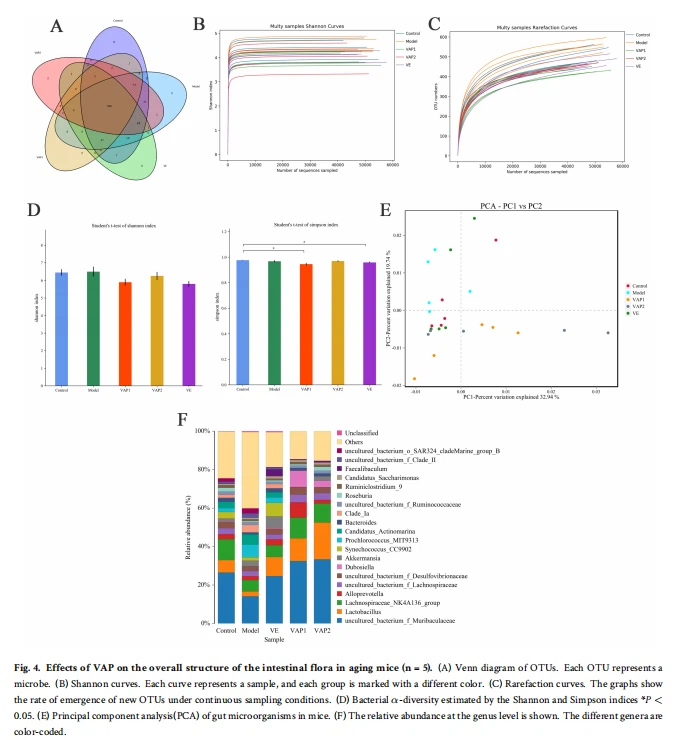
The gut microbiota, also known as the “second genome”, has been increasingly associated with human health [34]. Indeed, with the recent increase in the number of studies on this topic, the important role of gut microbiota in the body has been widely recognized [35]. We combined behavioral experiments with high-throughput sequencing technology and observed that VAP administration significantly improved aging mice’s learning and memory abilities. Analysis of the alpha diversity of the intestinal flora of mice in each group showed no significant difference in the alpha diversity of the intestinal flora of mice between the model group and each treatment group. PCA results showed that D-gal induced a large deviation in the type of flora in aging mice. The administration of VAP caused an increase in the similarity of the type of flora observed between aging and normal mice. For instance, at the genus level, VAP significantly increased the abundance of beneficial Lactobacillus. It is worth noting that Lactobacillus probiotics were demonstrated to protect cognitive function and improve lipid metabolism.
Based on the predicted functions of 16S rRNA gene functional genes, the KEGG analysis results [36] highlighted the fatty acid degradation pathway. We speculate that the aging caused by D-gal may be related to the abnormal metabolism of fatty acids in the body. Fatty acids are important structural components and energy sources of the body, and their content is affected by decomposition and synthesis rates [37]. As the brain is rich in lipids [38], this organ is particularly sensitive to OS due to its low free radical scavenging ability and weak antioxidant environment. Clinical studies have shown that the accumulation of extremely long-chain saturated fatty acids increases in patients with defects in peroxidase oxidase. At the same time, such patients suffer from impaired brain function and cognitive impairment [39]. Intestinal probiotics such as Lactobacillus help to regulate brain function and behavior [40]. Through neuroendocrine-immune system regulation, directly or indirectly mediates the microbial gut-brain axis, which has an important impact on the physiological function of the host [41, 42]. The gut-brain axis refers to the two-way signal mechanism between the gastrointestinal tract and the central nervous system. Related metabolites of intestinal microbes can effectively improve cognitive function by participating in oxidative stress and fatty acid metabolism [43, 44]. Therefore, VAP may play a role through the brain-gut axis by regulating the composition of the intestinal flora, reducing oxidative stress and fatty acid accumulation, promoting ATP energy supply, and ultimately improving cognitive impairment in aging mice.

The metabolism of fatty acids primarily occurs in the mitochondria and peroxisomes via β-oxidation. Mitochondria primarily break down short- and medium-to-long-chain fatty acids, while peroxisomes primarily break down long and very-long-chain fatty acids. The result of fatty acid metabolism is the generation of ATP [45]. This experiment shows that after VAP regulates fatty acid metabolism in aging mice, it further increases the ATP content of aging mice and improves energy metabolism in aging mice [46, 47]. Although the mitochondrial and peroxisomal fatty acid oxidation decomposition products are the same, they are catalyzed by different enzymes. Importantly, senescence is known to reduce peroxisomal oxidation and the levels of ACOX1 [48]. ACOX1 acts as a rate-limiting enzyme that catalyzes the metabolism of straight-chain fatty acids and is involved in the synthesis of precursors of specific decomposition mediators (SPMs).
Interestingly, in neurodegenerative diseases, increased SPM content has been shown to effectively improve the survival rate of neurons and the pathogenesis of diseases [49]. CPT1A is located in the outer mitochondrial membrane and is also a key enzyme in the mitochondrial β-oxidation of fatty acids. Notably, both ACOX1 and CPT1A are regulated by PPARα, the activation of which upregulates the expression of these two key enzymes and accelerates fatty acid decomposition [50]. The main function of PPARα is to regulate fatty acid oxidation metabolism and energy consumption by regulating the activity of ACOX1 and CPT1A. We showed that the administration of VAP induced the upregulation of the expression of PPARα, CPT1A, and ACOX1, suggesting that it may upregulate the expression of the latter two key enzymes via the activation of PPARα to promote fatty acid degradation.
APOE is the primary component of plasma lipoproteins and the most important carrier of cerebral cholesterol [51], playing a role in regulating lipid metabolism in the central nervous system and maintaining lipid metabolism balance in the brain [52]. Studies have shown that APOE can participate in the growth and repair of neurons, affect dendritic reconstruction and promote synapse generation via the regulation of lipid metabolism and possibly via the regulation of the cytoskeleton (e.g., affecting the phosphorylation of the tau protein) [53, 54]. These biological activities of APOE suggest that it may play an important role in nerve tissue repair [55]. APOE has three common isotypes (APOE2, APOE3, and APOE4), and studies have shown that APOE4 can lead to mitochondrial dysfunction in the brain. Indeed, the cerebral synapses in APOE4 gene carriers are severely damaged [56] and are more likely to suffer from neurodegenerative diseases [57]. Importantly, we showed that VAP could reduce the expression of APOE4 in the brain.
5. Conclusions
Results conclusively show that VAP promotes the expression of CPT1A and ACOX1 by activating PPARα, regulates the intestinal flora of aging mice, thereby improving lipid metabolism in aging mice, reducing fatty acid content, promoting fatty acid decomposition, and increasing ATP in aging mice. VAP increases ATP and reduces the expression of APOE by reducing fatty acid content in the brain of aging mice, thereby improving the cognitive impairment caused by aging, improving learning ability, and protecting neurons.

Abbreviations
VA, velvet antler; VAP, velvet antler polypeptide; Dgal, D-galactose; H&E, hematoxylin-eosin; TEM, transmission electron microscopy; SOD, superoxide dismutase; MDA, malonaldehyde; GSH-Px, glutathione peroxidase; CAT, catalase; CNS, central nervous system; OS, oxidative stress; ROS, reactive oxygen species; OTUs, operational taxonomic units; KEGG, Kyoto Encyclopedia of Genes and Genomes; PPARα, peroxisome proliferator-activated receptor α; CPT1A, carnitine-palmitoyl transferase-1 A; ACOXl, acyl-CoA oxidase 1; APOE4, apolipoprotein E4.
Author contributions
NL and QY conceived and designed the experiments; XRL, ZZ, STM, ZL, YXL, YHZ, QHP, and SG performed the experiments; XCL, MK, JNL, and JFW analyzed the data; HL contributed materials; XRL wrote the paper.
Ethics approval and consent to participate
All animal experiments performed in this study aligned with the relevant guidelines and were approved by the Laboratory Animal Ethics Committee at the Changchun University of Chinese Medicine (20180056).
Acknowledgment
We thank the anonymous reviewers for their excellent criticism of the article.
Funding
This study was supported by the National Key Research and Development Program of China (2018YFC1706603-05).
Conflict of interest
The authors declare no conflict of interest.
References
[1] Sui Z, Zhang L, Huo Y, Zhang Y. Bioactive components of velvet antlers and their pharmacological properties. Journal of Pharmaceutical and Biomedical Analysis. 2014; 87: 229–240.
[2] Ding Y, Ko S, Moon S, Lee S. Protective Effects of Novel Antioxidant Peptide Purified from Alcalase Hydrolysate of Velvet Antler Against Oxidative Stress in Chang Liver Cells in Vitro and in a Zebrafish Model In Vivo. International Journal of Molecular Sciences. 2019; 20: 5187.
[3] Tseng S, Sung C, Chen L, Lai Y, Chang W, Sung H, et al. Comparison of chemical compositions and osteoprotective effects of different sections of velvet antler. Journal of Ethnopharmacology. 2014; 151: 352–360.
[4] Zha E, Li X, Li D, Guo X, Gao S, Yue X. Immunomodulatory effects of a 3.2kDa polypeptide from velvet antler of Cervus nippon Temminck. International Immunopharmacology. 2013; 16: 210– 213.
[5] Yang Q, Lin J, Sui X, Li H, Kan M, Wang J, et al. Antiapoptotic effects of velvet antler polypeptides on damaged neurons through the hypothalamic-pituitary-adrenal axis. Journal of Integrative Neuroscience. 2020; 19: 469.
[6] Cenini G, Lloret A, Cascella R. Oxidative Stress in Neurodegenerative Diseases: from a Mitochondrial Point of View. Oxidative Medicine and Cellular Longevity. 2019; 2019: 2105607.
[7] Chen P, Chen F, Zhou B. Antioxidative, anti-inflammatory and anti-apoptotic effects of ellagic acid in liver and brain of rats treated by D-galactose. Scientific Reports. 2018; 8: 1465.
[8] Su B, Wang X, Nunomura A, Moreira P, Lee H, Perry G, et al. Oxidative Stress Signaling in Alzheimer’s Disease. Current Alzheimer Research. 2008; 5: 525–532.
[9] Rehman SU, Shah SA, Ali T, Chung JI, Kim MO. Anthocyanins Reversed D-Galactose-Induced Oxidative Stress and Neuroinflammation Mediated Cognitive Impairment in Adult Rats. Molecular Neurobiology. 2017; 54: 255–271.
[10] Feuerstein D, Backes H, Gramer M, Takagaki M, Gabel P, Kumagai T, et al. Regulation of cerebral metabolism during cortical spreading depression. Journal of Cerebral Blood Flow and Metabolism. 2016; 36: 1965–1977.
[11] Hébuterne X. Gut changes attributed to aging: effects on intestinal microflora. Current Opinion in Clinical Nutrition and Metabolic Care. 2003; 6: 49–54.
[12] Sommer F, Bäckhed F. The gut microbiota–masters of host development and physiology. Nature Reviews. Microbiology. 2013; 11: 227–238.
[13] Lynch SV, Pedersen O. The Human Intestinal Microbiome in Health and Disease. New England Journal of Medicine. 2016; 375: 2369–2379.
[14] Cryan JF, O’Riordan KJ, Sandhu K, Peterson V, Dinan TG. The gut microbiome in neurological disorders. Lancet Neurology. 2020; 19: 179–194.
[15] Kim S, Jazwinski SM. The Gut Microbiota and Healthy Aging: a Mini-Review. Gerontology. 2018; 64: 513–520.
[16] Hor Y, Ooi C, Khoo B, Choi S, Seeni A, Shamsuddin S, et al. Lactobacillus Strains Alleviated Aging Symptoms and Aging-Induced Metabolic Disorders in Aged Rats. Journal of Medicinal Food. 2019; 22: 1–13.
[17] Edgar RC. UPARSE: highly accurate OTU sequences from microbial amplicon reads. Nature Methods. 2013; 10: 996–998.

[18] Wang Y, Sheng H, He Y,Wu J, Jiang Y, Tam NF,et al. Comparison of the levels of bacterial diversity in freshwater, intertidal wetland, and marine sediments by using millions of Illumina tags. Applied and Environmental Microbiology. 2013; 78: 8264–8271.
[19] Parks DH, Tyson GW, Hugenholtz P, Beiko RG. STAMP: statistical analysis of taxonomic and functional profiles. Bioinformatics. 2014; 30: 3123–3124.
[20] Hashimoto K, Goto S, Kawano S, Aoki-Kinoshita KF, Ueda N, Hamajima M, et al. KEGG as a glycome informatics resource. Glycobiology. 2006; 16: 63R–70R.
[21] Grice EA, Kong HH, Conlan S, Deming CB, Davis J, Young AC, et al. Topographical and Temporal Diversity of the Human Skin Microbiome. Science. 2009; 324: 1190–1192.
[22] Hor Y, Lew L, Jaafar MH, Lau AS, Ong J, Kato T, et al. Lactobacillus sp. improved microbiota and metabolite profiles of aging rats. Pharmacological Research. 2019; 146: 104312.
[23] Walker L, McAleese KE, Erskine D, Attems J. Neurodegenerative Diseases and Ageing. Subcellular Biochemistry. 2019; 18: 75–106.
[24] Lindner MD. Reliability, Distribution, and Validity of AgeRelated Cognitive Deficits in the Morris Water Maze. Neurobiology of Learning and Memory. 1997; 68: 203–220.
[25] Puca AA, Carrizzo A, Villa F, Ferrario A, Casaburo M, Maciąg A, et al. Vascular aging: the role of oxidative stress. International Journal of Biochemistry and Cell Biology. 2013; 45: 556–559.
[26] Maynard S, Fang EF, Scheibye-Knudsen M, Croteau DL, Bohr VA. DNA Damage, DNA Repair, Aging, and Neurodegeneration. Cold Spring Harbor Perspectives in Medicine. 2015; 5: a025130.
[27] Floyd RA, Hensley K. Oxidative stress in brain aging. Implications for therapeutics of neurodegenerative diseases. Neurobiology of Aging. 2003; 23: 795–807.
[28] Zorić L, Colak E, Canadanović V, Kosanović-Jaković N, Kisić B. Oxidation stress role in age-related cataractogenesis. Medicinski Pregled. 2010; 63: 522–526. (In Serbian)
[29] Inal ME, Kanbak G, Sunal E. Antioxidant enzyme activities and malondialdehyde levels related to aging. Clinica Chimica Acta. 2001; 305: 75–80.
[30] Wang Y, Branicky R, Noë A, Hekimi S. Superoxide dismutases: Dual roles in controlling ROS damage and regulating ROS signaling. Journal of Cell Biology. 2018; 217: 1915–1928.
[31] Sun J, Zhang L, Zhang J, Ran R, Shao Y, Li J, et al. Protective effects of ginsenoside Rg1 on splenocytes and thymocytes in an aging rat model induced by d-galactose. International Immunopharmacology. 2018; 58: 94–102.
[32] Ziegler DV, Wiley CD, Velarde MC. Mitochondrial effectors of cellular senescence: beyond the free radical theory of aging. Aging Cell. 2015; 14: 1–7.
[33] Zhu W, Wang H, Zhang W, Xu N, Xu J, Li Y, et al. Protective effects and plausible mechanisms of antler-velvet polypeptide against hydrogen peroxide-induced injury in human umbilical vein endothelial cells. Canadian Journal of Physiology and Pharmacology. 2017; 95: 610–619.
[34] Cong X, Henderson WA, Graf J, McGrath JM. Early Life Experience and Gut Microbiome: the Brain-Gut-Microbiota Signaling System. Advances in Neonatal Care. 2015; 15: 314–323.
[35] Sudo N, Chida Y, Aiba Y, Sonoda J, Oyama N, Yu X, et al. Postnatal microbial colonization programs the hypothalamic-pituitary-adrenal system for stress response in mice. Journal of Physiology. 2004; 558: 263–275.
[36] Kanehisa M, Sato Y. KEGG Mapper for inferring cellular functions from protein sequences. Protein Science. 2020; 29: 28–35.
[37] Lang R, Mattner J. The role of lipids in host-microbe interactions. Frontiers in Bioscience (Landmark Edition). 2017; 22: 1581–1598.
[38] Hu T, Zhu Q, Hu Y, Kamal G, Feng Y, Manyande A, et al. Qualitative and Quantitative Analysis of Regional Cerebral Free Fatty Acids in Rats Using the Stable Isotope Labeling Liquid Chromatography-Mass Spectrometry Method. Molecules. 2020; 25: 5163.
[39] Forman BM, Chen J, Evans RM. Hypolipidemic drugs, polyunsaturated fatty acids, and eicosanoids are ligands for peroxisome proliferator-activated receptors alpha and delta. Proceedings of the National Academy of Sciences of the United States of America. 1997; 94: 4312–4317.
[40] Sanborn V, Azcarate-Peril MA, Updegraff J, Manderino LM, Gunstad J. A randomized clinical trial examining the impact of LGG probiotic supplementation on psychological status in middle-aged and older adults. Contemporary Clinical Trials Communications. 2018; 12: 192–197.
[41] Hamidi N, Nozad A, Sheikhkanloui Milan H, Amani M. Okadaic acid attenuates short-term and long-term synaptic plasticity of hippocampal dentate gyrus neurons in rats. Neurobiology of Learning and Memory. 2019; 158: 24–31.
[42] Angelucci F, Cechova K, Amlerova J, Hort J. Antibiotics, gut microbiota, and Alzheimer’s disease. Journal of Neuroinflammation. 2019; 16: 108.
[43] Hoffman BU, Lumpkin EA. A gut feeling. Science. 2018; 361: 1203–1204.
[44] Azad MAK, Sarker M, Li T, Yin J. Probiotic Species in the Modulation of Gut Microbiota: an Overview. BioMed Research International. 2018; 2018: 9478630.
[45] Thomas M, Davis T, Loos B, Sishi B, Huisamen B, Strijdom H, et al. Autophagy is essential for the maintenance of amino acids and ATP levels during acute amino acid starvation in MDAMB231 cells. Cell Biochemistry and Function. 2018; 36: 65–79.
[46] Pyper SR, Viswakarma N, Yu S, Reddy JK. PPARalpha: energy combustion, hypolipidemia, inflammation, and cancer. Nuclear Receptor Signaling. 2010; 8: e002.
[47] Jin X, Xue B, Ahmed RZ, Ding G, Li Z. Fine particles cause the abnormality of cardiac ATP levels via PPARα-mediated utilization of fatty acid and glucose using in vivo and in vitro models. Environmental Pollution. 2019; 249: 286–294.
[48] Fransen M, Nordgren M, Wang B, Apanasets O, Van Veldhoven PP. Aging, age-related diseases, and peroxisomes. Sub-Cellular Biochemistry. 2013; 69: 45–65.
[49] Vamecq J, Andreoletti P, El Kebbaj R, Saih F, Latruffe N, El Kebbaj MHS, et al. Peroxisomal Acyl-CoA Oxidase Type 1: AntiInflammatory and Anti-Aging Properties with a Special Emphasis on Studies with LPS and Argan Oil as a Model Transposable to Aging. Oxidative Medicine and Cellular Longevity. 2018; 2018: 6986984.
[50] Robertson G, Leclercq I, Farrell GC. Nonalcoholic steatosis and steatohepatitis. II. Cytochrome P-450 enzymes and oxidative stress. American Journal of Physiology—Gastrointestinal and Liver Physiology. 2001; 281: G1135–G1139.
[51] Boehm-Cagan A, Bar R, Harats D, Shaish A, Levkovitz H, Bielicki JK,et al. Differential Effects of apoE4 and Activation of ABCA1 on Brain and Plasma Lipoproteins. PLoS ONE. 2016; 11: e0166195.
[52] Nunes VS, Cazita PM, Catanozi S, Nakandakare ER, Quintão ECR. Decreased content, rate of synthesis, and export of cholesterol in the brain of apoE knockout mice. Journal of Bioenergetics and Biomembranes. 2018; 50: 283–287.
[53] Rohn TT. Is apolipoprotein E4 an important risk factor for vascular dementia? International Journal of Clinical and Experimental Pathology. 2014; 7: 3504–3511.
[54] Zlokovic BV. Cerebrovascular effects of apolipoprotein E: implications for Alzheimer disease. JAMA Neurology. 2013; 70: 440– 444.
[55] Serrano-Pozo A, Das S, Hyman BT. APOE and Alzheimer’s disease: advances in genetics, pathophysiology, and therapeutic approaches. Lancet Neurology. 2021; 20: 68–80.
[56] Trojanowski JQ, Lee VMY. The role of tau in Alzheimer’s disease. Medical Clinics of North America. 2002; 86: 615–627.
[57] Lin A, Parikh I, Yanckello L, White R, Hartz A, Taylor C, et al. APOE genotype-dependent pharmacogenetic responses to rapamycin for preventing Alzheimer’s disease. Neurobiology of Disease. 2020; 139: 104834.
【For more info:george.deng@wecistanche.com / WhatApp:86 13632399501】
You Might Also Like
-

Grape Seed Extract
-
Cistanche For Improve Sexual Function
-
Improve memory and prevent Alzheimer’s Disease rely on it...
-
Cistanche Supplements Enhance Memory and prevent Parkinso...
-

Cistanche Dietary Supplement Kidney Function Support Phen...
-
Cistanche Dietary Supplement Sexual Performance Improveme...