The Review Of Anti-aging Mechanism Of Polyphenols On Caenorhabditis Elegans Part 1
Jul 26, 2023
Micronutrients extracted from natural plants or made by biological synthesis are widely used in anti-aging research and applications. Among more than 30 effective anti-aging substances, employing polyphenol organic compounds for modification or delaying the aging process attracts great interest because of their distinct contribution to the prevention of degenerative diseases, such as cardiovascular disease and cancer. There is a profound potential for polyphenol extracts in the research of aging and the related diseases of the elderly. Previous studies have mainly focused on the properties of polyphenols implicated in free radical scavenging; however, the anti-oxidant effect cannot fully elaborate its biological functions, such as neuroprotection, Aβ protein production, ion channel coupling, and signal transduction pathways. Caenorhabditis elegans (C. elegans) has been considered an ideal model organism for exploring the mechanism of anti-aging research and is broadly utilized in screening for natural bioactive substances. In this review, we have described the molecular mechanisms and pathways responsible for the slowdown of aging processes exerted by polyphenols. We also have discussed the possible mechanisms for their anti-oxidant and anti-aging properties in C. elegans from the perspective of different classifications of the specific polyphenols, such as flavonols, anthocyanins, flavan-3-ols, hydroxybenzoic acid, hydroxycinnamic acid, and stilbenes.
Glycoside of cistanche can also increase the activity of SOD in heart and liver tissues, and significantly reduce the content of lipofuscin and MDA in each tissue, effectively scavenging various reactive oxygen radicals (OH-, H₂O₂, etc.) and protecting against DNA damage caused by OH-radicals. Cistanche phenylethanoid glycosides have a strong scavenging ability of free radicals, a higher reducing ability than vitamin C, improve the activity of SOD in sperm suspension, reduce the content of MDA, and have a certain protective effect on sperm membrane function. Cistanche polysaccharides can enhance the activity of SOD and GSH-Px in erythrocytes and lung tissues of experimentally senescent mice caused by D-galactose, as well as reduce the content of MDA and collagen in lung and plasma, and increase the content of elastin, have a good scavenging effect on DPPH, prolong the time of hypoxia in senescent mice, improve the activity of SOD in serum, and delay the physiological degeneration of lung in experimentally senescent mice With cellular morphological degeneration, experiments have shown that Cistanche has the good antioxidant ability and has the potential to be a drug to prevent and treat skin aging diseases. At the same time, echinacoside in Cistanche has a significant ability to scavenge DPPH free radicals and has the ability to scavenge reactive oxygen species and prevent free radical-induced collagen degradation, and also has a good repair effect on thymine free radical anion damage.

Click On Cistanche Tubulosa Extract
【For more info:george.deng@wecistanche.com / WhatApp:86 13632399501】
Keywords: polyphenols, Caenorhabditis elegans, anti-aging, anti-oxidant, insulin/insulin-like signaling pathway
INTRODUCTION
Aging is considered a universal physiological process that is accompanied by systemic changes in the structural integrity of cells that are caused by alterations in metabolic and signal transduction pathways (Childs et al., 2015). Understanding of the biological mechanisms of aging and longevity has been growing remarkably over the past two decades. At the molecular level, senescence is strongly associated with susceptibility to chronic diseases and disorders, such as chronic fibrosis, severe atherosclerosis, diabetes, osteoarthritis, and ultimately death (Childs et al., 2016; Amor et al., 2020). Among the various anti-aging methods and preventive strategies, the use of micronutrients or biologically active substances is considered a practical and efficient method that targets a variety of intracellular/extracellular pathways (Sahin et al., 2011; Johnson et al., 2013; Li et al., 2017).
Nutrients and bioactive substances have shed new light on the prevention and treatment of chronic diseases and aging. For example, short-term supplementation with appropriate doses of vitamin C or vitamin C plus E has already been confirmed to improve the immunological function in the elderly and contribute to health and longevity (De la Fuente et al., 2020). Most of the substances that exert bioactive properties originate from natural plants and animals and have been extensively studied for their preventive and therapeutic effects against chronic diseases and aging. Functional nutrition is of great significance to human health; however, the high cost involved in extracting and purifying bioactive compounds from natural sources in the past has limited the rapid growth of the market. Thus, with the development of synthetic biology technology, a few important functional nutrients can be produced at a low cost by biological manufacturing. In the future, biological manufacturing is expected to be replaced by traditional extraction techniques or functional nutritional chemicals. So far, plant polyphenols, such as blueberry polyphenols, black tea and green tea polyphenols, and tocotrienols in vegetable oils, have been proven to delay the aging process in model organisms (Adachi and Ishii, 2000; Wilson et al., 2006; Peng et al., 2009; Salminen et al., 2012; Zarse et al., 2012). The anti-aging effects of these polyphenols are mostly related to their anti-oxidant properties and their ability to scavenge free radicals. It has been reported that resveratrol, a polyphenol compound in red wine, could slow down aging in Caenorhabditis elegans due to the reduction of mitochondrial respiration (Wood et al., 2004). The understanding of human aging and longevity might be improved by elucidating the molecular mechanism of aging in C. elegans (Park et al., 2020).
ADVANTAGES OF USING C. ELEGANS AS A MODEL ORGANISM IN APPLIED ANTI-AGING RESEARCH
Although experimenting with a mammalian model is compelling, it is time-consuming and limited by the presence of ethical concerns. C. elegans has been proven as a reasonable model organism for biological research on aging because of its advantageous features (Guarente and Kenyon, 2000). Although its anatomical structure is simple, the tissues and organs, such as muscles, nervous system, gastrointestinal tract, and gonads of C. elegans, are similar to that of higher animals (Jorgensen and Mango, 2002). In addition, its complete genome sequence is available, and about 50% of human protein-coding sequences have identifiable homologous genes in nematodes (Kim et al., 2018). Similar to humans and other higher mammals, its behavior changes and descending physiological indexes are accompanied by aging. Moreover, there are highly evolutionary conserved mechanisms controlling physiological phenomena, such as development, aging, and disease. Homologous or functionally similar forms of the main enzymes, genes, and transcription factors involved in metabolism have been found in higher animals and C. elegans (Chen et al., 2013). For example, the important transcription factor forkhead box O (FOXO), which is involved in longevity, stress resistance, and metabolism, is present in drosophila, nematodes, rodents, and humans (Martins et al., 2016). Therefore, C. elegans is broadly utilized in screening for natural bioactive substances (Ye et al., 2020). Numerous transgenes and mutants related to the longevity and aging of C. elegans are available (Chen et al., 2015), and many polyphenols have been successfully tested for their effects on the general health benefits and longevity of nematodes.

At present, most of the bioactive substances with anti-aging activity were first discovered by using nematodes as model organisms. Since the first use of nematodes by Brenner as a tool in genetics research (Brenner, 1974), the model has been applied to many other research fields, such as development, disease modeling, metabolism, medicine, screening, and others. We also took advantage of this model organism in aging and signal transduction (Zheng et al., 2018; Qu et al., 2020b). Since two American scientists, Friedman and Johnson, discovered in the 1980s that the mutation of a single gene in nematodes can increase lifespan (Johnson and Wood, 1982; Friedman and Johnson, 1988), the genetic control of aging has rapidly developed. It is reported that aging and aging-related diseases are controlled by signaling pathways, such as autophagy-related target of rapamycin (TOR) signaling pathway (McCormick et al., 2011; Laplante and Sabatini, 2012), insulin/insulin-like growth factor 1 (IGF-1) signaling (IIS) pathway (Barbieri et al., 2003; Lapierre and Hansen, 2012), mitochondrial related functional signaling pathway (Sohal and Orr, 2012), and adenosine monophosphate (AMP)-activated protein kinase (AMPK) signaling pathway related to cell energy homeostasis (Salminen and Kaarniranta, 2012; Qu et al., 2020a).
POLYPHENOLS
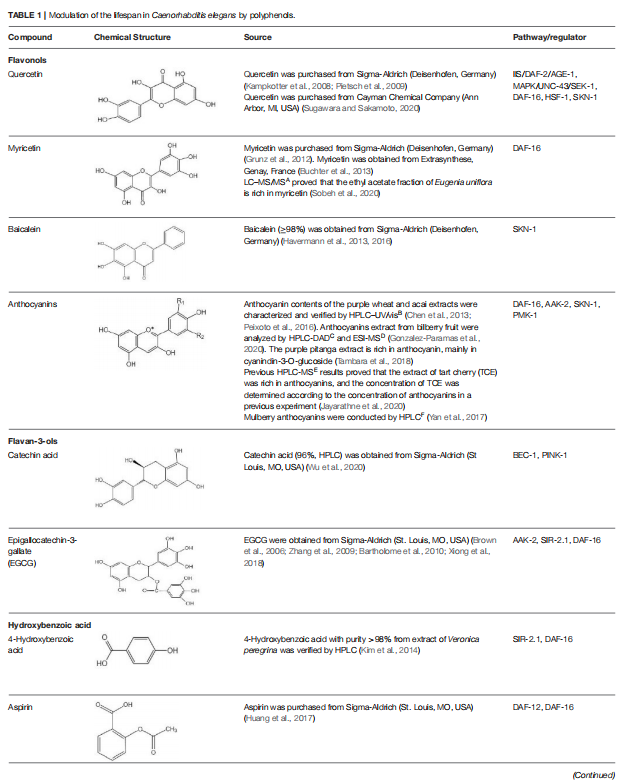
Polyphenols are the most widely distributed group of phytochemicals (Table 1). They are usually classified into flavonoids, phenolic acids, and non-flavonoids. Flavonoids are subdivided into flavonols, flavanones, isoflavones, anthocyanins, and flavan-3-ols according to their chemical structure. Phenolic acids are subdivided into hydroxybenzoic acid and hydroxycinnamic acid. Non-flavonoids are subdivided into lignans, stilbenes, and tannins (Papaevgeniou and Chondrogianni, 2018; Fraga et al., 2019; Majidinia et al., 2019). The category is illustrated in Figure 1.
Polyphenols exert beneficial effects on health, owing to their anti-oxidant and anti-inflammatory activities, and they have been commonly employed to treat cancer, autoimmune diseases, type 2 diabetes, cardiovascular disorders, and other diseases. The structural characteristics of the carbocyclic ring of polyphenols and the number of hydroxyl groups on the ring are the main prerequisites for prolonging lifespan (Grunz et al., 2012). In this article, we reviewed the literature regarding the anti-aging properties of each specific polyphenol. Different classes of chemicals might activate similar signaling pathways involved in aging processes, and one class of chemicals might be involved in multiple pathways. For example, it was reported that resveratrol can extend C. elegan's lifespan through the MPK-1/ERK or SIR- 2.1/DAF-16 pathway (Yoon et al., 2019). In addition, many kinds of polyphenols can modulate longevity through the IIS pathway, especially through the key transcription factor DAF-16 in the pathway, for example, myricetin (Buchter et al., 2013), blueberry extract (Wang et al., 2018), echinacoside (Wang et al., 2015), and others. The main reason for this effect might be that the DAF-16 expression increases the ability to scavenge free radicals and resist oxidative stress.


FLAVONOLS
Bioactive phytochemicals, such as flavonols, are abundant in fruits and vegetables, such as onions, peppers, cauliflower, and grapes. The most common flavonol is quercetin, and other common flavonols are kaempferol, myricetin, isorhamnetin, tamarixetin, morin, fisetin, apigenin, and luteolin (Adebamowo et al., 2005; Perez-Vizcaino and Duarte, 2010). Figure 2 illustrates the model of how flavonoids are involved in lifespan regulation.
Quercetin, as a strong anti-oxidant, has been demonstrated to have a positive effect on longevity and stress resistance in various animal models, and its activity and mechanism have also been studied in nematodes (Pietsch et al., 2012; Proshkina et al., 2016). Several studies have confirmed that quercetin accumulates in nematodes and exhibits reactive oxygen species (ROS) scavenging activity, which might be the reason for its beneficial health effects, and this process is regulated by the transcription factor DAF-16 (Kampkotter et al., 2008; Sugawara and Sakamoto, 2020). The C. elegans gene, daf-16, is homologous to the mammalian gene for the FOXO transcription factor, which plays a key role in controlling several stress response signaling cascades, aging processes, and other important biological functions, and it is also considered an important downstream factor of the IIS pathway, which is one of the main pathways that regulate the lifespan of nematodes. It starts from the DAF-2 insulin receptor, and it is also the ortholog of the insulin/IGF-1 receptor in C. elegans, through AGE-1/PI3K to AKT-1/2 and then to the downstream target DAF-16/FOXO transcription factor, to control the lifespan and metabolism of C. elegans. However, the conclusion is contrary. Some reports suggested that, although DAF-2 and other components of the IIS pathway mediate the anti-oxidant activity and life-prolonging effects of quercetin on nematodes, these effects seem to be independent of DAF-16 (Pietsch et al., 2009). Hence, the role of DAF-16 in quercetin-induced health effects requires further investigation. Besides DAF-16, SKN-1 and mitogen-activated protein kinase (MAPK) pathways are also involved in the process of scavenging ROS, lifespan extension, and health improvement in C. elegans. Quercetin also induces heat resistance by coactivating the expression and/or activity of HSF-1 and DAF-16 (Sugawara and Sakamoto, 2020). HSF orthologous, HSF-1, as a transcriptional regulator of stress-induced gene expression in worms, induces the expression of molecular chaperones. UNC-43 and SEK-1 seem to be parts of the lifespan regulation of quercetin (Pietsch et al., 2009). SEK-1 is an indispensable MAPK in innate immunity, and UNC-43 is a part of the SEK-1 upstream neuron regulation signal pathway. These two regulators belong to the MAPK pathway, a major immune signaling pathway (Troemel et al., 2006). UNC-43 is also a type II Ca2+/calmodulin-dependent kinase (CAMKII) that can also regulate osmotic pressure. Therefore, quercetin can be considered a multitarget nutrient.

In addition, myricetin was first discovered by Spanier for its activation of DAF-16 and its increase in the expression of its downstream gene sod-3, but it was found that the activation of DAF-16 was not the cause of the extended lifespan because it was found that DAF-16 activation was not correlated with the myricetin-mediated decrease in mitochondrial ROS and the increase in longevity (Grunz et al., 2012). However, further experiments proved that myricetin does exert its anti-oxidant effect through DAF-16 (Buchter et al., 2013; Sobeh et al., 2020). All these studies found that, in DAF-16 mutants, the ROS scavenging effect of myricetin was blocked to a great extent, and the beneficial effect on lifespan also disappeared completely. This indicates that, although myricetin is a strong anti-oxidant, its effect on the lifespan of C. elegans is heavily dependent on DAF- 16 rather than its direct antioxidant capacity. At present, the study of myricetin on the life extension of nematodes is limited to its regulation of the IIS pathway. In the future, additional pathways should be further analyzed in this respect, and other mechanisms for myricetin-mediating health effects should be investigated (Buchter et al., 2013).
Baicalein mainly comes from Huangqin, which is one of the commonly used traditional Chinese medicines. It has been demonstrated that baicalein mediates anti-oxidant effects by activating nuclear factor erythroid 2-related factor 2 (Nrf2) in mammalian cell lines. When it comes to C. elegans, SKN- 1 is the homologous gene of the mammalian transcription factor Nrf2 (An and Blackwell, 2003). Similar to Nrf2, SKN- 1 can also be activated by oxidative stress or exogenous bioactive substances; then, it can be transferred to the nucleus and combined with anti-oxidant response elements (AREs) of various anti-oxidant or protective gene promoter regions. This pathway can induce a variety of antioxidant enzymes as the key defense mechanism against oxidative stress. The lifespan of the skin-1 mutant is shortened, and the resistance to oxidative stress is reduced. SKN-1 is the direct target of the IIS pathway and MAPK pathway and has some common downstream targets with DAF-16. It is also required for dietary restriction (DR)-induced longevity because it interacts with amino acid and lipid metabolism during starvation (Dall and Faergeman, 2019). It has been reported that baicalein can modulate the lifespan and stress resistance of nematodes via SKN-1, but not DAF-16, a result similar to what was obtained in mammalian cell lines (Havermann et al., 2013, 2016).

ANTHOCYANINS
Anthocyanins are found in a wide variety of colored vegetables, fruits, and cereal, especially in various berry fruits, such as bilberries, blueberries, blackberries, blackcurrants, chokeberries, strawberries, and elderberries (Chen et al., 2013; Wallace and Giusti, 2015; Yan et al., 2017). Many studies have focused on the antioxidant capacity of different plant extracts rich in anthocyanins. The vast majority of plant extracts rich in anthocyanins, such as extracts of purple wheat (Chen et al., 2013), acai berry (Peixoto et al., 2016), mulberry (Yan et al., 2017), purple pitanga fruit (Tambara et al., 2018), tart cherry (Jayarathne et al., 2020), and bilberry (Gonzalez-Paramas et al., 2020), which can play their beneficial role by increasing nuclear translocation of DAF-16 and promoting the expression of anti-oxidant genes, such as sod-3, and the heat shock gene, hsp-16.2, in its downstream. Heat shock proteins (HSPs) are molecular chaperones and play important roles in the protection of molecular damage under environmental stress and have the ability to maintain proteostasis and prolong the longevity of organisms (Swindell, 2009). HSP-16.2 family is expressed under stress conditions and can be considered as stress-sensitive reporters to evaluate lifespan (Strayer et al., 2003). DAF-16 is a key protein for the anti-aging effects. Mechanistically, recent studies have found that anthocyanins could regulate the AAK-2/AMPK signaling pathway to perform its biological function (Jayarathne et al., 2020). aak-2 is the encoding gene of AMPK in nematodes. AMPK is a regulator of cellular energy homeostasis, which is essential for the metabolic regulation of nematodes during starvation and diapause (Demoinet and Roy, 2018), it can be activated under low energy conditions and can maintain the steady state of energy, linking nutritional availability with longevity (Tullet, 2015). Overexpression of AAK-2 in nematodes prolongs its lifespan, and this effect also requires the downregulation of the IIS pathway and the upregulation and transposition of DAF-16 (Zhao et al., 2017). Additionally, mulberry anthocyanins can also activate transcription factors SKN-1/Nrf2 and PMK-1/MAPK and their downstream targets that are related to oxidative stress (Yan et al., 2017).
FLAVAN-3-OLS
Flavan-3-ols include catechin, gallocatechin, epicatechin, epigallocatechin, epicatechin-3-gallate, epigallocatechin-3- gallate (EGCG), theaflavin, theaflavin-3-gallate, theaflavin-3′ - gallate, theaflavin-3′ -digallate, and thearubigins. Flavan-3-ols are mainly found in tea, apples, wine, and cocoa (Lei et al., 2016). Figure 2 shows the effect of flavan-3-ols on the lifespan of the nematode. There are many types of flavan-3-ols, but the current research has focused mostly on tea extracts and certain classes of flavan-3-ols, such as catechinic acid (CA) and EGCG. Xiong et al. (2014) found that black tea extracts contain a variety of flavan-3-ols, which can increase the lifespan of C. elegans under stress conditions, such as osmotic pressure imbalance, ultraviolet radiation, and heat stress. This effect might be mediated by the SEK-1 signaling and SIR-2.1/DAF-16/SOD-3 pathways, which could increase stress resistance. Worms simultaneously treated with catechins-rich green tea aqueous extract (GTE) and a lethal dose of pro-oxidant, i.e., juglone, showed a decreased expression of hsp-16.2 and a significantly increased survival rate as compared with worms not receiving GTE. It suggested that GTE could enhance the anti-stress ability of nematodes and reduce oxidative damage in vivo (Abbas and Wink, 2014). In addition, it was found that CA, as a natural polyphenol compound, extended the lifespan and declined the age-related behaviors of C. elegans by regulating the mitophagy pathway related to genes of bec-1 and pink-1. It was found that it can act the role of inducing mitochondrial phagocytosis at the early stage, which was also a key period to affect the lifespan (Wu et al., 2020). Mitophagy can prevent the accumulation of dysfunctional mitochondria and prolong lifespan. EGCG is another widely studied flavone. The regulation of EGCG on the lifespan of nematodes is affected by concentration. The effect on the organism can be described as a hormetic effect; in other words, stimulatory and inhibitory effects would be generated in low and high doses. The health effects of EGCG depend on the hormetic effect. It was found that, when the concentration was <25µM, it could prolong the lifespan of nematodes under stress and improve their stress ability and the partial decline of age-related physiological behavior, but it was not enough to affect the lifespan of worms under normal conditions (Brown et al., 2006; Zhang et al., 2009). When the concentration is above 800µM, it might produce toxic effects (Xiong et al., 2018). At a suitable concentration, EGCG induced ROS in a time-resolved manner, which can temporarily increase ROS level in the early stage and activate AAK-2/AMPK, change the metabolism of NAD+, and then increase the expression of its downstream target protein SIR-2.1. Previous studies have found that EGCG can increase the nuclear translocation and expression of DAF-16 and activate its downstream antioxidant genes (Zhang et al., 2009; Bartholome et al., 2010). However, the upstream regulation mechanism has not been further studied. Currently, it was found that EGCG acted on SIR-2.1 instead of the IIS pathway to regulate DAF-16 (Xiong et al., 2018). Besides, EGCG can mainly restore mitochondrial function and increase the biogenesis of early-to-mid adult worms, thus improving the redox steady state of worms. The EGCG-induced longevity of nematodes also depends on mitochondrial function. The health effect would decrease gradually with age increases (Xiong et al., 2018). Sirtuin of C. elegans is the closest homolog to human SIRT1, which is encoded by the gene sir-2.1. It is also a conservative transcription regulator. As an NAD+-dependent histone deacetylase, the overexpression of sirtuin can prolong the lifespan of many species (Smith et al., 2014; Seo et al., 2015). Sirtuin can directly activate DAF-16/FOXO by deacetylation, which affects the lifespan independently of IIS (Kenyon, 2010). It can also induce autophagy by upregulating the autophagy gene and inhibiting the TOR signal together with AMPK (Ruderman et al., 2010). In addition, the anti-oxidant mechanism is activating SKN-1 and regulates lifespan through the pathway, partially overlapping with DR (Jung et al., 2017). DR is one of the most influential environmental interventions for prolonging the lifespan and health span of many species.
HYDROXYBENZOIC ACID
Hydroxybenzoic acid is widely distributed in vegetables and fruits and can be synthesized from polyphenols by gut bacteria. It has been confirmed to activate Nrf2 (Juurlink et al., 2014), suggesting that it might have anti-aging effects on nematodes via the Nrf2 signaling pathway. Furthermore, 4- hydroxybenzoic acid could extend the lifespan of nematodes through the activation of DAF-16/FOXO mediated by SIR- 2.1/SIR-2, which demonstrated no relationship with DR and IIS pathway. It can also increase stress resistance under osmotic, heat, and oxidative stress conditions (Kim et al., 2014). By bioinformatics analysis, aspirin was found to alter the expression of genes, which are involved in fat metabolisms, such as acs-2, ech-1.2, and cpt-5, which can extend the longevity of C. elegans through the activation of DAF-12 and DAF-16 (Huang et al., 2017). DAF-12 is a nuclear hormone receptor that can be initiated by insulin/IGF-1 and TGF-β and plays an important role in metabolism, longevity, and reproductive development in C. elegans. As is known to all, the primary component of aspirin is salicylic acid. As an isomer of hydroxybenzoic acid, it suggests that hydroxybenzoic acid might influence the expression of genes involved in anti-oxidation and fat metabolism.

HYDROXYCINNAMIC ACID
Hydroxycinnamic acid and its derivatives, caffeic acid, are abundant in tea leaves, red wine, and coffee. It was reported that extracts of green coffee beans (GCEs), which are composed mainly of chlorogenic acid (CGA) and its derivative, 5- caffeoylquinic acid (5-CQA), have beneficial effects on longevity and reproduction in C. elegans. The study also indicated that, compared with CGEs rich in pure 5-CQA, the CGEs rich in 5-CQA have a stronger anti-aging effect, which strongly supports that it might be a better choice to use the mixture of bioactive compounds instead of just one single bioactive molecule (Amigoni et al., 2017). At the same time, it was also found that CGA and its isomers, such as 5-CQA and 4- caffeoylquinic acid (4-CQA), acted on the upstream of AKT in the IIS pathway and then exerted their life-prolonging and anti-aging effects mainly via DAF-16 and its downstream stress factors, HSF-1, SKN-1, and HIF-1 (Zheng et al., 2017). Moreover, p-coumaric acid, another derivative of hydroxycinnamic acid, can enhance the ability to resist SKN-1-mediated oxidative stress and OSR-1-mediated osmotic stress (OSR-1 can negatively regulate the activity of the MAPK pathway) (Yue et al., 2019).
LIGNANS
Six lignans were isolated from Arctium lappa seeds, and all of them were found to have anti-aging properties and to upregulate the expression of daf-16 and junk-1 (Su and Wink, 2015). junk-1 is considered a positive regulator of daf-16, which indicates that lignans have life-promoting activity through the JNK-1/DAF- 16 cascade. Sesamin is a major lignan constituent of sesame and possesses various health-promoting effects. That sesamin could not only prolong the life of nematodes but could also reduce the toxicity of Alzheimer’s disease (AD) β-amyloid (Aβ) plaque (Keowkase et al., 2018). It was also found that the resistance of nematodes to physical stress and some pathogenic bacteria could not be enhanced by sesamin, but it could protect nematodes from oxidative stress caused by toxins, which is partly due to the indirect hormetic effect of sesamin. Besides, it was found that sesamin could play the anti-aging role via the genes constituting the IIS pathway (daf-2 and daf-16) and MAPK pathway (pmk-1 and skin-1) (Yaguchi et al., 2014). PMK-1 is a kinase that plays an important role in immune defense and longevity in the MAPK pathway. In addition, sesamin can also act as a mimic of DR. Sesamin depends on SIR-2.1/SIRT1, AAK-2/AMPK, an autophagic modulator BEC-1, and daf-15, which encodes the target of TOR-binding partner raptor, to promote longevity (Yaguchi et al., 2014; Nakatani et al., 2018). The inhibition of the TOR pathway is another well-known intervention method to prolong lifespan. DR might induce autophagy and activate DAF-16 by inhibiting TOR kinase (Cypser et al., 2013). BEC-1 is necessary for longevity induced by overexpression of sir- 2.1. SIRT1, TOR, and AMPK are currently known as signaling pathways associated with DR. Unlike other DR analogs, sesamin is likely to be involved in almost all of the known DR-related pathways, which can prolong lifespan.
Another lignan, i.e., pinoresinol has been observed to increase the nuclear translocation of DAF-16, but it has no effect on the longevity of nematodes and has no regulating ability to the stress resistance and oxidation resistance. Although it shows strong oxidation resistance in vitro, its functional effects in organisms need further study at a molecular level (Koch et al., 2015).
STILBENES
The most important representative of stilbene compounds is resveratrol, which is mainly derived from grape skins, grape seeds, red wine (Salehi et al., 2018), blueberries, peanuts, and some traditional Chinese herbal medicines, such as rhubarb (Malaguarnera, 2019), and polygonum cuspidatum (Zhang, 2006). Resveratrol is usually recommended as a dietary supplement to maintain redox balance and delay aging (Desjardins et al., 2017).
The activation of sirtuins is considered to be an important mechanism of resveratrol-mediated longevity. The research found that resveratrol can activate SIR-2.1 and then prolong the life of nematodes by regulating bec-1 to induce autophagy (Morselli et al., 2010). Lee et al. (2016) found that resveratrol does not need to exert its health effects through DAF-16 after activating SIR-2.1, which indicates that there might be other regulatory pathways downstream of SIR-2.1, whereas Yoon et al. (2019) found that SIR-2.1 relies on DAF-16 for its function, so the role of DAF-16 in resveratrol-induced longevity needs further study. As research progresses, scientists have learned more about the mechanism of how resveratrol works to delay aging. The effect of resveratrol on life extension might not work entirely in a sirtuin-dependent way. As a DR analog, resveratrol can prolong lifespan through AAK-2, a key factor in the AMPK pathway, and without the association of DAF-16. Similar to SIR-2.1, MPK-1 is also one of the key regulators for lifespan extension (Yoon et al., 2019). However, its contribution to resveratrol-mediated life extension is completely independent of SIR-2.1, and they have different downstream regulatory genes. MPK-1 is also known as human ERK homo that acts by promoting downstream SKN-1 nuclear translocation and is first identified as a longevity factor (Okuyama et al., 2010). Resveratrol can alleviate the damage caused by ROS and prolong the life of nematodes under pressure (Chen et al., 2013). In addition, the two newly synthesized resveratrol derivatives have stronger biological and anti-oxidant activity than resveratrol. Their strong anti-oxidant ability can also regulate DAF-16, SKN-1, and SIR-2.1 in the redox activity signal pathway (Fischer et al., 2017).
【For more info:george.deng@wecistanche.com / WhatApp:86 13632399501】