

The Antidepressant And Cognitive Improvement Activities Of The Traditional Chinese Herb Cistanche
Mar 02, 2022
Contact: Audrey Hu audrey.hu@wecistanche.com
Dongfang Wang,1 Haizhen Wang,2 and Li Gu2
1 State Key Laboratory of Biocontrol, Institute of Aquatic Economic Animals and Guangdong Province Key Laboratory for Aquatic Economic Animals, School of Life Sciences, Sun Yat-sen University, Guangzhou 510275, China
2 Food and Health Engineering Research Center of State Education Ministry, Sun Yat-sen University, Guangzhou 510275, China
1. Introduction
Depression and related mood disorders, with an estimate of 12∼17% of the population experiencing at least one episode in a lifetime, are among the leading causes of mental disabilities and are considered as one of the worldwide major public health problems [1]. Of particular relevance, a significant proportion of patients with depression suffer from memory loss, concentration problems, decreased energy or fatigue, loss of interest or pleasure in hobbies and activities, difficulty in sleeping, early-morning awakening, or over-sleeping. Although the neural substrates for abnormality in depression and related syndromes are unclear, it is generally accepted that the impairment of neuroplasticity and cellular resilience gives rise to the pathophysiology of depression and successful treatment may depend on the intervention of the neurotransmitter level [2]. The approach to depression medication is basically based on the classic monoamine system hypothesis, which claims that dysregulation of monoamines especially serotonin (5-HT) and norepinephrine (NE) contributes to the depression pathogenesis, and intervention of the neurotransmitter system with dopamine agonists and dopamine-noradrenergic modulators would alleviate the symptoms of major depression disorder [3]. Although widely prescribed, the antidepressant's curative efficacy is questionable and the side-effect cannot be ignored because a significant proportion of the patients do not respond to the monoamine system manipulation [4]. Recently, novel theories of depression pathogenesis indicate that multiple systems, including inflammatory pathways, the oxidative stress pathway, the hypothalamic-pituitary-adrenal (HPA) axis, the metabolic and bioenergetics system, neurotrophic pathways, the glutamate system, the opioid system, and the cholinergic system, are closely associated with the depression occurrence [3]. Evidence shows that multiple target intervention produced better efficacy than one single target intervention [5]. New therapies based on the multiple system dysregulation theory are urgently needed.
Herbal products reportedly consumed more than half of the US population [6]; interest and demands for herb or herbal products as a supplemental way of treating depression are growing all over the world. Multiple medical plants are found to demonstrate the depression-relieving beneficial effect. Herbs that are reported to possess the effect of suppressing depression and improving cognitive function include sea buckthorn [7], Ginkgo biloba [8], Piper nigrum [9], Hypericum perforatum [10], Griffonia simplicifolia [11]. A combination administration of ferulic acid and piperine displayed a synergistic antidepressant-like effect in mice by manipulating the monoaminergic system [7]. Albiflorin was characterized by a high selective affinity to the neurotransmitter receptors and transporters and significantly increased extracellular concentrations of 5-HT and NE in the hypothalamus of freely moving rats [12]. A medical herb Melissa officinalis L. relieved the depressive behavior of mice by exerting an influence on the serotonergic neurotransmitter level [13]. These herbs or decoctions, developed as alternative remedies for depression, help alleviate the symptoms of depression and provide a new source for antidepressant drug development. Herb Cistanche species, distributed in arid lands and deserts northern part of China, are traditional Chinese medicine herbs and widely used for treating various diseases for more than 1,000 years in China. The multiple efficacies of herb Cistanche decoction range between the aphrodisiac [14], immune-promoting [15], antioxidative [16], and hepatoprotective [17] properties. C. deserticola decoctions induce the testicular steroidogenic enzymes [18], promote penis erectile response, and shorten the latency period of erectile reaction in castrated rats [19]. Herb Cistanche has been reported to inhibit the activities of dopaminergic neurons by regulating the inhibitory apoptosis genes and neurotrophic factors [20]. C. tubulosa decoctions amended the cognitive dysfunction caused via blocking amyloid deposition and revived the cholinergic and hippocampal dopaminergic neuronal function [21]. The neuroprotective property of herbal Cistanche implies the therapeutic potential in cognitive-related diseases. Depression is a common mixed mode of emotional reactions with forgetfulness and cognitive decline as the common symptoms [22]. Herb Cistanche was commonly used as a traditional Chinese medicine to treat forgetfulness; moreover, a recent report shows that an early-adult outset administration of the cornmeal supplemented with C. tubulosa is beneficial for the longevity promotion and olfactory-associated learning and memory improvement in the nonvertebrate Drosophila model [23]. These facts indicate the cognitive improving property of herb Cistanche; here in this research, for the first time, we characterized the antidepressant property and its relationship to cognitive improvement activities in the mammal model by regulating the monoamine system and HPA axis. Illuminating the antidepressant property and preliminary mechanism of herb Cistanche could expand the application spectrum of herb Cistanche, which could be developed as an alternative remedy for depression.

2. Materials and Methods
2.1. Plant Material and Decoction Preparation. C. deserticola Y.C.Ma was obtained from the Nei Mongol Autonomous Region, China; C. tubulosa was obtained from the Xinjiang Uygur Autonomous Region, China. Before decoction, the herb (C. deserticola Y.C.Ma or C. tubulosa) was inspected to detect the content of echinacoside and verbascoside using HPLC (high-performance liquid chromatography) (Milford, MA, Waters, USA), and the eligible product (according to Pharmacopoeia of the People’s Republic of China) was used for the animal experiments. The decoction was acquired based on the method of water vaporing developed by the Food and Health Engineering Research Center of State Education Ministry, Sun Yat-sen University. Dried Cistanche deserticola Y.C.Ma of 125 g was smashed and sieved by 120-mesh screen and then the powder was dissolved in 3 L ultrapure water, heated
at 100∘C for 2 h, then cooled down to room temperature, and sieved; the supernatant was recycled. The sediment was then dissolved in 2 L ultrapure water and then heated for 1.5 h and cooled down as mentioned above to recycle the supernatant; the sediment was then used for recycling the supernatant. The content of all the supernatant was enriched by rotary vacuum evaporators at 60∘C; finally, the crude drug concentration was set as 0.5 g/ml and the product was stored at −20∘C.
2.2. Echinacoside and Verbascoside Assay by HPLC Analy- sis. HPLC (high-performance liquid chromatography) was used to measure the qualitative and quantitative assay of echinacoside and verbascoside; verbascoside (purity > 93%) and echinacoside (purity > 93%) were purchased from the National Institutes for Food and Drug Control (Beijing, China) and utilized as a standard control.
2.3. The Animal Care and Experimental Conduct. The sub-jects were SPF (specific pathogen-free) male Kunming mice weighing 21∼25 grams, supplied by the Medical Experimental Animal Center of Guangdong Province. The animals were housed in plastic cages (ten per cage); the environment condition was set such as follows: humidity 40∼70%, room temperature 21 ± 1∘C, and a 12 h: 12 h light-dark period. All animal experiments were approved by the Animal Ethics Committee of Sun Yat-sen University.
2.4. Tail Suspension Test. The tail suspension test was done according to the protocol described by Cryan et al. [24] with modest changes. Briefly, on day 21, the mice were suspended by the tail using metallic gallows tethered by nylon catheter, with head at the height of 50 mm from the floor. The mice were hung on the hook on adhesive tapes 10∼20 mm from the extremity of its tail and were isolated acoustically and visually isolated by clapboards. The body movements of the mouse were recorded and the respiratory movements were ignored. Before the day of the experiment, the mice were suspended for 8 min for adaptation.

3. Results
3.1. Determining the Content of Main Bioactive Ingredients in the C. deserticola Y.C.Ma and C. tubulosa Samples. The phenylethanoid glycosides such as echinacoside and verbascoside are generally considered as the main bioactive ingredients; hence the content of echinacoside and verbascoside in both C. deserticola Y.C.Ma and C. tubulosa samples was determined by HPLC. The HPLC chromatograms were shown in Figure 1, and the results show that the total content of phenylethanoid glycosides from C. deserticola Y.C.Ma was approximately twice that from C. tubulosa. Echinacoside and verbascoside weights, respectively, account for 1.27 ± 0.009% and 0.52 ± 0.003% of the powder prepared from C. deserticola Y.C.Ma and 19.81 ± 0.66% and 2.45 ± 0.12% of the powder prepared from C. tubulosa. Echinacoside and verbascoside weights, respectively, account for 0.90 ± 0.001% and 0.20 ± 0.001% of C. deserticola Y.C.Ma decoction and 5.90 ± 0.12% and 0.54 ± 0.05% of powder prepared from C. tubulosa (Table 1).
3.2. Decoction of C. deserticola Y.C.Ma and C. tubulosa Alleviated the Stress and Depression Level. Tail suspension test (TST) is a quick and classic method to assess the antidepressant effect of drugs in mice [24]; in this research, the immobile status, caused by the short-term and inescapable stress of being suspended by the tail, was used as a trait to reflect the depression level of mice. We checked whether decoction of C. deserticola Y.C.Ma and C. tubulosa could reverse the immobility and promote the occurrence of escape-related behavior. Compared to control groups, the immobility period of the stress group increased by 27.4%.

Figure 1: The HPLC chromatographic profile of phenylethanoid glycosides from the C. deserticola Y.C.Ma and C. tubulosa powder. Peaks 1 and 2 represent echinacoside and verbascoside, respectively.
3.3 Decoction of C. deserticola Y.C.Ma and C. tubulosa Improved the Spatial Learning and Memory of Mice. People (both adolescent and adult) afflicted with depression are prone to suffering learning disability [28]; decoction of C. deserticola Y.C.Ma and C. tubulosa was proved to alleviate the stress and depression level; then we chose to assess whether decoction of C. deserticola Y.C.Ma and C. tubulosa could affect the spatial learning and memory by using the Morris water maze model, which is widely applied in assessing the spatial learning and memory function of related brain area [29]. The motion trails are classified into four during the search latency; a straight-line trajectory showed the mice pinpointed the rescue platform’s position, a tendency trajectory showed that the mice exhibited a basically right orientation, and the edgy type trajectory showed that the mice either were in the early training period or suffered from dementia, trying to locate target place based on instinct; the random searching trajectory showed that mice had the low ability of positioning and searched the target place aimlessly. Data were acquired according to the criteria.
The effect of C. deserticola Y.C.Ma and C. tubulosa decoctions on the space learning and memory capability of restraint stressed mice is shown in Figure 3. After the tail suspension test, mice showed a significantly prolonged latency period. Compared to the stress groups, the mice treated moderate, high dosage C. deserticola Y.C.Ma and low, high dosage C. tubulosa decoction showed a shortened latency period; the frequency that mice swam the hidden platform was upregulated significantly in the groups treated with moderate, high dosage C. deserticola Y.C.Ma decoction. These results indicate that the stressed mice benefited from the administration of herb Cistanche decoction and displayed an improvement in spatial learning and memory.
3.4 Decoction of C. deserticola Y.C.Ma and C. tubulosa Down-regulated the Monoamine Oxidase Activity. MAO catalyzes the oxidative deamination of amines such as tyramine, catecholamine, and 5-hydroxytryptamine (5-HT) in the brain and peripheral tissues; inhibition of MAO activity results in the antidepressant efficacy [30]. We sought to explain the antidepressant effect by C. deserticola Y.C.Ma and C. tubulosa; then the MAO activity in the brain was determined. After tail suspension test, the MAO activity was upregulated significantly; the MAO activity in the groups treated with tail suspension and then followed by moderate, high dosage.
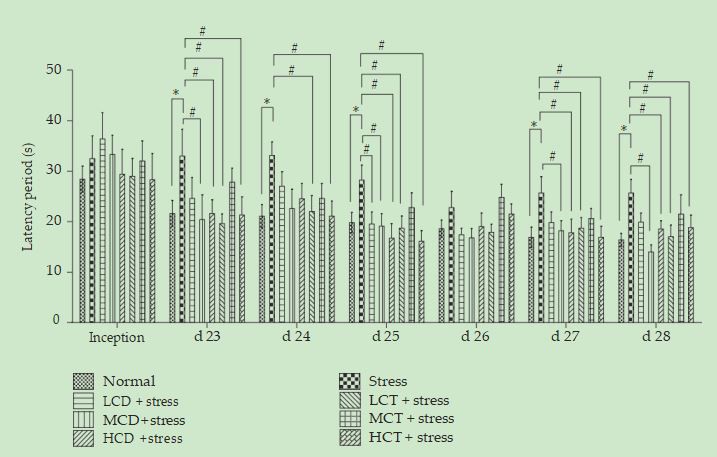
Figure 3: The effect of C. deserticola Y.C.Ma and C. tubulosa decoctions on the space learning and memory capability of the restraint stressed mice. After adaptation, the experimental groups were administered with herb Cistanche decoction by gavage for 21 days and then tested with R. Morris water maze for determination of spatial learning and memory. L, M, and H, respectively, represent low, medium, and high; CD and CT, respectively, represent C. deserticola Y.C.Ma and C. tubulosa decoction. “#” and “∗” each represent P< 0.05 and P < 0.01.
3.5. The Administration of C. deserticola Y.C.Ma and C. tubulosa Decoction Resulted in the Upregulation of Central Dopamine Concentration and the Downregulation of Serum Corticosterone Concentration. The level of DA and NE in the adrenocorticotropic hormone (ACTH), a polypeptide hormone produced and secreted by the anterior pituitary gland, stimulates the secretion of glucocorticosteroid by acting on the adrenal cortex, zona fasciculata [31]; corticosterone, a steroid hormone produced by the cortex of the adrenal glands, is involved in the regulation of the physiological processes such as energy-boosting, immunity reaction, and stress responses [32], so we chose to study the effect of herb decoction on the HPA axis. And ACTH and corticosterone concentration in the serum was measured. After 4 weeks of tail suspension test, the ACTH and corticosterone concentration of the stress group were significantly upregulated (Figure 6). No significant changes were observed in the herb Cistanche decoction treatment groups compared to the stress group (Figure 6(a)). Compared to the stress group, the corticosterone serum concentration of groups treated with moderate, high dosage C. deserticola Y.C.Ma decoction was downregulated significantly; the corticosterone concentration of groups treated with high dosage C. tubulosa was downregulated but not to a significant statistical difference.

Figure 4: Effect of C. deserticola Y.C.Ma and C. tubulosa decoctions on brain neurotransmitter levels of tail suspension stressed mice. After adaptation, the experimental groups were administered with herb Cistanche decoction by gavage for 21 days and then suspended by the tail for 5 min, each group was comprised of 10 mice, and the mice were sacrificed to harvest the brain tissues and used for brain neurotransmitter level measurement. L, M, and H, respectively, represent low, medium, and high; CD and CT, respectively, represent C. deserticola Y.C.Ma and C. tubulosa decoction. P= 10; all the data were represented as mean ± SEM; P< 0.05 was considered as significantly different and was marked as the central nervous system was measured to determine nerve excitability. After 4 weeks of tail suspension test, compared to the stress groups, the DA level of groups treated with moderate dosage C. deserticola Y.C.Ma has upregulated significantly each by 43.5%; the DA level of groups treated with moderate dosage C. tubulosa was upregulated significantly, too. The level of NE was mildly upregulated in the groups treated with a decoction of both herbs compared to the stress groups, and no statistical difference was found. These results might explain the molecular mechanism of the antidepressant effect of the herb Cistanche.
4. Discussion
In this study, the antidepressant activities and improvement of memory and learning of herb Cistanche were defined, which might shed new light on herb Cistanche function and give clues to expanding the therapeutic application range. Previous studies show that herb Cistanche is a multifunctional Chinese drug with biological activities of antiaging, antioxidant, estrogenic, antiosteoporotic, aphrodisiac, and anti-inflammation effects [33]. Herb Cistanche has been recognized as a treatment for kidney deficiency, infertility, and chronic constipation (Pharmacopoeia Committee of China, 2010). Herb Cistanche decoction is composed of volatile oils, nonvolatile phenylethanoid glycosides (PeGs), iridoids, lignans, alditols, oligosaccharides, and polysaccharides. Echinacoside and verbascoside are generally viewed as the main bioactive ingredients [34]. There are four main Cistanche species including C. deserticola Y.C.Ma, C. tubulosa, Cistanche Sinensis G. Beck, and Cistanche salsa var. albiflorashi et al. [35]; we chose C. deserticola Y.C.Ma and C. tubulosa as our model to determine the PeGs content, and C. deserticola Y.C.Ma possessed a higher content of PeGs (Figure 1), which may explain the higher efficacy of C. deserticola Y.C.Ma. The results indicate that the content of the main bioactive ingredients determines the efficacy of the herb Cistanche.

Figure 5: Effect of C. deserticola Y.C.Ma and C. tubulosa decoctions on serum hormone concentrations in hanging stressed mice. After adaptation, the experimental groups were administered with herb Cistanche decoction by gavage for 21 days and then suspended by the tail for 5 min, each group was comprised of 10 mice, and the blood was harvested and used for the determination of serum adrenocorticotrophic hormone (ACTH) and corticosterone (CORT) level. L, M, and H, respectively, represent low, medium, and high; CD and CT, respectively, represent C. deserticola Y.C.Ma and C. tubulosa decoction. P = 10; all the data were represented as mean ± SEM; P < 0.05 were considered as significantly different and was marked as “∗”.
6. Conclusions
Previous studies indicate that herb Cistanche products are beneficial for treating neurodegenerative disorders by upregulating nerve growth factor (NGF) in the hippocampus of mice [36, 37], but no research has been reported on the antidepressant and cognitive learning activities of herb Cistanche in the mammal models. In this study, herb Cistanche decoction was proven to be effective to alleviate the stress level and substantially increase the survival behavior in the tail suspension test (Figure 2) and improve the spatial learning and memory capacity in the water maze model (Figure 3). Lin et al. proved that herb Cistanche improved the olfactory-associated memory in the fruit-fly model [23]; we focused our research on the antidepressant effect and adopted a different animal model; the outcome proved that herb Cistanche improved a variant type of cognitive function, namely, the spatial learning ability in mice. According to the monoamine theory, the stress experience and depression are closely linked to the brain level of monoamine neurotransmitters, such as DA, NE, 5-HT, and epinephrine [38]. And we found that the herb Cistanche decoction could undermine the MAO activity (Figure 4) and augment the central DA concentration (Figure 5(a)). Surprisingly, the central 5-HT concentration was downregulated by herb Cistanche decoction treatment (data not shown), because previous research showed that the reduced central 5-HT activity is associated with depression [39]. Dysregulation of the hypothalamic-pituitary-adrenal axis is frequently associated with depression [40], intervention with the glucocorticoid receptor (GR) system successfully reversed the depressant phenotype in mice [41], and we found that herb Cistanche significantly alleviated the serum concentration of CORT (Figure 6(b)). Modulation of the monoamine system and HPA axis both contributes to the antidepressant effect of herb Cistanche. The echinacoside could cross the blood-brain barrier freely and act upon the central nervous system [42], which may explain why herb Cistanche decoction possessed an antidepressant function. For the first time, we characterized the antidepressant property and its relationship to cognitive improvement activities in the mouse model, and the preliminary mechanism was explored. Still, the mechanism of antidepressant property of Cistanche has not been clarified on the molecular level, and further research is needed to elucidate the comprehensive antidepressant mechanism of herb Cistanche.
Considering that herb Cistanche decoction is a mixture of compounds, there might be multiple ways of herb Cistanche decoction exerting the antidepressant effect and boosting learning ability. Oxidative stress affects many cellular functions of neurons, and the overproduction of reactive oxygen species (ROS) causes cell damage, apoptosis, and death [43]. Echinacoside extracted from the stems of C. salsa exhibits a neuroprotective effect by reducing the production of ROS and mitochondria-mediated apoptosis [44]; acteoside, an extremely strong antioxidative compound, might be partly responsible for the neuroprotective effect [45]. Besides the traditional method of decoction, the application of modern pharmaceutic methods such as controlled release glycoside capsules might boost the effect of herb decoction, because the bioactive ingredients could be digested and degraded by the gastrointestinal tract [37].
In this study, we found that decoctions of C. deserticola Y.C.Ma and C. tubulosa exhibited an antidepressant effect and improved the spatial learning and memory ability in the mouse model, and decoctions of C. deserticola Y.C.Ma and C. tubulosa had a significant impact on the HPA axis; C. deserticola Y.C.Ma showed a stronger pharmacological function. C. deserticola and C. tubulosa might hold the potential of being developed as alternative therapy drugs for depression.

The antidepressant effect of the herb Cistanche
Acknowledgments
This project was supported by grants from National Natural Science Foundation (81503333) and the Science and Technology Support by Project in the Xinjiang Uygur Autonomous Region (China) (200840102-15).
References
[1] R. C. Kessler, K. A. McGonagle, S. Zhao, et al., “Lifetime and 12-month prevalence of DSM-III-R psychiatric disorders in the United States: results from the National Comorbidity Survey,” Archives of General Psychiatry, vol. 51, no. 1, pp. 8–19, 1994.
[2] H. K. Manji, G. J. Moore, G. Rajkowska, and G. Chen, “Neuroplasticity and cellular resilience in mood disorders,” Molecular Psychiatry, vol. 5, no. 6, pp. 578–593, 2000.
[3] J. D. Rosenblat, R. S. McIntyre, G. S. Alves, K. N. Fountoulakis, and A. F. Carvalho, “Beyond monoamines-novel targets for treatment-resistant depression: A comprehensive review,” Current Neuropharmacology, vol. 13, no. 5, pp. 636–655, 2015.
[4] K. Wilson and P. Mottram, “A comparison of side effects of selective serotonin reuptake inhibitors and tricyclic antidepressants in older depressed patients: A meta-analysis,” International Journal of Geriatric Psychiatry, vol. 19, no. 8, pp. 754–762, 2004.
[5] S. Vezmar, B. Miljkovic´, K. Vucˇic´evic´ et al., “Pharmacokinetics and efficacy of fluvoxamine and amitriptyline in depression,” Journal of Pharmacological Sciences, vol. 110, no. 1, pp. 98–104, 2009.
[6] C. H. Halsted, “Dietary supplements and functional foods: 2 sides of a coin?” American Journal of Clinical Nutrition, vol. 77, pp. 1001S–1007S, 2003.
[7] J.-S. Tian, C.-C. Liu, H. Xiang, et al., “Investigation on the antidepressant effect of sea buckthorn seed oil through the GC- MS-based metabolomics approach coupled with multivariate analysis,” Food and Function, vol. 6, no. 11, pp. 3585–3592, 2015.
[8] Y. Hou, M. A. Aboukhatwa, D.-L. Lei, K. Manaye, I. Khan, and Y. Luo, “Anti-depressant natural flavonols modulate BDNF and beta-amyloid in neurons and hippocampus of double TgAD mice,” Neuropharmacology, vol. 58, no. 6, pp. 911–920, 2010.
[9] J. Wattanathorn, P. Chonpathompikunlert, S. Muchimapura, A. Priprem, and O. Tankamnerdthai, “Piperine, the potential functional food for mood and cognitive disorders,” Food and Chemical Toxicology, vol. 46, no. 9, pp. 3106–3110, 2008.
[10] M. Shirai, Y. Kawai, R. Yamanishi, and J. Terao, “Approach to novel functional foods for stress control 5. Antioxidant activity profiles of antidepressant herbs and their active components,” Journal of Medical Investigation, vol. 52, pp. 249–251, 2005.
[11] P. S. Kumar, T. Praveen, N. P. Jain, and B. Jitendra, “A review on Griffonia simpliciyollian ideal herbal anti-depressant,” International Journal of Pharmacy & Life Sciences, 2010.
[12] Z.-L. Jin, N. Gao, W. Xu et al., “Receptor and transporter binding and activity profiles of albiflorin extracted from Radix Paeonia Alba,” Scientific Reports, vol. 6, Article ID 33793, 2016.
[13] S.-H. Lin, M.-L. Chou, W.-C. Chen et al., “A medicinal herb, Melissa officinalis L. ameliorates depressive-like behavior of rats in the forced swimming test via regulating the serotonergic neurotransmitter,” Journal of Ethnopharmacology, vol. 175, article no. 9741, pp. 266–272, 2015.
[14] H. Shimoda, J. Tanaka, Y. Takahara, K. Takemoto, S.-J. Shan, and M.-H. Su, “The hypocholesterolemic effects of Cistanche tubulosa extract, a Chinese traditional crude medicine, in mice,” American Journal of Chinese Medicine, vol. 37, no. 6, pp. 1125– 1138, 2009.
[15] L. I. Xia, M. A. Yong-Qing, Y. X. Song, J. F. Shui, and L. I. Xiu-Wei, “Effect of different plant growth regulators on transplanting survival ratio of haloxyfop ammodendron seedling and the parasitic ratio of cistanche deserticola,” Journal of Chinese Medicinal Materials, vol. 32, pp. 1651–1654, 2009.
[16] Q. Xiong, S. Kadota, T. Tani, and T. Namba, “Antioxidative effects of phenylethanoids from Cistanche deserticola,” Biological and Pharmaceutical Bulletin, vol. 19, no. 12, pp. 1580–1585, 1996.
[17] Y. Wu, L. Li, T. Wen, and Y.-Q. Li, “Protective effects of echinacoside on carbon tetrachloride-induced hepatotoxicity in rats,” Toxicology, vol. 232, no. 1-2, pp. 50–56, 2007.
[18] T. Wang, C. Chen, M. Yang, B. Deng, G. M. Kirby, and X. Zhang, “Cistanche tubulosa ethanol extract mediates rat sex hormone levels by induction of testicular steroidogenic enzymes,” Pharmaceutical Biology, vol. 54, no. 3, pp. 481–487, 2016.
[19] L. Gu, W. T. Xiong, Y. L. Zhuang, J. S. Zhang, and X. Liu, “Effects of Cistanche deserticola extract on penis erectile response in castrated rats,” Pakistan Journal of Pharmaceutical Sciences, vol. 29, no. 2, pp. 557–562, 2016.
[20] S. G. Lin, S. F. Ye, J. M. Huang, et al., “How do Chinese medicines that tonify the kidney inhibit dopaminergic neuron apoptosis?” Neural Regeneration Research, vol. 8, no. 30, pp. 2820–2826, 2013.
[21] C.-R. Wu, H.-C. Lin, and M.-H. Su, “Reversal by aqueous extracts of Cistanche tubulosa from behavioral deficits in Alzheimer’s disease-like rat model: relevance for amyloid deposition and central neurotransmitter function,” BMC Complementary and Alternative Medicine, vol. 14, pp. 1–11, 2014.
[22] D. R. Lara, L. W. Bisol, and L. R. Munari, “Antidepressant, mood-stabilizing and procognitive effects of very low dose sublingual ketamine in refractory unipolar and bipolar depression,” International Journal of Neuropsychopharmacology, vol. 16, no. 9, pp. 2111–2117, 2013.

Effects of cistanche extract: anti-depression


