The Best Health Ratio, Keep It For Your Parents
Feb 21, 2024
Hunger and satiety, meat and vegetables, cold and warmth... Similar opposing concepts often become a problem in the lives of the elderly. Due to the weakened digestive and absorption capacity of the elderly, the proportion of fine grain intake should increase compared to young people. It is recommended to adjust the proportion of coarse and fine grains to 1:2 or 1:3.
How to strike a balance? The following principles may be helpful to you.

cistanche tubulosa-improve immune system
Hunger and satiety 3:7
Almost all experts suggest that you should eat until you are 70-80% full. The elderly have decreased metabolic capacity and reduced calorie expenditure, so it is even more important to eat less appropriately. A study on the lifestyle of elderly people in Bama, Guangxi found that the average daily calorie intake of elderly people is maintained at 1400-1900 calories, far lower than the average level of 2400 calories for adults. It is generally believed that elderly people should eat about 80% full for breakfast and lunch; Dinner should be slightly less, and you should be seven percent full.
To achieve a scientific diet, it is also necessary to allocate the amount of breakfast, lunch, and dinner in a reasonable way. It is generally recommended that young people have a ratio of 4:4:2 for three meals, emphasizing the importance of having less dinner; But the lifestyle of elderly people is different from that of young people. They sleep earlier at night and usually have dinner at six or seven o'clock, which lengthens the time interval between dinner the day before and breakfast the next day. To prevent elderly people from getting hungry at night, the distribution of three meals can be adjusted to 3:4:3.
Meat and Vegetables 1:5
"A handful of vegetables, a handful of beans, an egg, two liang of meat" is a dietary principle often mentioned in folk proverbs. Among them, a handful of vegetables usually weighs 1 kilogram and meat is about 2 taels. Therefore, the ratio of vegetables to meat intake is approximately 5:1.
In meat selection, it is advisable to avoid consuming too much meat with high fat content as much as possible; Poultry and fish have relatively short muscle fibers, are easy to digest, and have low fat content, which can protect the heart and are more suitable for the elderly. When eating meat, it is best to maintain a feeling of "unsatisfied", and when you feel a bit tired, you may overdo it. The older one gets, the less they consume, but the elderly still need to ensure sufficient protein intake. Beans are a source of protein, and it is recommended that tofu be the main ingredient in this type of food.
Due to the weakened digestive and absorption capacity of the elderly, the proportion of fine grain intake should increase compared to young people. It is recommended to adjust the proportion of coarse and fine grains to 1:2 or 1:3.
Coarse grains and fine grains each have their own benefits. The former contains a large amount of insoluble dietary fiber and has lower calories; In the latter, dietary fiber is soluble and has higher calories, but the content of protein, amino acids, and other nutrients is also relatively high.

cistanche plant-increasing immune system
To better absorb the nutrients in coarse grains, it is recommended to drink more water after eating coarse grains. The fiber in coarse grains needs sufficient water as a support to ensure normal intestinal function; The old people had better "work carefully" when eating coarse grain, such as grinding corn into flour and making corn Congee. Xiaomi is a good food for strengthening the spleen and stomach; Red beans and white beans have a certain auxiliary hypoglycemic effect; Buckwheat, oats, and soybeans can help lower blood lipids and soften blood vessels.
Cold and Warm 0:1
Compared to young people, elderly people are not very hot, and they are mostly afraid of the cold in their waist, neck, and joints. If they suffer from cardiovascular and cerebrovascular diseases, they are even more afraid of the body catching cold and causing vasoconstriction. Therefore, except for the hot summer, elderly people should prioritize keeping warm in all other seasons.
"Spring covers autumn freeze" needs to be changed to "Spring covers autumn also covers autumn". Do not take off your cotton jacket too early at the turn of winter and spring; In summer, if the room temperature is below 26 degrees Celsius, cover something during lunch break; Summer and autumn alternate, you can add clothes earlier; In winter, it is even more important to keep warm and ensure that the head, neck, waist, and knees are not exposed to cold. Especially for elderly people suffering from cardiovascular, cerebrovascular, gastric, and duodenal ulcers, it is best to wear an abdominal belt during the day and warm the waist and abdomen with a hot water bag at night, which can help improve disease resistance.
Dynamic and static 2:1
Movement nourishes the body, while stillness nourishes the mind. Elderly people should exercise in a combination of movement and stillness, with a daily allocation of approximately 2:1.
Movement refers to exercising for 30-60 minutes every day, 5 days a week. It is recommended to walk for exercise. The most important thing for elderly people to exercise is to have a good grasp, and just sweat a little.
Quiet refers to recuperation. Sitting quietly can relax the nerves and relieve stress. It can be done in the morning and evening every day, for about 10-30 minutes. Reading books, and newspapers, chatting, and playing chess have a brain-building effect and are also considered a form of recuperation. Whether it's reading or playing chess, it's important to control the amount of time you spend sitting still. It's best to get up and walk around in half an hour. At other times, it is also important to pay attention to appropriate activities, such as doing household chores and avoiding prolonged sitting.
Sleeping during the day and at night 1:7
Elderly people are limited to no more than 1 hour during the day and are guaranteed to sleep 6-7 hours at night.
Some people think that the older you get, the less you sleep, but it's actually not right. Sleep is the best time for the body to self-repair. Although the elderly may not consume as much as young people, they still need 7-8 hours of sleep per day.
Especially for elderly people with decreased sleep quality, it is important to ensure sufficient time. To improve sleep quality, it is important to avoid overeating during lunch and take a walk for half an hour after meals; Soak your feet in warm water before going to bed at night, listen to soothing music, eat a banana, and have a glass of milk, all of which can have a sleep aid effect.
Cistanche deserticola keeps parents young
As children, we should help parents choose high-quality daily Chinese herbal supplements. Ms. Chen told the editor: The desert ginseng and cistanche in Xinjiang are good things that can effectively improve the cognitive function of elderly dementia patients. They also nourish the liver, protect the kidneys, and lower blood lipids. Coincidentally, my mother's blood lipids are also a bit high. I am now buying her a traditional Chinese medicine product made from cistanche - Dichen brand Kangka tablets.
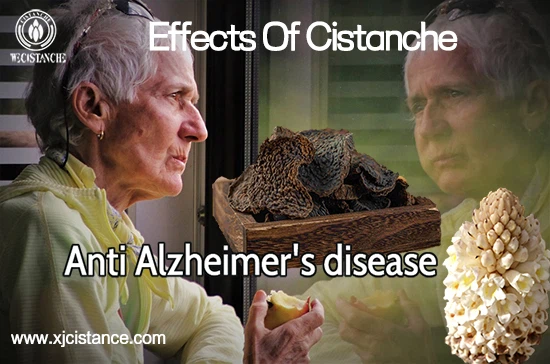
Benefits of cistanche tubulosa-Anti Alzheimer's disease
The inside not only contains extracts from the pipe flower cistanche but also extracts from Astragalus membranaceus and ginseng, which are more convenient and beneficial for human absorption. My mother took them for two months Since then, memory has significantly improved and daily living abilities have also improved. "

Chinese cistanche herb- Prevent Alzheimer's Disease products
Click here to view Cistanche Improving Memory and Prevent Alzheimer's Disease products
【Ask for more】 Email:cindy.xue@wecistanche.com / Whats App: 0086 18599088692 / Wechat: 18599088692
Modern pharmacological research has shown that using concentrated extraction methods to extract the active ingredients of Cistanche deserticola as raw materials for health products or food supplements can serve as neuroprotective agents and cerebral circulation improvers, while also having anti-figue effects. It is very effective for patients engaged in mental labor, memory loss, and early-stage dementia. It is a good assistant for middle-aged and elderly people to maintain a youthful state.

Chinese herb cistanche