The Effect Of Transportation Duration On Lying Behavior in Young Surplus Dairy Calves Part 1
Aug 29, 2023
ABSTRACT
Surplus dairy calves are commonly transported long distances from dairy farms to calf-raising facilities and livestock auctions. Current calf transportation research mainly describes physiological changes resulting from transportation. However, few studies have described the impact of transportation on calf behavior. The main objective of this study was to determine the effect of different durations of transportation (6, 12, and 16 h) on lying time and bouts in surplus dairy calves. A secondary objective of this study was to investigate if calf age affected lying behavior around transportation. Surplus dairy calves (n = 175) were transported in 7 cohorts from 5 commercial dairy farms in Ontario to a single veal facility. On the day of transportation (d 0), calves were randomly assigned to one of 3 treatment groups: 1) 6 h (n = 60), 2) 12 h (n = 58), and 3) 16 h (n = 57) of continuous transportation by road. Calf lying and standing behavior was recorded using HOBO data loggers. Daily lying time (h/d) and bouts (no./d) were assessed from −1 to 3 d relative to transportation. The total time spent lying during transportation was assessed as the percentage of time lying (min lying/ total min on the trailer × 100) from the time each calf was loaded onto the trailer until the time each calf was unloaded at the veal facility (n = 167). On the day of transportation (d 0), calves transported for 12 and 16 h spent less time lying (6 h: 17.1 h/d; 12 h: 15.9 h/d; 16 h: 15.0 h/d) and had more lying bouts (6 h: 21.9 bouts/d; 12 h: 25.8 bouts/d; 16 h: 29.8 bouts/d) compared with those transported for 6 h. On the day after transportation (d 1), calves transported for 16 h spent more time lying down than calves transported for 6 h (19.9 h/d vs. 18.8 h/d, respectively). In addition, during transportation, calves transported for 12 h and 16 h spent 5.8% and 7.6% more time lying down, respectively, than calves transported for 6 h. On each day relative to transportation (d −1 to 3), younger calves (2 d to 5 d) spent a greater amount of time lying down than older calves (6 d to 19 d) and, overall, had a greater number of lying bouts. The results of this study suggest that longer durations of transportation have an impact on the lying behavior of surplus dairy calves resulting in more fatigue during and after the journey, and therefore, potentially have negative implications on calf welfare. Additionally, longer durations of transportation may be more impactful on younger calves than older calves.
Cistanche can act as an anti-fatigue and stamina enhancer, and experimental studies have shown that the decoction of Cistanche tubulosa could effectively protect the liver hepatocytes and endothelial cells damaged in weight-bearing swimming mice, upregulate the expression of NOS3, and promote hepatic glycogen synthesis, thus exerting anti-fatigue efficacy. Phenylethanoid glycoside-rich Cistanche tubulosa extract could significantly reduce the serum creatine kinase, lactate dehydrogenase, and lactate levels, and increase the hemoglobin (HB) and glucose levels in ICR mice, and this could play an anti-fatigue role by decreasing the muscle damage and delaying the lactic acid enrichment for energy storage in mice. Compound Cistanche Tubulosa Tablets significantly prolonged the weight-bearing swimming time, increased the hepatic glycogen reserve, and decreased the serum urea level after exercise in mice, showing its anti-fatigue effect. The decoction of Cistanchis can improve endurance and accelerate the elimination of fatigue in exercising mice, and can also reduce the elevation of serum creatine kinase after load exercise and keep the ultrastructure of skeletal muscle of mice normal after exercise, which indicates that it has the effects of enhancing physical strength and anti-fatigue. Cistanchis also significantly prolonged the survival time of nitrite-poisoned mice and enhanced the tolerance against hypoxia and fatigue.

Click on Tired
【For more info:george.deng@wecistanche.com / WhatApp:8613632399501】
INTRODUCTION
‘Surplus dairy calf’ is a term for calves born on dairy farms that are undesirable as milking herd replacements. These calves can be transported up to 1,300 km from dairy farms to calf-raising facilities (reviewed by Creutzinger et al., 2021) to be reared for veal or dairy beef at 3 to 7 d of age (reviewed by Roadknight et al., 2021; Wilson et al., 2020). There are several factors related to transportation that can impact a calf’s behavior and activity. For example, during transportation, calves experience feed and water withdrawal which can potentially lead to hunger (reviewed by Roadknight et al., 2021) and dehydration (Knowles et al., 1997). Inadequate space allowance due to high stocking densities is also a common issue that dairy calves experience during transportation and can reduce their ability to lie down and rest (Jongman and Butler, 2014). Bedding and flooring material can also impact the amount of time calves spend lying down during transportation and may contribute to calves experiencing more fatigue (Jongman and Butler, 2014. Additionally, the commingling of calves from different source farms can increase pathogen transmission and lead to greater disease challenges after arrival to calf-raisers (Taylor et al., 2010). These stressors associated with transportation may result in compromised health and welfare and contribute to higher morbidity and mortality rates after arrival at the calf-raising facility (Cave et al., 2008; Goetz et al., 2023a,b).
Current calf transportation research mainly describes the physiological changes of young calves and limited studies have investigated the impact of transportation on calf behavior (Goetz et al., 2021). One behavior that is likely affected by transportation is the amount of time calves can spend lying down. Typically, young calves spend the majority of their time lying down throughout the day. For example, 7.5 d old calves housed in groups or individually spend an average of 16.9 h/d and 17.2 h/d lying down, respectively (Wormsbecher et al., 2017). However, during transportation, calves are exposed to multiple stressors, such as novel environments, commingling with new and unfamiliar animals, and braking and turning during driving (Trunkfield and Broom, 1990; reviewed by Creutzinger et al., 2021), all of which can potentially reduce lying time. Jongman and Butler (2014) found that, when given 0.5 m2 of space during a 12 h journey, 3 to 10 d old Holstein calves laid down for up to 70% of the trip. Jongman and Butler (2014) also found a relationship between calf age and lying time; 3 d old Holstein calves spent more time lying down during 12 hours of transportation and in the 12 hours afterward compared with 5 and 10-year-old Holstein calves. Few studies have investigated the relationship between lying time and transportation for young dairy calves and, to our knowledge, none have had the main objective of investigating the effect of varying durations of transportation on calf lying behavior. To understand the impact of transportation on calf welfare, further research is needed.
The main objective of this study was to determine the effect of different durations of transportation (6, 12, and 16 h) on lying time and lying bouts of young surplus dairy calves on the day of and days following transportation from dairy farms to a veal facility. A secondary objective of this study was to investigate if calf age is associated with lying behavior around transportation. We hypothesized that calves transported for 16 h would lay down less and have more lying bouts on the day of transportation (d 0) than calves transported for 6 h as more time spent in the trailer could increase fatigue. Additionally, trailer stops, starts, and turns may disrupt lying in calves, thereby increasing the number of lying bouts. Additionally, we hypothesized that younger calves would spend more time lying down and have fewer lying bouts in the days following transportation.
MATERIALS AND METHODS
Experimental design
This project was part of a larger study investigating the impact of transportation duration on the physiological and health outcomes of dairy calves (Goetz et al., 2023a,b). The University of Guelph Animal Care Committee approved animal use for this project (Animal Use Protocol #4430). The sample size for this study was calculated based on physiological and health outcomes, not lying behavior (Goetz et al., 2023a,b), however, we anticipate that the sample size is larger than what would be required based on similar studies (Fisher et al., 2014; Knowles et al., 1997). A total of 175 male (n = 150) and female (n = 25) surplus calves were enrolled in the study. Both Holstein (n = 57) and dairy-beef cross calves (n = 116) were included in the study. Calves from 5 dairy farms in southern Ontario, within 50 km of the University of Guelph were enrolled at birth over a 2 wk period leading up to the day of transportation. Between 24 to 48 hours after birth, a blood sample was collected via jugular venipuncture to assess serum total protein to determine the passive transfer of immunity. Blood was allowed to clot and then centrifuged for 15 min at 1,500 x g. The serum was separated and frozen at −20°C. Radial immunodiffusion was performed by Saskatoon Colostrum Company (Saskatoon, SK, CAN) for additional parameters. Daily health exams were conducted from birth until transportation for navel health, fecal consistency, and the presence of respiratory disease (explained in companion papers by Goetz et al., 2023a,b).

Seven cohorts of calves were transported from October 2020 to June 2021. Multiple drivers were responsible for the 16-hour duration of transportation; however, the same cattle transportation company was responsible for driving the truck for all cohorts. For each cohort of calves, a random allocation sequence generated in Microsoft Excel (Microsoft Corp., Redmond, WA) was used to randomly assign calves to one of 3 treatments on the day of transportation: 1) 6 h (n = 60), 2) 12 h (n = 58), and 3) 16 h (n = 57) of continuous transportation by road. Calves were blocked by the farm and assigned to the sequence from youngest to oldest. Researchers were not blinded to the treatment allocation however, the veal producer responsible for feeding and disease management was blinded.
Calves in all treatments were loaded onto a single gooseneck trailer from each dairy farm between 5:50 a.m. and 8:45 a.m. The trailer was disinfected before transportation and deeply bedded with clean, chopped straw. The trailer was 20.9 m2 (9.1 m long by 2.3 m wide) and had a maximum capacity of 40 calves. Calves were dropped off at the veal facility in cohorts from different farms based on the transportation duration that they were assigned. A consistent space allowance was maintained by moving a sliding wall within the trailer at each drop-off point. Each cohort began with 20 calves or less so, the partition was moved to the middle of the trailer (10.47 m2 interior trailer space). Space allowance throughout the study ranged from 0.52 m2 to 0.91 m2 per calf. At the veal facility, calves were housed individually in outdoor hutches. In the hour after unloading, calves were health checked, weighed, and blood sampled (explained in detail in another paper: Goetz et al., 2023a,b). Additionally, calves transported for 12 h and 16 h were fed 2 L of milk replacer by researchers within the hour after unloading. Calves transported for 6 h were fed 2 L of milk replacer by the veal producer approximately 4 h after unloading.
Data collection
Calf lying and standing behavior was recorded using HOBO data loggers (Hobo Pendant G Acceleration Data Logger, Onset Computer Corporation; validated by Ledgerwood et al., 2010). Researchers attached a HOBO data logger to each calf’s medial hind left or right leg using Vet Wrap (Co-Flex, Andover Coated Products Inc., Maplewood, MN) 2 d before transportation and removed the loggers 4 d after transportation. The data loggers recorded the g-forces of the y-axis at 1-minute intervals from attachment to removal.
Data summarization
Lying time (min/h) and lying bouts (no./h) during the first 24 h after loading, daily lying time (h/d), and several lying bouts (no./d) were summarized for each calf using the cut point reported by Ledgerwood et al. (2010) and a modified SAS algorithm (UBC Animal Welfare Program, 2013). Hour relative to loading was set by the time calves were loaded onto the trailer; hour 1 began when each calf was loaded onto the trailer. The 24-hour time after loading was unique to the transportation cohort and dairy farm of birth. For daily variables, ‘day’ was defined as 05:00 a.m. on one day to 04:59 a.m. on the following day. Throughout the study, calves were loaded onto the trailer no earlier than 05:00 a.m. and arrived at the veal farm no later than 03:00 a.m. the following day. Defining ‘day’ from 05:00 a.m. to 04:59 a.m. on the following day allowed all transportation activity to be recorded within one 24-hour period. The total time spent lying during transportation was assessed as the percentage of time lying (min lying/total min on the trailer × 100) from the time each calf was loaded onto the trailer until the time each calf was unloaded at the veal facility (n = 167). Eight calves were excluded due to malfunctions with the data loggers (n = 3), missing data (n = 4), and lack of fitness during transportation (n = 1; described in Goetz et al., 2023a,b).

Statistical Analysis
Data were imported from Microsoft Excel (Microsoft Corp., Redmond, WA) into Stata 17 (StataCorp LP, College Station, TX) for statistical analyses. In each analysis, the calf was the experimental unit. Univariable analyses were conducted between outcome variables and each predictor variable. From the time calves began to be unloaded from the trailer (during the unloading of the group transported for 6 h), the environment of calves was different (i.e., at the veal facility or on the trailer) depending on the treatment. The environment was a confounding factor to hourly lying time and bouts; as such, differences in lying behavior between treatments could not be statistically analyzed. Thus, lying time and lying bouts in the first 24 hours after loading were assessed visually for descriptive purposes using a line graph generated in Stata 17 (StataCorp LP, College Station, TX) imported from Microsoft Excel (Microsoft Corp., Redmond, WA).
To determine the effect of transportation duration on lying behavior, outcome variables included daily lying time relative to transportation (d −1 to d 3), daily lying bouts relative to transportation (d −1 to d 3), and percentage of lying time during transportation. Predictor variables included transportation duration (6 h, 12 h, 16 h), transportation cohort (1–7), dairy farm of birth, age on the day of transportation (2 to 19 d), sex (male or female), breed (dairy-beef or Holstein), weight before loading on the day of transportation (kg), serum total protein concentration (g/dL), presence or absence of diarrhea on each day relative to loading, presence or absence of respiratory disease before loading on each day relative to loading, and number of diseases present on each day relative to loading (no disease present, 1 disease present, or 2 diseases present) (described in Goetz et al. 2023a,b). In each model, age was categorized into quartiles to assess the relationship between calf age and lying behavior. Predictor variables with P < 0.2 were included for assessment in the multivariable model. The assumption of independence was evaluated using Spearman Rank coefficients for each of the variables and determined to be fulfilled if values were less than 0.7. Stepwise backward elimination was used to build the final models, where variables with P < 0.05 were included in the final models. Hypothesis-driven comparisons were performed; 12 and 16 h of transportation were compared with 6 h, which was set as the referent in all models. Concerning age at transport, calves transported at 6 to 10 d old, 11 to 13 d old, and 14 to 19 d old were compared with those transported at 2 to 5 d old, which was set as the referent.
A repeated measures mixed linear regression model was created to identify factors associated with daily lying time (h/d). In the final model, transportation cohort, dairy farm of birth, transportation duration, age, and the interaction between day relative to transportation (d −1 to d 3) were included as fixed effects; calf was included as a random effect, and day relative to transportation was included a repeated measure (d −1 to d 3). Another repeated measures mixed linear regression model was created to assess daily lying bouts (no./d). In the final model, day relative to transportation (d −1 to d 3) was included as the repeated measure; transportation cohort, dairy farm of birth, transportation duration, breed, age, presence or absence of respiratory disease, and the interaction between day relative to transportation and transportation duration were included as fixed effects, with calf included as a random effect. Finally, a mixed linear regression model was created to investigate the percentage of time that calves spent lying during transportation. In the final model, farm, transportation duration, and age were included as fixed effects, with the transportation cohort being included as a random effect. The normality of residuals was evaluated for each of the models visually using residual plots. Statistical significance was declared at P < 0.05. To account for Type I error, a Bonferroni adjustment was made for each repeated measures model.
RESULTS
Descriptive Results
A total of 167 calves (6 h = 55, 12 h = 58, 16 h = 54) were included in the lying behavior analysis before, during, and after transportation. The median age of calves at loading was 11 d (range 2 to 19 d) with 47 calves (27%) transported at less than 1 week old. Twenty-seven percent of calves were 2 to 5 years old, 32.2% of calves were 6 to 10 years old, 17.5% of calves were 11 to 13 years old, and 23.3% of calves were 14 to 19 years old. Calf sex (P = 0.71), breed (P = 0.87), and calf age (P = 0.79) were not statistically different across treatment groups.

Hourly Lying Behavior
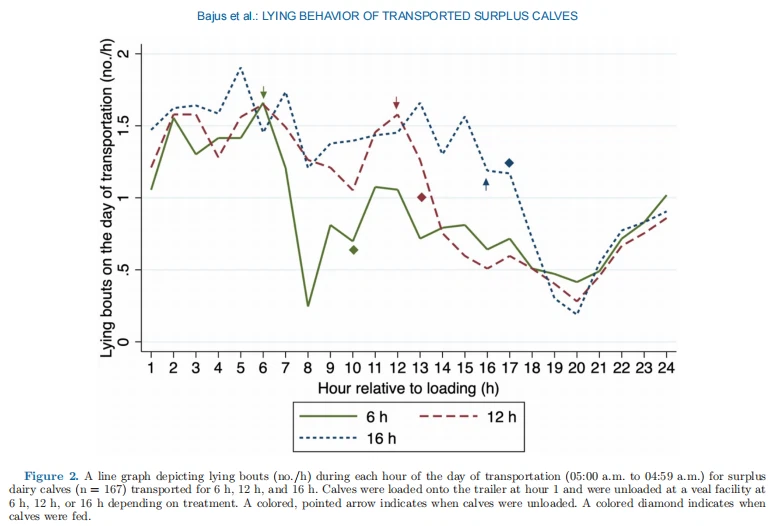
Immediately after loading, hourly lying time for all treatment groups seemed to increase steadily (Figure 1). In the hour after unloading for the 6 h treatment, (6 to 7 h), lying time slightly decreased before sharply increasing from h 7 to 8 and then decreasing again. In the hour after unloading for the 12 h treatment (12 to 13 h) and for the 16 h treatment (16 to 17 h), lying time decreased before beginning to increase again at the next hour. During transportation, lying bouts for all treatment groups ranged between 1 to 2 bouts per hour (Figure 2). Calves transported for 6 h and 12 h showed a sharp decline in the number of lying bouts after unloading. The number of lying bouts for calves transported for 16 h stayed consistent until a decline approximately 1 h after unloading. Around feeding (10 h for the 6 h treatment; 13 h for the 12 h treatment; 17 h for the 16 h treatment), the calves transported for 6 h showed an increase in lying bouts while lying bouts for the calves transported for 12 h and 16 h continuously decreased.
Daily lying time
There was an interaction between treatment and day relative to transportation for daily lying time (P < 0.01). On the day of transportation (d 0), calves transported for 16 h spent 2.0 h less lying down than calves transported for 6 h (P < 0.01, 95% CI: −2.8 to −1.3; Figure 3) and calves transported for 12 h spent 1.2 h less lying down than calves transported for 6 h (P < 0.01, 95% CI: −2.0 to −0.4). On the day after transportation (d 1), calves transported for 16 h spent 1.1 h more lying than calves that were transported for 6 h (P < 0.01, 95% CI: −0.3 to 1.8). Daily lying time was not different between treatments on d 2 and d 3 after transportation.
Daily lying bouts
There was an interaction between treatment and day relative to transportation on daily lying bouts (P < 0.01). On the day of transportation (d 0), calves that were transported for 16 h had 7.9 more lying bouts than calves transported for 6 h (P < 0.01, 95% CI: 5.5 to 10.4) and calves transported for 12 h had 3.8 more lying bouts than calves transported for 6 h (P < 0.01, 95% CI: 1.4 to 6.2; Figure 4). On the day before transportation (d −1) and the days after transportation (d 1 – 3), daily lying bouts were not affected by treatment.
Percentage of lying time during transportation
The percentage of time spent lying down (%) during transportation was positively associated with transportation duration (P < 0.01). Calves transported for 16 h spent a greater percentage of time lying than calves transported for 6 h (D = +7.6%; P < 0.01, 95% CI: 3.7 to 11.4%). Calves transported for 12 h also spent a greater percentage of time lying down than calves transported for 6 h (D = +5.8%; P < 0.01, 95% CI: 1.9 to 9.7%, Figure 5).
Calf age and daily lying time
There was an interaction between calf age and day relative to transportation on daily lying time (P < 0.001). On the day before transportation (d −1), 2 to 5 d old calves spent 1.2 h more lying than 6 to 10 d old calves (P < 0.01, 95% CI: −2.1 to −0.3; Figure 6), 1.2 h more lying down than 11 to 13 d old calves (P = 0.01, 95% CI: −1.9 to −0.2), and 2.1 h more lying down than 14 to 19 d old calves (P < 0.01, 95% CI: −3.1 to −1.1). On the day of transportation (d 0), 2 to 5 d old calves spent 1.6 h more lying down than 6 to 10 d old calves (P < 0.01, 95% CI: −2.5 to −0.8), 2.2 h more lying down than 11 to 13 d old calves (P < 0.01, 95% CI: −3.2 to −1.2), and 2.8 h more lying down than 14 to 19 d old calves (P < 0.01, 95% CI: −3.8 to −1.9). On the day after transportation (d 1), 2 to 5 d old calves spent 0.9 h more lying down than calves 6 to 10 d old (P < 0.01, 95% CI: −1.4 to −0.3), 1.4 h more lying down than 11 to 13 d old calves (P < 0.01, 95% CI: −2.1 to −0.7) and 1.8 h more lying down than 14 to 19 d old calves (P < 0.01, 95% CI: −3.2 to −1.2). Two days after transportation (d 2), 2 to 5 d old calves spent 1.1 h more lying down than 6 to 10 d old calves (P < 0.01, 95% CI: −2.0 to −0.2), 1.9 h more lying down than 11 to 13 d old calves (P < 0.01, 95% CI: −2.9 to −0.8), and 2.2 h more lying down than 14 to 19 d old calves (P < 0.01, 95% CI: −2.8 to −1.5). Three days after transportation (d 3), 2 to 5 d old calves spent 1.4 h more lying down than 6 to 10 d old calves (P < 0.01, 95% CI: −2.3 to −0.5), 1.8 h more lying down than 11 to 13 d old calves (P < 0.01, 95% CI: −2.9 to −0.8), and 1.9 h more lying down than 14 to 19 d old calves (P < 0.01, 95% CI: −2.9 to −1.0).
Calf age and daily lying bouts
Age had a significant relationship with the number of daily lying bouts (P = 0.01). Overall, calves aged 2 to 5 d old had more daily lying bouts than 11 to 13 d old calves (D = +2.5; P = 0.02; 95% CI: −4.7 to −0.38) and 14 to 19 d old calves (D = +2.2; P = 0.04; 95% CI: −4.2 to −0.2).

Calf age and percentage of time lying down during transportation
Calf age was associated with the percentage of time spent lying down during transportation (P < 0.01). Specifically, 2 to 5 d old calves spent more time lying down during transportation than 6 to 10 d old calves (+10.1%; P < 0.01, 95% CI: −14.3 to −5.9), 11 to 13 d old calves (D = +16.4%; P < 0.01, 95% CI: −21.5 to −11.4), and 14 to 19 d old calves (D = +18.9%; P < 0.01, 95% CI: −23.6 to −14.3).
【For more info:george.deng@wecistanche.com / WhatApp:8613632399501】