Post-COVID Interstitial Lung Disease And Other Lung Sequelae Part 2
Aug 28, 2023
Hospitalized Patients
PASC affects people along the entire disease spectrum—from minimal/mild symptoms to critical illness. Among hospitalized patients, a telephone interview of 488 survivors, 60 days after symptom onset, found that 32% had persistent symptoms defined as a conglomerate of shortness of breath, cough, chest tightness, wheezing, difficulty ambulating, breathlessness with stairs, oxygen use, and continuous positive airway pressure (CPAP) use, with only 16% being able to return to work.67 Another survey of 143 hospitalized patients performed at 60 days after initial diagnosis found that 87% had at least one persistent symptom and 55% had three or more; only 12% stated that they were completely free of symptoms.68 Halpin and colleagues69 performed a crosssectional evaluation of 100 hospitalized patients at 4 to 8 weeks post-symptom onset; 70% continued to experience fatigue and 50% endorsed dyspnea. Huang and colleagues performed an analysis of 17 different symptoms in 1733 hospitalized patients at 6 months postadmission, dividing the cohort into severity scales; 76% of the total cohort had at least one symptom, and symptom burden increased with severity of illness. Muscle weakness (63%), sleeping difficulties (26%), and anxiety or depression (23%) were the most common reported symptoms. Of note, 23% of the patients had a decreased age-adjusted 6MWD and diffusion defects which correlated with illness severity.
Cistanche can act as an anti-fatigue and stamina enhancer, and experimental studies have shown that the decoction of Cistanche tubulosa could effectively protect the liver hepatocytes and endothelial cells damaged in weight-bearing swimming mice, upregulate the expression of NOS3, and promote hepatic glycogen synthesis, thus exerting anti-fatigue efficacy. Phenylethanoid glycoside-rich Cistanche tubulosa extract could significantly reduce the serum creatine kinase, lactate dehydrogenase, and lactate levels, and increase the hemoglobin (HB) and glucose levels in ICR mice, and this could play an anti-fatigue role by decreasing the muscle damage and delaying the lactic acid enrichment for energy storage in mice. Compound Cistanche Tubulosa Tablets significantly prolonged the weight-bearing swimming time, increased the hepatic glycogen reserve, and decreased the serum urea level after exercise in mice, showing its anti-fatigue effect. The decoction of Cistanchis can improve endurance and accelerate the elimination of fatigue in exercising mice, and can also reduce the elevation of serum creatine kinase after load exercise and keep the ultrastructure of skeletal muscle of mice normal after exercise, which indicates that it has the effects of enhancing physical strength and anti-fatigue. Cistanchis also significantly prolonged the survival time of nitrite-poisoned mice and enhanced the tolerance against hypoxia and fatigue.

Click on Covid Fatigue
【For more info:george.deng@wecistanche.com / WhatApp:8613632399501】
Nonhospitalized Patients
Similar observations have been made in non-hospitalized patients. Jacobsen and colleagues found that in a survey of 118 patients (96 outpatients), symptom burden was statistically similar between inpatient versus outpatient status and 67% of patients continued to experience symptoms, including a mean 6MWD of 59% of expected. Likewise, at a median follow-up of 169 days Logue and colleagues72 found a similar burden of persistence of at least one symptom (33 vs. 31%) in outpatients versus inpatients, respectively. Patients are also more likely to use health system resources including outpatient primary care and outpatient hospital visits.73
Risk Factors
The risk factors for PASC remain unknown, and data remain discordant. Wynberg and colleagues74 found that female gender (adjusted hazard ratio [aHR] 0.65, CI 0.47–0.92) and body mass index (BMI) greater than 30 (aHR 0.62 CI 0.39–0.97) were associated with slower recovery and symptoms beyond 6 months correlated with decreased chance of resolution. A large study of 2,149 healthcare professionals identified 323 participants who had no or mild symptoms and were found to be seropositive; 83% were women and 15% reported at least one persistent symptom at 8 months, as compared with seronegative participants (relative risk [RR] 4.4 [95 CI, 2.9–6.7]), causing significant disruption in work life, home life, and in any Sheehan Disability Scale category.75 Among patients who survived hospitalization, the presence of ICU admission, need for respiratory support, premorbid lung problems, higher age, higher BMI, and BAME (Black, Asian, and Minority Ethnic) predicted breathlessness post-discharge.69 Another study suggested that women were more likely to develop fatigue and anxiety/depression and presenting symptoms of palpitations, rhinitis, dysgeusia, insomnia, hyperhidrosis, anxiety, sore throat, and headache predicted PASC.76 Sudre77 and colleagues found that PASC was more likely with increasing age, female gender, higher BMI, and having five or more symptoms within the first week of onset A cohort study of 189 people similarly found that only female gender and preexisting anxiety disorder predicted PASC compared with controls; in this group of patients with predominantly mild/moderate initial infection, there was no association between developing PASC and any modality of diagnostic testing (PFTs, echocardiogram, serologic testing/inflammatory markers, and cognitive testing), though participants with PASC had significantly lower scores on the SF-36 Health Survey. There was no evidence of abnormal systemic immune activation, autoimmune disease, or persistent viral infection.78
Post-Acute Sequelae of SARS-CoV-2 Phenotypes
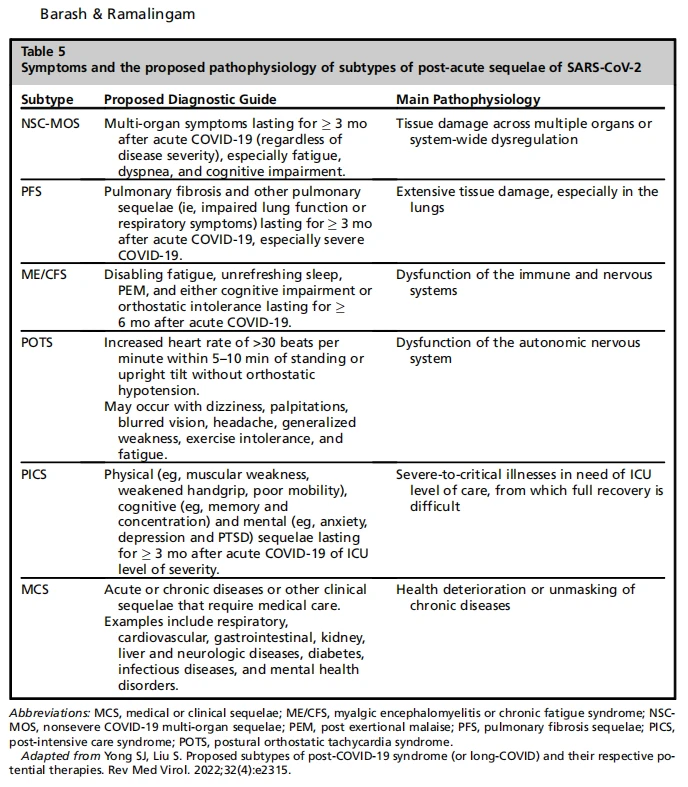
Various phenotypes of PASC may exist. Defining them is complex due to the dynamic nature of both the initial illness and subsequent sequelae across illness severities. For example, a survivor of ARDS and ICU admission may develop dyspnea and abnormal PFTs that correlate with residual postinfectious fibrosis and overlap with the post-intensive care syndrome (PICS). A patient with only a mild illness without a known history of pneumonia or hospitalization may also develop dyspnea out of proportion to imaging abnormalities and PFT derangements. Anecdotally, the latter is a remarkably common finding seen in our PASC clinic where most of the referrals are patients with no history of hospitalization and, generally, no known history of prior pneumonia. Several classification systems have been proposed. Becker proposed a system based on the severity and evolution of symptoms over time.79 Yong proposed subtypes based on long-term clinical and physiologic sequelae.80 Tables 4 and 5 summarize these two different schemas of subtyping PASC phenotypes. These descriptions will likely change over time and another schema will likely emerge, illustrating the complex nature of PASC that will undoubtedly continue to evolve along with our understanding. A newer schema would, ideally, group patients into phenotypes that also correlate with clinically relevant outcomes. No formal guidelines currently exist to define PASC phenotypes.

Mechanism(s) of Post-Acute Sequelae of SARS-CoV-2
A unifying mechanism for the variety and variability of symptoms of PASC remains elusive. Several studies have sought to clarify the causes of exercise intolerance as this is both a common and debilitating symptom. Studies using cardiopulmonary exercise testing (CPET) at various time points from illness and recovery have demonstrated predominantly circulatory and anaerobic threshold limitations when compared with matched controls81–83; however, ventilatory inefficiency has also been suggested.82 Cassar and colleagues 83 performed a longitudinal evaluation of 58 survivors and 30 matched controls via symptom questionnaires, cardiac and lung magnetic resonance imaging (CMR), and CPET at 3 and 6 months. By 6 months, survivors demonstrated normalization of cardiac abnormalities noted on previous CMR imaging, though persistent (and improved) lowgrade abnormalities of parenchymal abnormalities and peak VO2 persisted in 52% of participants; importantly (and congruent with our real-world experience), these abnormalities did not correlate with cardiopulmonary symptoms. These impairments could be related to direct damage to muscle tissue, impaired oxygen extraction/utilization, or simple deconditioning from prolonged hospital stay and critical illness. To this end, the sheer breadth of physical, neuropathic, and neuropsychiatric symptoms is likely not explained by these mechanisms alone, and certainly not all patients will experience dyspnea or exercise intolerance.
Other proposed mechanisms include ACE-2/ Ang 1 to 7 receptor downregulation with deleterious upstream effects,84 autoantibody production targeting cytokines, chemokines, complement system, or cell surface proteins85, and proinflammatory cytokines.86,87 The nature of the initial immune response may also have a bearing on both the clinical disease course and the long-lasting sequelae.88
Triage, Workup, and Treatment
Owing to the massive influx of patients with multitudes of symptoms, many centers around the United States and abroad have initiated multispecialty COVID clinics to help triage, treat, and address the paucity of knowledge and expertise in this disease process. Clinics may have providers representing various medical specialties including neurology, neuropsychiatry and psychology, ear, nose and throat, cardiology, pulmonary, physical medicine and rehab, and physical and occupational therapy, among many others. No standardized approach has yet been validated but it is generally recommended that patients are approached holistically based on the severity of illness and symptom burden. 55,89,90 Basic laboratory testing such as complete blood count, basic metabolic panels, liver function, and thyroid function is likely reasonable. More specialized testing, for example, looking for evidence of vitamin deficiencies, inflammatory markers, rheumatological conditions, myocardial injury, and so forth, should be guided by symptoms and clinical gestalt. Advanced testing may include chest and cardiac imaging, electrocardiograms, and invasive testing such as heart catheterization or CPET if a high clinical suspicion exists. It should be noted that a “shot-gun” approach to testing is not recommended given dubious clinical utility, increasing cost and emotional burden on the patient.

In the author’s experience (MB), patients often have trouble navigating their new symptoms and finding understanding from their families, peers, and even other healthcare providers. A survey of 114 mostly female (80/114) medical professionals (51/114) with PASC in the United Kingdom described a heavy sense of loss and stigma, trouble accessing and navigating services, and difficulty being taken seriously.91 The clinician should consider then, the extra burden placed on their non-medical patients. Acknowledging symptoms is very important, as are validating statements like “what you are going through is very real” and “there are many others just like you, learning to navigate this new illness”; for example, after a thorough history and examination, we focus heavily on first, setting expectations that the time course of illness and recovery is unknown. Once both patient and provider are ready to move forward, appropriate testing is ordered to diagnose both preexisting and new conditions. Emphasis should be placed on symptomatic and supportive therapy.60 Our practice is skewed heavily toward physical and occupational therapy as fatigue and the sensation of dyspnea are often quite prevalent and debilitating. Patients should be counseled on paying particular attention to “post-exertional malaise,” a debilitating state of fatigue onset from both physical and/or mental overexertion which has been well characterized in the setting of CFS/ME.92 Healthy dietary habits, sleep hygiene, and modification of daily routines to prioritize certain activities over others are encouraged. Individualized reconditioning protocols should be implemented by experienced physical and occupational therapists with experience treating PASC patients.55 The triage, evaluation, and treatment of patients suffering from PASC remains dynamic, and a holistic approach is paramount.60,93–96
SUMMARY
Post-COVID sequelae including lung injury and PASC are complex and poorly understood, representing heterogeneous manifestations, mechanisms, and short- and long-term outcomes. The mainstay of therapy remains mostly supportive, though robust research is underway to better understand and characterize pathways for intervention. Historical insight remains important to clarify whether current observations are truly novel or representative of previously ignored or misunderstood syndromes.
CLINICS CARE POINTS


DISCLOSURE
The authors have nothing to disclose.
REFERENCES
1. So M, Kabata H, Fukunaga K, et al. Radiological and functional lung sequelae of COVID-19: a systematic review and meta-analysis. BMC Pulm Med 2021;21(1):97.
2. Herridge MS, Tansey CM, Matte A, et al. Functional disability 5 years after acute respiratory distress syndrome. N Engl J Med 2011;364(14):1293–304.
3. Ahmed H, Patel K, Greenwood DC, et al. Longterm clinical outcomes in survivors of the severe acute respiratory syndrome and Middle East respiratory syndrome coronavirus outbreaks after hospitalization or ICU admission: a systematic review and meta-analysis. J Rehabil Med 2020;52(5): jrm00063.
4. Chen Y, Ding C, Yu L, et al. One-year follow-up of chest CT findings in patients after SARS-CoV-2 infection. BMC Med 2021;19(1):191.
5. Bellan M, Soddu D, Balbo PE, et al. Respiratory and psychophysical sequelae among patients with COVID-19 four months after hospital discharge. JAMA Netw Open 2021;4(1):e2036142.
6. Lerum TV, Aalokken TM, Bronstad E, et al. Dyspnoea, lung function, and CT findings 3 months after hospital admission for COVID-19. Eur Respir J 2021;57(4).
7. van den Borst B, Peters JB, Brink M, et al. Comprehensive health assessment 3 Months after recovery from acute coronavirus disease 2019 (COVID-19). Clin Infect Dis 2021;73(5):e1089–98.
8. Gonzalez J, Benitez ID, Carmona P, et al. Pulmonary function and radiologic features in survivors of critical COVID-19: a 3-month prospective cohort. Chest 2021;160(1):187–98.
9. Liang L, Yang B, Jiang N, et al. Three-month follow-up study of survivors of coronavirus disease 2019 after discharge. J Korean Med Sci 2020;35(47): e418.
10. van Gassel RJJ, Bels JLM, Raafs A, et al. High prevalence of pulmonary sequelae at 3 Months after hospital discharge in mechanically ventilated survivors of COVID-19. Am J Respir Crit Care Med 2021;203(3):371–4.
11. Guler SA, Ebner L, Aubry-Beigelman C, et al. Pulmonary function and radiological features 4 months after COVID-19: first results from the national prospective observational Swiss COVID-19 lung study. Eur Respir J 2021;57(4):2003690.
12. Zhao YM, Shang YM, Song WB, et al. Follow-up study of the pulmonary function and related physiological characteristics of COVID-19 survivors three months after recovery. EClinicalMedicine 2020;25:100463.
13. Huang L, Li X, Gu X, et al. Health outcomes in people 2 years after surviving hospitalization with COVID-19: a longitudinal cohort study. Lancet Respir Med 2022;10(9):863–76.
14. Ambardar SR, Hightower SL, Huprikar NA, et al. Post-COVID-19 pulmonary fibrosis: novel sequelae of the current pandemic. J Clin Med 2021;10(11): 2452.
15. Han X, Fan Y, Alwalid O, et al. Six-month follow-up chest CT findings after severe COVID-19 pneumonia. Radiology 2021;299(1): E177–e186.
16. Wang Y, Dong C, Hu Y, et al. Temporal changes of CT findings in 90 patients with COVID-19 pneumonia: a longitudinal study. Radiology 2020; 296(2):E55–e64.
17. Han X, Fan Y, Alwalid O, et al. Fibrotic interstitial lung abnormalities at 1-year follow-up CT after severe COVID-19. Radiology 2021;301(3): E438– e440.

18. Antonio GE, Wong KT, Hui DS, et al. Thin-section CT in patients with severe acute respiratory syndrome following hospital discharge: preliminary experience. Radiology 2003;228(3):810–5.
19. Das KM, Lee EY, Singh R, et al. Follow-up chest radiographic findings in patients with MERS-CoV after recovery. Indian J Radiol Imaging 2017; 27(3):342–9.
20. Albert RK, Smith B, Perlman CE, et al. Is the progression of pulmonary fibrosis due to ventilation-induced lung injury? Am J Respir Crit Care Med 2019;200(2):140–51.
21. Cabrera-Benitez NE, Laffey JG, Parotto M, et al. Mechanical ventilation-associated lung fibrosis in acute respiratory distress syndrome: a significant contributor to poor outcome. Anesthesiology 2014;121(1):189–98.
22. Cabrera-Benı´tez NE, Parotto M, Post M, et al. Mechanical stress induces lung fibrosis by epithelial-mesenchymal transition. Crit Care Med 2012; 40(2):510–7.
23. Tzouvelekis A, Harokopos V, Paparountas T, et al. Comparative expression profiling in pulmonary fibrosis suggests a role of hypoxia-inducible factor-1alpha in disease pathogenesis. Am J Respir Crit Care Med 2007;176(11):1108–19.
24. Higgins DF, Kimura K, Bernhardt WM, et al. Hypoxia promotes fibrogenesis in vivo via HIF-1 stimulation of epithelial-to-mesenchymal transition. J Clin Invest 2007;117(12):3810–20.
25. Manresa MC, Godson C, Taylor CT. Hypoxia-sensitive pathways in inflammation-driven fibrosis. Am J Physiol Regul Integr Comp Physiol 2014;307(12): R1369–80.
26. Myall KJ, Mukherjee B, Castanheira AM, et al. Persistent post-COVID-19 interstitial lung disease. An observational study of corticosteroid treatment. Ann Am Thorac Soc 2021;18(5):799–806.
27. Doglioni C, Ravaglia C, Chilosi M, et al. COVID-19 interstitial pneumonia: histological and immunohistochemical features on cryobiopsies. Respiration 2021;100(6):488–98.
28. Menter T, Haslbauer JD, Nienhold R, et al. Postmortem examination of COVID-19 patients reveals diffuse alveolar damage with severe capillary congestion and variegated findings in lungs and other organs suggesting vascular dysfunction. Histopathology 2020;77(2):198–209.
29. Barisione E, Grillo F, Ball L, et al. Fibrotic progression and radiologic correlation in matched lung samples from COVID-19 post-mortems. Virchows Arch 2021;478(3):471–85.
30. Li Y, Wu J, Wang S, et al. Progression to fibrosing diffuse alveolar damage in a series of 30 minimally invasive autopsies with COVID-19 pneumonia in Wuhan, China. Histopathology 2021;78(4):542–55.
31. Bharat A, Querrey M, Markov NS, et al. Lung transplantation for patients with severe COVID-19. Sci Transl Med 2020;12(574):eabe4282.
32. Aesif SW, Bribriesco AC, Yadav R, et al. Pulmonary pathology of COVID-19 following 8 Weeks to 4 Months of severe disease: a report of three cases, including one with bilateral lung transplantation. Am J Clin Pathol 2021;155(4):506–14.
33. Bharat A, Machuca TN, Querrey M, et al. Early outcomes after lung transplantation for severe COVID-19: a series of the first consecutive cases from four countries. Lancet Respir Med 2021;9(5):487–97.
34. Culebras M, Loor K, Sansano I, et al. Histological findings in transbronchial cryobiopsies obtained from patients after COVID-19. Chest 2022;161(3): 647–50.
35. Konopka KE, Perry W, Huang T, et al. Usual interstitial pneumonia is the most common finding in surgical lung biopsies from patients with persistent interstitial lung disease following infection with SARS-CoV-2. EClinicalMedicine 2021;42:101209.
36. Funke-Chambour M, Bridevaux PO, Clarenbach CF, et al. Swiss recommendations for the follow-up and treatment of pulmonary long COVID. Respiration 2021;100(8):826–41.
37. Kostorz-Nosal S, Jastrze˛bski D, Chyra M, et al. A prolonged steroid therapy may be beneficial in some patients after COVID-19 pneumonia. Eur Clin Respir J 2021;8(1):1945186.
38. Zhang P, Li J, Liu H, et al. Long-term bone and lung consequences associated with hospital-acquired severe acute respiratory syndrome: a 15-year follow-up from a prospective cohort study. Bone Res 2020;8:8.
39. Ogata H, Nakagawa T, Sakoda S, et al. Nintedanib treatment for pulmonary fibrosis after coronavirus disease 2019. Respirol Case Rep 2021;9(5): e00744.
40. Bussolari C, Palumbo D, Fominsky E, et al. Case report: Nintedaninb may accelerate lung recovery in critical coronavirus disease 2019. Front Med (Lausanne) 2021;8:766486.
41. Zhang F, Wei Y, He L, et al. A trial of pirfenidone in hospitalized adult patients with severe coronavirus disease 2019. Chin Med J (Engl) 2021;135(3): 368–70.
42. Umemura Y, Mitsuyama Y, Minami K, et al. Efficacy and safety of nintedanib for pulmonary fibrosis in severe pneumonia induced by COVID-19: an interventional study. Int J Infect Dis 2021;108:454–60.
43. Reina-Gutie´rrez S, Torres-Costoso A, Martı´nezVizcaı´no V, et al. Effectiveness of pulmonary rehabilitation in interstitial lung disease, including coronavirus diseases: a systematic review and meta-analysis. Arch Phys Med Rehabil 2021;102(10): 1989–97. e1983.
44. Goodwin VA, Allan L, Bethel A, et al. Rehabilitation to enable recovery from COVID-19: a rapid systematic review. Physiotherapy 2021;111:4–22.
45. Post-COVID conditions: an overview for healthcare providers. 2022. A
46. Lopez-Leon S, Wegman-Ostrosky T, Perelman C, et al. More than 50 long-term effects of COVID-19: a systematic review and meta-analysis. Sci Rep 2021;11(1):16144.
47. Assaf G.D.H., McCorkell L., Louise T., et al., What does COVID-19 recovery look like? An analysis of the prolonged COVID-19 symptoms survey by a patient-led research team.
48. Honigsbaum M, Krishnan L. Taking pandemic sequelae seriously: from Russian influenza to COVID-19 long-haulers. Lancet 2020;396(10260): 1389–91.
49. Reid AH, McCall S, Henry JM, et al. Experimenting on the past: the enigma of von Economo’s encephalitis lethargica. J Neuropathol Exp Neurol 2001; 60(7):663–70.
50. Meals RW, Hauser VF, Bower AG. Poliomyelitis Los Angeles epidemic of 1934: Part I. Cal West Med 1935;43(2):123–5.
51. Acheson ED. The clinical syndrome is variously called benign myalgic encephalomyelitis, Iceland disease, and epidemic neurasthenia. Am J Med 1959;26(4):569–95.
52. Holmes GP, Kaplan JE, Gantz NM, et al. Chronic fatigue syndrome: a working case definition. Ann Intern Med 1988;108(3):387–9.
53. Brurberg KG, Fønhus MS, Larun L, et al. Case definitions for chronic fatigue syndrome/myalgic encephalomyelitis (CFS/ME): a systematic review. BMJ Open 2014;4(2):e003973.
54. Fukuda K, Straus SE, Hickie I, et al. The chronic fatigue syndrome: a comprehensive approach to its definition and study. International Chronic Fatigue Syndrome Study Group. Ann Intern Med 1994; 121(12):953–9.
55. Herrera JE, Niehaus WN, Whiteson J, et al. Multidisciplinary collaborative consensus guidance statement on the assessment and treatment of fatigue in post-acute sequelae of SARS-CoV-2 infection (PASC) patients. Pm r 2021;13(9): 1027–43.

56. Tansey CM, Louie M, Loeb M, et al. One-year outcomes and health care utilization in survivors of severe acute respiratory syndrome. Arch Intern Med 2007;167(12):1312–20.
57. Lam MH-B, Wing Y-K, Yu MW-M, et al. Mental morbidities and chronic fatigue in severe acute respiratory syndrome survivors: long-term follow-up. Arch Intern Med 2009;169(22):2142–7.
58. Batawi S, Tarazan N, Al-Raddadi R, et al. Quality of life reported by survivors after hospitalization for Middle East respiratory syndrome (MERS). Health Qual Life Outcomes 2019; 17(1):101.
59. Lee SH, Shin HS, Park HY, et al. Depression as a mediator of chronic fatigue and post-traumatic stress symptoms in Middle East respiratory syndrome survivors. Psychiatry Investig 2019;16(1): 59–64.
60. Greenhalgh T, Knight M, A’Court C, et al. Management of post-acute covid-19 in primary care. Bmj 2020;370:m3026.
61. Tenforde MW, Kim SS, Lindsell CJ, et al. Symptom duration and risk factors for delayed return to usual health among outpatients with COVID-19 in a multistate health care systems network - United States, March-June 2020. MMWR Morb Mortal Wkly Rep 2020;69(30):993–8.
62. Guidance on “long COVID” as a disability under the ADA, section 504, and section 1557. 2022.
63. Prevalence of ongoing symptoms following coronavirus (COVID-19) infection in the UK. 2022.
64. Antonelli M, Pujol JC, Spector TD, et al. Risk of long COVID associated with delta versus omicron variants of SARS-CoV-2. Lancet 2022;399(10343): 2263–4.
65. Self-reported long COVID after infection with the Omicron variant in the UK: 6 May 2022.
66. Ayoubkhani D, Bermingham C, Pouwels KB, et al. Trajectory of long COVID symptoms after COVID-19 vaccination: community-based cohort study. Bmj 2022;377:e069676.
67. Chopra V, Flanders SA, O’Malley M, et al. Sixtyday outcomes among patients hospitalized with COVID-19. Ann Intern Med 2021;174(4): 576–8.
68. Carfi A, Bernabei R, Landi F. Persistent symptoms in patients after acute COVID-19. JAMA 2020; 324(6):603–5.
69. Halpin SJ, McIvor C, Whyatt G, et al. Postdischarge symptoms and rehabilitation needs in survivors of COVID-19 infection: a cross-sectional evaluation. J Med Virol 2021;93(2):1013–22.
70. Huang C, Huang L, Wang Y, et al. 6-month consequences of COVID-19 in patients discharged from hospital: a cohort study. Lancet 2021;397(10270): 220–32.
71. Jacobson KB, Rao M, Bonilla H, et al. Patients with uncomplicated coronavirus disease 2019 (COVID-19) have long-term persistent symptoms and functional impairment similar to patients with severe COVID-19: a cautionary tale during a global pandemic. Clin Infect Dis 2021;73(3):e826–9.
72. Logue JK, Franko NM, McCulloch DJ, et al. Sequelae in adults at 6 Months after COVID-19 infection. JAMA Netw Open 2021;4(2):e210830.
73. Lund LC, Hallas J, Nielsen H, et al. Post-acute effects of SARS-CoV-2 infection in individuals not requiring hospital admission: a Danish population-based cohort study. Lancet Infect Dis 2021;21(10):1373–82.
74. Wynberg E, van Willigen HDG, Dijkstra M, et al. Evolution of COVID-19 symptoms during the first 12 months after illness onset. Clin Infect Dis 2021;75(1):e482–90.
75. Havervall S, Rosell A, Phillipson M, et al. Symptoms and functional impairment assessed 8 Months after mild COVID-19 among healthcare workers. JAMA 2021;325(19):2015–6.
76. Huang Y, Pinto MD, Borelli JL, et al. COVID symptoms, symptom clusters, and predictors for becoming a long-hauler: looking for clarity in the haze of the pandemic. medRxiv 2021;03(03): 21252086.
77. Sudre CH, Murray B, Varsavsky T, et al. Attributes and predictors of long COVID. Nat Med 2021; 27(4):626–31.
78. Sneller MC, Liang CJ, Marques AR, et al. A longitudinal study of COVID-19 Sequelae and immunity: baseline findings. Ann Intern Med 2022; 175(7):969–79.
79. Becker RC. COVID-19 and its sequelae: a platform for optimal patient care, discovery and training. J Thromb Thrombolysis 2021;51(3):587–94.
80. Yong SJ, Liu S. Proposed subtypes of post-COVID- 19 syndrome (or long-COVID) and their respective potential therapies. Rev Med Virol 2022;32(4): e2315.
81. Rinaldo RF, Mondoni M, Parazzini EM, et al. Deconditioning as the main mechanism of impaired exercise response in COVID-19 survivors. Eur Respir J 2021;58(2):2100870.
82. Singh I, Joseph P, Heerdt PM, et al. Persistent exertional intolerance after COVID-19: insights from invasive cardiopulmonary exercise testing. Chest 2022;161(1):54–63.
83. Cassar MP, Tunnicliffe EM, Petousi N, et al. Symptom persistence despite improvement in cardiopulmonary health - insights from longitudinal CMR, CPET and lung function testing post-COVID-19. EClinicalMedicine 2021;41:101159.
84. Bolay H, Gul A, Baykan B. COVID-19 is a real headache. Headache 2020;60(7):1415–21.
85. Wang EY, Mao T, Klein J, et al. Diverse functional autoantibodies in patients with COVID-19. Nature 2021;595(7866):283–8.
86. Bhavana V, Thakor P, Singh SB, et al. COVID-19: pathophysiology, treatment options, nanotechnology approaches, and research agenda to combating the SARS-CoV2 pandemic. Life Sci Life Sci 2020;261:118336.
87. Alpert O, Begun L, Garren P, et al. Cytokine storm-induced new-onset depression in patients with COVID-19. A new look into the association between depression and cytokines -two case reports. Brain Behav Immun-Health 2020;9:100173.
88. Carvalho T, Krammer F, Iwasaki A. The first 12 months of COVID-19: a timeline of immunological insights. Nat Rev Immunol 2021;21(4):245–56.
89. Nalbandian A, Sehgal K, Gupta A, et al. Postacute COVID-19 syndrome. Nat Med 2021; 27(4):601–15.
90. Lutchmansingh DD, Knauert MP, Antin-Ozerkis DE, et al. A Clinic blueprint for post-coronavirus disease 2019 recovery: learning from the past, looking to the future. Chest 2021;159(3):949–58.
91. Ladds E, Rushforth A, Wieringa S, et al. Persistent symptoms after COVID-19: qualitative study of 114 "long COVID" patients and draft quality principles for services. BMC Health Serv Res 2020;20(1): 1144.
92. Chu L, Valencia IJ, Garvert DW, et al. Deconstructing post-exertional malaise in myalgic encephalomyelitis/chronic fatigue syndrome: a patient-centered, cross-sectional survey. PLoS One 2018;13(6): e0197811.
93. Pavli ATMMHC. Post-COVID syndrome: incidence, clinical spectrum, and challenges for primary healthcare professionals. ARCMED Arch Med Res 2021;52(6):575–81.
94. COVID-19 rapid guideline: managing the long-term effects of COVID-19.
95. Siso Almirall A, Brito Zeron P, Conangla Ferrin L, et al. Long Covid-19: Proposed primary care clinical guidelines for diagnosis and disease management. Int J Environ Res Public Health 2021;18(8):4350.
96. Parkin A, Davison J, Tarrant R, et al. A Multidisciplinary NHS COVID-19 service to manage post-COVID-19 syndrome in the community. J Prim Care Community Health 2021;12. 21501327211010994.
97. You J, Zhang L, Ni-Jia-Ti MY, et al. Anormal pulmonary function and residual CT abnormalities in rehabilitating COVID-19 patients after discharge. J Infect 2020;81(2):e150–2.
98. Huang Y, Tan C, Wu J, et al. Impact of coronavirus disease 2019 on pulmonary function in early convalescence phase. Respir Res 2020;21(1):163.
99. Smet J, Stylemans D, Hanon S, et al. Clinical status and lung function 10 weeks after severe SARSCoV-2 infection. Respir Med 2021;176:106276.
100. Shah AS, Wong AW, Hague CJ, et al. A prospective study of 12-week respiratory outcomes in COVID-19-related hospitalizations. Thorax 2021;76(4): 402–4.
101. Mo X, Jian W, Su Z, et al. Abnormal pulmonary function in COVID-19 patients at time of hospital discharge. Eur Respir J 2020;55(6):2001217.
【For more info:george.deng@wecistanche.com / WhatApp:8613632399501】