The Role Of Functional Foods in Cutaneous Anti-aging
May 05, 2022
Please contact oscar.xiao@wecistanche.com for more information
Oral supplementation of micronutrients, or functional foods, to prevent aging has gained much attention and popularity as society ages and becomes more affluent, and as science reveals the pathological mechanisms of aging. Aging of the skin combines biologic aging and extrinsic aging caused predominantly by sunlight and other environmental toxins. Anti-aging functional foods exert their influence mostly through their anti-oxidant and anti-inflammatory effects, thereby abrogating collagen degradation and/or increasing procollagen synthesis. Clinical evidence supporting a role in pre-venting cutaneous aging is available for oral supplements such as carotenoids, polyphenols, chlorophyll, aloe vera, vita-mins Cand E, red ginseng, squalene, and omega-3 fatty acids. Collagen peptides and proteoglycans are claimed to provide building blocks of the dermal matrix. buy cistanche This review summarizes the current study findings on these functional foods.
Key Words: Functional foods, Photoaging, Anti-oxidant, Collagen
INTRODUCTION
Cutaneous aging is the composite sum of biological aging and extrinsic aging due to environmental factors including sunlight, smoking, pollution, and inflammation. Regardless of etiology, the aging process essentially involves the generation of reactive oxygen species(ROS) with subsequent signal transduction and activation of transcription factors activator protein 1(AP-1)and nuclear factor x B(NF-n B). AP-1 increases the secretion of matrix-degrading enzymes called matrix metalloproteinases(MMPs), which results in the degradation of the dermal matrix, including collagen [1]. Functional foods and 'nutraceuticals include all kinds of food with health or medical effects. According to an international survey, about 69% of adults worldwide take vitamins, minerals, or food supplement products daily [2]. bioflavonoids There is an ever-increasing interest in anti-aging substances derived from food, and since the aging process inevitably involves the generation of reactive oxygen species, oral supplements with antioxidant properties are the most popular. These include botanicals with carotenoids or polyphenols, isoflavones, vitamins, coenzyme Q10, phytoestrogens, probiotics, and omega-3 fatty acids. In addition, collagen peptides and hyaluronic acid, which provide building blocks of the skin, are on the market.

Please click here to know more
Endogenous antioxidant defenses include non-enzymatic (e.g., uric acid, glutathione, bilirubin, thiols, albumin, and nutritional factors such as vitamins C and E, β-carotene, ubiquinone, and phenols)and enzymatic (e.g., superoxide dismutases, glutathione peroxidases, and catalase)components. Although nutritional antioxidants are all mainly free radical scavengers, they act through different mechanisms and in different compartments: 1)they directly neutralize free radicals, 2)they reduce peroxide concentrations and repair oxidized membranes, 3)they quench iron to decrease ROS production, and 4)they neutralize ROS via lipid metabolism, ie., short-chain free fatty acids and cholesteryl esters [3].
In contrast to topically applied cosmeceuticals, the effects of dietary bioactive compounds are complicated by the fact that they must go through the gastrointestinal tract, cross the intestinal barrier, reach the blood circulation, and then be distributed to the target tissue, the skin [4].
CAROTENOIDS
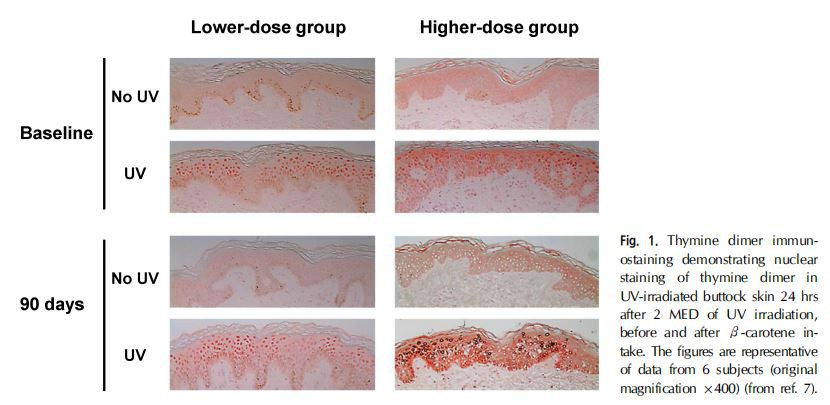
Beta-carotene is a very lipophilic, plant-derived carotenoid that has provitamin A(retinol)ROS-quenching activity [5] and therefore has been used for the treatment of erythropoietic protoporphyria and to increase sunburn threshold. The maximum dosage recommended by the Food and Drug Administration is 300 mg/d [6]. In 30 photoaged female subjects, 90 days of 30 mg/d β-carotene supplementation improved facial wrinkles and elasticity, increased type I procollagen mRNA levels, decreased UV-induced thymine dimer staining, and reduced 8-hydroxy-2'-detox-guanosine staining, hence demonstrating its anti-photo-aging effects; cistanch however,90 mg/d β-carotene decreased minimal erythema dose (MED) and tended to increase thymine dimer-staining cells after supplementation (Fig.1)[7].

Cistanche could anti-aging
Since MED is a measure of cutaneous reactivity to UV irradiation, 90 mg/d of β-carotene seems to render the skin more susceptible to UV-induced erythema. In addition, UV-induced direct cutaneous DNA damage, as measured by thymine dimer staining, tended to increase, albeit non-significantly, in the high-dose group. Oxidative DNA damage, as measured by the 8-OHdG stain, was not significantly affected by high-dose β-carotene. Taken together, the dosage of β-carotene matters:30 mg/d has beneficial effects on cutaneous photoaging, but single 90 mg/d supplementations are not recommended.
Astaxanthin is a xanthophyll carotenoid widely distributed in marine organisms and is responsible for the red color of lobsters and shrimp. It has potent antioxidant and anti-inflammatory properties, with 10-fold greater anti-oxidant action than that of other carotenoids and 100-fold greater action than that of α-tocopherol [8]. Our group found that dietary astaxanthin(2 mg/d) combined with collagen (3 g/d)improves facial elasticity and skin barrier integrity, upregulates type I procollagen gene expression, and decreases MMP-1 and-12 expression in human subjects compared to placebo (unpublished data).
POLYPHENOLS AND ISOFLAVONES
Natural polyphenols or flavonoids are not only plant pigments but also powerful antioxidants that protect plants from diseases. Flavonoids may be divided into 7 subclasses: flavones(apigenin, luteolin, etc.), flavonols(quercetin, etc.), flavanones(hesperidin, etc.), flavanonols (taxifolin), flavanols (catechin, epigallocatechin gallate, etc., isoflavones (genistein, daidzein, etc.), anthocyanins, and anthocyanidins. Resveratrol is a small polyphenol compound found in red grape skin, nuts, fruits, and red wine. Many studies have suggested that this compound has anti-carcinogenic effects that can be attributed to its free radical-scavenging ability [9] and anti-inflammatory effects [10]. It has been shown to protect against depletion of endogenous antioxidant defense enzymes, suppress H, O2, and NO production as well as lipid and protein oxidation, inhibit activation of mitogen-activated protein kinase(MAPK), and NF-x B, and inhibit apoptosis through activation of p53 activity [11]. It has poor bioavailability, and up to 5g of resveratrol intake has been described as safe [12]; however, in a recent pilot study with 10 healthy volunteers, resveratrol was shown to possess cytokine-potentiating, pro-inflammatory properties with a significant increase in TNF-u and activation of alternative NF-x B signaling, suggesting enhanced immune surveillance as the mechanism behind its anti-carcinogenic effects [13].

Green tea polyphenols have been shown to prevent UVB-induced protein oxidation and MMP expression in mouse skin [14]. Epigallocatechin gallate(EGCG) comprises 59% of total catechins and is responsible for most of the biological activity of tea, and oral EGCG supplementation has been shown to increase MED, skin barrier function, and reduce UVB-induced skin damage in rats [15]. However, similar studies on human beings have not demonstrated such effects [16,17], presumably because the human dermis forms a stronger barrier to absorption from the vasculature [18], warranting further clinical studies with high methodological quality.
Soybean isoflavone, a well-known anti-aging agent, is also referred to as a phytoestrogen because it has a chemical structure similar to estrogen [19]. In hairless mouse models, dietary soy isoflavones cause less skin wrinkling in UV-irradiated skin than in controls, with a concomitant increase in collagen deposition, which is partly due to the inhibitory effects on UV-induced MMP expression and subsequent collagen degradation [20].In human subjects, facial fine wrinkles are decreased after 12 weeks of isoflavone aglycone supplementation [21]; however, more robust clinical studies are necessary to substantiate these initial findings.
OTHER BOTANICALS
We reported that chlorophyll improves facial wrinkles and elasticity in female volunteers over the age of 45 who received two different doses of chlorophyll extract supplement for 90 days. Compared to baseline, type I procollagen synthesis was increased, with a substantial reduction in UV-induced thymine dimer staining and UV-induced apoptosis of keratinocytes in a dose-dependent manner [22]. Considering the pivotal role of ROS in photoaging, Chlor-ophyl's anti-oxidant properties are speculated to play a role in reducing wrinkles, epidermal DNA damage, and apoptosis.

Aloe vera gel is obtained from the pulp of a tropical cactus that belongs to the lily family with purported anti-inflammatory, healing, moisturizing, antibacterial, antifungal, and antiviral properties. Dietary aloe vera gel supplementation(low dose,1,200 mg/d; high dose,3,600 mg/d)in 30 photoaged female volunteers for 90 days resulted in improvements in facial wrinkles and elasticity, an increase in type I procollagen mRNA levels, and a reduction in MMP-1 mRNA levels at both doses. Compared to baseline, type I procollagen immunostaining increases throughout the dermis in both groups(Fig. 2)[23]. No dose-response relationship has been found in the tested doses. The known therapeutic effect of aloe vera is due to its immunostimulatory properties attributed to the presence of polysaccharides; the poly-saccharides have no significant anti-oxidant activity [24]. An acetylated glucomannan, acemannan, is the biologically active, dominant polysaccharide that has been shown to increase collagen biosynthesis, probably through macrophage immunostimulation [25].
VITAMINS C AND E
Vitamin C(ascorbic acid) is the major water-soluble endogenous antioxidant; it is a powerful inhibitor of lipid peroxidation, regenerates vitamin E in lipoproteins and membranes, and is essential for the production of collagen. It has been shown to provide a wide variety of benefits including lowering blood pressure and decreasing infectious episodes in daily doses of 500 mg to 6g [26]; however, no benefit has been reported regarding skin aging. Vitamin E(a-tocopherol)is a lipid-soluble antioxidant vitamin found in cell membranes and circulating lipoproteins. Vitamin E can also enhance immune function, reducing infection rates in elderly subjects [27]. For a systemic photoprotective effect, several hundred mg/d is required, and doses up to 800 mg/d have been taken for years without harm. Vitamin C and vitamin E act synergistically [28]. Simultaneous oral intake of these two vitamins has been shown to reduce UV-induced skin inflammation, in contrast to either vitamin alone, which has shown no protective effects [29]. Several controlled clinical studies have demonstrated that the two vitamins act synergistically to reduce sunburn reaction and increase MED [30]. Unfortunately, oral supplementation of vitamin C and E has proven insufficient in preventing skin aging owing to their poor solubility, inefficient skin permeability, or instability during storage [31]. Chemical modification of the molecules or new delivery systems would make optimized delivery of these molecules to the skin possible in the future. On the other hand, there are some promising reports regarding mixtures of antioxidants: an antioxidant combination containing vitamins C and E, carotenoids, selenium, and proanthocyanidins decreases MMP-1 compared to placebo in

humans [32], and a combination of vitamins C and E, pycnogenol, and evening primrose oil also decrease wrinkles and MMP while increasing collagen synthesis in hairless mice [33]. Both studies imply that antioxidants are effective when they work together.
This article is extracted from http://dx.doi.org/10.15280/jlm.2014.4.1.8