The X-linked Epigenetic Regulator UTX Controls NK Cell-intrinsic Sex Differences
Dec 27, 2023
Viral infection outcomes are sex-biased, with males generally more susceptible than females. Paradoxically, the numbers of antiviral natural killer (NK) cells are increased in males. We demonstrate that while numbers of NK cells are increased in male mice, they display decreased effector function compared to females in mice and humans. These differences were not solely dependent on gonadal hormones, because they persisted in gonadectomized mice. Kdm6a (which encodes the protein UTX), an epigenetic regulator that escapes X inactivation, was lower in male NK cells, while NK cell-intrinsic UTX deficiency in female mice increased NK cell numbers and reduced effector responses. Furthermore, mice with NK cell-intrinsic UTX deficiency showed increased lethality to mouse cytomegalovirus. Integrative multi-omics analysis revealed a critical role for UTX in regulating chromatin accessibility and gene expression critical for NK cell homeostasis and effector function. Collectively, these data implicate UTX as a critical molecular determinant of sex differences in NK cells.
Evolutionarily conserved sex differences exist in both innate and adaptive immune responses1,2. While males are less susceptible to autoimmunity, they also mount a less potent antiviral immune response than females. For instance, males have a higher human cytomegalovirus (HCMV) burden after infection, suggesting increased susceptibility to viral threats4. This has also been recently illustrated during the coronavirus disease 2019 (COVID-19) pandemic, in which the strong male bias for severe disease has been postulated to reflect sex differences in immune responses5. Multiple studies in humans and mice have recently reported differences in immune cell distribution and/ or function in males versus females6,7. However, the molecular basis for these differences, and the mechanisms by which these differences influence disease outcomes, remain poorly understood. Sex differences in mammals are defined not only by divergent gonadal hormones but also by sex chromosome dosage1. Expression of a subset of X-linked genes, for example, is higher in females (XX) than males (XY)8. While females undergo random X-chromosome inactivation (XCI) to maintain similar levels of X-linked protein expression between sexes, XCI is incomplete, with 3–7% of X-chromosome genes escaping inactivation in mice and 20–30% escaping inactivation in humans8,9. As such, differential levels of X-linked gene expression in females versus males have been linked to sex differences in a wide range of conditions including neural tube defects10 and autoimmune disease11,12. As circulating type 1 innate lymphocytes, NK cells serve as an early line of defense against herpesvirus family members13. The importance of NK cells in antiviral immunity is illustrated in patients with defective NK cell numbers or functionality, who are highly susceptible to infection by herpesviruses such as HCMV and Epstein–Barr virus14. In mice, NK cells are required for the control of mouse cytomegalovirus (MCMV) and other viral infections15. Mice with either genetic deficiency in NK cell function or loss of NK cell numbers have a significant increase in viral titers and mortality following MCMV infection15–18. Thus, NK cells are critical in antiviral immunity in both mice and humans.

cistanche tubulosa-improve immune system
Given the potent antiviral function of NK cells, it was therefore unexpected that virus-susceptible males display higher numbers of NK cells6,7. Beyond NK cell numbers, other previously unappreciated sexually dimorphic NK cell feature(s) may instead account for sex differences during viral infection. We demonstrate that while male NK cells display enhanced cellular fitness in mice, they show decreased effector function in mice and humans. These sex biases in NK cell composition and function were not completely due to hormonal differences, because they persisted in gonadectomized mice. Through differential expression screening, we identified the X-linked epigenetic regulator and known XCI escapee UTX, which was expressed at significantly lower levels in both mouse and human male NK cells. UTX regulated both NK cell fitness and effector function in a dose-dependent manner because UTX haploinsufficiency in female NK cells was sufficient to increase NK cell numbers while impairing cytokine production and cytotoxicity. Female UTX-deficient NK cells displayed enhanced persistence in vivo and resistance to apoptosis ex vivo, as well as increased susceptibility to MCMV infection. These effects were independent of UTX's intrinsic demethylase activity, as NK cell numbers and interferon (IFN)-γ production were unaltered in mice expressing a 'demethylase-dead' UTX mutant. Integrative analysis using the assay for transposase-accessible chromatin using sequencing (ATAC-seq), bulk RNA sequencing (RNA-seq), and anti-UTX CUT&Tag (Cleavage Under Targets and Tagmentation Assay) of wild-type (WT) and UTX-deficient NK cells revealed a critical role for UTX in regulating the expression of gene loci involved in NK cell fitness and effector responses. Our findings identify UTX as a major driver of sex differences in NK cell homeostasis and effector function through demethylase-independent modulation of gene expression.

cistanche tubulosa-improve immune system
Click here to view Cistanche Enhance Immunity products
【Ask for more】 Email:cindy.xue@wecistanche.com / Whats App: 0086 18599088692 / Wechat: 18599088692
Results
NK sexual dimorphism is independent of gonadal sex hormones
A recent investigation examining spleens of C57BL/6 mice reported increased numbers of NK cells in males versus females19. Consistent with these data, we observed that splenic NK cells (identified as CD3− TCRβ− NK1.1+; Extended Data Fig. 1a) are increased in frequency (Fig. 1a,b) and absolute numbers (Fig. 1c) in male C57BL/6 mice compared to females. These findings suggest that other sexually dimorphic features beyond NK cell numbers may account for increased male susceptibility to viral infections. In response to viral infection, NK cells are critical for early production of pro-inflammatory cytokines, particularly IFN-γ20–22. To test if sex differences exist in NK cell-intrinsic function, we compared effector cytokine production in NK cells isolated from female versus male mice ex vivo. Stimulation with the pro-inflammatory cytokines interleukin (IL)-12 and IL-15 resulted in lower IFN-γ production by male NK cells (Fig. 1d,e and Extended Data Fig. 1b). Similar results were observed in response to IL-12 and IL-18 (Extended Data Fig. 1c,d), suggesting a respective defect in male NK cell responsiveness to cytokine stimulation. Additionally, human NK cells (TCRβ− CD3− CD56+ ) isolated from peripheral blood mononuclear cells (PBMCs) activated with IL-12 and K562 leukemia cells resulted in a lower percentage of IFN-γ+ (Fig. 1f and Extended Data Fig. 1e) and IFN-γ mean fluorescence intensity (MFI; Fig. 1g) in male versus female NK cells. Thus, although NK cell numbers are increased, male NK cell effector cytokine production is consistently reduced in both mice and humans in response to pro-inflammatory cytokines induced during viral infection.
Female or male sex is based on a composite of gonadal hormones (for example, estrogens or androgens) and sex chromosomes (for example, 46XX or 46XY)1. Previous studies demonstrated the direct effects of gonadal hormones in the regulation of IFN-γ production by NK cells23, but it remains possible that NK cell sex differences could also be attributed to cell-intrinsic factors. To identify sex hormone-mediated effects, we examined NK cell abundance and function in gonadectomized mice. Gonadectomy failed to eliminate sex differences in NK cell frequency (Fig. 1h and Extended Data Fig. 1f), absolute numbers (Fig. 1i) and IFN-γ protein production in response to cytokine stimulation (Fig. 1j,k and Extended Data Fig. 1g), indicating gonadal hormones are not solely responsible for sex differences in NK cells. While NK cell maturation subsets identified by CD11b and CD27 expression have differential capacities for survival and effector function24, splenic NK cells derived from either WT or gonadectomized female and male mice did not display significant differences in the frequencies of NK cell maturation subsets (Extended Data Fig. 1h–k). These results indicated that the observed sex biases in NK cell number and effector function are not due to differential maturation states. Thus, we hypothesized that sex chromosome dosage may contribute to differential NK cell abundance and function between sexes.

cistanche tubulosa-improve immune system
UTX escapes X inactivation and is expressed more in females
While 46XX females undergo XCI to control dosages of X-linked genes, a subset of genes escapes XCI (termed XCI escapees), often resulting in higher expression in females compared to males25,26. Thus, increased XCI escapee expression in females compared to males could potentially mediate sex differences in NK cells. While different genes escape X inactivation in humans and mice, five genes (XIST, DDX3X, KDM6A, EIF2S3, KDM5C) have previously been identified as XCI escapees in both27. XIST was excluded from further analysis because it is not expressed in male cells due to its known role in XCI in female cells1. All four remaining genes were significantly downregulated in male versus female NK cells, in both humans (Fig. 2a) and mice (Fig. 2b). Kdm6a (which encodes UTX) transcript levels displayed the most sexually dimorphic expression in both human and mouse NK cells (Fig. 2a,b). Male NK cells also expressed lower UTX protein levels compared to female NK cells in mice (Fig. 2c,d). These differences in Kdm6a transcript levels and UTX protein levels persisted in both gonadectomized mice (Fig. 2e–g) and Four Core Genotypes (FCG) mice (Extended Data Fig. 2a) in which sex chromosome complement (XX or XY) is uncoupled from gonadal sex organ (ovaries or testes)28. These data indicate expression levels of Kdm6a (UTX) are sex-biased in NK cells and primarily dictated by X-chromosome dosage rather than gonadal hormones.
UTX suppresses NK cell fitness
To determine if UTX mediates the observed sex differences in NK cells, we generated a series of mice with dose-dependent loss of UTX. First, we generated female mice with a heterozygous deletion of UTX in NK cells (Kdm6afl/WT Ncr1Cre+, hereafter referred to as UTXHet; Supplementary Data Table 1) to mimic the single copy of UTX expressed in males. We confirmed similar NK cell UTX protein expression between female UTXHet and male WT (Kdm6afl/y Ncr1Cre-) mice (Extended Data Fig. 2b). Female UTXHet mice displayed similar splenic NK cell numbers compared to male WT (Fig. 3a,b), and both displayed increased numbers of NK cells compared to female WT. No significant differences in maturation by CD11b and CD27 expression were observed between NK cells from female WT, male WT, and female UTXHet mice (Extended Data Fig. 2c). Thus, loss of one copy of UTX was sufficient to increase NK cell numbers in a maturation-independent manner. We next produced mice with a homozygous deletion of UTX (Kdm6afl/flNcr1Cre+, hereafter referred to as UTXNKD; Supplementary Data Table 1), resulting in the loss of both copies of UTX in NK cells. UTX protein expression was significantly lower in female UTXNKD NK cells compared to female WT NK cells by flow cytometry (Extended Data Fig. 2b), as well as lower compared to NK cells with a single UTX copy (that is, male WT and female UTXHet). The absence of UTX protein at the predicted size (180 kD) in female UTXNKD compared to WT NK cells was confirmed by western blot (Extended Data Fig. 2d). NK cell frequencies and absolute numbers increased with decreasing UTX copy number (Fig. 3c,d and Extended Data Fig. 3a). These data implicate UTX in regulating NK cell frequency and absolute numbers in a dose-dependent manner.

Fig. 1 | Sex differences in IFN-γ production and NK cell numbers are independent of gonadal hormones. a–c, Representative dot plots (a), frequency (b), and absolute numbers (c) of splenic NK cells (CD3− TCRβ− NK1.1+ ) in female and male C57BL/6 mice (n = 15 per group). d,e, Percentage IFN-γ+ (d) and normalized IFN-γ MFI (e) of total splenic NK cells from female versus male mice cultured with no treatment (NT) or IL-15 (50 ng ml−1) and IL-12 (20 ng ml−1) for 4 h, normalized to MFI of female IL-15/IL-12 treatment (n = 8 per group). f,g, Percentage IFN-γ+ (f) and normalized IFN-γ MFI (g) of CD3− CD56+ female (n = 6) and male (n = 7) human NK cells cultured and stimulated with 10 ng ml−1 of IL-12 for 16 h in the presence of K562 cells, normalized to MFI of female IL-12 treatment. h, i, Frequency (h) and absolute numbers (i) of splenic NK cells in gonadectomized female and male mice (n = 18 per group). j,k, Percentage IFN-γ+ (j) and normalized IFN-γ MFI (k) of total splenic NK cells isolated from gonadectomized female and male mice and cultured with NT or IL-15 (50 ng ml−1) and IL-12 (20 ng ml−1) for 4 h (n = 12 per group). Data are representative of 2–4 independent experiments. Samples were compared using a two-tailed unpaired Student's t-test and data points are presented as individual mice with the mean ± s.e.m. (*P < 0.05; **P < 0.01; ***P < 0.001; ****P < 0.0001). Specific P values are as follows: b = 0.0002; c = 0.006; d = 0.0036; e = 0.0013; f = 0.04; g = 0.03; h < 0.0001; i = 0.0006; j = 0.0234; k = 0.0019.
To define the mechanisms underlying the increased NK cell numbers in UTXNKD mice (CD45.2+ ), a 1:1 ratio of mixed bone marrow chimeric (mBMC) mice with WT (CD45.1+ ) was produced. Six weeks after reconstitution, we observed a marked competitive advantage of female UTXNKD (CD45.2+ ) NK cells compared to WT in female recipients (CD451x2 ) following bone marrow transplantation (Extended Data Fig. 3b,c). In contrast to NK cells, T cells from the same donor (UTXNKD, CD45.2+ ), which are UTX sufficient due to NK-specific deletion of UTX, displayed the original injection ratio (1:1; Extended Data Fig. 3b,c). These data suggest UTX repressed NK cell numbers in a cell-intrinsic manner during development. To test whether this phenotype was driven by differences in proliferation, we analyzed the cell division marker Ki67 in splenic NK cells in WT: UTXNKD mBMC mice, injected at a 4:1 ratio to normalize cell number between genotypes. Paradoxically, UTXNKD NK cells displayed lower frequencies of Ki67+ cells and showed less CFSE dilution in response to IL-15 (Extended Data Fig. 3d,e). These results suggest that the higher NK cell numbers observed in UTXNKD mice were not due to increased proliferation. Given these results, we hypothesized that the elevated frequency of NK cells in UTXNKD mice (Fig. 3c,d) could be due to enhanced cellular fitness of NK cells in the absence of UTX expression. To test this possibility, congenically distinct WT (CD451x2 ) and UTXNKD (CD45.2+ ) splenic NK cells were labeled with Cell Trace Violet (CTV) and transferred into WT (CD45.1+ ) recipients at a 1:1 ratio (Extended Data Fig. 3f). On day 7 after transfer, the transferred population was skewed toward UTXNKD NK cells in recipient spleens (Fig. 3e,f), demonstrating cell-intrinsic UTX suppression of mature NK cell homeostasis. This difference was not due to altered proliferation, because CTV dilution by both transferred populations was minimal on day 7 after transfer (Extended Data Fig. 3g). To test whether UTX repressed NK cell homeostasis through regulation of apoptosis, we compared cleaved caspase 3 expression in sorted NK cells incubated with either IL-15 alone or with IL-15 and an apoptosis inducer, Nutlin-3a29. Lower UTX expression correlated with decreased cleaved caspase 3+ NK cells in the presence of low-dose IL-15 and Nutlin-3a treatment (Fig. 3g,h). Moreover, male NK cells also displayed a modest but significant decrease in the frequency of cleaved caspase 3+ NK cells in response to Nutlin-3a compared to female NK cells, which also persisted in gonadectomized mice (Extended Data Fig. 3h–k). Moreover, regulation of NK cell apoptosis and survival relies on the relative expression levels of Bcl-2 (anti-apoptotic factor)30, which can be antagonized by Bim (pro-apoptotic factor)31. UTXNKD NK cells showed increased intracellular protein expression of Bcl-2 and a modest increase in Bim (Fig. 3i,j and Extended Data Fig. 3l) compared to WT NK cells. This resulted in a significantly increased Bcl-2:Bim ratio in UTXNKD NK cells (Fig. 3k). Male NK cells also displayed a significant increase in Bcl-2:Bim ratio (Fig. 3l), which persisted following gonadectomy (Fig. 3m). Together, these data demonstrate that altered UTX levels may underlie sex differences in NK cell fitness through regulation of Bcl-2 expression.

Fig. 2 | X-linked UTX displays sexually dimorphic gene expression independent of sex hormones.a Normalized expression of XCI escapee genes using DICE database RNA-seq data on sorted NK cells from human females (n = 36) versus males (n = 54) normalized to females. b, Normalized expression of XCI escapee genes by quantitative PCR with reverse transcription (RT–qPCR) in splenic NK cells from female versus male mice (C57BL/6; 8 weeks old, n = 5 per group). Genes are ordered by increasing fold change between females and males from left to right. c,d, Representative histogram (c) and normalized MFI (d) of UTX protein expression in splenic NK cells from naive female versus male mice by flow cytometry, normalized to MFI of female mice (C57BL/6; 8 weeks old; n = 15 per group). e, Relative expression of Kdm6a (UTX) by RT–qPCR of isolated splenic NK cells normalized to females (n = 6 per group). f,g Representative histograms (f) and relative UTX MFI (g) of NK cells by flow cytometry from spleens of gonadectomized female and male mice (n = 6 per group) normalized to female. Samples were compared using unpaired two-tailed Student's t-test and data points are presented as individual mice with the mean ± s.e.m. (*P < 0.05; **P < 0.01; ***P < 0.001). Specific P values are as follows: a < 0.001; b: Ddx3x = 0.03, Kdm5c = 0.0017, Eif2s3 = 0.0113, Kdm6a = 0.000087; d = 0.003; e = 0.008; g = 0.0029).
UTX enhances NK cell effector function
Because male NK cells exhibited decreased IFN-γ production (Fig. 1d,e) independent of gonadal hormones (Fig. 1j,k) we next sought to determine if this phenotype was regulated by UTX levels. After cytokine stimulation, frequencies and absolute numbers of IFN-γ-producing cells (Fig. 4a and Extended Data Fig. 4a,b) as well as IFN-γ MFI (Fig. 4a) were similar between male WT and female UTXHet NK cells. IFN-γ production by female UTXHet NK cells was intermediate between female WT and female UTXNKD NK cells (Fig. 4a and Extended Data Fig. 4a,b). This trend was also observed by comparing NK cell IFN-γ accumulation by ELISA (Fig. 4b). Moreover, this phenomenon was not specific to IFN-γ, because granulocyte-macrophage colony-stimulating factor (GM-CSF) production, a pro-inflammatory NK effector molecule32, was also reduced with decreasing UTX copy number in female NK cells (Fig. 4c).
In addition to cytokine production, NK cell cytolytic activity is crucial for antiviral33 and antitumor defenses34. To assess sex differences in NK cell cytotoxicity, we performed killing assays with major histocompatibility complex (MHC) class I-deficient MC38 cells as targets. At a 4:1 effector: target ratio, male WT NK cells displayed significantly lower lysis of target cells compared to female WT (Fig. 4d), which was sustained in gonadectomized mice (Extended Data Fig. 4c). Impaired target cell killing by male NK cells was not due to differences in degranulation, because CD107a levels were similar between female and male NK cells (Extended Data Fig. 4d,e). However, males produced significantly lower levels of cytotoxic molecules perforin and granzyme B in response to IL-15 and anti-NK1.1 activating receptor ligation (Extended Data Fig. 4d,e). Notably, UTXHet and male WT NK cells showed similar killing capacity (Fig. 4d), which was intermediate between female WT and UTXNKD NK cells (Fig. 4d). Together, these data suggest that UTX enhances NK cell cytotoxicity in a dose-dependent manner.
cistanche tubulosa-improve immune system
Considering the observed effects of UTX loss on NK cell effector function, we examined whether UTXNKD mice were more vulnerable to viral infection. Rapid IFN-γ and GM-CSF production is critical for NK cell-mediated antiviral control20. Strikingly, UTXNKD mice rapidly succumbed to infection (n = 3/8 survived) upon challenge with a sublethal dose of MCMV (Fig. 4e). Moreover, UTX-deficient splenic NK cells displayed a marked defect in IFN-γ production and granzyme B production in total NK cells on day 1.5 after infection (Fig. 4f and Extended Data Fig. 4f,g). Additionally, a similar defect in IFN-γ production by UTXNKD was observed in all maturation subsets (Extended Data Fig. 4h), implicating UTX in control of IFN-γ production in a maturation-independent manner. To confirm whether the dosage of UTX expression in mature NK cells associates with the production of IFN-γ during viral infection in vivo, we generated transgenic mice to achieve a tamoxifen-inducible UTX deletion (Kdm6afl/fl Rosa26ERT2CRE+, hereafter referred to as iUTX−/−; Supplementary Data Table 1). mBMC mice were produced with a 1:1 mix of WT (CD45.1+ ) and iUTX−/− (CD45.2+ ) to limit UTX deletion to the hematopoietic compartment. WT:iUTX−/− mBMC mice were treated with tamoxifen immediately before infection with MCMV to ablate UTX expression (Fig. 4g). IDX−/− (CD45.2+ ) NK cells produced less IFN-γ compared to their WT counterparts (Fig. 4h and Extended Data Fig. 4i). Tamoxifen administration in WT:iUTX−/− mBMC mice resulted in differential degrees of UTX protein loss and displayed a significant positive correlation between intracellular UTX levels and IFN-γ production on day 1.5 after infection (Fig. 4i). These results demonstrate that cell-intrinsic UTX levels in mature NK cells regulate effector molecule production and subsequent protection against MCMV infection.
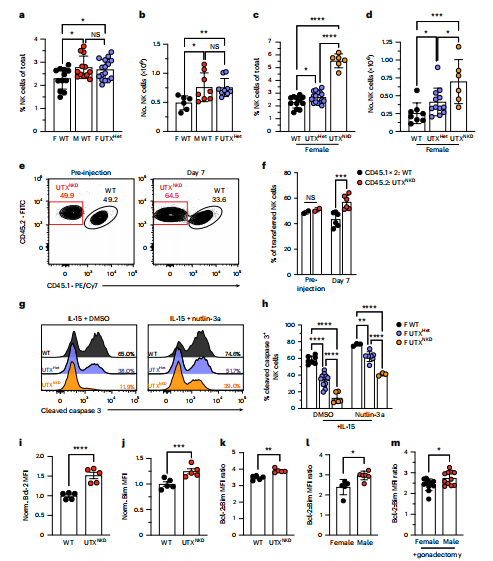
Fig. 3 | UTX suppresses NK cell fitness. a,b, Frequency (F and M WT: n = 12; F UTXHet: n = 16; a) and absolute numbers (F WT: n = 6; M WT: n = 8; F UTXHet: n = 9; b) of NK cells in the spleen of female (F) WT, male (M) WT and F UTXHet mice. c,d, Frequency (WT: n = 12; UTXHet: n = 16; UTXNKD: n = 6; c) and absolute numbers (WT: n = 8; UTXHet: n = 12; UTXNKD: n = 6; d) of NK cells in spleen of F WT, UTXHet and UTXNKD mice. e, Representative contour plots of congenically distinct WT (CD451x2 ) and UTXNKD (CD45.2+ ) NK cells transferred into WT (CD45.1+ ) recipients at a 1:1 ratio before injection (left) and on day 7 after transfer (right). f, Frequency of WT and UTXNKD cells in the spleen of recipient mice before injection and day 7 after transfer (n = 6). g,h, Representative histograms (g) and percentage (h) of cleaved caspase 3+ NK cells of female WT, UTXHet, and UTXNKD mice cultured with IL-15 (5 ng ml−1) and either dimethylsulfoxide (DMSO; F WT: n = 7; F UTXHet: n = 11; F UTXNKD: n = 6) or 2.5 μM Nutlin-3a (F WT: n = 3; F UTXHet: n = 7; F UTXNKD: n = 3) for 24 h. i–k, Normalized Bcl-2 MFI (i), Bim MFI (j), and Bcl-2:Bim MFI ratio (k) in splenic NK cells from female WT and UTXNKD mice (n = 5). l,m, Bcl-2:Bim MFI ratio in splenic NK cells from female WT and male WT mice (n = 6; l) and gonadectomized female and male mice (n = 11; m). Data are representative of 2–4 independent experiments. Samples were compared using ordinary one-way analysis of variance (ANOVA; a–d), two-way ANOVA with Tukey's correction for multiple comparisons (h), or unpaired two-tailed Student's t-test (f, i–m). Data points are individual mice with the mean ± s.e.m. (NS, not significant; *P < 0.05; **P < 0.01; ***P < 0.001; ****P < 0.0001). Specific P values are as follows: a: F WT versus M WT = 0.0201, M WT versus UTXHet = 0.989, F WT versus UTXHet = 0.0327, WT versus UTXNKD = 0.001; b: F WT versus M WT = 0.0320, M WT versus UTXHet < 0.99, F WT versus UTXHet = 0.0029, WT versus UTXNKD = 0.001; c: WT versus UTXHet = 0.0375, UTXHet versus UTXNKD and WT versus UTXNKD < 0.0001; d: WT versus UTXHet = 0.0191, UTXHet versus UTXNKD = 0.0278, WT versus UTXNKD = 0.001; f: Pre-injection = 0.3304; day 7 = 0.001918; h: DMSO < 0.0001, Nutlin-3a–F WT versus F UTXHet = 0.0048, rest < 0.0001; i < 0.0001; j = 0.0004; k = 0.0025; l = 0.0115; m = 0.0227.
UTX regulates NK cells in a demethylase-independent manner
As a histone demethylase, UTX may control NK cell homeostasis and effector gene expression programs by catalyzing the removal of a methyl group from trimethylated histone H3 Lys27 (H3K27me3; a repressive histone mark) to poise chromatin for active gene expression35. However, UTX also possesses demethylase-independent activities by interacting with epigenetic regulators and chromatin modifiers to coordinate gene expression36,37. To explore the role of UTX demethylase activity in modulating NK cell homeostasis and effector function, we leveraged mice that express a catalytically inactive UTX (UTX 'demethylase-dead' or UTXDMD mice; Supplementary Data Table 1) harboring p.His1146Ala and p.Glu1148Ala point mutations in the catalytic domain38. Interestingly, female UTXDMD and WT mice exhibited similar frequencies and absolute numbers of splenic NK cells (Fig. 5a–c), while UTXNKD mice showed increased splenic NK cell numbers compared to both. These findings suggest that UTX's repression of NK cell numbers was demethylase-independent. Moreover, no differences were observed between WT and UTXDMD NK cells in the ability to produce IFN-γ in response to cytokine stimulation (Fig. 5d–f). These results demonstrate that UTX's function in restraining NK cell numbers and promoting IFN-γ production is demethylase-independent. In addition to a single copy of UTX, males express the catalytically inactive Kdm6c (which encodes the protein UTY), the Y-chromosome-linked homolog of UTX. We confirmed that UTY is only expressed in male NK cells from humans (Extended Data Fig. 5a) and mice (Extended Data Fig. 5b) and was not altered by gonadectomy in mice (Extended Data Fig. 5b). As discussed above, no differences were seen in NK cell numbers or effector function between male WT (one copy of UTX and UTY) and female UTXHet (one copy of UTX) mice (Figs. 3a,b and 4a,d), suggesting a limited role for UTY in regulating NK cell homeostasis and effector function. Additionally, male UTXNKD (Kdm6afl/y Ncr1cre+) mice showed increased NK cell frequency and absolute numbers (Extended Data Fig. 5c,d) and produced less IFN-γ (Extended Data Fig. 5e–h), compared to male WT controls, which mirrors changes seen in females with NK cell UTX deficiency. (Figs. 3a,b and 4a,b). Thus, UTX loss in NK cells has similar effects in females and males.
UTX controls NK cell transcriptome by remodeling chromatin
Recent studies have identified NK cell regulatory circuitry (regulons) that prime innate lymphoid cells for swift effector responses even before NK cell activation 39. As an epigenetic modifier, UTX can alter transcription by organizing chromatin at regulatory elements of target gene loci40. To investigate the UTX-mediated modifications on chromatin accessibility and gene expression in NK cells, we performed ATAC-seq in tandem with bulk RNA-seq on sort-purified WT (CD45.1+ ) and UTXNKD (CD45.2+ ) NK cells from 4:1 WT: UTXNKD mBMC mice (Extended Data Fig. 6a). Using mBMC mice allowed for an internally controlled experiment and minimized environmental confounding factors. Principal-component analysis (PCA) of both ATAC-seq and RNA-seq data revealed sample clustering by genotype (Extended Data Fig. 6b). ATAC-seq revealed 3,569 peaks decreased and 2,113 peaks increased in accessibility in UTXNKD compared to WT NK cells (log2 fold change > ±0.5, adjusted P value < 0.05, false discovery rate (FDR) < 0.05; Supplementary Data Table 2). Moreover, RNA-seq identified 701 decreased and 554 increased genes in UTXNKD versus WT (log2 fold change > ±0.5, adjusted P value < 0.05, FDR < 0.05; Extended Data Fig. 6c and Supplementary Data Table 3). These findings suggest profound changes in both the chromatin landscape and transcriptome of NK cells in the absence of UTX.
cistanche plant-increasing immune system
Integrative analysis of ATAC-seq and RNA-seq identified 395 genes that are both differentially accessible and expressed with a significant positive correlation (Spearman correlation: R = 0.62, P < 2.2 × 10⁻¹⁶) between the mean log2 fold change of ATAC-seq peaks and log2 fold change of RNA-seq expression (Extended Data Fig. 6d). Fuzzy c-means clustering of both the ATAC-seq and RNA-seq datasets identified six major clusters that were significantly decreased (clusters 1, 2, 3 and 6) or increased (clusters 4 and 5) inaccessibility (Fig. 6a) and expression (Fig. 6b) in UTXNKD NK cells. For functional enrichment analysis, g:Profiler was used to analyze clusters of differentially expressed genes identified by RNA-seq (Fig. 6c). Major pathways such as immune system process, cytokine production, IFN-γ production, lymphocyte activation and immune effector process were associated with decreased expression in UTXNKD (clusters 1, 2, 3 and 6; Fig. 6c). Meanwhile, pathways such as developmental process, biosynthetic process and metabolic process were significantly associated with increased expression in UTXNKD (clusters 4 and 5; Fig. 6c). Of note, analysis of cell death pathway genes revealed multiple genes to be differentially expressed (Extended Data Fig. 6e). Notably, expression of the anti-apoptotic gene Bcl2 was increased, while the pro-apoptotic gene Casp3 was decreased (Extended Data Fig. 6e). Collectively, these findings implicate loss of UTX results in modifications of chromatin accessibility and expression of genes associated with NK cell homeostasis and effector function.

Fig. 4 | UTX enhances NK cell effector function and is required for survival against viral infection. a Percentage IFN-γ+ and normalized IFN-γ MFI of NK cells from female WT (n = 8), male WT (n = 8), female UTXHet (n = 12) and female UTXNKD (n = 6) mice with no treatment (NT) or IL-15 (50 ng ml−1) and IL-12 (20 ng ml−1) for 4 h, normalized to MFI of female IL-15/IL-12 treatment. b,c, IFN-γ (b) and GM-CSF (c) concentrations measured by ELISA in supernatants from female WT (n = 4), UTXHet (n = 5) and UTXNKD (n = 3) NK cells with NT or IL-12 (20 ng ml−1) and IL-18 (10 ng ml−1) for 4 h. d, Specific lysis of MHCI-deficient MC38 (target) cells by female WT (n = 5), male WT (n = 8), female UTXHet (n = 12) or female UTXNKD (n = 6) NK (effector) cells for 16 h at a 4:1 effector: target ratio, normalized to lysis by female WT. e, Kaplan–Meier survival curves of WT and UTXNKD mice infected with MCMV (n = 8). Mantel–Cox test (P = 0.0093). f, Percentage IFN-γ+ (n = 14), normalized IFN-γ MFI (n = 14) and granzyme B (GzmB) MFI (n = 8) relative to WT in splenic NK cells on D1.5 after MCMV infection of 4:1 WT:UTXNKD mBMC mice. g, Schematic of 1:1 WT (CD45.1+ ) and iUTX−/− (CD45.2+ ) bone marrow (BM) transferred into busulfan-depleted hosts and treated with 1 mg tamoxifen for 3 d before MCMV infection. h, Percentage IFN-γ+ and normalized IFN-γ MFI of NK cells from 1:1 WT:iUTX−/− mBMC mice on D1.5 after MCMV infection, normalized to WT (n = 6). i, Two-tailed Pearson correlation of IFN-γ versus UTX MFI of NK cells (n = 12; r 2 = 0.775; P < 0.0001). Data are representative of 2–3 independent experiments. Two-way ANOVA (a–c), one-way ANOVA with Tukey's correction for multiple comparisons (d), or paired two-tailed Student's t-test (f,h) were used. Data points are individual mice with the mean ± s.e.m. *P < 0.05; **P < 0.01; ***P < 0.001; ****P < 0.0001. Specific P values: a: F WT versus M WT = 0.0027, F WT versus F UTXHet and F WT versus F UTXNKD < 0.0001, M WT versus F UTXHet = 0.269, F UTXHet versus F UTXNKD = 0.0007; b: WT versus UTXHet = 0.0037, UTXHet versus UTXNKD = 0.0011, WT versus UTXNKD < 0.0001; c: WT versus UTXHet = 0.0026, UTXHet versus UTXNKD = 0.0349, WT versus UTXNKD < 0.0001; d: F WT versus M WT = 0.0005, F WT versus F UTXHet and F WT versus F UTXNKD < 0.0001, M WT versus F UTXHet = 0.1616, F UTXHet versus F UTXNKD = 0.0439; f: %IFN-γ+ < 0.0001, IFN-γ MFI = 0.0024, GzmB = 0.0032; g: %IFN-γ+ < 0.0001, IFN-γ MFI = 0.0018. PI, post-infection.
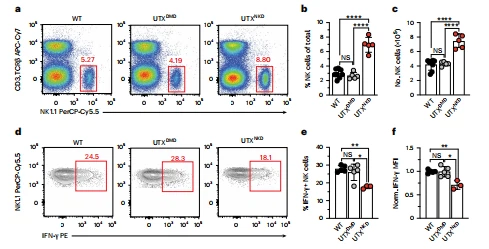
Fig. 5 | UTX controls NK cell homeostasis and IFN-γ production independent of demethylase activity. a–c, Representative density plots (a), frequency (b), and absolute number (c) of NK cells in the spleens of female WT, UTXDMD, and UTXNKD mice (n = 5 per group). d–f, Representative contour plots (d), percentage IFN-γ+ (e), and normalized IFN-γ MFI (f) of female WT, UTXDMD, and UTXNKD NK cells (n = 5 per group) normalized to WT. Data are representative of 2–3 independent experiments. Samples were compared using one-way ANOVA with Tukey's correction for multiple comparisons. Data points are presented as individual mice with the mean ± s.e.m. *P < 0.05; **P < 0.01; ****P < 0.0001. Specific P values are as follows: b: WT versus UTXDMD = 0.7353, WT versus UTXNKD and UTXDMD versus UTXNKD < 0.0001; c: WT versus UTXDMD = 0.4888, WT versus UTXNKD and UTXDMD versus UTXNKD < 0.0001; e: WT versus UTXDMD = 0.855, WT versus UTXNKD = 0.0030, UTXDMD versus UTXNKD = 0.0380; f: WT versus UTXDMD = 0.1382, WT versus UTXNKD = 0.0079, UTXDMD versus UTXNKD = 0.0166.
Considering the genome-wide differences in accessibility and gene expression we observed by ATAC-seq and RNA-seq, we also explored direct UTX-mediated effects. We performed anti-UTX CUT&Tag followed by sequencing, allowing the detection of DNA regions bound to UTX using an antibody-based immunoprecipitation method41. Anti-UTX CUT&Tag on sort-purified WT and UTXNKD NK cells revealed 5,746 UTX-bound peaks (FDR < 0.01, adjusted P value < 0.05; Fig. 6d and Supplementary Data Table 4). PCA of both ATAC-seq and RNA-seq data revealed sample clustering by genotype (Extended Data Fig. 6f). We identified 191 genes that were UTX bound, differentially accessible by ATAC-seq and differentially expressed by RNA-seq (Fig. 6d). Within these 191 genes, a majority of UTX-bound peaks were located in promoter (20.58%), intronic (46.94%) and intergenic (27.4%) regions (Fig. 6e). Noteworthy genes involved in NK cell homeostasis (Bcl2 and Thy1; Fig. 6f) 30,42 and effector function (Ifng and Csf2) were UTX bound, differentially accessible and differentially expressed (Fig. 6g). Moreover, of the 191 UTX-bound genes, 140 genes were decreased in expression, while the remaining 51 genes were increased (Supplementary Data Table 3) corroborating a prior report in T cells that UTX functions in both activating and repressing gene transcription43. Enrichr pathway analysis44 on these 191 UTX-bound genes revealed decreased inflammatory response, IFN-γ signaling and NK cell cytotoxicity pathways in UTXNKD NK cells (Extended Data Fig. 6g). Conversely, increased cellular catabolic process and apoptosis signaling pathways, which include both pro-apoptotic and anti-apoptotic genes (for example, Bcl2, Bbc3 and Gadd45g), were seen in UTXNKD NK cells. Among 865 UTX-bound peaks with UTX-dependent expression and chromatin accessibility differences (191 unique genes), linear regression analysis showed a significant positive correlation (Pearson's R = 0.5165, P < 0.0001) between chromatin accessibility and gene expression (Extended Data Fig. 6h, i). UTX-occupied regions within the Bcl2, Thy1, Ifng, and Csf2 gene loci corresponded with regions in which differences in accessibility and gene expression were also noted (Fig. 6f,g). These data suggest UTX regulates chromatin accessibility and gene transcription pathways important in regulating NK cell homeostasis and function.
UTX is known to interact with transcription factors (TFs) to orchestrate target gene transcription40. To identify putative TF motifs with differential accessibility due to loss of UTX, we performed HOMER (Hypergeometric Optimization of Motif Enrichment)45 TF motif analysis on differentially accessible peaks identified by ATAC-seq (Extended Data Fig. 6j). TFs associated with NK cell effector function (for example, Runt (Runx1 and Runx2)46 and T-box (Eomes, T-bet, Tbr1 and Tbx6)47 family members) were more significant and had a higher percentage of target motifs associated with decreased accessibility in UTXNKD (clusters 1, 2, 3 and 6; Extended Data Fig. 6j). Conversely, TFs associated with proliferation, differentiation and metabolism in the zinc finger and ETS family TFs48 were more significantly associated with increased accessibility (clusters 4 and 5; Extended Data Fig. 6j). Furthermore, TF motif analysis of UTX-bound peaks by UTX CUT&Tag corroborates these results by revealing TFs critical in both NK cell effector processes (T-bet, Eomes, Runx1 and Tbx5) and developmental programs (ETS1 and AP-1; Extended Data Fig. 6k). These data suggest both differential accessibility and direct UTX binding of important TF binding motifs implicated in regulating NK cell fitness and effector processes. These analyses suggest that UTX modulates the chromatin landscape to control the expression of genes important in NK cell homeostasis (Bcl2 and Thy1) and effector function (Ifng and Csf2). Ultimately, these findings suggest a model in which differential UTX expression levels may underlie sexual dimorphism in NK cells as a central regulator of NK cell fitness and effector function (Fig. 6h).

Fig. 6 | Global changes in NK cell chromatin accessibility and transcription mediated by UTX. a–c, 4:1 WT: UTXNKD mBMCs were generated by transferring WT (CD45.1+ ) and UTXNKD (CD45.2+ ) bone marrow into lymphodepleted host mice (CD451x2 ) and allowed to reconstitute for 6 weeks. Splenic NK cells were sorted for ATAC-seq and RNA-seq library preparation (n = 3 per group). Line graphs (left) and heat map (right) of fuzzy c-means clustered differentially accessible peaks identified by ATAC-seq (a) and differentially expressed genes identified by RNA-seq (b) of splenic NK cells from WT: UTXNKD mBMC mice (adjusted P value < 0.05 and membership score > 0.5). Line graphs show the mean (black line) and standard deviation (red ribbon) of mean-centered normalized log2 values of significance (FDR and adjusted P value < 0.05). c, Pathway analysis of significant fuzzy c-means clustered RNA-seq genes using g: Profiler with point size indicating −log10(P value; calculated by g: GOSt using Fisher's one-tailed test). d–g, Anti-UTX CUT&Tag was performed in WT and UTXNKD NK cells and identified 5,746 unique UTX-bound peaks (n = 3 per group). d, Venn diagram outlining overlapping differentially accessible (DA) genes identified by ATAC-seq and differentially expressed (DE) genes identified by RNA-seq. e, Location of UTX-bound peaks. f,g, Representative gene tracks from UCSC Integrated Genome Browser of anti-UTX CUT&Tag ('anti-UTX'), ATAC-seq and RNA-seq of Bcl2 and Thy1 (f) and Ifng and Csf2 (g); y-axis depicts counts per million (CPM). h, Schematic of how differential UTX expression levels underlie sexual dimorphism in NK cell composition and function (left). Diagram of how UTX may be regulating gene programs involved in NK cell numbers and effector function during homeostasis and viral infection (right). Created with BioRender.com.
Discussion
Sex is a critical biological variable in determining outcomes of viral infections3. This was recently illustrated with COVID-19, in which male sex was identified as a major risk factor for severe disease5. Moreover, recent studies have linked NK cell dysfunction to severe COVID-19 disease49. Given the importance of NK cells in antiviral immunity, understanding the root causes of sex differences in NK cell biology will have far-reaching implications in optimizing endogenous effector responses. In this study, we demonstrate that lower UTX expression in male NK cells contributes to their increased numbers and decreased effector functionality. NK cell UTX is required for controlling NK cell fitness, modulating accessibility of TF binding motifs, increasing chromatin accessibility at effector gene loci, and poising NK cells for rapid response to viral infection.
In addition to NK cells, sexual dimorphism has been reported in B cells, monocytes, neutrophils, CD4+ T cells, and CD8+ T cells25. While sex differences in immune cells have previously been reported to be mediated by gonadal sex hormones50–52, it remains possible that a subset of these disparities may also be attributed to differential UTX expression. In support of this possibility, UTX deficiency has been associated with decreased T cell and invariant NK T cell numbers53–55; and UTX transcripts are lower in male versus female cells for multiple immune cell types (CD4+ T cells, CD8+ T cells, monocytes, B cells) queried in the DICE database56. Further phenotypic studies are needed to determine UTX's role in modulating sex differences in other immune cell types. NK cell-mediated effector functions include cytokine production and cytotoxic molecule expression. Our multi-omic analyses suggest that UTX poises the chromatin landscape of NK cells to quickly respond to viral challenges by increasing accessibility and transcription of effector loci. These studies revealed 191 genes (including Ifng and Csf2) 20,32 that were simultaneously bound by UTX, differentially accessible and expressed. Decreased IFN-γ and GM-CSF cytokine production and impaired cytolytic capacity of UTX-deficient NK cells support UTX's role in promoting effector functionality during inflammation. However, there may be additional indirect consequences of UTX-mediated gene regulation that play important roles in NK cell effector function, as evidenced by the additional genes that are differentially expressed but not bound by UTX.
As an H3K27me3 demethylase, UTX poises chromatin for active gene expression57. In addition to its catalytic activity, UTX functions in multiprotein complexes with other epigenetic regulators (for example, SWI/SNF, MLL4/5, and p300) to mediate chromatin remodeling in a demethylase-independent manner36,57. We report the demethylase-independent functions of UTX in regulating homeostasis and effector programs in NK cells. This is in contrast to UTX's role in invariant NK T cells, in which its demethylase activity is required53. Thus, the molecular mechanisms by which UTX functions may be lineage-specific. In support of this hypothesis, UTX has been reported to interact with lineage-specific TFs in T cells to target effector loci40. Our HOMER motif analysis revealed potential UTX interactions with Runx1, Runx2, Eomes, and other TFs important for NK cell effector function during viral infection46,47. Moreover, these analyses also point to UTX interactions with KLF1, KLF5, Sp2, and other TFs associated with NK cell proliferation, differentiation, and metabolism48. Furthermore, our results support previously published studies in which UTX in other cell types has been reported to coordinate responses with T-bet, Eomes, and Tbx5 (ref. 40), ETS1 (ref. 48) and AP-1 (ref.58). Finally, Runx1 has been shown to interact with UTX-regulated BRG1 and SWI/SNF complexes46. However, due to the correlative nature of HOMER analysis, further studies with co-immunoprecipitation and mass spectrometry are needed to experimentally verify these interactions in situ. Furthermore, as a constitutive XCI escapee, UTX may have cell-type-specific mechanisms through two possibilities: (i) pool of cofactors present and (ii) availability of its epigenetic binding partners. UTX relies on byproducts of metabolic pathways for cofactors (for example, Fe(II), α-ketoglutarate, and oxygen) crucial for its enzymatic activity59. Thus, dependent on the metabolic state, there are distinct pools of cofactors accessible for UTX's demethylase function, allowing differential levels of catalytic activity based on the cell type. Additionally, UTX's functionality may also be contingent on the activity and expression level of its binding partners (for example, MLL3/4, SWI/SNF, and p300) which are autosomally encoded.

cistanche benefits for men-strengthen immune system
Weighing factors that define patient subsets with different immune responses will allow us to move past a 'one-size-fits-all' therapeutic approach to a precision medicine paradigm. UTX deficiency has been associated with Kabuki syndrome and Turner syndrome60, two human conditions associated with immune dysregulation and increased infections. Our findings suggest the possibility that UTX deficiency in human NK cells may contribute to decreased viral immunosurveillance observed in these patients, although future work will be needed to support this hypothesis. Moreover, understanding sex differences in NK cell function is required to incorporate sex as a biological factor in treatment decisions. In males with severe viral illness, for instance, enhancing NK cell UTX activity may provide therapeutic benefits. We expect that these insights will be important not only in the setting of viral infections but also in other infections and cancer, where NK cells also play an important role. These findings may also have important implications for adoptive cellular therapies, in which NK cells are the subject of intense interest61.
References
1. Wilkinson, N. M., Chen, H. C., Lechner, M. G. & Su, M. A. Sex differences in immunity. Annu Rev. Immunol. 40, 75–94 (2022).
2. Klein, S. L. & Flanagan, K. L. Sex diferences in immune responses. Nat. Rev. Immunol. 16, 626–638 (2016).
3. Pardue, M.-L. & Wizemann, T. M. Exploring the biological contributions to human health: does sex matter? The National Academies Press https://doi.org/10.17226/10028 (2001).
4. Gianella, S. et al. Sex differences in CMV replication and HIV persistence during suppressive ART. Open Forum Infect. Dis. 7, ofaa289 (2020).
5. Takahashi, T. & Iwasaki, A. Sex differences in immune responses. Science 371, 347–348 (2021).
6. Patin, E. et al. Natural variation in the parameters of innate immune cells is preferentially driven by genetic factors. Nat. Immunol. 19, 302–314 (2018).
7. Huang, Z. et al. Effects of sex and aging on the immune cell landscape as assessed by single-cell transcriptomic analysis. Proc. Natl Acad. Sci. USA 118, e2023216118 (2021).
8. Talebizadeh, Z., Simon, S. D. & Butler, M. G. X chromosome gene expression in human tissues: male and female comparisons. Genomics 88, 675–681 (2006).
9. Fang, H., Disteche, C. M. & Berletch, J. B. X inactivation and escape: epigenetic and structural features. Front. Cell Dev. Biol. 7, 219 (2019).
10. Chen, X. et al. Sex difference in neural tube defects in p53-null mice is caused by differences in the complement of X, not Y genes. Dev. Neurobiol. 68, 265–273 (2008).
11. Smith-Bouvier, D. L. et al. A role for sex chromosome complement in the female bias in autoimmune disease. J. Exp. Med. 205, 1099–1108 (2008).
12. Souyris, M. et al. TLR7 escapes X chromosome inactivation in immune cells. Sci. Immunol. 3, eaap8855 (2018).
13. Hammer, Q., Ruckert, T. & Romagnani, C. Natural killer cell specificity for viral infections. Nat. Immunol. 19, 800–808 (2018).
14. Orange, J. S. Natural killer cell deficiency. J. Allergy Clin. Immunol. 132, 515–525 (2013).
15. Bukowski, J. F., Warner, J. F., Dennert, G. & Welsh, R. M. Adoptive transfer studies demonstrating the antiviral effect of natural killer cells in vivo. J. Exp. Med. 161, 40–52 (1985).
16. Brown, M. G. et al. Vital involvement of a natural killer cell activation receptor in resistance to viral infection. Science 292, 934–937 (2001).
17. Welsh, R. M., Brubaker, J. O., Vargas-Cortes, M. & O'Donnell, C. L. Natural killer (NK) cell response to virus infections in mice with severe combined immunodeficiency. The stimulation of NK cells and the NK cell-dependent control of virus infections occur independently of T and B cell function. J. Exp. Med. 173, 1053–1063 (1991).
18. Bancroft, G. J., Shellam, G. R. & Chalmer, J. E. Genetic influences on the augmentation of natural killer cells during murine cytomegalovirus infection: correlation with patterns of resistance. J. Immunol. 126, 988–994 (1981).
19. Menees, K. B. et al. Sex- and age-dependent alterations of splenic immune cell profile and NK cell phenotypes and function in C57BL/6J mice. Immun. Aging 18, 3 (2021).
20. Mujal, A. M., Delconte, R. B. & Sun, J. C. Natural killer cells: from innate to adaptive features. Annu. Rev. Immunol. 39, 417–447 (2021).
21. Loh, J., Chu, D. T., O'Guin, A. K., Yokoyama, W. M. & Virgin, H. W. T. Natural killer cells utilize both perforin and gamma interferon to regulate murine cytomegalovirus infection in the spleen and liver. J. Virol. 79, 661–667 (2005).
22. Orange, J. S., Wang, B., Terhorst, C. & Biron, C. A. Requirement for natural killer cell-produced interferon-gamma in defense against murine cytomegalovirus infection and enhancement of this defense pathway by interleukin-12 administration. J. Exp. Med. 182, 1045–1056 (1995).
23. Nakaya, M., Tachibana, H. & Yamada, K. Effect of estrogens on the interferon-gamma producing cell population of mouse splenocytes. Biosci. Biotechnol. Biochem. 70, 47–53 (2006).
24. Chiossone, L. et al. Maturation of mouse NK cells is a 4-stage developmental program. Blood 113, 5488–5496 (2009).
25. Wainer Katsir, K. & Linial, M. Human genes escaping X-inactivation revealed by single-cell expression data. BMC Genomics 20, 201 (2019).
26. Yang, F., Babak, T., Shendure, J. & Disteche, C. M. Global survey of escape from X inactivation by RNA-sequencing in mouse. Genome Res. 20, 614–622 (2010).
27. Berletch, J. B. et al. Escape from X inactivation varies in mouse tissues. PLoS Genet. 11, e1005079 (2015).
28. Arnold, A. P. Four core genotypes and XY* mouse models: update on impact on SABV research. Neurosci. Biobehav. Rev. 119, 1–8 (2020).
29. Hasegawa, H. et al. Activation of p53 by Nutlin-3a, an antagonist of MDM2, induces apoptosis and cellular senescence in adult T-cell leukemia cells. Leukemia 23, 2090–2101 (2009).
30. Riggan, L. et al. The transcription factor Fli1 restricts the formation of memory precursor NK cells during viral infection. Nat. Immunol. 23, 556–567 (2022).
31. Min-Oo, G., Bezman, N. A., Madera, S., Sun, J. C. & Lanier, L. L. Proapoptotic Bim regulates antigen-specific NK cell contraction and the generation of the memory NK cell pool after cytomegalovirus infection. J. Exp. Med. 211, 1289–1296 (2014).
32. Louis, C. et al. NK cell-derived GM-CSF potentiates inflammatory arthritis and is negatively regulated by CIS. J. Exp. Med. 217, e20191421 (2020).
33. Bjorkstrom, N. K., Strunz, B. & Ljunggren, H. G. Natural killer cells in antiviral immunity. Nat. Rev. Immunol. 22, 112–123 (2022).
34. Smyth, M. J. et al. Perforin is a major contributor to NK cell control of tumor metastasis. J. Immunol. 162, 6658–6662 (1999).
35. Van der Meulen, J., Speleman, F. & Van Vlierberghe, P. The H3K27me3 demethylase UTX in normal development and disease. Epigenetics 9, 658–668 (2014).
36. Wang, S. P. et al. A UTX-MLL4-p300 transcriptional regulatory network coordinately shapes active enhancer landscapes for eliciting transcription. Mol. Cell 67, 308–321 (2017).
37. Gozdecka, M. et al. UTX-mediated enhancer and chromatin remodeling suppresses myeloid leukemogenesis through noncatalytic inverse regulation of ETS and GATA programs. Nat. Genet. 50, 883–894 (2018).
38. Wang, C. et al. UTX regulates mesoderm differentiation of embryonic stem cells independent of H3K27 demethylase activity. Proc. Natl Acad. Sci. USA 109, 15324–15329 (2012).
39. Shih, H. Y. et al. Developmental acquisition of regulomes underlies innate lymphoid cell functionality. Cell 165, 1120–1133 (2016).
40. Miller, S. A., Mohn, S. E. & Weinmann, A. S. Jmjd3 and UTX play a demethylase-independent role in chromatin remodeling to regulate T-box family member-dependent gene expression. Mol. Cell 40, 594–605 (2010).
41. Kaya-Okur, H. S. et al. CUT&Tag for efficient epigenomic profiling of small samples and single cells. Nat. Commun. 10, 1930 (2019).
42. Kupz, A. et al. Contribution of Thy1+ NK cells to protective IFN-gamma production during Salmonella typhimurium infections. Proc. Natl Acad. Sci. USA 110, 2252–2257 (2013).
43. Langmead, B. & Salzberg, S. L. Fast gapped-read alignment with Bowtie 2. Nat. Methods 9, 357–359 (2012).
44. Chen, E. Y. et al. Enrichr: interactive and collaborative HTML5 gene list enrichment analysis tool. BMC Bioinformatics 14, 128 (2013).
45. Heinz, S. et al. Simple combinations of lineage-determining transcription factors prime cis-regulatory elements required for macrophage and B cell identities. Mol. Cell 38, 576–589 (2010).
46. Rapp, M. et al. Core-binding factor-beta and Runx transcription factors promote adaptive natural killer cell responses. Sci. Immunol. 2, eaan3796 (2017).
47. Simonetta, F., Pradier, A. & Roosnek, E. T-bet and eomesodermin in NK cell development, maturation and function. Front. Immunol. 7, 241 (2016).
48. Presnell, J. S., Schnitzler, C. E. & Browne, W. E. KLF/SP transcription factor family evolution: expansion, diversification and innovation in eukaryotes. Genome Biol. Evol. 7, 2289–2309 (2015).
49. Kramer, B. et al. Early IFN-alpha signatures and persistent dysfunction are distinguishing features of NK cells in severe COVID-19. Immunity 54, 2650–2669 (2021).
50. D'Agostino, P. et al. Sex hormones modulate inflammatory mediators produced by macrophages. Ann. N. Y. Acad. Sci. 876, 426–429 (1999).
51. Lu, F. X. et al. The strength of B cell immunity in female rhesus macaques is controlled by CD8+ T cells under the influence of ovarian steroid hormones. Clin. Exp. Immunol. 128, 10–20 (2002).
52. Singh, R. P. & Bischof, D. S. Sex hormones and gender influence the expression of markers of regulatory T cells in SLE patients. Front. Immunol. 12, 619268 (2021).
53. Cook, K. D. et al. T follicular helper cell-dependent clearance of a persistent virus infection requires T cell expression of the histone demethylase UTX. Immunity 43, 703–714 (2015).
54. Beyaz, S. et al. The histone demethylase UTX regulates the lineage-specific epigenetic program of invariant natural killer T cells. Nat. Immunol. 18, 184–195 (2017).
55. Mitchell, J. E. et al. UTX promotes CD8+ T cell-mediated antiviral defenses but reduces T cell durability. Cell Rep. 35, 108966 (2021).
56. Schmiedel, B. J. et al. Impact of genetic polymorphisms on human immune cell gene expression. Cell 175, 1701–1715 (2018).
57. Bosselut, R. Pleiotropic functions of H3K27Me3 demethylases in immune cell differentiation. Trends Immunol. 37, 102–113 (2016).
58. Kechin, A., Boyarskikh, U., Kel, A. & Filipenko, M. cutPrimers: a new tool for accurate cutting of primers from reads of targeted next-generation sequencing. J. Comput. Biol. 24, 1138–1143 (2017).
59. Hong, S. et al. Identification of JmjC domain-containing UTX and JMJD3 as histone H3 lysine 27 demethylases. Proc. Natl Acad. Sci. USA 104, 18439–18444 (2007).
60. Van Laarhoven, P. M. et al. Kabuki syndrome genes KMT2D and KDM6A: functional analyses demonstrate critical roles in craniofacial, heart, and brain development. Hum. Mol. Genet. 24, 4443–4453 (2015).
61. Rezvani, K. Adoptive cell therapy using engineered natural killer cells. Bone Marrow Transpl. 54, 785–788 (2019).