Trends in The Use Of Botanicals in Anti-Aging Cosmetics Part 3
May 17, 2022
Please contact oscar.xiao@wecistanche.com for more information
2.2.10.Acacia decurrens
Acacia decurrens (black wattle) belong to the Fabaceae family [93]. The lipids from the flower extract are the most used preparation in cosmetic products, providing a skin-conditioning and occlusive action [94]."Acacia decurrens flower wax", which only was found in cosmetic formulations from 2018, contains an association of free fatty alcohols (7%), saturated monoesters (22%), and a large amount of odd-numbered hydrocarbon chains (27%, C27-C33) [94,95]. No data connecting this preparation to an anti-aging benefit were found.
2.3. Botanicals'Anti-Aging Mechanisms
After analyzing the literature regarding each botanical preparation, the ingredients whose anti-aging mechanisms are documented in the scientific literature were categorized and quantified (Figure 2).
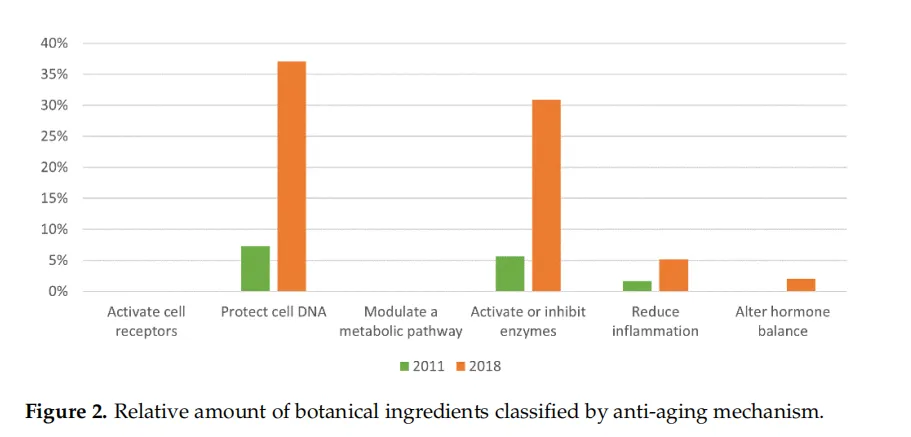
Overall, there was an increase in the use of botanicals with proven anti-aging action from 2011 to 2018. cistanche genghis khan It is noticeable that the most used categories are the same in both years. Botanicals with DNA-protecting action were used more frequently, followed by enzyme-inhibiting ingredients and those with inflammation-reducing action. It is also worth mentioning the emergence of ingredients that alter hormone balance.
The use of botanical ingredients that activate cell receptors and modulate a metabolic pathway appears to be less relevant. Compared with a similar study based on the American market in 2010, only"Vitis vinifera grape seed extract" and"Glycyrrhiza glabra root extract" were mentioned in both studies [13].
Please click here to know more
Evidence for the efficacy and mechanism of action from botanical ingredients is sparse, and it often lacks relevance. cistanche life extension, In addition, the multitude of factors affecting botanical preparations composition, from plantation to the extraction method, adds even greater complexity to this discussion. It is not easy for formulators to choose the most appropriate botanical ingredients for the development of cosmetic products, which ultimately may impact a product's performance. This is not only detrimental to the consumer but also to the manufacturer, which may find it harder to generate and substantiate appealing claims.
Cistanche can anti-aging
3. Materials and Methods
3.1.Data Collection
Data were collected from anti-aging cosmetic products from multination brands marketed in pharmacies and para pharmacies in Portugal. Anti-aging cosmetics were included in the study if they exhibited on the label one of the following words: anti-wrinkle(s); anti-age/anti-aging; wrinkles repair; regenerator; aging; firming. All the information available on the product's label was collected, along with the information available on the menu-facturers'websites. The data collection started in 2011 and was updated with products launched in 2018 or whose composition has been renewed that year, in order to avoid duplicate product analysis and to reflect the market trends. cistanche nz Cosmetics for application on the face, neck, and eve contour were included, comprising more than 40 multinational brands Following these criteria, 280 products were selected, namely 177 and 103 respectively in 2011 and 2018.
3.2. Botanical Preparations Prevalence and Variety
The relative amount of cosmetic products containing anti-aging botanical preparations (expressed in percentage) and the variety of preparations used for each year was determined.
3.3. Top Botanical Species
Each botanical preparation was listed according to its INCI name and then classified according to the botanical's scientific name. The analysis focused on the ten botanical species (Plantae kingdom) with the highest usage frequency among the selected products. The usage frequency for each botanical species was determined by the sum of the number of products containing that specific preparation in both years and then ranked in descending order.
3.4. Evidence for Botanicals Anti-Aging Efficacy
The preparations' composition and respective anti-aging benefits were searched on the following online databases: PubMed, Google Scholar, Scopus, Cochrane, and KOS-MET. Then, the botanical preparations that showed anti-aging activity in clinical trials were grouped according to their mechanisms of action, as described by Hyland Cronin and Zoe Draelos [13]. This classification system categorizes the anti-aging ingredients according to eight distinct mechanisms of action:"modify the skin barrier"(e.g.,smooth skin scale, exfoliate skin scale),"enhance intercellular lipids"(e.g., cholesterol, triglycerides, essential fatty acids, ceramides, natural moisturizing factor),"activate cell receptors"(e.g., retinoids),"protect cell DNA"(e.g., antioxidants, sunscreens),"modulate a metabolic pathway"(e.g.,peptides), "activate or inhibit enzymes"(e.g.,skin-lightening agents),"reduce inflammation"(e.g.,botanic antioxidants, plant sterols), or"alter hormone balance"(soy phytoestrogens).Botanicals that were found to solely modify the skin barrier and/or enhance intercellular lipids were not considered anti-aging active ingredients. Those categories are not specific to the anti-aging segment, which is why these ingredients may be used in a given formulation because of their occlusive/emollient or viscosity modifying actions. Therefore, their inclusion as anti-aging active ingredients could bias this study.

4. Conclusions
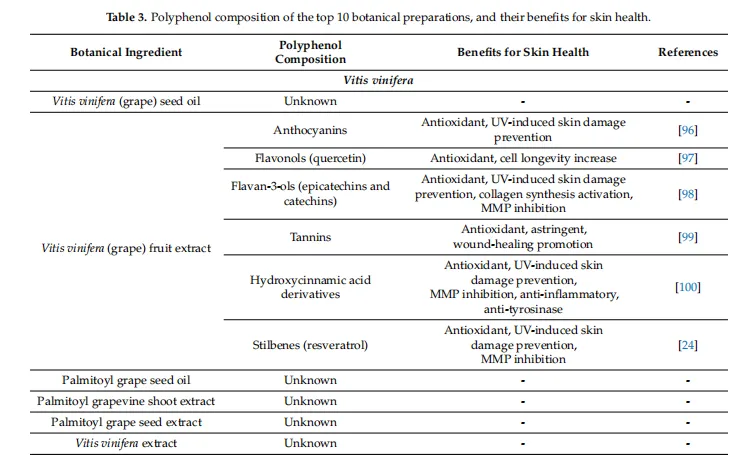
The cosmetic industry is always evolving, and the competition together with the need to meet consumers' preferences requires constant product development and reformulation. Nature-derived ingredients are increasingly popular. The prevalence of botanical preparations in the composition of anti-aging products has increased from 2011 to 2018. During this period, Vitis vinifera, Butyrospermum parkii, and Glycine soja have remained in the pole positions. These three plant species, together with Theobroma cacao and Glycyrrhiza glabra, have shown to be effective as anti-aging active ingredients. These botanical preparations stand out for their content in compounds with interest for anti-aging cosmetics, and their efficacy has been shown both in vitro and in vivo. cistanche penis size It is noteworthy that all these preparations contain polyphenols, mostly flavonoids, but also stilbenes. Among the various flavonoid families,flavan-3-ols were the most frequently found in the top 10 botanical preparations, followed by proanthocyanidins, anthocyanins, flavonols, isoflavones, and tannins. On the other hand, botanical species such as Simmondsia Chinensis, Helianthus annuus, Calendula officinalis, Limnanthes alba, and Acacia decurrens have insufficient or non-existing data supporting their use as anti-aging actives, and they are likely to be incorporated in formulations for their emollient or rheological-modifying properties.
Regarding the function of the botanical preparations studied, it is clear there is a preference for DNA-protecting ingredients, followed by ingredients that are able to activate or inactivate enzymes and inflammation-reducing ingredients. It is noteworthy that ingredients that alter hormone imbalance have reached the top 10 only in 2018, which may predict a trend for the coming years. cistanche powder In conclusion, despite the widespread use of botanical ingredients in anti-aging cosmetics, only a few preparations were studied for their anti-aging effectiveness, mainly using in vitro tests. In vivo randomized controlled trials are needed to strengthen the evidence for the use of botanicals as anti-aging active ingredients. 5. Limitations
Over the period of seven years, the noticed changes in the use of botanical preparations could have been influenced by the methodology used, since data collection in 2018 has focused only on new and renewed formulations, which might have resulted in the study of different brands across the years.
In addition, botanical preparations' properties are related to a wide variety of environmental factors and maturation degrees, as well as the extraction methods. Even though some botanicals possessed a well-documented anti-aging activity, the efficacy of the final product also depends on the formulation. Several variables can greatly affect the efficacy of formulations containing botanical active ingredients such as their concentration and release, the presence of penetration enhancers, or special skin delivery systems, but also botanical preparations' stability and their interaction with other ingredients of the formulation.
This article is extracted from Molecules 2021, 26, 3584. https://doi.org/10.3390/molecules26123584 https://www.mdpi.com/journal/molecules