When Physical Chemistry Meets Circular Economy To Solve Environmental Issues: How The ReScA Project Aims At Using Waste Pyrolysis Products To Improve And Rejuvenate Bitumens Part 2
Jun 28, 2023
4. Preliminary Results: RDF as a Case Study
In this section, preliminary results on the characterization of bio-oil and char produced through RDF pyrolysis, selected as a case study, at different final temperatures, and their feasible use as rheological modifiers, rejuvenating agents, and antioxidant agents are reported.
Glycoside of cistanche can also increase the activity of SOD in heart and liver tissues, and significantly reduce the content of lipofuscin and MDA in each tissue, effectively scavenging various reactive oxygen radicals (OH-, H₂O₂, etc.) and protecting against DNA damage caused by OH-radicals. Cistanche phenylethanoid glycosides have a strong scavenging ability of free radicals, a higher reducing ability than vitamin C, improve the activity of SOD in sperm suspension, reduce the content of MDA, and have a certain protective effect on sperm membrane function. Cistanche polysaccharides can enhance the activity of SOD and GSH-Px in erythrocytes and lung tissues of experimentally senescent mice caused by D-galactose, as well as reduce the content of MDA and collagen in lung and plasma, and increase the content of elastin, have a good scavenging effect on DPPH, prolong the time of hypoxia in senescent mice, improve the activity of SOD in serum, and delay the physiological degeneration of lung in experimentally senescent mice With cellular morphological degeneration, experiments have shown that Cistanche has the good antioxidant ability and has the potential to be a drug to prevent and treat skin aging diseases. At the same time, echinacoside in Cistanche has a significant ability to scavenge DPPH free radicals and has the ability to scavenge reactive oxygen species and prevent free radical-induced collagen degradation, and also has a good repair effect on thymine free radical anion damage.

Click on Where Can I Buy Cistanche
【For more info:george.deng@wecistanche.com / WhatApp:86 13632399501】
The RDF used as the first feedstock for pyrolysis testing was provided by Calabra Maceri S.p.A. (Rende, CS, Italy).
The RDF was pyrolyzed in a tubular lab-scale quartz reactor under fast pyrolysis conditions (heating rate 30 ◦C/min) at three different final temperatures (550 ◦C, 650 ◦C, 750 ◦C). The final temperatures have been selected based on the TG profiles reported in Figure 3.
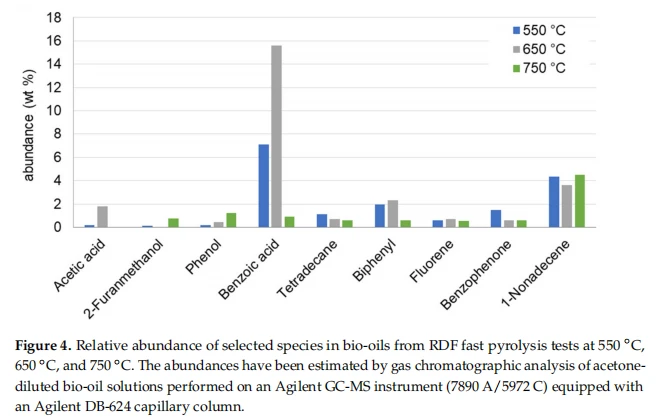
Figure 4 highlights the chemical composition of bio-oils collected after each pyrolysis test. As can be seen, the chemical composition of the bio-oil depends on the pyrolysis final temperature. It is interesting to note that the presence of specific compounds (for example, fluorene and 1-nonadecene) is scarcely influenced by the pyrolysis temperature, while other compounds (benzoic acid, for instance) are characterized by amounts that can vary as a consequence of a temperature change. This aspect is related to the occurrence of secondary reactions at high temperatures, leading to the decomposition of more reactive compounds [52].
When using char as a bitumen filler in asphalt preparation, the relevant char features to take into account are the composition, the surface chemistry, and the textural and morphological properties. These chemical-physical and morphological characteristics greatly affect the chemical interactions between the char particles (acting as a filler) and the macromolecules forming the bitumen. These influence the stability and/or the mechanical properties of the asphalt [27,68]. By acting on pyrolysis conditions, the possibility of influencing the chemical composition of the char can be achieved. For this reason, it becomes advisable to optimize the whole process by varying the pyrolysis conditions in such a way that the relative quantities of the desired pyrolysis products and their compositions match as much as possible those of the additives for asphalts.
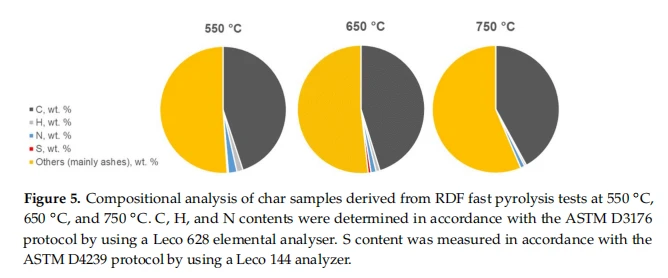
Figure 5 evidences the influence of the final temperature on the chemical composition of char obtained from RDF fast pyrolysis. The results for the final temperatures of 550 ◦C, 650 ◦C, and 750 ◦C are reported.
To demonstrate the feasibility of the usage of the liquid and solid products from pyrolysis tests as bitumen additives, bio-oil, and char produced by the pyrolysis of a wood-based RDF supplied by Calabria Maceri S.p.A. (Rende, CS, Italy), have been tested at two different temperatures (550 ◦C and 750 ◦C):
• neat bio-oil (P-Oil) obtained from a pyrolysis test at 750 ◦C (temperature test allowing for the highest yield of the liquid fraction);
• neat char, (P-C1) obtained from a pyrolysis test at 550 ◦C (temperature test allowing for the highest yield of the solid fraction);
• a 50:50 w/w mixture of P-Oil and P-C1 (P-C2).

The modified bitumen samples were prepared by adding 2 wt.% of the three additives to different aliquots of a neat bitumen. The bitumen used was a 50/70 penetration grade bitumen kindly supplied by Polyglass SpA (Ponte di Piave, TV, Veneto, Italy) and derived from a crude oil originating from Saudi Arabia, asphaltene content 32.4 wt.%.
Time cure tests to evaluate how the additive addition can change the mechanical properties of a given bitumen were performed. In particular, the effectiveness of their use as a rheological modifier, as a rejuvenating agent, and as an antioxidant agent was evaluated. Rheology time cure tests were performed with a temperature ramp at a constant heating rate of 1 ◦C/min (tan δ = G00 /G0 ) [69] under the regime of a small amplitude oscillatory shear at a frequency of 1Hz using a dynamic stress-controlled rheometer (SR5, Rheometric Scientific, Piscataway, NJ, USA) equipped with a parallel plate geometry (gap 2 mm, diameter 25 mm), and the temperature was controlled by a Peltier element (uncertainty ±0.1 ◦C). These conditions are those generally adopted for accurate studies on bitumen mechanical properties [70,71].
The time cure test results are reported in Figure 6.
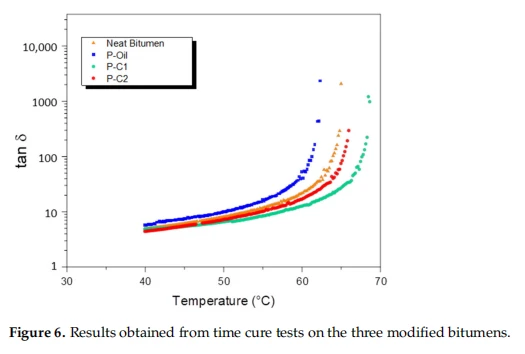
P-Oil can lower the transition temperature of the neat bitumen. This is an expected result because as far as it is known, only an oily compound has a softening ability, so bio-oil can be considered a bituminous fluxing agent. Conversely, P-C1 and P-C2, showing a moderate modifying action, might be used as bituminous conglomerates fillers.
All the additive formulations were also tested as anti-aging agents. In Table 1, the transition temperatures of bitumens modified by P-Oil, P-C1, and P-C2, before and after the aging procedure, are reported.

The rheological analysis showed that P-Oil is the only additive that can be used as a bituminous antioxidant. Its tan δ tends to resist the hardening induced by oxidation.
The effect of pyrolysis-derived additives on the oxidized bitumen (aging simulated by the standard procedure of RTFOT, according to the standard protocol ASTM D2872) is shown by the mechanical spectra (results of time cure tests) reported in Figure 7.
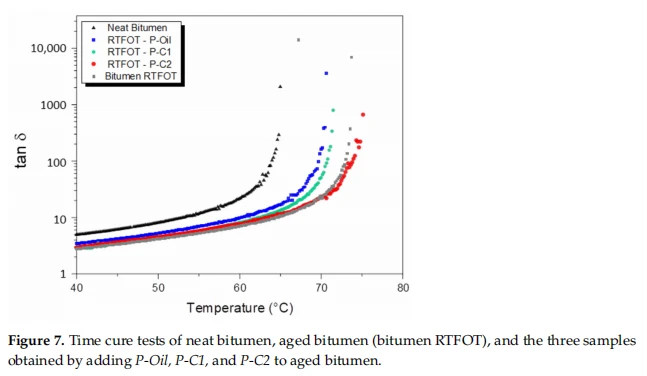
As widely demonstrated in the literature, to understand the real regenerative capacity of an additive, it is necessary to make a preliminary rheological analysis. Since the tan δ trend is similar to that for virgin bitumen, it is possible to claim that this additive might act as a rejuvenating agent [68].
According to the results in Figure 6, P-Oil and P-C1 seemed to have the ability to rejuvenate the aged bitumen since both showed an intermediate rheological behavior between the virgin and aged samples. On the other hand, P-C2 had a profile almost similar to that of the aged bitumen, so the possibility of using it as a bituminous regenerator is excluded.
These preliminary tests demonstrated that the pyrolysis products act in different ways when integrated into the formulation of bitumen, and they can also effectively act as rejuvenating agents.
This work is expected to have important impacts, in both technological and social fields, with beneficial effects on the economy, as detailed in the next section.
5. Expected Impacts in Technological, Social, and Economic Fields
The approach proposed by the ReScA project is expected to impact the quality of people’s lives, fostering technological, economic, and social development.
The focus on the pyrolysis process foresees related advantages: the production of energy vectors, smaller dimensions of treatment plants and their cleaning sections, with consequent lower investment costs, and in general, greater global efficiencies, as well as operating flexibility and reduced greenhouse gas emissions.
In the vision of the ReScA project, RDF is not used to produce energy (“quaternary recovery”, according to the European waste hierarchy introduced by the waste directive (Dir. 2008/98/EC) and recently amended in the Circular Economy Package of 4/7/2018), but as a starting point for added-value materials recovery (“tertiary recovery”) to be used for the production of asphalts.
From the technological point of view, the use of char to enhance bitumen is a promising strategy to exploit the use of carbonaceous nanoparticles as modifiers since, at present, their application, despite the advantageous results achieved on fullerenes, nanotubes, and graphene-related materials [25,26], is limited due to the high production costs. The availability of carbonaceous particles at a low cost and with high performance as bitumen enhancers will explode studies in this sector. It has been predicted that the bitumen modified with char will have a greater resistance to cracking and rutting phenomena occurring at both high and low temperatures. This greater resistance to thermal fluctuations would undoubtedly offer greater safety for motorists and a drastic reduction in road maintenance activities. Moreover, it can be stated that the use of char as a modifier for asphalt, in addition to giving better mechanical performance and an increase in shelf life, can also lead to significant advantages in the regeneration phase. Indeed, the use of bio-oil for the regenerative purposes of aged asphalt could reasonably be effective in establishing synergistic effects with the char already present in the improved asphalt. The hydrocarbon molecules present as a fraction of the bio-oil are chemically similar to the carbonaceous particles of char, offering an enhanced rejuvenating effect, thanks to adsorption and chemical interaction phenomena. This would represent a breakthrough in the use of multi-functional and multi-effect additives, providing safer, longer-lasting, easy-to-regenerate roads with reduced maintenance and production costs. A study conducted in 2008 [72] estimated that the energy consumption reduction would be about 23% if the asphalt was reused for the construction of new road pavements. This result is by those obtained by a project financed by the European Community [73] and highlights the environmental advantages of the reuse of exhaust asphalts (a lower release of heavy metals and polycyclic aromatic hydrocarbons (PAHs)).
The recent work of Moins et al. [19] indeed, demonstrated through LCA studies that concerning the total economic and environmental impact of the asphalt industry:
- bitumen production is the main hotspot and accounts for 12% to 41% of the environmental impact and 10% to 39% of the economic impact;
- the virgin aggregates supply has an economic impact from 5% to 16%;
- the transport of raw materials contributes between 10% and 24% to the environmental impact and between 6% to 14% to the economic impact;
- plant operation activities have an economic impact from 12% to 24%;
- the energy use in asphalt mixture production has an environmental impact ranging between 11% and 24%.

The approach suggested by ReScA pointed towards a reduction in the consumption of bitumen for the production of any new asphalts and would boost the strategies for the regeneration of aged asphalts, thus limiting exhaust asphalt landfilling and new asphalt production. All this, therefore, would lead to a reduced and rationalized use of petroleum materials and derivatives, as well as aggregates and sands, constituent elements of asphalt extracted from natural resources, achieving economic returns, resource preservation, and landscape and environmental protection.
6. Conclusions and Future Perspectives
The simultaneous coupling and closing of waste pyrolysis and asphalt cycles have been proposed. In this approach, the solid (char) and liquid (bio-oil) residues of waste pyrolysis can be used as added-value ingredients to (i) produce improved asphalts, with increased performances for motorists’ safety and with an increased life-cycle, and (ii) regenerate exhaust asphalt. In this way, a virtuous mechanism where urban wastes are no longer disposed to landfills has been individuated. In addition, the asphalt's prolonged life cycle and the possibility to regenerate asphalt with pyrolysis-derived oil will reduce waste, slowing down landfilling. Of course, the pyrolysis conditions (temperature, temperature ramp, duration of thermal treatment) are all factors that can be tuned to optimize the pyrolysis process to obtain residues with ad-hoc characteristics for asphalt technology. The benefit of this approach is also to be seen from a circular economy perspective. Sustainable development is pursued through research and innovation and the improvement of infrastructures. To increase the knowledge on process development, scientists, policymakers, and entrepreneurs must work together to develop new and innovative approaches to waste reuse that address both safety and sustainability.
The overall perspective of the ReScA project is to contribute to the recovery of added-value materials through the valorization of wastes and their exploitation as additives for improved bitumens and asphalt production. The main goal of the ReScA project is to pursue both process sustainability and environment protection by taking these into account for all levels of the production cycle, namely from the limitation of waste disposal in the environment to the development of new protocols for bitumens and asphalt production and management.
The choice of pyrolysis, an extremely promising and flexible thermochemical conversion technology (but not yet consolidated on a global scale) will allow the verification of its potential and applicability in terms of sustainability and the framework of the circular economy paradigm.
The proposed idea integrates the urban waste transformation process with that of asphalt production, leading to:
- the promotion of cleaner technologies for the use of urban wastes;
- the production of road materials with improved properties from the reuse of urban wastes;
- alternative applications of pyrolysis products (liquids and solids) outside of the fuel and chemicals industries;
- the reduction of the costs for the construction of safer and longer-lasting road pavements and those related to maintenance activities;
- the integration of systems and processes;
- the optimization of low-cost processes by operating on the parameters involved;
- energy saving and environmental protection (LCA analysis indicates that the chemical recycling of plastic wastes through pyrolysis has a climate change impact 42% lower than the energy recovery option) [10].
These aspects are by the community policies dealing with the circular economy approach, the Sustainable Development Goals pillars, and the Kyoto Protocol, since they pursue the security of energy supply, sustainable use of urban solid wastes, the reduction of gaseous emissions, landscape, and environmental protection, and the limited consumption of resources. The recovery and reuse of wastes are strongly encouraged since wastes are considered a source of new functional materials.
The use of char to enhance bitumen properties, exploiting the char composition and characteristics that are very close to those of the carbonaceous nanoparticles currently used for this purpose (fullerenes, nanotubes, and graphenes) [26], is a very promising strategy, first of all, because a fine modulation of char morphological and functional characteristics (granulometry and porosity, to name a few) can be obtained by operating on the pyrolysis process parameters. These interesting potentials would make char an excellent candidate to replace fullerenes, nanotubes, and graphenes, which, despite being recently considered as very valid additives for bitumen due to their high performance-enhancing abilities [26], currently have a very limited application due to their high production costs [25].
To conclude, one aspect of complex systems physics has to be considered: it is known that often, different additives yield an overall effect that is not the sum of the two single effects, but the result of synergistic effects [74]. Therefore, the simultaneous use of char and bio-oil can enlarge the scenario of beneficial effects in bitumens. For these reasons, the ReScA project will foster future developments in the use of multi-functional and multi-effect additives, a quite novel field in bitumen and asphalt technology. The benefits achievable through safer, longer-lasting roads, with reduced maintenance and production costs, and with an overall reduction of wastes to be disposed into landfills, would be indisputable.

Author Contributions: P.C. (Paolino Caputo)—investigation; P.C. (Pietro Calandra)—writing and editing, supervision, funding acquisition; V.L.—investigation; A.L.P.—methodology; A.-M.P.—investigation; A.A.A.—writing; L.M.—investigation; B.T.—conceptualization; M.L.L.—methodology; M.A.— writing and editing, funding acquisition; V.G.—investigation, writing, and editing; G.R.—investigation, writing, and editing; C.O.R.—funding acquisition, methodology. All authors have read and agreed to the published version of the manuscript.
Funding: This research was funded by (i) Fondo per la crescita sostenibile—Sportello Fabbrica intelligente, PON I&C 2014-2020, Progetto n.F/190182/00/X44, CUP:B21B19000680008 COR:1460220, and by (ii) @CNR Project ReScA, “Recupero degli scarti da pirolisi di rifiuti urbani per potenziare e ripristinare asfalti,” decision of Administration Council dated 21 Dicembre 2021.
Acknowledgments: Financial support from the CNR-RA Romania bilateral project 2020–2022 (proposal n. 4657/2019) is acknowledged: it permitted fruitful discussions. The help of Renata Migliaccio (CNRSTEMS) and Massimo Urciuolo (CNR-STEMS) in performing pyrolysis tests is kindly acknowledged.
References
1. Khan, A.H.; Lopez-Maldonado, E.A.; Khan, N.A.; Villarreal-Gomez, L.J.; Munshi, F.M.; Alsabhan, A.H.; Perveen, K. Current solid waste management strategies and energy recovery in developing countries—State of the art review. Chemosphere 2022, 291, 133088. [CrossRef] [PubMed]
2. Onur, O.; Niziolek, A.M.; Hasan, M.F.; Floudas, C.A. Municipal solid waste to liquid transportation fuels—Part 1: Mathematical modeling of a municipal solid waste gasifier. Comput. Chem. Eng. 2014, 71, 636–647.
3. Adella, L.; Tuscano, J. Contesto Europeo. In Rapporto Rifiuti Urbani—Edizione 2021; ISPRA: Rome, Italy, 2021; ISBN 978-88-448-1084-9.
4. Gandidi, I.M.; Susila, M.D.; Rustamaji, H. Effect of natural zeolite and kaolin as a catalyst in the isothermal-catalytic cracking of real municipal solid waste (MSW) for bio-oil production. Iop Conf. Ser. Earth Environ. Sci. 2018, 160, 012018. Available online:
5. Le Courtois, A. Municipal solid waste: Turning a problem into a resource. In Waste: The Challenges Facing Developing Countries; Urban Specialist, World Bank: Washington, DC, USA, 2012; pp. 2–4.
6. Arinal, H.; Gandidi, I.M.; Harmen, B. Integrated System for Municipal Solid Waste Management. University of Lampung, Bandarlampung, Indonesia. 2010.
7. Mohajan, H.K. Dangerous Effects of Methane Gas in Atmosphere. Int. J. Econ. Political Integr. 2012, 2, 3–10.
8. Sipra, A.T.; Gao, N.; Sarwar, H. Municipal solid waste (MSW) pyrolysis for bio-fuel production A review of effects of MSW components and catalysts. Fuel Process. Technol. 2018, 175, 131–147. [CrossRef]
9. Morris, J. Recycle, bury, or burn wood waste biomass? LCA's answer depends on carbon accounting, emissions controls, displaced fuels, and impact costs. J. Ind. Ecol. 2017, 21, 844–856. [CrossRef]
10. Jeswani, H.; Krüger, C.; Russ, M.; Horlacher, M.; Antony, F.; Hann, S.; Azapagic, A. Life cycle environmental impacts of chemical recycling via pyrolysis of mixed plastic waste in comparison with mechanical recycling and energy recovery. Sci. Total Environ. 2021, 769, 144483. [CrossRef]
11. Farooq, A.; Haputta, P.; Silalertruksa, T.; Gheewala, S.H. A Framework for the Selection of Suitable Waste to Energy Technologies for a Sustainable Municipal Solid Waste Management System. Front. Sustain. 2021, 2, 681690. [CrossRef]
12. Aguado, J.; Serrano, D.P.; Guillermo, S.M.; Madrid, S. Feedstock recycling of polyethylene in a two-step thermo-catalytic reaction system. J. Anal. Appl. Pyrolysis 2007, 79, 415–423. [CrossRef]
13. McKendry, P. Energy production from biomass (part 1): Overview of biomass. Bioresour. Technol. 2002, 83, 37–46. [CrossRef]
14. Hossain, A.K.; Davies, P.A. Pyrolysis liquids and gases as alternative fuels in internal combustion engines–A review. Renew Sustain. Energy Rev. 2010, 21, 165–189. [CrossRef]
15. Neuwahl, F.; Cusano, G.; Benavides, J.G.; Holbrook, S.; Roudier, S. Best Available Techniques (BAT) Reference Document for Waste Incineration: Industrial Emissions Directive 2010/75/EU (Integrated Pollution Prevention and Control); Publications Office of the European Union: Luxembourg, 2019; ISBN 978-92-76-12993-6.
16. Abnisa, F.; Daud, W.M.A.W. A review on co-pyrolysis of biomass: An optional technique to obtain a high-grade pyrolysis oil. Energy Convers. Manag. 2014, 87, 71–85. [CrossRef]
17. European Asphalt Pavement Association—EAPA. Asphalt in Figures 2018; EAPA: Brussels, Belgium, 2018.
18. Tarsi, G.; Tataranni, P.; Sangiorgi, C. The Challenges of Using Reclaimed Asphalt Pavement for New Asphalt Mixtures: A Review. Materials 2020, 13, 4052. [CrossRef]
19. Moins, B.; Hernando, D.; Buyle, M.; France, C.; van den Bergh, W.; Audenaert, A. On the road again! An economic and environmental break-even and hotspot analysis of reclaimed asphalt pavement and rejuvenators. Resour. Conserv. Recycle. 2022, 177, 106014. [CrossRef]
20. Abdy, C.; Zhang, Y.; Wang, J.; Yang, Y.; Artamendi, I.; Allen, B. Pyrolysis of polyolefin plastic waste and potential applications in asphalt road construction: A technical review. Resour. Conserv. Recycle. 2022, 180, 106213. [CrossRef]
21. Available online: https://ec.europa.eu/environment/strategy/circular-economy-action-plan_it (accessed on 4 February 2022).
22. Gudde, N.; Larivé, J.-F.; Yugo, M. CO2 Reduction Technologies. In Opportunities within the EU Refining System (2030/2050) Concawe Special Task Force Refinery 2050 (STF-2) Report n◦ 8/19; Concawe: Brussels, Belgium, 2019.
23. Geissdoerfer, M.; Savaget, P.; Bocken, N.M.; Hultink, E.J. The Circular Economy–A new sustainability paradigm? J. Clean. Prod. 2017, 143, 757–768. [CrossRef]
24. Hasan, M.R.M.; Chew, J.W.; Jamshidi, A.; Yang, X.; Hamzah, M.O. Review of sustainability, pretreatment, and engineering considerations of asphalt modifiers from the industrial solid wastes. J. Traffic Transp. Eng. 2019, 6, 209–244.
25. Caputo, P.; Porto, M.; Angelico, R.; Loise, V.; Calandra, P.; Oliviero Rossi, C. Bitumen and asphalt concrete modified by nanometer-sized particles: Basic concepts, the state of the art and future perspectives of the nanoscale approach. Adv. Colloid Interface Sci. 2020, 285, 102283. [CrossRef]
26. Calandra, P.; Loise, V.; Porto, M.; Oliviero Rossi, C.; Lombardo, D.; Caputo, P. Exploiting Nanoparticles to Improve the Properties of Bitumens and Asphalts: At What Extent Is It Worth It? Appl. Sci. 2020, 10, 5230. [CrossRef]
27. Loise, V.; Caputo, P.; Porto, M.; Calandra, P.; Angelico, R.; Oliviero Rossi, C. A Review on Bitumen Rejuvenation: Mechanisms, Materials, Methods, and Perspectives. Appl. Sci. 2019, 9, 4316. [CrossRef]
28. Zhao, S.; Huang, B.; Ye, X.P.; Shu, X.; Jia, X. Utilizing bio-char as a bio-modifier for asphalt cement: A sustainable application of bio-fuel by-product. Fuel 2014, 133, 52–62. [CrossRef]
29. Gupta, S.; Kua, H.K.; Koh, H.J. Application of biochar from food and wood waste as a green admixture for cement mortar. Sci. Total Environ. 2018, 619–620, 419–435. [CrossRef]
30. Naskar, M.; Chaki, T.K.; Reddy, K.S. Effect of waste plastic as a modifier on thermal stability and degradation kinetics of bitumen/waste plastics blend. Thermochim. Acta 2010, 509, 128–134. [CrossRef]
31. Huang, W.; Guo, Y.; Zheng, Y.; Ding, Q.; Sun, C.; Yu, J.; Zhu, M.; Yu, H. Chemical and rheological characteristics of rejuvenated bitumen with typical regeneration agents. Constr. Build. Mater. 2021, 273, 121525. [CrossRef]
32. Taborda, E.A.; Franco, C.A.; Ruiz, M.A.; Alvarado, V.; Cortés, F.B. Experimental and Theoretical Study of Viscosity Reduction in Heavy Crude Oils by Addition of Nanoparticles. Energy Fuels 2017, 31, 1329–1338. [CrossRef]
33. Das, O.; Sarmah, A.K.; Bhattacharyya, D. Structure–mechanics property relationship of waste derived biochars. Sci. Total Environ. 2015, 538, 611–620. [CrossRef]
34. Zhang, R.; Dai, Q.; You, Z.; Wang, H.; Peng, C. Rheological Performance of Bio-Char Modified Asphalt with Different Particle Sizes. Appl. Sci. 2018, 8, 1665. [CrossRef]
35. Gan, X.; Zhang, W. Application of biochar from crop straw in asphalt modification. PLoS ONE 2021, 16, e0247390. [CrossRef]
36. Calandra, P.; Caputo, P.; de Santo, M.P.; Todaro, L.; Turco Liveri, V.; Oliviero Rossi, C. Effect of additives on the structural organization of asphaltene aggregates in bitumen. Constr. Build. Mater. 2019, 199, 288–297. [CrossRef]
37. Rajib, A.; Saadeh, S.; Katawal, P.; Mobasher, B.; Fini, E.H. Enhancing Biomass Value Chain by Utilizing Biochar as A Free Radical Scavenger to Delay Ultraviolet Aging of Bituminous Composites Used in Outdoor Construction. Resour. Conserv. Recycle. 2021, 168, 105302. [CrossRef]
38. Kumar, A.; Choudhary, R.; Kumar, A. Characterization of thermal storage stability of waste plastic pyrolytic char modified asphalt binders with sulfur. PLoS ONE 2021, 16, e0248465. [CrossRef] [PubMed]
39. Petersen, J.C. Chemical composition of asphalt as related to asphalt durability: State of the art Transport. Transp. Res. Rec. 1984, 999, 13–30.
40. Vasilyev, V.V.; Salamatova, E.V.; Maidanova, N.V.; Kalinin, M.V.; Strakhov, V.M. Change in Properties of Roadmaking Bitumen on Oxidation. Coke Chem. 2020, 63, 307–314. [CrossRef]
41. Deygout, F. Volatile emissions from hot bitumen storage tanks. Environ. Prog. Sustain. Energy 2011, 30, 102–112. [CrossRef]
42. Boczkaj, G.; Przyjazny, A.; Kami ´ski, M. Characteristics of volatile organic compounds emission profiles from hot road bitumens. Chemosphere 2014, 107, 23–30. [CrossRef]
43. Soenen, H.; Lu, X.; Laukkanen, O.V. Oxidation of bitumen: Molecular characterization and influence on rheological properties. Rheol. Acta 2016, 55, 315–326. [CrossRef]
44. Roberts, F.L.; Kandhal, P.S.; Brown, E.R.; Lee, D.Y.; Kennedy, T.W. Hot Mix Asphalt Materials, Mixture Design and Construction, 2nd ed.; NAPA: Lanham, MD, USA, 1996.
45. Asli, H.; Ahmadinia, E.; Zargar, M.; Karim, M.R. Investigation on physical properties of waste cooking oil–Rejuvenated bitumen binder. Constr. Build. Mater. 2012, 37, 398–405. [CrossRef]
46. Dedene, C.D.; You, Z. The performance of aged asphalt materials rejuvenated with waste engine oil. Int. J. Pavement Res. Technol. 2014, 7, 145–152.
47. Loise, V.; Caputo, P.; Porto, M.; Teltayev, B.; Angelico, R.; Oliviero Rossi, C. Unravelling the role of a green rejuvenator agent in contrasting the aging effect on bitumen: A dynamics rheology, nuclear magnetic relaxometry, and self-diffusion study. Colloids Surf. A Physicochem. Eng. Asp. 2020, 603, 125182. [CrossRef]
48. Calandra, P. On the physicochemical basis of self-nano segregation giving magnetically-induced birefringence in dibutyl phosphate/bis(2-ethylhexyl) amine systems. J. Mol. Liq. 2020, 310, 113186. [CrossRef]
49. Ren, Y.; Zhang, L.; Duan, W.; Han, Z.; Guo, J.; Heydenrych, M.D.; Zhang, A.; Nie, K.; Tan, T.; Liu, L. Performance of bitumen coating sheet using biomass pyrolysis oil. J. Air Waste Manag. Assoc. 2020, 70, 219–227. [CrossRef]
50. Ebru, A.; Ahmet, D. Energy content estimation of municipal solid waste by multiple regression analysis. In Proceedings of the International Advanced Technologies Symposium, Karabük, Turkey, 13–15 May 2009; pp. 1–4.
51. Ari, D.P.; Kilbergen, W.; Gultom Aryadi, S. Final Report of Feasibility Study; Bandung Institute of Technology: Bandung, Indonesia, 2007; pp. 8–57.
52. Giudicianni, P.; Gargiulo, V.; Grottola, C.M.; Alfè, M.; Ferreiro, A.I.; Mendes, M.; Fagnano, M.; Ragucci, R. Inherent Metal Elements in Biomass Pyrolysis: A Review. Energy Fuels 2021, 35, 5407–5478. [CrossRef]
53. Zhang, G.; Chen, F.; Zhang, Y.; Zhao, L.; Chen, J.; Cao, L.; Gao, J.; Xu, C. Properties and utilization of waste tire pyrolysis oil: A mini-review. Fuel Process. Technol. 2021, 211, 106582. [CrossRef]
54. Miandad, R.; Barakat, M.A.; Aburiazaiza, A.S.; Rehan, M.; Ismail, I.M.I.; Nizami, A.S. Effect of plastic waste types on pyrolysis liquid oil. Int. Biodeterior. Biodegrad. 2017, 119, 239–252. [CrossRef]
55. Honus, S.; Kumagai, S.; Fedorko, G.; Molnár, V.; Yoshioka, T. Pyrolysis gases produced from individual and mixed PE, PP, PS, PVC, and PET—Part I: Production and physical properties. Fuel 2018, 221, 346–360. [CrossRef]
56. Honus, S.; Kumagai, S.; Molnár, V.; Fedorko, G.; Yoshioka, T. Pyrolysis gases produced from individual and mixed PE, PP, PS, PVC, and PET—Part II: Fuel characteristics. Fuel 2018, 221, 361–373. [CrossRef]
57. Wijayanta, A.T.; Alam, M.S.; Nakaso, K.; Fukai, J. Numerical investigation on combustion of coal volatiles under various O2/CO2 mixtures using a detailed mechanism with soot formation. Fuel 2012, 93, 670–676. [CrossRef]
58. Wijayanta, A.T.; Alam, M.S.; Nakaso, K.; Fukai, J.; Shimizu, M. Optimized combustion of biomass volatiles by varying O2 and CO2 levels: A numerical simulation using a highly detailed soot formation reaction mechanism. Bioresour. Technol. 2012, 110, 645–651. [CrossRef]
59. Lu, P.; Huang, Q.; Bourtsalas, A.C.; Chi, Y.; Yan, J. Experimental research of basic properties and reactivity of waste derived chars. Appl. Therm. Eng. 2017, 119, 639–649. [CrossRef]
60. Hasan, M.M.; Rasul, M.G.; Khan, M.M.K.; Ashwath, N.; Jahirul, M.I. Energy recovery from municipal solid waste using pyrolysis technology: A review on current status and developments. Renew. Sustain. Energy Rev. 2021, 145, 111073. [CrossRef]
61. Cai, J.; He, Y.; Yu, X.; Banks, S.W.; Yang, Y.; Zhang, X.; Yu, Y.; Liu, R.; Bridgwater, A.V. Review of physicochemical properties and analytical characterization of lignocellulosic biomass. Renew. Sustain. Energy Rev. 2017, 76, 309–322. [CrossRef]
62. Stepien, P.; Serowik, M.; Koziel, J.A.; Białowiec, A. Waste to Carbon: Estimating the Energy Demand for Production of Carbonized Refuse-Derived Fuel. Sustainability 2019, 11, 5685. [CrossRef]
63. Rezaei, H.; Panah, F.Y.; Lim, C.J.; Sokhansanj, S. Pelletization of Refuse-Derived Fuel with Varying Compositions of Plastic, Paper, Organic, and Wood. Sustainability 2020, 12, 4645. [CrossRef]
64. Gerassimidou, S.; Velis, C.A.; Williams, P.T.; Komilis, D. Characterisation and composition identification of waste-derived fuels obtained from municipal solid waste using thermogravimetry: A review. Waste Manag. Res. 2020, 38, 942–965. [CrossRef]
65. Arnal, C.; Alfè, M.; Gargiulo, V.; Ciajolo, A.; Alzueta, M.U.; Millera, A.; Bilbao, R. Characterization of Soot. In Cleaner Combustion: Green Energy and Technology; Battin-Leclerc, F., Simmie, J., Blurock, E., Eds.; Springer: London, UK, 2003.
66. Parlouër, P.L. Thermal analysis and calorimetry techniques for catalytic investigations. In Calorimetry and Thermal Methods in Catalysis; Springer: Berlin/Heidelberg, Germany, 2013; pp. 51–101.
67. Perugini, F.; Mastellone, M.L.; Arena, U. A Life Cycle Assessment of Mechanical and Feedstock Recycling Options for Management of Plastic Packaging Wastes. Environ. Prog. 2005, 24, 137–154. [CrossRef]
68. Loise, V.; Calandra, P.; Abe, A.A.; Porto, M.; Oliviero Rossi, C.; Davoli, M.; Caputo, P. Additives on aged bitumens: What probe to distinguish between rejuvenating and fluxing effects? J. Mol. Liq. 2021, 339, 116742. [CrossRef]
69. Hunter, R.; Self, A.; Read, J. The Shell Bitumen Handbook, 6th ed.; ICE Publishing: London, UK, 2015.
70. Caputo, P.; Porto, M.; Calandra, P.; de Santo, M.P.; Oliviero Rossi, C. Effect of epoxidized soybean oil on mechanical properties of bitumen and aged bitumen Molecular Crystals and Liquid. Crystals 2018, 675, 68–74. [CrossRef]
71. Remišová, E.; Zatkaliková, V.; Schlosser, F. Study of Rheological Properties of Bituminous Binders in Middle and High Temperatures. Civ. Environ. Eng. 2018, 12, 13–20. [CrossRef] 72. Chiu, C.T.; Hsu, T.H.; Yang, W.F. Life cycle assessment on using recycled materials for rehabilitating asphalt pavements. Resour. Conserv. Recycle. 2008, 52, 545–556. [CrossRef]
73. Re-road–End-of-life strategies of asphalt pavements. Eur. Comm. DG Res.
74. Calandra, P.; Caschera, D.; Turco Liveri, V.; Lombardo, D. How self-assembly of amphiphilic molecules can generate complexity in the nanoscale. Colloids Surf. A Physicochem. Eng. Asp. 2015, 484, 164–183. [CrossRef]
【For more info:george.deng@wecistanche.com / WhatApp:86 13632399501】