How Calcium treat luoride-induced kidney damage?
Mar 16, 2022
Contact: Audrey Hu Whatsapp/hp: 0086 13880143964 Email: audrey.hu@wecistanche.com
Keywords: Calcium, Kidney, Apoptosis
ABSTRACT
Long-term excessive intake of fluoride (F) can cause osseous and non-osseous damage. The kidney is the main fluoride excretion organ of the body. This study aimed to explore whether dietary calcium supplementation can alleviate kidney damage caused by fluorosis and to further investigate the effects of Calcium on the mitigation mechanism of kidney cell apoptosis triggered by F. We evaluated the histopathological structure, kidney function indicators, and gene and protein expression levels of death receptor-mediated apoptosis pathways in Sprague Dawley (SD) rats treated with sodium fluoride (NaF) and/or calcium carbonate (CaCO3) for 120 days. The results showed that 100 mg/L NaF induced kidney histopathological injury and apoptosis, increased the concentrations of Creatinine (CRE), uric acid (UA), blood urea nitrogen (BUN), potassium (K), phosphorus (P), and F (p < 0.05), and decrease the level of serum magnesium (Mg) (p < 0.05). Moreover, NaF increased the mRNA and protein expression levels of Fas cell surface death receptor (FAS), tumor necrosis factor (TNF), TNF-related apoptosis-inducing ligand (TRAIL), Caspase 8, Caspase 3, and poly ADP-ribose polymerase (PARP) (p < 0.01), which finally activated the death receptor pathway. Inversely, Calcium supplementation reversed the decrease of CRE, BUN, UA, F, and P levels induced by F, alleviated histopathological damage and apoptosis, and reduced the gene and protein expression levels of death receptor pathway-related markers. In conclusion, 1% Calcium alleviates F-induced kidney apoptosis through FAS/FASL, TNFR/TNF, DR5/TRAIL signaling pathways.

Introduction
Fluorine is widely present in the soil, water, and food. However, some natural factors (weathering of minerals and rocks, formation of calcium and magnesium salts, infiltration of groundwater, etc.) and human activities (industrial wastewater, agrochemicals, household products, etc.) cause fluorine pollution in the environment (Daiwile et al., 2019). At present, the biggest factor of exposure to fluoride (F) is drinking water, and the recommended concentration of F in drinking water by the World Health Organization is less than 1.5 mg/L (Guidelines for Drinking-Water Quality, 2017). Epidemiological evidence suggests that higher than this concentration increases the risk of dental fluorosis, and the increasing concentration will increase the risk of skeletal fluorosis (Guidelines for Drinking-Water Quality, 2017; National Research Council, 2006). Long-term expos to high concentrations of fluoride can increase the body’s absorption of fluorine through the respiratory
and digestive tracts. Excessive intake of F can cause damage to bony and non-bony organs of the body. Soft tissue damage outside the bone is generally referred to as non-bony damage. At present, it has been found that the damage of non-bone tissue caused by F involves the digestive tract, liver, kidney, brain, etc. (Jha et al., 2011; Perumal et al., 2013).
The kidney, the main excretory organ of the body, is responsible for the metabolism of toxic substances and exogenous toxins in the body. Studies have reported that about 50–80% of the fluoride ingested by the body is filtered and reabsorbed by the kidneys, and the remaining fluorine is accumulated in other tissues and organs (Chen et al., 2013; Dharmaratne, 2019). Many kinds of literature have demonstrated that 50 and 100 mg/L F exposure can lead to enlargement of the kidney capsule cavity, atrophy of kidney tubules, irregular arrangement of papillary cells, narrowing of the lumen, resulting in apoptosis of kidney cells and deterioration of biochemical functions such as creatinine (CRE), uric acid (UA), calcium (Ca), and phosphorus (P) (Song et al., 2014; H.W. Wang et al., 2020; Wei et al., 2018a).
Apoptosis, a kind of cell death controlled by genes, which is divided into endogenous apoptosis and exogenous apoptosis. Recent reports have indicated that apoptosis caused by high F mainly includes mitochondria-mediated, the endoplasmic reticulum is stress-mediated, and death receptor-mediated pathways (Wei et al., 2018a). Previous experiments in our group pointed out that NaF induces bone and liver apoptosis through the intracellular endoplasmic reticulum (ER) pathway and mitochondrial pathway (Li et al., 2021; J. Wang et al., 2020; Wang et al., 2019). In addition, studies have also shown that the mitochondrial pathway is involved in NaF-induced apoptosis of mouse kidneys (Wei et al., 2018b). However, there is no systematic study on the death receptor-mediated pathway in F-induced kidney apoptosis. The death receptor pathway dominates every stage of exogenous apoptosis, including the Fas cell surface death receptor (FAS) pathway, tumor necrosis factor (TNF) pathway, and TNF-related apoptosis-inducing ligand (TRAIL) pathway (Grunert et al., 2012; Lu et al., 2017; Wang and Su, 2018). FAS pathway is the primitive signal transduction system that mediates apoptosis. FAS has the characteristics of a membrane receptor and forms a trimer after binding with the FAS ligand (FAS-L). Then the specific domain of the trimer binds with the death domain (DD) of the corresponding connexin molecule FAS-associated death domain protein (FADD) to form a death-induced signal complex (DISC) (Wang and Su, 2018). In the following biological signal transduction process, FADD can activate Caspase 8 and Caspase family at the same time, and eventually lead to apoptosis through the participation of Caspase 3 and poly ADP-ribose polymerase (PARP) effect (Kischkel et al., 2000; Meynier and Rieux-Laucat, 2019). Recent studies have shown that the FAS pathway mediates apoptosis in T cells and during kidney failure induced by cisplatin (Djiadeu et al., 2017; Linkermann et al., 2011). In addition, a study has also reported that NaF induces apoptosis in mice through the FAS pathway (Sun et al., 2017). TRAIL is a recognized cytokine in the TNF superfamily. It binds to its homologous agonist receptors, namely death receptors (DR4 and DR5). There is a DD in its cellular region. The DD is necessary for the recruitment of adaptive protein FADD. FADD in turn induces the release of Caspases into the cytoplasm, activated Caspase 3 cleaves PARP, and inhibits its DNA repair potential, resulting in apoptosis (Bodmer et al., 2000; Micheau, 2018). It has been implied that the TRAIL/DR5 pathway is involved in NaF-induced apoptosis in mice (Song et al., 2021). Osteoprotegerin (OPG) is a free soluble receptor that lacks a transmembrane domain. It can restrain TRAIL-mediated apoptosis by inhibiting the binding of TRAIL and other death receptors (Duiker et al., 2006; Kiraz et al., 2016; Micheau, 2018). The binding of TNF and TNF receptor (TNF-R1) can activate the recruitment of TNFR-associated death domain (TRADD) protein through its DD. Whereafter, TRADD interacts with FADD, leading to the recruitment of pro-Caspase 8, which is cleaved into active Caspase 8 by proteolytic enzymes. Caspase 8 then activates Caspase 3, which is responsible for cell apoptosis (Kiraz et al., 2016; Sedger and McDermott, 2014). It is reported that NaF induces hepatocyte apoptosis in mice through the TNF-R1 signal pathway (Lu et al., 2017)
Calcium plays various roles in the composition of bones and teeth, and it also can control nerve transmission and material release (Cao et al., 2016), participate in systemic calcium homeostasis (Carmeliet et al., 2003; Yang et al., 2016), change membrane permeability (Lappe et al., 2017), activate the secretion of a variety of enzymes and hormones (Kim et al., 2012), etc. Many previous studies have found that F and Ca have an antagonistic effect in biology (Dure-Smith et al., 1996; Nobrega et al., 2019). Once F is absorbed by the body, it will enter the blood to form insoluble CaF2 precipitates. If the dietary supply of Ca is insufficient and the blood Ca does not reach the due level, there will be pathological changes such as hypocalcemia and osteolysis, so a dietary supplement of Ca plays an important role in preventing and improving fluorosis (Dure-Smith et al., 1996; Li et al., 2021; Yang et al., 2021). Our group has confirmed that dietary calcium can alleviate the apoptosis of bone and liver through the PI3K-AKT signal pathway, ER pathway, and mitochondrial pathway (Li et al., 2021; J. Wang et al., 2020; Wang et al., 2019; Yang et al., 2021). In order to further prove whether Calcium attenuates the nephrotoxicity of F through the death receptor-mediated apoptosis pathway, we established a rat model of high fluoride diet calcium and evaluated the kidney injury index, the degree of apoptosis, and the changes of marker gene and protein expression in the death receptor-mediated apoptosis pathway.

Materials and methods
Chemicals and instruments
Distilled water was prepared by Heal Force water purification System (Shanghai, China). Radio immunoprecipitation assay (RIPA) lysis buffer and Sodium fluoride (NaF) were provided by Sigma-Aldrich (Shanghai, China). 10% formalin, Glycine, sodium dodecyl sulfate (SDS), TRIS, Phenylmethylsulfonyl fluoride (PMSF), CaCO3, nitrocellulose (NC) membrane, Bicinchoninic Acid (BCA) Kit and hematoxylin-eosin (H&E) staining kit were obtained from Solarbio Technology Co., Ltd. (Beijing, China). Trizol reagent was acquired from Takara Biological Engineering Company (Dalian, China). CRE, UA, blood urea nitrogen (BUN), magnesium (Mg), P, and potassium (K) kits were purchased from Nanjing Jiancheng Bioengineering Institute (Nanjing, China). In situ apoptosis detection kit, FAS Rabbit Polyclonal antibody (BA0484), and FAS-L Rabbit Polyclonal antibody (PB0042) were purchased from Boster Biotechnology (Wuhan, China). β-actin Rabbit Polyclonal antibody (20536-1-AP), FADD Rabbit Polyclonal antibody (14906-1-AP), Caspase 8 Rabbit Polyclonal antibody (13423-1-AP), Caspase 3 Rabbit Polyclonal antibody (19677-1-AP), and HRPconjugated Affinipure Goat Anti-Rabbit IgG(H+L) (SA00001–2) were acquired from Proteintech Group (Wuhan, China). TRAL Rabbit Polyclonal Antibody (bs-1214R), TNF alpha Rabbit Polyclonal antibody (bs2081R), PARP Rabbit Polyclonal Antibody (bs-55164R) were purchased from Bioss (Beijing, China). Electrochemical luminescence (ECL) and 3,3′-diaminobenzidine (DAB) were purchased from KeyGen Biotech (Jiangsu, China). PrimeScript® RT Master Mix and SYBR® Premix Ex Taq™ II Kit were provided by Promega Biotechnology (Beijing, China).
Animals and treatments
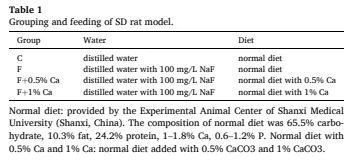
Forty healthy 4-week-old male Sprague-Dawley (SD) rats (120 ± 20 g) were obtained from the Experimental Animal Center of Shanxi Medical University (Shanxi, China). The rats were acclimatized for one week, randomly divided into four groups (10 rats per group): Control group (C), NaF group (F), NaF + 0.5% CaCO3 group (F + 0.5% Ca), NaF + 1% CaCO3 group (F + 1% Calcium) and treated as Table 1. All rats were housed in plastic cages at 22–25 ◦C (55 ± 5% humidity, 12 h light/dark cycle), diet and drinking water are freely accessible.
After 17 weeks of rearing, rats fasted for 24 h, and water was free to drink. Then the rats were anesthetized with sodium pentobarbital and sacrificed by cervical dislocation after the blood was collected from eyeballs. Some blood was collected by the tubes containing anticoagulant heparin sodium for the BUN test. Part of the blood was put into common test tubes, placed at room temperature for 2 h, and then centrifuged at 3000 rpm/min for 10 min to separate serum. The serum was separated for CRE, UA, Mg, P, K, and F tests. Eight samples of kidneys from each group were randomly selected and quickly frozen in liquid nitrogen, and then stored at − 80 ◦C for qRT-PCR and western blotting experiments. The other samples of kidneys were fixed in 10% formalin for histopathological examination and terminal deoxynucleotidyl transferase-mediated dUTP nick end labeling (TUNEL) experiments. All animal-related experimental operations were strictly implemented under the regulations of the Animal Care Institution and the Use Committee of Shanxi Agricultural University, Shanxi, China.
Kidney coefficient
The rats were weighed first; then the kidney tissue was removed and weighed. The kidney coefficient was obtained by the following formula.
Kidney coefficient = [kidney wet weight (g) / body weight (g)] ×100%.
Histopathological examination
Kidney specimens were embedded in paraffin. Section (5 μm thickness) of the kidney was stained by H&E. Then, the slides were observed using a light microscope (Olympus, Tokyo, Japan). The severity of the kidney injury was judged by histopathological score. Kidney tubular injury is defined as the kidney corpuscles being atrophied and deformed, the kidney capsule cavity widened, the kidney tubules forming a cast, and epithelial cells falling off. At 200 times magnification, the following criteria were used to evaluate the degree of liver injury. 1: 0–25% damage; 2: 25–50% damage; 3: 50–75% damage; 4: 75–100% damage (Baranova et al., 2016).
Determination of kidney-related indicators
The level of F was measured by an F ion-specific electrode (Quadri et al., 2018). The levels of CRE, UA, BUN, Mg, P, and K were measured by using commercially available kits. All related procedures were performed according to the manufacturer’s instructions.
Detection of apoptosis level by TUNEL
In order to quantify the apoptosis in kidney cells, experimental analysis was performed by using a situ apoptosis detection kit. The kidney sections were deparaffinized and then subjected to digestion by using Proteinase K. Terminal Deoxynucleotidyl Transferase can mark digoxin-labeled dUTP (DIG-dUTP) to the 3′-OH end, and DIG-dUTP binds to the DNA breakpoint after reacting with the biomarker anti-dig-Biotin. Combined with DAB was added to display. For visualizing
all the nuclei, the sections were counterstained with hematoxylin. Dark brown signals indicate positive cells and blue indicates unresponsive cells. The apoptosis index was calculated according to the following formula.
The proportion of apoptotic cells = (number of apoptotic cells per node / total number of cells per node) ×100%.
Quantitative real-time PCR (qRT-PCR)
Total RNA from the kidney was extracted by using Trizol reagent. We used an ND-1000 spectrophotometer (nano-drop, USA) and agarose gel electrophoresis to check the quality and quantity of the RNA. Reverse transcription (RT) was performed on 500 ng total RNA through using PrimeScript® RT Master Mix. Specific primers for β-actin and FAS, TRAIL, TNF, and other genes were designed by Primer Premier 7.0 software (Table 2) and synthesized by Sangon Biotech (Shanghai, China). Quantstudio 7 flex real-time PCR system (thermo-fisher, USA) and SYBR® Premix Ex Taq™ II Kit were used for RT-PCR. The PCR reaction volume was 20 μL, and the RT-PCR conditions were: 95 ◦C 10
min, 40 cycles of 95 ◦C 15 s, 55 ◦C 30 s, 72 ◦C 30 s, and finally one cycle of 95 ◦C 15 s, 60 ◦C 15 s, 95 ◦C 15 s. All reactions were repeated three times. The relative 2-ΔΔCt method was used to calculate the relative mRNA expression levels, and β-actin was used as a calibrator. In the process, the efficiency difference is less than 5%.

Total protein extraction and western blotting analysis
The kidney tissue was washed with PBS, dried with filter paper, and decomposed in RIPA lysis (containing PMSF), at 12,000 rpm/min, 4 ◦C for 10 min. Protein concentration was determined by using the Bicinchoninic Acid (BCA) Kit (Solarbio Science & Technology, Beijing, China). 35 ng protein sample was successfully extracted and separated on 8% SDS-polyacrylamide gel by electrophoresis. The target protein was transferred to an NC membrane, and the NC membrane was blocked with 5% non-fat milk at room temperature for 2 h. After that, the NC membrane was incubated with primary antibodies of β-actin (1:1000), TRAIL (1:500), FAS (1:500), FAS-L (1:100), TNF (1:500), FADD (1:500), Caspase 8 (1:500), Caspase 3 (1:500) and PARP (1:1000) at 4 ℃ overnight. After washing 3 times with PBST, the NC membrane was incubated with HRP-conjugated secondary goat anti-rabbit IgG antibodies (1:2000) at room temperature for 2 h. ECL was used to visualize the target protein bands. Optical density was calculated by AlphaView software (version: 3.2.2.0) on the FluorChem Q system (Alpha Innotech, CA, USA).
Statistical analysis
GraphPadPrism-7 software was used to organize and analyze the experimental data, and each data was represented by mean ± SEM. The significance of the difference between means was determined by analysis of variance (ANOVA) followed by Tukey’s test with P < 0.05 being considered significant.
Results
Alterations in kidney coefficient and biochemical function indicators
The kidney coefficient and the levels of F, CRE, BUN, UA, Mg, P, K was shown in Fig. 1. In comparison with the C group, the kidney coefficient was significantly decreased in the F group (p < 0.05). However, the kidney coefficient in the F+ 1% Calcium group showed a significant increase as compared with the F group (p < 0.05). The F level in the F group was markedly higher than in the C group (p < 0.001). Interestingly, compared to the F group, the F level in the F+ 1% Ca group was significantly decreased (p < 0.01).


CRE, BUN, and UA were evaluated to reflect the degree of kidney damage and functional change. The levels of CRE, BUN, and UA were distinctly increased in the F group as compared to those in the C group (p < 0.05), However, relative to the F group, the above three indicators were notably decreased in the F+ 1% Calcium group (p < 0.05). Mg, P and K were the electrolyte indicators closely related to kidney function. Compared with the C group, the level of serum Mg was significantly decreased, the levels of P and K were dramatically increased in the F group (p < 0.05). Nevertheless, adding 1% calcium to the diet notably increased the serum Mg levels by 15.3% (p < 0.05) and markedly reduced the serum P levels by 16.9% (p < 0.05). The content of serum K has shown a downward trend with no significance after supplement 1% Ca treatment.
Changes in kidney morphology
The morphological changes of kidney tissue were examined by H&E (Fig. 2I-Ⅳ, ⅰ-ⅳ). In the C group, kidney tubular cells were compactly arranged, the morphology was regular, and the morphology of glomeruli was intact. However, the boundaries between cells were unclear, the kidney corpuscles were atrophied and deformed, the kidney capsule cavity widened, the kidney tubules formed a cast, and epithelial cells became detached in the F group. In comparison to the F group, with the increase of Calcium concentration, the arrangement of kidney cells gradually became more orderly, the morphology of kidney corpuscles gradually recovered, and the degree of injury was gradually alleviated. In addition, we evaluated the damage by using the kidney score (Fig. 2Ⅴ). The score of the F group was significantly higher than that of the C group (p < 0.01); nevertheless, the score in F+ 1% Calcium group decreased markedly when compared to the F group (p < 0.05).

TUNEL detects kidney cell apoptosis
We performed the TUNEL assay to detect and analyze whether kidney cells have undergone apoptosis in this study (Fig. 3I-Ⅳ, ⅰ-ⅳ). Kidney tissues in the C group were neatly arranged, with fewer apoptotic cells (4.67 ± 1.15%). The F group showed a large number of TUNEL-positive kidney tubular epithelial cells (48.17 ± 3.94%). In contrast, the F+ 1% Calcium group displayed a dramatic decrease in the number of TUNEL-positive cells (28.83 ± 4.81%) (Fig. 3Ⅴ).
Effects of Calcium on F-induced alterations in death receptor pathway-related genes
The relative mRNA expression levels of upstream factors related to the death receptor-mediated apoptosis pathway (TRAIL, DR5, TNF, TNFR1, TNF-R2, FAS, FAS-L, OPG) were revealed in Fig. 4a. Relative to the C group, the mRNA expression levels of TRAIL, DR5, TNF, TNF-R1, TNFR2, FAS, and FAS-L were notably enhanced in F-treated rats (p < 0.01). In contrast, the relative mRNA expressions of TRAIL, TNF, TNF-R2, FAS, and FAS-L were markedly reduced in the F + 1% Calcium group as compared with the F group (p < 0.05). In comparison to the C group, an obvious decrease in the mRNA expression levels of OPG in the F group was observed (p < 0.01). However, relative to the F group, OPG in the F + Calcium groups were increased. Downstream factors FADD, TRADD, Caspase 8, Caspase 3, and PARP relative mRNA expression levels were shown in Fig. 4b. The protein expressions of FADD, TRADD, Caspase 8, Caspase 3, and PARP were obviously enhanced in the F group as compared with the C group (p < 0.01), but were obviously reduced in the F + Calcium groups, as compared with the F group (p < 0.05).
Effects of Calcium on F-induced alterations in apoptosis-related proteins
The protein expression of TRAIL, FAS, FAS-L, TNF, FADD, Caspase 8, Caspase 3, and PARP were detected by Western blotting (Fig. 5a, b). Compared to the C group, the protein expressions of TRAIL, FAS, FAS-L, TNF, FADD, Caspase 8, Caspase 3, and PARP in the F group were markedly elevated (p < 0.01). The protein expressions of all the above factors were notably decreased in the F + 1% Calcium group when compared to the F group (p < 0.05).
Discussion
Most recent evidence proved that F can cause lesions to soft tissues, and the degree of F damage depends on the concentration of F, exposure time, and organ type (Wei et al., 2019). In this study, 100 mg/L NaF was used for 17 weeks to establish a drinking water subacute NaF exposure animal model. The dosage of NaF is selected according to the pollution degree of F in the environment and the uncertain factors of different species. Given that the natural F- concentration measured in local groundwater is about 4.5 mg/L, the distilled water with 100 mg/L NaF used in this study (the F- concentration is about 45 mg/L) was calculated according to uncertain factor for animal-to-human extrapolation at 10 (Guidelines for Drinking-Water Quality, 2017; Mukherjee and Singh, 2021; Wen et al., 2013; Zhang et al., 2020). Early studies have found that dietary calcium can affect the absorption of fluorine, promote the excretion of fluorine in the body, reduce the absorption rate of fluorine, and thus reduce the toxicity of F (Harrison et al., 1984; Larsen et al., 1981). Our recent experimental studies have shown that Ca alleviates F-induced bone and liver injury by inhibiting the intrinsic pathway of apoptosis (Li et al., 2021; J. Wang et al., 2020; Wang et al., 2019). However, so far, the research on the protective effect of Ca on F-induced nephrotoxicity and its related mechanism is unprecedented. Here, we report that Ca alleviates F-induced kidney damage. In addition, we also found that Ca reverses F-induced kidney cell apoptosis through the death receptor-mediated apoptosis pathway (FAS/FASL, TNFR/TNF, DR5/TRAIL pathways). The long-term accumulation of F in the kidney can lead to tissue structure and functional damage. In this study, we found that NaF exposure caused kidney cell apoptosis in rats, accompanied by glomerular atrophy and deformation, kidney capsule cavity widening, kidney tubules forming casts, and epithelial cells falling off. However, kidney damage was significantly alleviated after supplementation of 1% Ca. These results were similar to the results obtained in previous reports (Cao et al., 2015; H.W. Wang et al., 2020).
CRE is the metabolite of muscle, UA is the final product of purine metabolism, and BUN is the main end product of the body’s protein metabolism, which is excreted by glomerular filtration and is usually used to detect kidney function (Myers et al., 2006; H.W. Wang et al., 2020). The biochemical survey of the high F region showed that the glomerular filtration rates were significantly reduced, and F, UA, and BUN changed significantly (Malin et al., 2019). The animal tests showed that serum CRE, Calcium, and P concentrations were significantly reduced in mice exposed to 100 mg/L NaF, suggesting that F disturbed kidney function as well as Ca and P metabolism (H.W. Wang et al., 2020). F-induced nephrotoxicity is related to kidney dysfunction. When kidney function deteriorates, the excretion of F in the body is reduced, leading to excessive accumulation of fluorine in the kidney and aggravating F toxicity (Kido et al., 2017). When the kidneys are severely impaired, the
excretion of F in the urine decreases, and serum F concentration further increases (Dharmaratne, 2019). In this study, we observed that the levels of BUN and serum CRE, UA, P, K in rats treated with 100 mg/L NaF increased significantly, suggesting that high F exposure caused changes in kidney biochemical indicators in rats and led to kidney insufficiency. Furthermore, we also pointed out that the various indicators of the kidney tend to be normal after Calcium supplementation. It shows that Ca (especially 1% Calcium) has a significant alleviating effect on F-induced kidney damage in rats.

Cistanche can help with kidney damage.
Apoptosis is an autonomous and orderly cell death controlled by genes, which is characterized by DNA degradation without obvious cell lysis. This study observed that fluorosis caused kidney cell apoptosis in rats. FAS plays a major role in the occurrence of apoptosis and various diseases. Recent literature revealed that FAS mediates apoptosis in the kidney induced by ischemia-reperfusion and human leukocytes apoptosis induced by N-nitrosodimethylamine (Iwaniuk et al., 2019; Xu
et al., 2019). When FAS and FAS-L combine to form a trimer, the pro-apoptotic signal is triggered. A recent study has shown that F induces cell apoptosis through the FAS/FAS-L pathway (Xu et al., 2011). In this study, F significantly increased the mRNA and protein expression of FAS and FAS-L in the kidney. The up-regulation of FAS and FAS-L levels suggests that FAS/FAS-L-related apoptotic pathways may be involved in F-induced apoptosis. FAS/FAS-L trimer recruitment of FADD leads to the cleavage of Pro-Caspase 8 to produce active Caspase 8, which in turn activates Caspase 3 and then leads to apoptosis (Li et al., 2011; Xu et al., 2011). This study verified that 100 mg/L NaF induced apoptosis in rat kidneys through the FAS/FAS-L pathway. The most important result is that dietary Ca supplementation attenuates the apoptosis-inducing effect of F, which is attributed to down-regulation of FAS/FAS-L activation and secondary activation of Caspases.
TNF is a pleiotropic cytokine that participates in a wide range of cellular responses, including differentiation, proliferation, inflammation, and cell death. The TNF signal triggers both apoptosis and anti-apoptotic pathways. Many kinds of literature have reported that TNF dominates lipopolysaccharide-induced kidney damage and cisplatin-induced acute kidney injury (Lee et al., 2016; Li et al., 2018). TNF binds to TNF-R1, its DD recruits TRADD, and then TRADD interacts with FADD, leading to the formation of the DISC (Kiraz et al., 2016; Sun et al., 2003). Studies have revealed that F can induce liver, neuron, and kidney leukocyte apoptosis through the TNF signaling pathway (Lu et al., 2017; Singh et al., 2017; Yan et al., 2016). Similar to the results of these reports, the relative expressions of TNF, TNF-R1, TNF-R2, and TRADD in the F group were significantly increased in this experiment. By contrast, the expression of these genes decreased significantly after the 1% Calcium supplement, suggesting the intervention of Calcium in the TNF pathway.
TRAIL is involved in the regulation of apoptosis, proliferation, immune-inflammatory response, etc. At present, it is believed that TRAIL is closely related to the occurrence and prognosis of kidney disease (Candido, 2014). More and more literature has confirmed that TRAIL regulates the apoptosis of kidney tubular epithelial cells in HBV-associated glomerulonephritis and kidney apoptosis in Uromodulin-associated kidney disease (Johnson et al., 2017; Yang et al., 2018). Further, a study reported that the expression of TRAIL was generally altered during the homeostasis and various kidney injuries (Devarapu et al., 2017). TRAIL attaches to the death receptor DR5 and recruits FADD through the interaction of the DD, and then binds to pro-Caspase 8 through the death effect domain existing in FADD to form a DISC (Yuan et al., 2018). This study showed that the expression of TRAIL and DR5 were significantly increased in the F group. After supplementing with Calcium, the expression of TRAIL and DR5 was inhibited. It is suggested that Calcium inhibits the TRAIL pathway to reduce F-induced apoptosis.

Conclusion
100 mg/L NaF exposure activated death receptor-mediated apoptosis pathway (FAS/FASL, TNFR/TNF, DR5/TRAIL pathways) and then induced kidney cell apoptosis in rats, causing kidney metabolic disorders and kidney insufficiency, resulting in the kidney corpuscles were atrophied and deformed, the kidney capsule cavity widened, the kidney tubules formed a cast. However, the addition of 1% Calcium to the diet decreased the blood fluoride content, further alleviated the kidney metabolic disorder and kidney insufficiency through the death receptor-mediated pathway, and significantly reduced the kidney injury (component Fig. 6).
References
The source is by Haojie Li, College of Veterinary Medicine, Shanxi Agricultural University, Taigu 030801, Shanxi, PR China and etc.