A Food‑As‑Medicine (Medicine–Food Homology) Composition For Improving Kidney Yang Deficiency–Related Fatigue (Symptoms) And Its Preparation Method
Oct 19, 2026
Abstract
This invention belongs to the technical field of health foods (nutraceuticals), and specifically relates to a medicine–food homology composition designed to improve fatigue associated with Kidney Yang deficiency (a sub‑health state commonly characterized by persistent low energy, poor endurance, cold intolerance, and delayed recovery).
By mass parts, the raw materials of the composition comprise:
Prepared Rehmannia (Rehmanniae Radix Praeparata) polysaccharides: 2–3.5 parts
Cistanche (Cistanches Herba) polysaccharides: 0.7–1.5 parts
Cornus officinalis (Corni Fructus) polysaccharides: 0.2–0.5 parts
Cinnamon bark (Cinnamomi Cortex) polysaccharides: 0.4–1.2 parts
Dried ginger (Zingiberis Rhizoma): 6–10 parts
Goji berry (Lycii Fructus): 3–10 parts
Stir‑fried Chinese yam (Dioscoreae Rhizoma, stir‑fried with wheat bran): 3–9 parts
Honey‑processed licorice (Glycyrrhizae Radix et Rhizoma Praeparata cum Melle): 3–6 parts
The invention uses scientific compatibility and a modernized preparation approach to form a functional formula suitable for daily dietary intake, aiming to help regulate physiological functions, enhance anti‑fatigue capacity, and improve the sub‑health state of Kidney Yang deficiency fatigue symptoms. It reflects the Traditional Chinese Medicine concept of "treating disease before it arises" and provides an innovation resource with both scientific rationale and traditional heritage for the modern functional food industry.
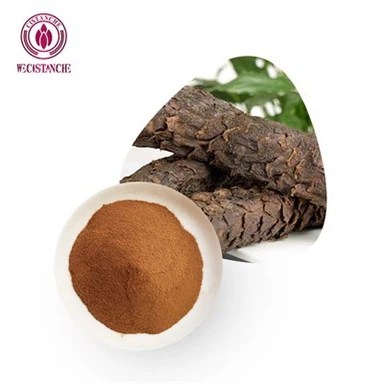
Cistanche Raw Materials

1. Claims
Claim 1
A medicine–food homology composition for improving Kidney Yang deficiency fatigue, characterized in that, by mass parts, the raw materials include:
Prepared Rehmannia polysaccharides 2–3.5 parts
Cistanche polysaccharides 0.7–1.5 parts
Cornus polysaccharides 0.2–0.5 parts
Cinnamon polysaccharides 0.4–1.2 parts
Dried ginger 6–10 parts
Goji berry 3–10 parts
Stir‑fried Chinese yam 3–9 parts
Honey‑processed licorice 3–6 parts
Claim 2 (Preparation of Prepared Rehmannia Polysaccharides)
The method includes:
Dry prepared Rehmannia and grind into powder to obtain prepared Rehmannia powder.
Use water as solvent to perform boiling‑water extraction; combine extracts; perform ethanol precipitation; freeze‑dry to obtain prepared Rehmannia polysaccharides.
The prepared Rehmannia polysaccharides are α‑pyran‑type acidic polysaccharides with molecular weight of 1×1051 \times 10^51×105 to 1.5×1051.5 \times 10^51.5×10⁵ Da, and monosaccharide composition including galactose and glucose.
Claim 3 (Preparation of Cistanche Polysaccharides)
The method includes:
Dry Cistanche and grind into powder to obtain Cistanche powder.
Use water as solvent for boiling‑water extraction; combine extracts; ethanol precipitation; freeze‑dry to obtain Cistanche polysaccharides.
The Cistanche polysaccharides are pyran‑type acidic sulfated polysaccharides with molecular weight of 5×1035 \times 10^35×103 to 1×1041 \times 10^41×104 Da, and monosaccharide composition including glucose and monosaccharide A; monosaccharide A is selected from rhamnose, arabinose, galactose, and mannose, at least one.
Claim 4 (Preparation of Cornus Polysaccharides)
The method includes:
Dry Cornus and grind into powder to obtain Cornus powder.
Use water as solvent for extraction at 70°C; combine extracts; ethanol precipitation; freeze‑dry to obtain Cornus polysaccharides.
The Cornus polysaccharides mainly contain a pyranose ring structure, with molecular weight of 1×1051 \times 10^51×105 to 5×1055 \times 10^55×105 Da, and monosaccharide composition including glucose, galacturonic acid, and monosaccharide B; monosaccharide B is selected from rhamnose, arabinose, galactose, and mannose, at least one.
Cistanche Benefits

Claim 5 (Preparation of Cinnamon Polysaccharides)
The method includes:
Dry cinnamon and grind into powder to obtain cinnamon powder.
Use water as solvent for boiling‑water extraction; combine extracts; ethanol precipitation; freeze‑dry to obtain cinnamon polysaccharides.
The cinnamon polysaccharides are neutral pyran‑type polysaccharides with molecular weight of 2×1052 \times 10^52×105 to 5×1055 \times 10^55×105 Da, and monosaccharide composition including glucose and monosaccharide C; monosaccharide C is selected from rhamnose, galactose, galacturonic acid, and mannose, at least one.
Claim 6 (Dosage Forms)
The dosage form of the composition may be: decoction, granules, powder, capsules, tablets, or oral liquid.
Claim 7 (Preparation Method of the Composition)
The method includes:
By mass parts, soak dried ginger, goji berry, stir‑fried Chinese yam, and honey‑processed licorice in water; boil at 1800 W, then decoct at 500 W; filter to obtain the first decoction liquid.
Add water to the residue; boil at 1800 W, then decoct at 500 W; filter to obtain the second decoction liquid.
Combine the first and second decoction liquids.
Add prepared Rehmannia polysaccharides, Cistanche polysaccharides, Cornus polysaccharides, and cinnamon polysaccharides by mass parts; dissolve; concentrate to one‑tenth of the original volume to obtain the final medicine–food homology composition.
Claim 8 (Use)
Use of the composition in manufacturing health foods or pharmaceuticals for improving Kidney Yang deficiency fatigue.
Claim 9 (Definition of "Improving Kidney Yang Deficiency Fatigue")
Improvement includes one or more of the following:
Prolonging weighted swimming time
Increasing total distance and grid crossings in open‑field test
Reducing post‑exercise serum lactic acid and blood urea nitrogen
Reducing creatine kinase levels
Increasing serum adrenocorticotropic hormone (ACTH) and cyclic adenosine monophosphate (cAMP)
Reducing IL‑1β and IL‑6 levels in muscle tissue
Improving muscle fiber injury caused by exercise
2. Technical Field
The invention relates to the field of health foods (nutraceuticals), and particularly to a medicine–food homology composition for improving Kidney Yang deficiency fatigue and its preparation method.
3. Background: Why "Kidney Yang Deficiency Fatigue Symptoms" Matter in Modern Health Products
With the accelerating pace of modern life and ubiquitous stress, sub‑health has become a widespread public health challenge. A particularly large population experiences symptoms centered around persistent fatigue, low energy, and functional decline.
In Traditional Chinese Medicine, fatigue is considered an external manifestation of Kidney Yang deficiency. The Kidney is regarded as the root of the body's Yang Qi, functioning as a core driver of warming, propulsion, and transformation. When Kidney Yang declines, warming and transformative functions weaken.
From a modern physiological perspective, this state corresponds to a pattern involving:
Decreased energy metabolism rate
Reduced exercise capacity
Dysregulation of neuroendocrine networks such as the hypothalamic–pituitary–adrenal (HPA) axis
Therefore, Kidney Yang deficiency can be interpreted as a systemic sub‑health state characterized by low动力/low metabolism/low tolerance, with symptoms including:
persistent tiredness and lack of vitality
reduced endurance
cold intolerance
delayed recovery
Current anti‑fatigue products face limitations:
Chemical stimulants (e.g., caffeine‑like central stimulation; certain nootropics or stimulants mentioned in the original text) often mask fatigue temporarily rather than addressing root issues such as oxidative stress, energy depletion, and metabolite accumulation; they may carry dependence or adverse‑reaction risk and can worsen anxiety under excessive intake.
Traditional herbal formulas can be multi‑component and multi‑target (anti‑oxidation, anti‑inflammation, HPA axis modulation, energy metabolism). However, some classic formulas include restricted or safety‑concern ingredients (e.g., aconite‑type materials), limiting their use in food categories.
In this context, medicine–food homology ingredients provide a practical path for developing anti‑fatigue products with higher safety expectations: more "dietary" in usage, gentler in action, and aligned with consumer demand for natural health solutions.
4. Summary of the Invention (What This Formula Tries to Deliver)
This invention provides a safe and effective medicine–food homology composition and its method of preparation. The composition demonstrates significant effects in:
Enhancing anti‑fatigue capacity
Reducing exercise‑related muscle injury
Improving Kidney Yang deficiency–related fatigue symptoms
5. Ingredients and Compatibility Logic (TCM Formulation Structure)
In the invention, the compatibility principle is described as:
Chief (Jun): Prepared Rehmannia polysaccharides
Traditionally supports essence and blood, nourishing and replenishing foundational deficiency patterns.
Deputies (Chen): Cistanche polysaccharides, Cinnamon polysaccharides, Cornus polysaccharides
Assist the chief ingredient to strengthen the intended effects: warming/supporting Yang, supporting essence/blood, and improving deficiency‑related weakness; also consider fatigue‑related muscle inflammation.
Assistants/Envoys (Zuo/Shi): Dried ginger, Goji berry, Stir‑fried Chinese yam, Honey‑processed licorice
Harmonize the formula and support overall body state regulation.
6. Preparation Details of Key Polysaccharides (Process‑Oriented "Dry Goods" for Developers)
Common extraction parameters (as specified)
For preparing prepared Rehmannia polysaccharides, Cistanche polysaccharides, and cinnamon polysaccharides:
Powder‑to‑water ratio: 1:20 (g/mL)
Extraction time: 3 h (boiling‑water extraction)
For preparing Cornus polysaccharides:
Powder‑to‑water ratio: 1:20 (g/mL) (the text also describes 1:30 in the implementation section; see "Embodiments" below)
Extraction time: 2 h at 70°C
Wecistanche Lab

7. Potential Active Compounds (As Described)
The functional components of the composition include, but are not limited to:
anethole, β‑ionone, crocetin aldehyde‑type compounds (as named), niacin, trigonelline, formononetin, isoliquiritigenin, umbelliferone, (−)‑α‑pinene, glycyrrhetinic acid, linoleic acid, geraniol, rutin
and one or more selected from:
oleic acid, liquiritin/related licorice compounds (as named), scopoletin, ginger olefins (as named), and ural licorice glycosides (as named)
(For product development, these markers can be used as a reference list for profiling; actual marker selection typically depends on regulatory category and analytical feasibility.)
8. Embodiments (Examples)
Example 1: Preparation Procedure (Representative)
Raw material processing
Dry prepared Rehmannia, Cistanche, Cornus, and cinnamon at 60°C for 4 h (3–5 h acceptable), grind and pass 60‑mesh sieve.
Water extraction
For prepared Rehmannia / Cistanche / cinnamon: 100 g powder + 2000 mL deionized water; extract at 100°C for 3 h.
For Cornus: 100 g powder + 3000 mL deionized water; extract at 70°C for 2 h.
Centrifuge at 4500 rpm for 10 min; re‑extract sediments once; combine supernatants.
Ethanol precipitation
Concentrate each filtrate to 200 mL; add 800 mL absolute ethanol slowly with stirring to reach 80% ethanol; stand overnight to precipitate polysaccharides.
Freeze‑drying
Centrifuge at 4500 rpm for 10 min; re‑dissolve precipitate in 200 mL water; remove ethanol by rotary evaporation; freeze at −80°C for 12 h and freeze‑dry to obtain four polysaccharides.
Preparation of decoction liquid
Weigh and wash:
dried ginger 8 g
goji berry 5 g
stir‑fried Chinese yam 5 g
honey‑processed licorice 4 g
Add 500 mL deionized water (roughly 2–3 cm above herbs), soak 30 min; bring to boil at 1800 W, then decoct at 500 W for 50 min; filter through 200‑mesh gauze (first decoction).
Add 300 mL water to residue (1–2 cm above), boil at 1800 W then decoct at 500 W for 40 min; filter and combine with the first decoction.
Final blending and concentration
Add and dissolve:
prepared Rehmannia polysaccharides 3 g
Cistanche polysaccharides 1 g
Cornus polysaccharides 0.4 g
cinnamon polysaccharides 0.8 g
Then concentrate the liquid to one‑tenth of original volume to obtain the final composition.
Example 1: Polysaccharide characterization (as provided)
Prepared Rehmannia polysaccharides: α‑pyran acidic polysaccharide; weight‑average MW 149.4 kDa; monosaccharides: Gal 62.00%, Glc 38.00%.
Cistanche polysaccharides: acidic sulfated polysaccharide; MW 6.5 kDa; monosaccharides: Glc 88.33%, Rha 3.81%, Ara 5.18%, Gal 2.68%.
Cinnamon polysaccharides: neutral pyran polysaccharide; MW 370.1 kDa; monosaccharides: Glc 88.28%, Rha 4.23%, Gal 3.10%, GalA 4.39%.
Cornus polysaccharides: pyranose‑ring dominant; MW 224.6 kDa; monosaccharides: Glc 55.82%, GalA 27.42%, Rha 0.50%, Ara 13.87%, Gal 2.39%.
Example 2
Different dosage ratio selection within the claimed ranges (process generally consistent with Example 1). Reported to achieve comparable technical effects.
Comparative Example
Same as Example 1 but without adding the four polysaccharides (prepared Rehmannia / Cistanche / Cornus / cinnamon polysaccharides). The results indicate some potential benefit, but overall weaker effects than the full polysaccharide‑enhanced composition.
9. Efficacy Verification (Animal Study) - Anti‑Fatigue and Symptoms‑Related Biomarkers
9.1 Animals and materials
SPF male KM mice (5 weeks, 35 ± 2 g). Test kits include lactate (LD), blood urea nitrogen (BUN), creatine kinase (CK), ACTH, cAMP, IL‑1β, and IL‑6 (suppliers listed in the original text).
9.2 Model and intervention design
Mice were divided into 4 groups (n=6 each):
Normal control
Swimming control
Model group
Composition group
Days 1–10:
Model group + composition group: intragastric administration of hydrocortisone 25 mg/kg·bw/day to induce a Kidney Yang deficiency fatigue model (the description attributes the effect to adrenal cortex function disturbance and decreased ACTH).
Normal + swimming control groups: saline.
Days 11–20:
Composition group: gavage with the composition concentrate 10 mL/kg·bw/day.
Other groups: saline 10 mL/kg·bw/day.
Swimming training on days 11, 14, 17 for swimming control/model/composition groups: 30 min each session.
Open‑field test on day 19.
Weighted exhaustive swimming on day 20.
Biochemical indices measured on day 21 after timed swimming.
9.3 Measured outcomes (development‑friendly endpoints)
The invention describes improvements including:
Longer weighted swimming time
Greater open‑field total distance and grid crossings
Lower post‑exercise lactate (LD), BUN, and CK
Higher ACTH and cAMP
Lower muscle IL‑1β and IL‑6
Histology showing reduced skeletal muscle damage after exercise
These endpoints are aligned with "fatigue symptoms" and recovery‑related physiological states:
lactate/BUN: fatigue metabolite accumulation
CK: muscle damage marker
ACTH/cAMP: endocrine/metabolic signaling related to stress response and energy regulation
IL‑1β/IL‑6: inflammation associated with exercise‑induced muscle injury
Cistanche extract specs list
Click to get a sample order of cistanche extract

10. Ingredient Notes (Traditional Functions Listed in the Text)
The invention also lists traditional attributes for each material:
Prepared Rehmannia (Rehmanniae Radix Praeparata): traditionally supports essence/blood, foundational replenishment.
Cistanche (Cistanches Herba): traditionally supports Kidney Yang and essence/blood; helps deficiency weakness.
Cornus (Corni Fructus): traditionally astringes and stabilizes; supports deficiency patterns.
Cinnamon bark (Cinnamomi Cortex): traditionally warms and supports Yang; warms the lower region.
Dried ginger (Zingiberis Rhizoma): traditionally warms middle, dispels cold; supports Yang.
Goji berry (Lycii Fructus): traditionally nourishes and supports liver/kidney aspects; harmonizes with tonic formulas.
Stir‑fried Chinese yam (Dioscoreae Rhizoma, stir‑fried): traditionally supports spleen/lung/kidney; helps "postnatal to support prenatal" concept.
Honey‑processed licorice (Glycyrrhizae Radix et Rhizoma Praeparata cum Melle): traditionally tonifies Qi and harmonizes the formula.
11. Product Development Takeaways (For Herbal / Functional Food Developers)
If you are developing products targeting kidney function regulation and fatigue symptoms, the key "dry goods" here are:
A polysaccharide‑enhanced medicine–food homology strategy
The comparative example suggests that adding the four polysaccharide fractions strengthens anti‑fatigue performance versus the herb‑only decoction base.
A clear set of measurable endpoints
Swimming endurance, locomotor activity, lactate/BUN/CK, ACTH/cAMP, IL‑1β/IL‑6, and muscle histology provide a framework for preclinical screening.
Multiple dosage forms feasible
Decoction, granules, powder, capsules, tablets, and oral liquid are all listed, allowing flexible commercialization pathways.
Wecistanche Base


12. Disclaimer (Important for Compliance)
This content is a technical translation and educational summary intended for R&D and product development discussion. It does not constitute medical advice, diagnosis, or a promise of clinical efficacy in humans. For commercialization, labeling, claims, and regulatory positioning should be evaluated according to the target market's laws and standards.