A Men’s Herbal Health Liquor And Its Compounding (Formulation) Method
Oct 21, 2026
Abstract
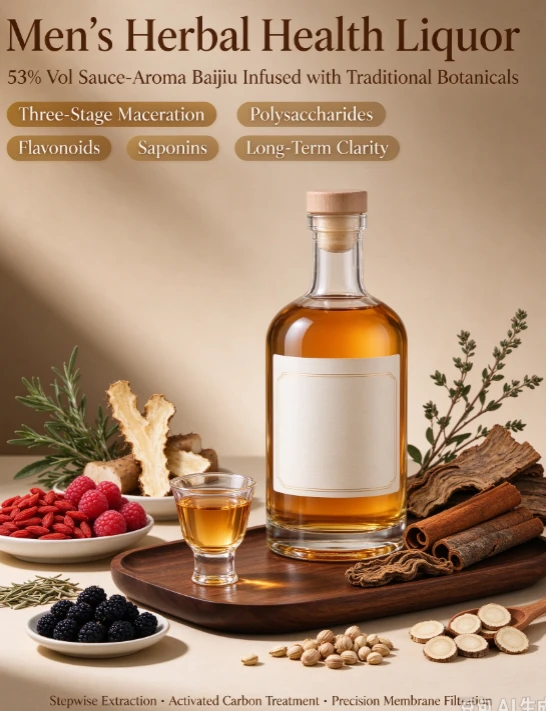
The invention discloses a men's herbal health liquor and a compounding method. The method uses 53% vol sauce-aroma Baijiu as the base spirit and employs botanical materials including goji berry (Lycium barbarum), raspberry (Rubus chingii), mulberry, Polygonatum (Huangjing), Chinese yam, cinnamon, Eucommia ulmoides, Cistanche (Rou Cong Rong), Alpinia oxyphylla (Yizhiren), and licorice, etc.
A key innovation is a three-stage, stepwise maceration (soaking) process. Each soaking stage is carried out with fresh base spirit, maintaining a strong mass-transfer driving force each time, thereby enabling tiered and sufficient extraction of functional constituents. The three macerates are then blended at a defined ratio, followed by activated carbon color adjustment, three-step gradient filtration, settling, and final precision polishing filtration using microporous membranes. The invention also establishes a two-round testing system covering both routine quality indicators for sauce-aroma Baijiu and functional-component indicators for the compounded liquor.
Through stepwise maceration, the method achieves efficient extraction of functional components; through multi-stage clarification and precision filtration, it ensures long-term clarity and stability; and through dual-index testing, it provides comprehensive quality control, effectively solving problems of insufficient extraction, inadequate clarification, and lack of targeted QC indicators for functional compounded liquors.
Claims
1. Men's Herbal Health Liquor
A men's herbal health liquor, characterized by comprising a base spirit and a traditional botanical formula, wherein:
Base spirit: 53% vol sauce-aroma Baijiu is selected as the base spirit.
Botanical ingredients (in parts by weight) comprise:
Polygonatum (Huangjing) 95–105 g
Cuscuta seed (Tusizi) 48–52 g
Goji berry (Gouqizi) 95–105 g
Schisandra berry (Wuweizi) 48–52 g
Raspberry (Fupenzi) 95–105 g
Plantago seed (Cheqianzi) 95–105 g
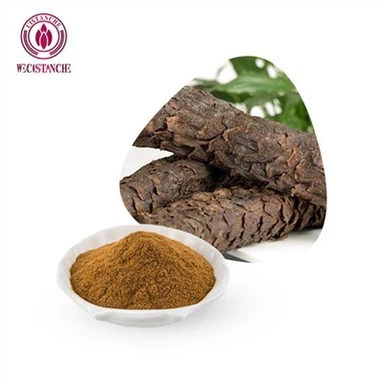
Cistanche (Rou Cong Rong) 28–32 g
Ginseng (Renshen) 18–22 g
Cynomorium (Suoyang) 18–22 g
2. Preferred Formula
The men's herbal health liquor of Claim 1, wherein the botanical ingredients (in parts by weight) are:
Huangjing 100 g, Tusizi 50 g, Gouqizi 100 g, Wuweizi 50 g, Fupenzi 100 g, Cheqianzi 100 g, Rou Cong Rong 30 g, Renshen 20 g, Suoyang 20 g.
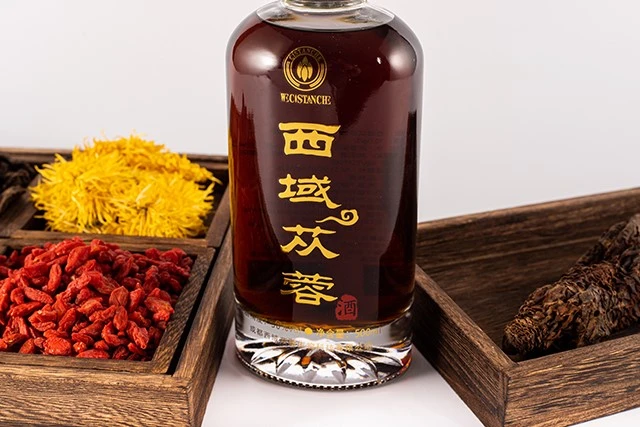
Cistanche(roucongrong) and goqi berry whiskey
3. Compounding Method
A compounding method for the men's herbal health liquor of Claim 1 or 2, characterized by comprising the following steps:
S1. Base spirit selection: Select 53% vol sauce-aroma Baijiu as base spirit.
S2. Raw material preparation and milling: Prepare the botanicals in the weight ranges of Claim 1. After sorting/cleaning and drying, mix evenly and mill into a coarse powder with particle size 0.5–2 mm to obtain a botanical mixed coarse powder.
S3. Three-stage stepwise maceration (with fresh base spirit each stage):
Place the coarse powder into a gauze bag. Using a ratio of total powder weight : base spirit volume = 1:5–1:8 (kg/L), immerse the bag into base spirit. Seal and macerate at 15–25°C for 15–30 days, stirring once every 3–5 days. After maceration, remove the bag and press; combine the press liquor with the macerate to obtain the first macerated liquor.
Then immerse the same bag into a fresh batch of base spirit in an amount equal to the first stage, and repeat under the same temperature/time and stirring schedule to obtain the second macerated liquor.
Repeat a third time with fresh base spirit to obtain the third macerated liquor.
S4. Blending + activated carbon color/clarity adjustment:
Blend the first, second, and third macerated liquors at a volume ratio of 1 : 0.8–1.2 : 0.6–1.0 to obtain a blended liquor. Add activated carbon at 0.05%–0.2% (v/v) of the blended liquor, mix, then let stand 24–48 h to adjust color and brightness.
S5. Triple filtration: Filter the treated blended liquor through three sequential filtrations to obtain a clarified liquor.
S6. Sealed settling: Place the clarified liquor in a stainless-steel tank and seal at 10–20°C for 2 weeks.
S7. Microporous membrane polishing filtration: Filter the settled liquor using a dedicated filtration vessel equipped sequentially with 0.45 μm and 0.22 μm microporous membranes.
S8. Two-round testing: Test the polished liquor in two rounds.
Round 1: routine compliance testing for sauce-aroma Baijiu, including total acids, total esters, solids, methanol, higher alcohols, and heavy metals.
Round 2: functional-component testing for compounded liquor, including total polysaccharides, total flavonoids, and total saponins.
4. Low-Temperature Milling (Preferred)
The method of Claim 3, wherein milling in S2 is conducted by low-temperature milling, controlling material temperature below 40°C, and the milled material is sieved through a 10-mesh sieve, collecting the undersize fraction.
5. Circulation Mixing During Maceration (Preferred)
The method of Claim 3, wherein stirring in S3 is performed by a circulation pump to drive liquor recirculation, with a circulation flow rate of 0.5%–1% of total tank volume per minute, each circulation lasting 10–20 min, once every 3 days.
6. Activated Carbon Specification (Preferred)
The method of Claim 3, wherein the activated carbon in S4 is powdered medicinal activated carbon with specific surface area 800–1200 m²/g and particle size 200–300 mesh.
7. Carbon Mixing Conditions (Preferred)
The method of Claim 3, wherein mixing speed during carbon treatment in S4 is 60–100 rpm for 30–60 min.
8. Details of Triple Filtration (Preferred)
The method of Claim 3, wherein the triple filtration in S5 comprises:
first filtration: plate-and-frame filter with 10 μm filter bag;
second filtration: cartridge precision filter with 5 μm filter element;
third filtration: titanium rod filter with 1 μm filter element;
with filtration pressure controlled at 0.2–0.4 MPa.
9. Turbidity-Controlled Settling Endpoint (Preferred)
The method of Claim 3, wherein during settling in S6, samples are taken every 3 days from a bottom sampling valve to measure turbidity, and settling ends when turbidity remains below 0.5 NTU for two consecutive measurements.
10. Low-Temperature Standing for Carbon Treatment (Preferred)
The method of Claim 3, wherein the standing environment in S4 is 4–8°C.
Men's Herbal Health Liquor and Compounding Method
Technical Field
[0001] The invention relates to the technical field of herbal health liquor, particularly a men's herbal health liquor and its compounding method.
Background
[0002] At present, men's herbal liquors are commonly produced by using Baijiu as the base spirit, adding one or more botanicals such as goji, raspberry, mulberry, Huangjing, Chinese yam, cinnamon, Eucommia, and Cistanche, and preparing by one-time or two-time soaking. A typical process is to mix botanicals at a given ratio, soak in 50–60% vol Baijiu at room temperature for 15–30 days with occasional stirring, then obtain product by decanting the supernatant or simple filtration (e.g., gauze filtration or plate-and-frame filtration).
[0003] However, the existing techniques have several issues:
First, one-time or two-time soaking often fails to achieve sufficient extraction of actives. Different botanicals have different cell-wall structures, polarity of actives, and dissolution kinetics. During a single maceration, the concentration gradient between botanical matrix and liquor decreases over time, slowing extraction; some lipophilic or bound-form actives cannot reach ideal extraction levels within limited time. Even with a second soaking, the botanical material has already swollen and partially extracted, reducing the mass-transfer driving force, leading to incomplete extraction and low raw-material utilization.
Second, clarification is often rough. Simple coarse filtration or plate-and-frame filtration cannot effectively remove fine residues, colloids, macromolecular proteins, and polysaccharides. During storage these may flocculate, precipitate, or cause haze reversion, harming stability and appearance. Even when activated carbon is used, it is often added in a simple manner without a systematic multi-stage filtration plus precision filtration strategy, making long-term brilliance difficult to maintain.
Third, quality control often focuses on sensory evaluation and basic spirit parameters such as alcohol strength, total acids, and total esters, lacking targeted testing and QC for functional components (e.g., polysaccharides, flavonoids, saponins). This leads to large batch-to-batch variation in functional content and poor quality consistency.
[0004] Therefore, to address the above issues, this invention proposes a men's herbal health liquor and compounding method.
Summary of the Invention
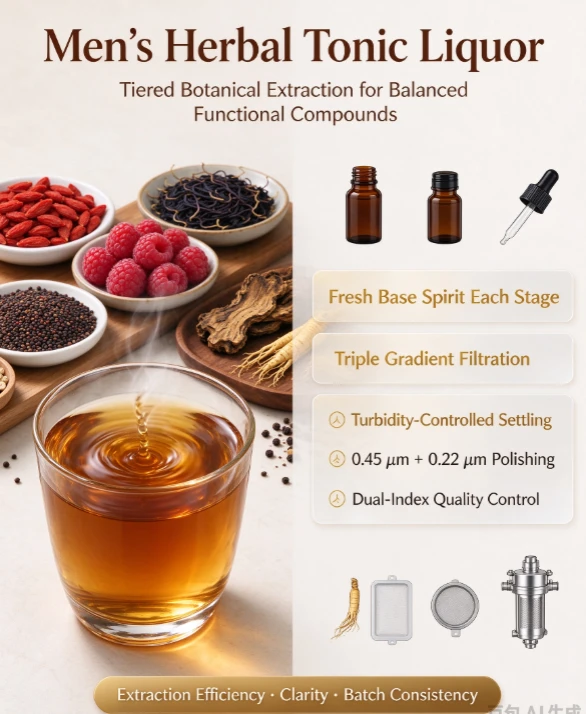
[0005] To overcome insufficient extraction, imperfect clarification, lack of targeted QC indicators, and blending inconsistency across multiple macerates, the invention provides a men's herbal health liquor and its method.
[0006] Technical solution (method) includes:
S1 selecting 53% sauce-aroma Baijiu (preferably high-temperature Daqu fermentation, Kunsha process, and aged for at least 3 years);
S2 preparing botanicals within specified ranges, cleaning/drying, mixing, and low-temperature coarse milling (below 40°C), sieving through 10 mesh, obtaining 0.5–2 mm particles;
S3 performing three consecutive macerations, each time using fresh base spirit, at 15–25°C for 15–30 days, with circulation mixing at 0.5%–1% tank volume per minute, 10–20 min each time, once every 3 days; pressing after each stage to recover absorbed liquor;
S4 blending the three macerates at 1 : 0.8–1.2 : 0.6–1.0, mixing at 60–100 rpm for 30–60 min, adding activated carbon (surface area 800–1200 m²/g, 200–300 mesh) at 0.05%–0.2% v/v, and standing at 4–8°C for 24–48 h;
S5 triple filtration (10 μm → 5 μm → 1 μm) at 0.2–0.4 MPa;
S6 sealed settling for 2 weeks at 10–20°C, checking turbidity every 3 days, ending when two consecutive results are < 0.5 NTU;
S7 polishing with 0.45 μm + 0.22 μm membranes;
S8 two-round testing: (1) routine sauce-aroma spirit indicators; (2) functional indicators: total polysaccharides, total flavonoids, total saponins.
[0007] Preferred botanical formula is: Huangjing 100 g, Tusizi 50 g, Gouqizi 100 g, Wuweizi 50 g, Fupenzi 100 g, Cheqianzi 100 g, Rou Cong Rong 30 g, Renshen 20 g, Suoyang 20 g.
[0008] Preferred threshold values for Round-1 testing: total acids ≥ 0.8 g/L; total esters ≥ 1.5 g/L; solids ≤ 0.5 g/L; methanol ≤ 0.2 g/L; higher alcohols ≤ 0.5 g/L; Pb ≤ 0.2 mg/L; As ≤ 0.1 mg/L.
Preferred thresholds for Round-2 testing: total polysaccharides ≥ 0.5 g/L; total flavonoids ≥ 0.2 g/L; total saponins ≥ 0.1 g/L.
[0009] Beneficial effects:
The three-stage maceration with fresh base spirit each time maintains strong concentration gradients, enabling stepwise and sufficient extraction of polysaccharides, flavonoids, saponins, improving utilization and extraction yield.
Activated carbon + triple gradient filtration + settling with turbidity endpoint + 0.45/0.22 μm membrane filtration ensures long-term clarity, preventing haze and precipitation caused by colloids and macromolecules.
Dual-index testing integrates routine spirit QC with functional-component QC, ensuring batch-to-batch stability and controllable quality.
Brief Description of the Drawings
[0012] FIG. 1 shows a schematic flow of the preparation process.
Detailed Description of Embodiments
[0013] To make the objectives, technical solutions, and advantages clearer, embodiments are described below with reference to the drawings. The described embodiments are part of the invention rather than all embodiments. Other embodiments obtained by those skilled in the art without creative effort shall fall within the protection scope of the invention.
[0014] Embodiment explanation: The base spirit is 53% sauce-aroma Baijiu, preferably Kunsha-process sauce-aroma Baijiu produced by high-temperature Daqu fermentation and aged for at least three years. Such Baijiu contains rich ester, acid, and alcohol flavor substances, producing a coordinated flavor system when combined with botanicals; its high alcohol content also aids extraction of lipophilic actives.
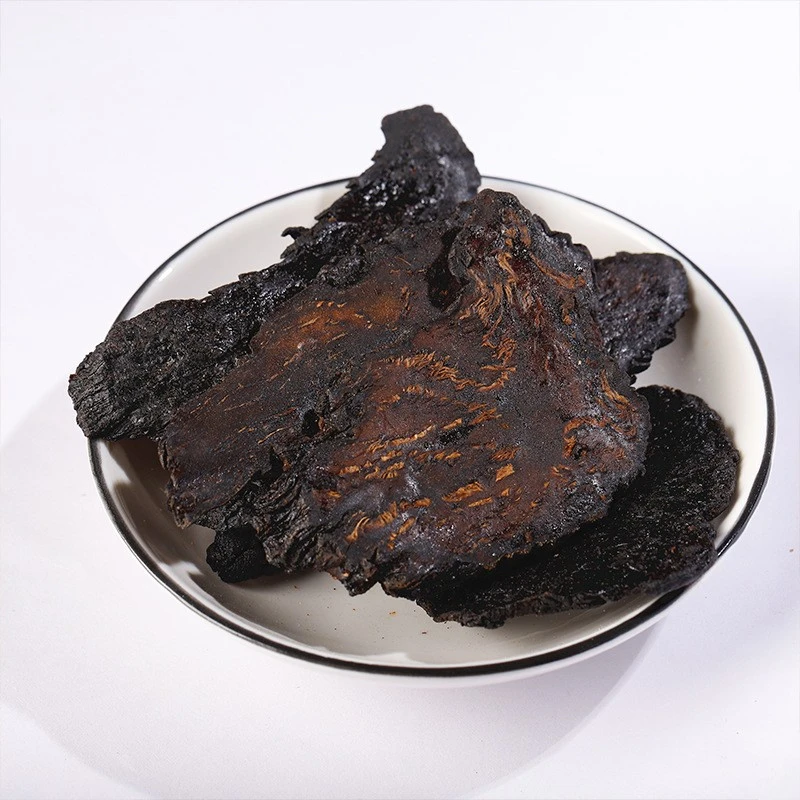
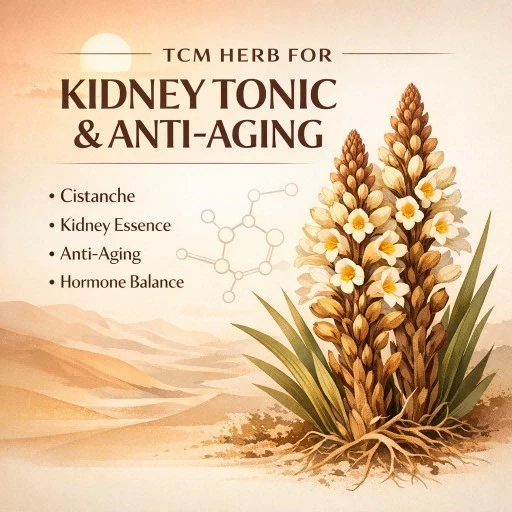
[0015] Botanical compatibility design: Based on TCM theory and male wellness characteristics, the formula is designed as follows (original meaning retained): goji nourishes liver/kidney and benefits essence; raspberry benefits kidney and consolidates essence; mulberry nourishes yin and blood-these serve as principal herbs; Huangjing tonifies qi and nourishes yin; Chinese yam strengthens spleen and benefits kidney-assistant herbs; cinnamon warms yang; Eucommia benefits liver/kidney and strengthens tendons/bones; Cistanche tonifies kidney yang and benefits essence/blood; Alpinia oxyphylla warms kidney and consolidates essence-adjuvant herbs; licorice harmonizes the formula. The overall formula aims to balance yin and yang and regulate spleen and kidney.
[0016] Coarse milling to 0.5–2 mm provides sufficient surface area while avoiding excessive fine powder that could form paste and block filter pores. Low-temperature milling (below 40°C) prevents oxidation/degradation of heat-sensitive components such as flavonoids and saponins. After milling, sieve through 10 mesh and collect the undersize; load into a food-grade cotton gauze bag for easy removal and pressing.
[0017] Rationale for three-stage maceration: In traditional one-time maceration, extraction rate decreases sharply as concentration gradients diminish. The invention uses three macerations, each with fresh base spirit, maintaining strong mass-transfer driving force and achieving stepwise release of actives.
[0018] Process details: The powder-to-spirit ratio is 1:5–1:8 (kg/L). Too high a ratio increases viscosity and reduces mass transfer; too low decreases active concentration and increases downstream burden. Maceration temperature is 15–25°C (preferably 18–22°C) balancing extraction kinetics and protection of heat-sensitive compounds. Time is 15–30 days (preferably 20–25 days). Stirring uses gentle circulation to avoid excessive fragmentation and fine residue. After each stage, press at 0.3–0.5 MPa, combining press liquor with macerate to obtain each stage liquor.
[0019] Because different actives have different extraction behaviors, the three macerates differ in composition. Polar components (e.g., polysaccharides and some saponins) extract faster in the first stage, while less polar/bound components (e.g., flavonoids and lipophilic constituents) continue extracting in later stages. Therefore, blending at 1 : 0.8–1.2 : 0.6–1.0 yields a balanced functional profile.
[0020] Activated carbon treatment uses powdered medicinal activated carbon (800–1200 m²/g, 200–300 mesh) to selectively adsorb pigments, macromolecular proteins, colloids, and some off-flavor higher alcohols while retaining small-molecule actives. Dose is 0.05%–0.2% v/v; mix 60–100 rpm for 30–60 min, then stand 24–48 h at 4–8°C to promote settling and stability.
[0021] Clarification uses three-step filtration (10 μm → 5 μm → 1 μm) at 0.2–0.4 MPa, removing carbon and suspended particles. Although visually clear after triple filtration, trace colloids may remain and slowly flocculate during storage.
[0022] Therefore, a settling step is set: 2 weeks at 10–20°C in stainless steel tanks. Turbidity is monitored every 3 days via a bottom sampling valve. When two consecutive readings remain below 0.5 NTU, settling ends.
[0023] After settling, polishing filtration is performed via 0.45 μm then 0.22 μm membranes, achieving sterilizing-grade removal of microorganisms and fine particulates, thereby improving long-term microbial and colloidal stability.
[0024] Two-round testing: Round 1 checks routine sauce-aroma spirit indices with specified limits; Round 2 quantifies functional indices: total polysaccharides ≥ 0.5 g/L, total flavonoids ≥ 0.2 g/L, total saponins ≥ 0.1 g/L.
Embodiment 1
[0025] S1: Select 53% sauce-aroma Baijiu produced by high-temperature Daqu fermentation and Kunsha process, aged 5 years.
[0026] S2: Prepare: Huangjing 100 g, Tusizi 50 g, Gouqizi 100 g, Wuweizi 50 g, Fupenzi 100 g, Cheqianzi 100 g, Rou Cong Rong 30 g, Renshen 20 g, Suoyang 20 g. Clean/dry/mix; low-temperature mill at 35–40°C; sieve through 10 mesh; obtain coarse powder with particle size mainly 0.5–1.5 mm.
[0027] S3: Load into cotton gauze bag. Ratio powder weight : base spirit volume = 1:6.5 (kg/L). Macerate at 20°C for 22 days. Every 3 days perform circulation mixing: flow rate 0.8% of tank volume per minute; 15 min each time. After maceration, press at 0.4 MPa; combine press liquor and macerate to obtain first macerate. Repeat with equal volume of fresh base spirit for second and third macerations to obtain the second and third macerates.
[0028] S4: Blend at volume ratio 1 : 1 : 0.8. Add activated carbon (1000 m²/g, 250 mesh) at 0.1% v/v; mix at 80 rpm for 45 min; stand at 6°C for 36 h.
[0029] S5: Filter sequentially with 10 μm bag, 5 μm cartridge, 1 μm cartridge; pressure 0.3 MPa.
[0030] S6: Settle sealed at 15°C for 2 weeks. Turbidity at day 12 and day 15: 0.42 NTU and 0.40 NTU, both < 0.5 NTU; end settling.
[0031] S7: Polish with 0.45 μm then 0.22 μm membranes to obtain finished product.
[0032] S8: Two-round testing.
[0033] Round 1 results: total acids 1.2 g/L; total esters 2.1 g/L; solids 0.3 g/L; methanol 0.12 g/L; higher alcohols 0.28 g/L; Pb 0.05 mg/L; As 0.03 mg/L; all compliant.
[0034] Round 2 results: total polysaccharides 0.78 g/L; total flavonoids 0.35 g/L; total saponins 0.18 g/L; all compliant.
Embodiment 2
[0035] S1: Select 53% sauce-aroma Kunsha Baijiu aged 4 years.
[0036] S2: Prepare lower-end ranges: Huangjing 95 g, Tusizi 48 g, Gouqizi 95 g, Wuweizi 48 g, Fupenzi 95 g, Cheqianzi 95 g, Rou Cong Rong 28 g, Renshen 18 g, Suoyang 18 g; mill at 30–38°C; particle size 0.8–1.8 mm.
[0037] S3: Ratio 1:7 (kg/L). Macerate at 18°C for 25 days. Every 4 days circulate at 0.6%/min for 18 min. Press at 0.35 MPa. Repeat for 2nd and 3rd macerations.
[0038] S4: Blend 1 : 0.9 : 0.7. Carbon 900 m²/g, 280 mesh at 0.08% v/v; 70 rpm for 50 min; stand 5°C for 40 h.
[0039] S5: Triple filtration; pressure 0.25 MPa.
[0040] S6: Settle sealed at 12°C for 2 weeks; day 12 and 15 turbidity 0.45 and 0.43 NTU; end settling.
[0041] S7: 0.45 μm + 0.22 μm membranes; finished product.
[0042] S8: Two-round testing.
[0043] Round 1: total acids 1.0 g/L; total esters 1.9 g/L; solids 0.28 g/L; methanol 0.10 g/L; higher alcohols 0.25 g/L; Pb 0.04 mg/L; As 0.02 mg/L.
[0044] Round 2: total polysaccharides 0.68 g/L; total flavonoids 0.29 g/L; total saponins 0.15 g/L.
Embodiment 3
[0045] S1: Select 53% sauce-aroma Kunsha Baijiu aged 6 years.
[0046] S2: Prepare upper-end ranges: Huangjing 105 g, Tusizi 52 g, Gouqizi 105 g, Wuweizi 52 g, Fupenzi 105 g, Cheqianzi 105 g, Rou Cong Rong 32 g, Renshen 22 g, Suoyang 22 g; mill at 35–40°C; particle size 0.5–1.2 mm.
[0047] S3: Ratio 1:6 (kg/L). Macerate at 22°C for 20 days. Every 5 days circulate at 0.7%/min for 12 min. Press at 0.45 MPa. Repeat for 2nd and 3rd macerations.
[0048] S4: Blend 1 : 1.1 : 0.9. Carbon 1100 m²/g, 220 mesh at 0.15% v/v; 90 rpm for 40 min; stand 7°C for 30 h.
[0049] S5: Triple filtration; pressure 0.35 MPa.
[0050] S6: Settle sealed at 18°C for 2 weeks; day 12 and 15 turbidity 0.38 and 0.36 NTU; end settling.
[0051] S7: 0.45 μm + 0.22 μm membranes; finished product.
[0052] S8: Two-round testing.
[0053] Round 1: total acids 1.3 g/L; total esters 2.2 g/L; solids 0.32 g/L; methanol 0.13 g/L; higher alcohols 0.30 g/L; Pb 0.06 mg/L; As 0.04 mg/L.
[0054] Round 2: total polysaccharides 0.85 g/L; total flavonoids 0.38 g/L; total saponins 0.20 g/L.
Comparative Example
[0055] A control example uses a traditional single maceration:
S1: same 53% sauce-aroma Baijiu.
S2: same botanicals and coarse milling.
S3: single maceration at 1:6.5 (kg/L), 20°C, 22 days, stir every 3 days, press and combine to obtain a single macerate.
S4: no blending step; proceed directly.
S5: 10 μm → 5 μm → 1 μm filtration.
S6–S8: same as Embodiment 1.
[0063] Testing and stability evaluation results (as described):
Embodiments 1–3 show higher functional contents than the control:
Total polysaccharides: 0.68–0.85 g/L vs control 0.42 g/L
Total flavonoids: 0.29–0.38 g/L vs control 0.18 g/L
Total saponins: 0.15–0.20 g/L vs control 0.09 g/L
Indicating three-stage maceration significantly improves extraction. Approximate improvements vs control: polysaccharides +62% to +102%; flavonoids +61% to +111%; saponins +67% to +122%.
[0064] Finished turbidity of Embodiments 1–3 is below 0.45 NTU vs control 0.85 NTU. After a 37°C accelerated stability test for 30 days, Embodiments 1–3 remain below 0.55 NTU with no obvious sediment; the control increases to 1.35 NTU with visible flocculent precipitate, demonstrating the advantage of the activated-carbon + multi-stage filtration + settling + membrane polishing route for long-term stability.
[0065] Total acids and total esters of Embodiments 1–3 are higher than control, while solids, methanol, higher alcohols, and heavy metals are lower than control. This is attributed to using fresh base spirit in each maceration stage and the refined clarification process.
[0066] The above are preferred embodiments and do not limit the invention. Any simple modifications, equivalent changes, or variations made based on the technical essence of the invention fall within the protection scope of the invention.
Takeaways for Commercial Buyers
Extraction Efficiency: Replace one long soak with three stepwise macerations using fresh spirit each time to maintain concentration gradients and boost extraction yield of polysaccharides/flavonoids/saponins.
Long-Term Clarity: Use a systematic clarification train: activated carbon (low-temp standing) → 10 μm/5 μm/1 μm → settling with turbidity endpoint → 0.45 μm + 0.22 μm polishing.
QC That Matches Function: Don't stop at routine alcohol QC. Add a second QC panel for total polysaccharides, total flavonoids, total saponins to control functional consistency batch-to-batch.