A Meta-analysis Of Randomized Controlled Trials Of Cistanche Decoction in The Treatment Of Rheumatoid Arthritis
Mar 09, 2022
Contact: Audrey Hu Whatsapp/hp: 0086 13880143964 Email: audrey.hu@wecistanche.com
Hai-Yu Wang, Chen-Hui Song, Fang-Kai Li, Xiao-Ping Liu, Wei Zhen1, Yu-Ting Zhang, Yue-Lan Zhu, Xiu-Juan Hou
Highlights
The article systematically evaluated the efficacy and safety of Cistanche Decoction combined with western medicine and western medicine alone in the treatment of rheumatoid arthritis. The results of this meta-analysis showed that Cistanche Decoction combined with western medicine had certain advantages over the clinical symptoms and laboratory indicators of rheumatoid arthritis.
Abstract
Objective: To systematically evaluate the efficacy and safety of Cistanche Decoction combined with western medicine and western medicine alone in the treatment of rheumatoid arthritis. Methods: Databases of CNKI, VIP, Wanfang Data, PubMed, Medline, Cochrane Library, and Embase were retrieved by computers. The references of the included studies, relevant dissertations, and conference proceedings were manually retrieved. The search intervals were from the database inception until July 2017. The retrieval and screening of studies were carried out respectively by 2 researchers, and the quality and data were evaluated and extracted according to the Jadad quality scale. Meta-analysis was performed with RevMan5.3 software. Results: (1) A total of 7 randomized controlled trials and 485 patients were enrolled, among which 262 cases were in the experimental group and 223 cases were in the control group. The point of 2 studies was 3, other studies were 1-2. The studies included indicated that the group baselines were comparable. (2)The total effective rate of Cistanche Decoction with the western medicine group was higher than that of the western medicine group (RR = 0.85, 95%CI [0.78, 0.92]. Improved Conditions of tender joint count (MD = -2.79, 95%CI [-3.47, -2.12]); erythrocyte sedimentation rate (MD = -9.5, 95%CI [15.67, -3.33]); and C-reactive protein (MD = -3.36, 95%CI [-5.45, -1.27]) were superior to control group. There was no significant difference in the side effects of drugs and the rheumatoid factor between the two groups. Conclusion: Cistanche Decoction with western medicine had advantages in alleviating clinical symptoms and laboratory index of rheumatoid arthritis patients. While the quality of included studies was low and possible publication bias was present, further multi-center double-blind randomized control trials with larger samples are needed.
Keywords: Rheumatoid arthritis, Cistanche Decoction, Meta-analysis
Background
Rheumatoid arthritis (RA) is one of the most common inflammatory arthritis [1], the longer the sick period, the higher the disability rate, which often brings an economist burden and mental stress to the patients and families. Therefore, it will have great significance to choose the realizable and effective treatment for patients with RA to improve the quality of life and reduce economic as well as psychological burden. The disease has no way to cure currently, and non-steroidal anti-inflammatory drugs, diseases modifying anti-rheumatic drugs, glucocorticoids, biological agents, and other commonly used clinical drugs will cause varying degrees of adverse reactions [2], thus affecting the long-term treatment of this disease. Chinese medicine has a better advantage in the treatment of the disease. Cistanche Decoction from the Leizhengzhicai is a classic prescription in the treatment of RA induced by cold and dampness. At present, a number of studies have proved the effectiveness and safety of Cistanche Decoction combined with western medicine in the treatment of RA [3]. Due to the small sample size, the clinical significance of guiding the clinical treatment is limited. In this study, the meta-analysis method was used to evaluate the efficacy and safety of Cistanche Decoction combined with western medicine in the treatment of RA, and to provide some evidence for clinical diagnosis and treatment.
Materials and methods
Inclusion and exclusion criteria
Study type. Randomized controlled trials (RCTs) published at home and abroad and language limited to Chinese and English. Subjects of study. All included cases were in line with the diagnostic criteria for RA established in the United States in 1987. Chinese medical syndrome, age, and gender were not limited. Exclusion criteria: (1) Pregnant and lactating women. (2) People who were allergic to drugs. (3) Patients with severe liver and kidney function and hematopoietic system damage. (4) People with mental abnormalities. (5) Literature without the full text. Intervention measures. Patients in the experimental group were given Cistanche Decoction combined with western medicine treatment. The control group was treated with western medicine alone. The western medicine used in the two groups was exactly the same. Different western medicine or combined with other traditional Chinese medicine preparations and massage therapy were excluded. Outcome indicators. The effective indicators: total effective rate; clinical quantitative indicators: morning stiffness time, tender joint count. The main laboratory indicators: erythrocyte sedimentation rate (ESR), C-reactive protein (CRP). Adverse reactions: blood toxicity, gastrointestinal reactions, liver and kidney injury, etc

Search strategy
To retrieve literature published at home and abroad. The database of CNKI, VIP, Wanfang, PubMed, Medline, Cochrane library, and Embase were searched from database inception until 2017 July. At the same time, references to the literature were also retrieved. Search terms were used:#1 Cistanche Decoction, #2 Rheumatoid Arthritis (RA), #3 “randomized controlled trials” OR “random” OR “control” OR “trials”, #4 #1 and #2 and #3.
Screening the data included
Two researchers independently completed the literature screening and data extraction. In case of disagreements, they discussed coming to an agreement. By reading the title and abstract of the literature, the literature not meeting the inclusion criteria was initially screened. For the literature which may meet the inclusion criteria, it is needed to read the full text to decide whether or not to be included. If the opinion is inconsistent, it will be determined by the experienced third party in the team.
Data Extraction and Quality
Assessment The quality of included studies was evaluated by the revised Jadad quality scale [4] (low quality: 1-3 points, high quality: 4-7 points). Evaluation content: (1) the generation of random sequences; (2) allocation of hidden; (3) blind method; (4) quit/lost to follow-up. The methodological quality evaluation was performed by two reviewers independently. In case of disagreement, the third party would discuss and resolve it.
Statistical methods
Meta-analysis of the extracted outcome was performed using the Rev Man 5.3 software provided by the Cochrane Collaboration Network. The continuous variable was represented as mean difference (MD), the standard mean difference (SMD) was used when the measurement scale of the outcome indicator is different; the relative risk (RR) or odds ratio (OR) was used for the dichotomous data, with 95% confidence interval (CI). I2 < 50% suggested there was no statistical heterogeneity among the studies, and the fixed effect model was adopted, and I2 > 50% suggested the heterogeneity existed in the study, and the random-effects model was adopted; P < 0.05 was considered statistically significant.
Results
Characteristics of included studies
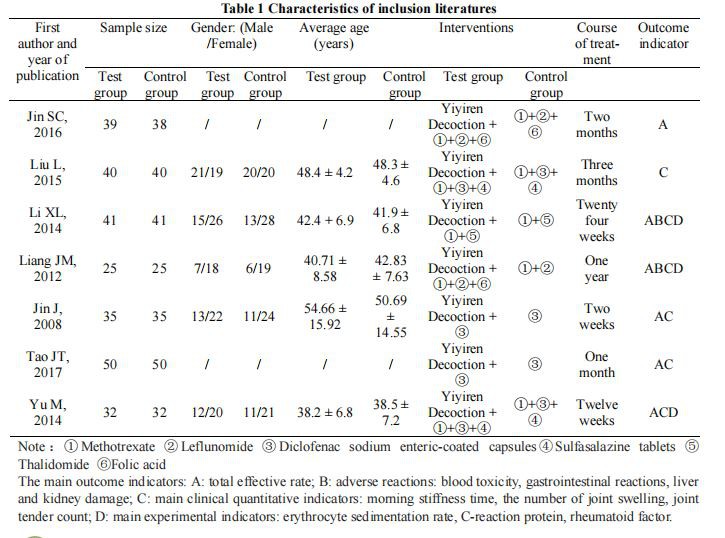
We screened 54 literature initially and 7 literature were included eventually [5-11]. The flowchart of the literature screening process was shown in Figure 1, and the characteristics of the literature were shown in Table 1.

Quality evaluation results
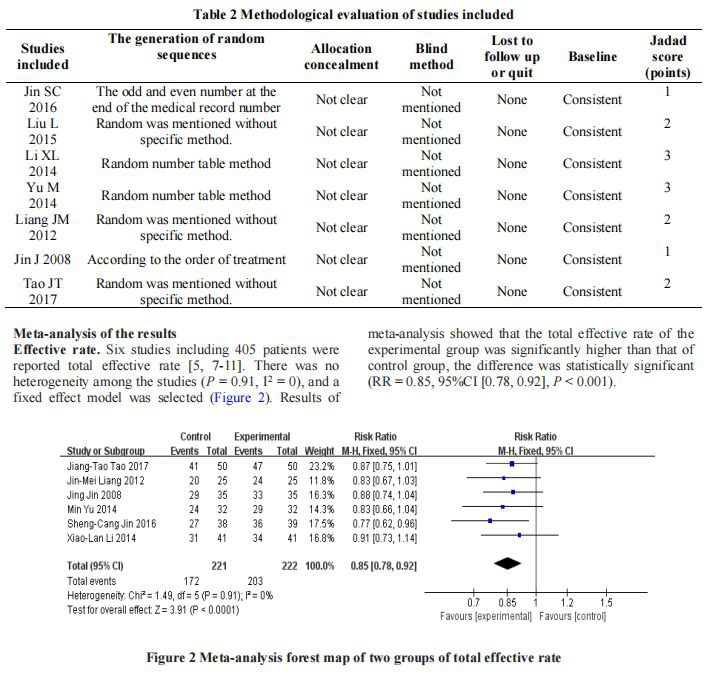
In this study, a total of 7 Chinese pieces of literature were included. The quality evaluation of all the literature was performed according to the Jadad quality scale. Among them, there were 2 pieces of literature with 3 points [7-8], and the remaining literature was 1-2 points [5-6, 9-11]. All of the included literature referred to randomization, of which four studies had shown the method of randomization [5, 7-8, 10]. None of the seven studies referred to allocation concealment and blind method. Seven studies were randomized and indicated that the baseline between groups was comparable, without uncompleted report outcome, and selective report outcome. Specific design methods and quality evaluation were shown in Table 2.
Meta-analysis forest map of CRP in both groups. CRP was reported in 3 literature [7-9]. Meta-analysis showed that the experimental group was superior to the control group in the aspect of CRP, and the difference was statistically significant. (MD = -3.36, 95%CI [-5.45, -1.27], P = 0.202) (Figure 3).

Meta-analysis forest map of two groups of ESR. ESR was reported in 3 literature [7-9]. Meta-analysis showed that the experimental group was superior to the control group in the ESR, and the difference was statistically significant. (MD = -9.5, 95%CI [15.67, -3.33], P = 0.003) (Figure 4).

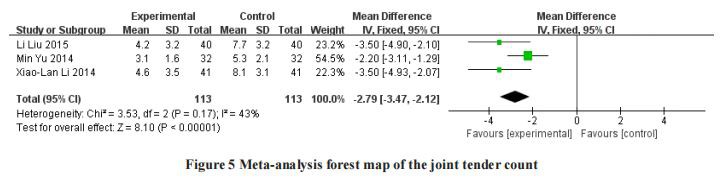
Meta-analysis forest map of the joint tender count. The joint tender count was reported in 3 articles [6-8]. Results of meta-analysis showed that the joint tender count of the experimental group was significantly less than that of the control group. (MD = -2.79, 95%CI [-3.47, -2.12], P < 0.001) (Figure 5).
Meta-analysis forest map of rheumatoid factor in two groups. Rheumatoid factor (RF) was reported in 3 articles [7-8]. Results of meta-analysis showed that RF in the experimental group has no statistical significance compared with the control group (SMD = -0.17, 95%CI [-0.50, 0.16], P = 0.31) (Figure 6).
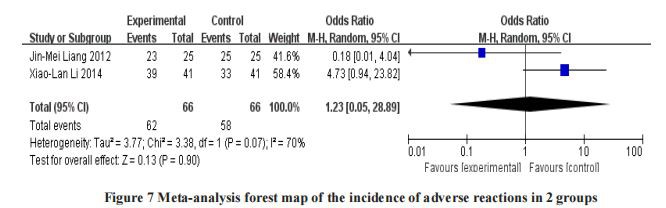
Meta-analysis forest map of the incidence of adverse reactions in 2 groups. Adverse reactions were reported in 2 literature [7-8]. Meta-analysis showed that there was no significant difference between the experimental group and the control group (OR = 1.23, 95%CI [0. 05, 28.89], P = 0.90) (Figure 7)
Publication bias and sensitivity analysis
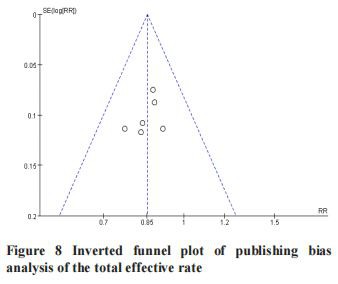
Inverted funnel plot of publishing bias. The funnel plot about the total effective rate of Cistanche Decoction combined with western medicine group and western medicine group alone treating RA was made to perform publication bias analysis. The funnel plot of the total effective rate is asymmetric, suggesting the possibility of publication bias existed, which indicates the low quality of studies included. This may be related to the fact that negative results were not included and positive results were easily published (Figure 8). Because the number of ESR, CRP, joint tenderness, and adverse drug reactions were less than 4, the funnel plot analysis of its publication bias was not performed.
Sensitivity analysis. The results of the meta-analysis of the total effective rate, CRP, joint tender count, adverse drug reaction, sensitivity analysis of effect model did not substantially change the results of a meta-analysis. This indicated the results of the study were reliable. But the resultant effect of ESR and RF have changed, which indicated the instability that existed in meta-analysis. The results of the specific sensitivity analysis were shown in Table 3.

Discussion
Methodological Quality of Literature
Seven studies included were of low quality according to the Jadad quality score. Only three pieces of literature referred to random and did not mention the specific method of randomization. All the literature did not mention the allocation concealment and blind method. The absence of a blind method may be relevant to the usage of traditional Chinese medicine decoction, which was difficult to be blind in the clinic. Most of the studies did not mention follow-up and loss to follow-up, which affected the quality of the literature. The study also found that the number of negative results of the literature was small, and a certain publication bias might exist.
Curative effect analysis
Cistanche Decoction is from the Leizhengzhicai, in which Cistanche (Coicis Semen) and Cangzhu (Atractylodes Rhizoma) can tonify spleen and dehumidify; Duhuo (Angelicae Pubescentis Radix), Qianghuo (Notopterygh Rhizoma Et Radix), and Fangfeng (Saposhnikoviae Radix) can dispel wind and overcome dampness; Chuanwu (Aconiti Radix), Mahuang (Ephedra Herba) and Guizhi (Cinnamomi Ramulus) can warm and activate meridian, dissipate cold and dispel dampness; Danggui (Angelicae Sinensis Radix) and Chuanxiong (Chuanxiong Rhizoma) can nourish the blood and promote blood circulation and promote the circulation of qi; Shengjiang (Zingiberis Rhizoma Recent), and Gancao (Glycyrrhizae Radix Et Rhizoma) can invigorate the spleen and regulate the middle warmer, avoid evil and preserve substantial vital energy. All herbs combined can dissipate cold, dispel dampness and activate meridians to stop the pain. It's reported that Cistanche Decoction can significantly inhibit the ear inflammation caused by xylene, and significantly reduce the permeability of capillaries and the PGE2 content of inflammatory tissue, which has good anti-inflammatory and analgesic effects. Cistanche (Coicis Semen) is sweet, tasteless, and cold in nature, which can clear dampness, promote diuresis, invigorate the spleen, stop diarrhea, treat rheumatism, and expel pus. Studies indicated that Cistanche active ingredient coixenolide can increase the proportion of Foxp3+, CD4+, CD25+, and Treg in collagen-induced arthritis mice, which may have immunoregulation in RA [13]. This study evaluated the efficacy of Cistanche Decoction combined with western medicine in the treatment of RA by the meta-analysis method of the Cochrane Handbook. The results showed that the total effective rate, CRP, ESR, joint tender count, and morning stiffness time in Cistanche Decoction combined with western medicine were better than those in the western medicine group. In the aspect of RF and the incidence of adverse reactions, the difference was not statistically significant. Taking into account the limitation of the literature included, it needs to further develop a multi-center, random, double-blind, and large sample study to provide a higher level of evidence.

The limitations of this system evaluation
(1) Blind method in the literature included was not adopted, which may have a psychological impact on patients and further affect the clinical efficacy. (2) The original data of many kinds of literature were incomplete and can’t be obtained after contacting the authors by E-mail, which affected the comprehensiveness of the data. (3) The confounding factors of different randomized controlled trials included would affect the authenticity and the reliability of the study.
The significance for future research
In recent years, studies concerning Chinese medicine in the treatment of RA are getting more and more, but the quality of methodological still needs to be improved. Evidence-based medicine requires a high-quality RCT study, but only two of the seven pieces of literature included in this study were rated as 3 points based on the Jadad quality scale, the others were 1 to 2 points, and the quality of the literature was low in general. Therefore, it is recommended that future relevant studies should clearly report the generation method of random sequences; the hiding measures of random allocation programs; blind method or placebo control should be used; the dispose of quit or loss to follow-up; the integrity of the test data should be made to avoid selective outcome report, and tracking drug adverse reactions. Ensure the authenticity and reliability of the research results as far as possible.

References
1 Zeng XF, Zhu SL, Tan AC, et al. China’s rheumatoid arthritis disease burden and quality of life of the systematic evaluation. Chin Med, 2013, (03): 300-307.
2. Edward D. Harris, Steven B, Abramson, Leyla Alparslan, et al. Kelly rheumatology. 8th edition. Beijing: Peking University Medical Publishing House 2011.879-1001.
3. Li JM. Dialectical treatment of arthralgia in 320 cases of clinical observation. J Pract Tradit Chin Med 2015, (12): 27-28.
4. Jadad AR, Moore RA, Corral D. Assessing the quality of the reports of randomized clinical trials: is blinding necessary? Control Clin Trials 1996, 17(1): 1-12.
5. Quan SC. Cistanche Decoction in the treatment of rheumatoid arthritis effect. For all healthy 2016 (4): 40-40.
6. Liu L, He JM, Li G, et al. Chinese and Western medicine treatment of rheumatoid arthritis joint function and clinical symptoms. Cardiovasc Dis J Integr Tradit Chin Western Med 2015, 3 (31): 56-57.
7. Li XL, Deng GZ, Li J. Integrative Medicine in the treatment of rheumatoid arthritis in 41 cases. Guiding J Tradit Chin Med Pharm 2014 (16): 62-65.
8. Yu M, Chen YY. Observation of the effect of integrated Chinese medicine and western medicine on 32 patients with rheumatoid arthritis. Intern Med China 2014, 9 (1): 12-14.
9. Liang JM. Coixifolia Decoction in the treatment of rheumatoid arthritis clinical study. Hubei Univ Tradit Chin Med 2012.
10. Jin J, An LP, Xiao MX. Analysis of the efficacy of coixenolide soup for cold dampness closed-resistance of 35 cases of rheumatoid arthritis. J Xinjiang Med Univ 2008, 31 (5): 591-593.
11. Tao JT. Analysis of the efficacy of coixenolide soup for cold dampness closed-resistance of rheumatoid arthritis. Capital Food Med 2017, (14): 103-104.
12. Gao L, Zhang ZY, Zhang L, et al. Experimental research of anti-inflammation and analgesic effect of vDecoction. J Tianjin Coll Tradit Chin Med 2005, 24(1):17-19.
13. Zheng HX, Zhang WM, Zhou HJ, et al. Effect of Coixenolide on Fox3+, CD4+, CD25+ regulatory T cells in collagen-induced arthritis mice. Chin J Integr Tradit Western Med, 2016 2016, 36(3):348-350.