A Review On Ergonomics Evaluations Of Virtual Reality Part 2
Sep 04, 2023
3.3.2. Cognitive ergonomics
Cognitive ergonomics research for virtual reality software is focused on two aspects: task performance and cognitive load.
Cistanche can act as an anti-fatigue and stamina enhancer, and experimental studies have shown that the decoction of Cistanche tubulosa could effectively protect the liver hepatocytes and endothelial cells damaged in weight-bearing swimming mice, upregulate the expression of NOS3, and promote hepatic glycogen synthesis, thus exerting anti-fatigue efficacy. Phenylethanoid glycoside-rich Cistanche tubulosa extract could significantly reduce the serum creatine kinase, lactate dehydrogenase, and lactate levels, and increase the hemoglobin (HB) and glucose levels in ICR mice, and this could play an anti-fatigue role by decreasing the muscle damage and delaying the lactic acid enrichment for energy storage in mice. Compound Cistanche Tubulosa Tablets significantly prolonged the weight-bearing swimming time, increased the hepatic glycogen reserve, and decreased the serum urea level after exercise in mice, showing its anti-fatigue effect. The decoction of Cistanchis can improve endurance and accelerate the elimination of fatigue in exercising mice, and can also reduce the elevation of serum creatine kinase after load exercise and keep the ultrastructure of skeletal muscle of mice normal after exercise, which indicates that it has the effects of enhancing physical strength and anti-fatigue. Cistanchis also significantly prolonged the survival time of nitrite-poisoned mice and enhanced the tolerance against hypoxia and fatigue.

Click on chronic fatigue syndrome
【For more info:george.deng@wecistanche.com / WhatsApp:8613632399501】
3.3.2.1. Task performance. Virtual reality environments can have an impact on users' task performance. Rizzuto et al. [73] evaluated the performance of the pointing task in real and virtual environments and found that the target error in the virtual condition was significantly larger than that in the real condition. To compare walking in virtual reality and the real world, various aspects were studied, including types of systems such as video displays and helmet displays, 3D spatial recognition, speed recognition, and environments such as space stations or buildings. Several scholars [74, 75] have compared navigation tasks in HMD and desktop environments, including the number of captures, distance traveled, and average speed. The experiments showed that, in general, people were more satisfied and intuitive with HMD, but performed better on the desktop environment for most tasks.
Task performance is closely related to access to information in the virtual environment. Lee et al. [76] investigated the influence of text information on the cognitive processing of visual information in HMD by obtaining user evaluations from three dimensions: contrast sensitivity, sentence length, and text size. They proposed that in a virtual reality environment, a text size of 96 pixels or more, a background contrast sensitivity of 75% to 50%, and an effective sentence length ratio of 33.3% to 50% were used to ensure the readability of text information. Lambooij et al. [77] also conducted a user study to determine the visual discomfort associated with 3D stereoscopic displays compared to 2D displays and suggested that participants with a moderate binocular condition experienced more visual discomfort and showed decreased performance in reading tasks. By studying the effects of color mode (dark or light mode), peripheral illumination, and virtual illumination on reading text, Erickson et al. [78] found that using light mode under bright virtual illumination facilitates the legibility of text to the user, but switching to dark mode was beneficial when lowering the virtual illumination. They believed that this was partially due to a color bleeding effect that occurs when a light-colored letter is presented on a dark background, where the light from the letter partially illuminates neighboring background pixels and results in a letter that appears slightly larger [79].
3.3.2.2. Cognitive load. A particular challenge of virtual reality is the potential overload of visual input, which creates an unnecessary cognitive load [80]. Rhiu et al. [81] verified that users felt a higher workload when using the HMD while walking and driving. In particular, the scores of mental demand and frustration were significantly different between the two systems, as users felt dizzy or mentally stressed when participating in the experiment. Chang et al. [82] designed a driving system with embedded Stroop tasks. Stroop task was used to assess cognitive processing and selective attention abilities, which asked an individual to distinguish whether a certain word’s meaning and visual color match [82]. They found that the average response time when users answered Stroop trials in the FSD (flat-screen displays) condition was shorter than that in the HMD condition. This indicated that HMDs might have caught more of the users' attention for virtual driving, which led to their delayed responses to the Stroop trials. In terms of gender differences, they found that men outperformed women in virtual driving, especially at longer driving distances. They speculated that the reason for this may be that females have a higher cognitive load in virtual driving. Female users had a significantly lower average minimum oxygen saturation and a greater decrease in oxygen saturation during the use of the system. The virtual driving system generated more mental work for women, which resulted in greater oxygen consumption [82].
4. Summary of the evaluation methods for the above ergonomic issues
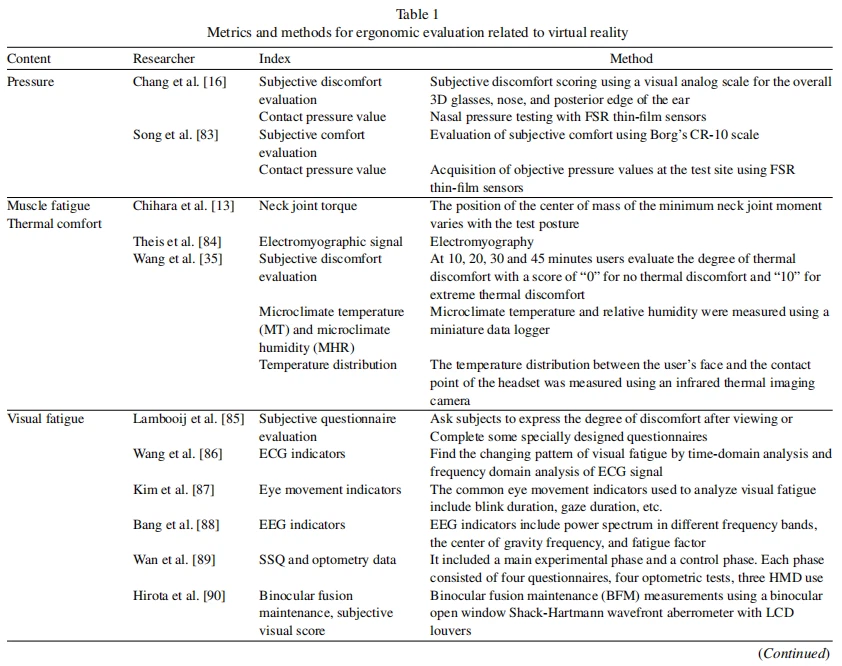
Facing the ergonomic evaluation of virtual reality, there are different evaluation indexes and methods for different problems, which are summarized in Table 1.

5. Conclusion
In this paper, we summarized the ergonomics research of virtual reality and introduced subjective and objective evaluation methods for related issues. Based on the above review, we consider that there are three trends in future research:
(1) First and foremost, we should enhance the development of VR hardware.
From the various human-caused problems listed in the text, it can be found that problems concerning VR hardware are serious problems that limit the development of the virtual reality industry and affect the user experience, and emphasis should be placed on enhancing the development technology of the virtual reality headset hardware system. Methods such as reducing latency and flicker and increasing display resolution can effectively reduce VR-related diseases.
(2) We should refine design guidelines for VR software content.
Virtual reality-related illnesses often prevent users from experiencing virtual reality-designed content for long periods. In terms of improving user experience from VR software, we believe that VR content developers should consider not only the design of the content but also whether the user will feel any discomfort due to unsuitable VR content, such as the speed of scene switching and the dynamic effect of the interface. In the future, we can refine the design guidelines of VR software content through in-depth research.
(3) We should establish the design model based on human factors and a comprehensive evaluation system for head-up displays.
By clarifying the mapping relationship between the design parameters of product modeling characteristics and human factors evaluation indicators, we can provide a theoretical basis and data support for the improved design of products. In the future, we can consider customizing HMD according to personal conditions such as head circumference to reduce the current local pressure and light leakage caused by improper size. Combining subjective evaluation by experts and statistical analysis of data, a comprehensive evaluation index system for human factors of the headset is gradually constructed to form a complete set of subjective and objective evaluation methods.
Ethical approval
Not applicable.

Informed consent
Not applicable.
Conflict of interest
The authors declare that the research was conducted in the absence of any commercial or financial relationships that could be construed as a potential conflict of interest.
Acknowledgments
The authors thank the editors and the reviewers for their helpful suggestions on earlier versions of this manuscript.
Funding
This study was partly supported by the National Natural Science Foundation of China (No. 51905175), the second Batch of 2020 MOE of PRC Industry-University Collaborative Education Program (Program No. 202101042012, Kingfar-CES “Human Factors and Ergonomics” Program), Shanghai Pujiang Talent Program (No. 2019PJC021), the Shanghai Soft Science Key Project (No. 21692196800) and the Smart Travel Art Design Innovation Laboratory (No.20212679).
References
[1] Berg LP, Vance JM. Industry use of virtual reality in product design and manufacturing: a survey. Virtual Real-London. 2017;21:1-17.
[2] Roche EM, Townes LW. Millimeter Wave “5G” Wireless Networks to Drive New Research Agenda. Journal of Information Technology Case & Application Research. 2018:1-9.
[3] Koivisto J, Hamari J. The rise of motivational information systems: A review of gamification research. Int J Inform Manage. 2019.
[4] IEA. What is ergonomics vol. 2021; 2020.
[5] Leskovsk´y R, Kuˇcera E, Haffner O, Matiˇs´ak J, Stark E. A Contribution to Workplace Ergonomics Evaluation Using Multimedia Tools and Virtual Reality. 2019 Federated Conference on Computer Science and Information Systems. 2019.
[6] Arlati S, Spoladore D, Mottura S, Zangiacomi A, Ferrigno G, Sacchetti R, et al. Analysis for the design of a novel integrated framework for the return to work of wheelchair users. Work. 2019;61:603-25.
[7] Stanney K, Mourant M, Ronald R, et al. Human factors issues in virtual environments: A review of... Presence: Teleoperators & Virtual Environments. 1998;7:327.
[8] Wilson JR. Virtual environments applications and applied ergonomics. Appl Ergon. 1999;30:3-9.
[9] Yang Q, Zhong S. A Review of Foreign Countries on the Development and Evolution Trends of Virtual Reality Technology. Journal of Dialectics of Nature. 2021;43: 97-106.
[10] Jinsoo A, Young K, Ronny K. Virtual Reality-Wireless Local Area Network: Wireless Connection-Oriented Virtual Reality Architecture for Next-Generation Virtual Reality Devices. Applied Sciences. 2018;8:43.
[11] Bowman DA, Datey A, Ryu YS, Farooq U, Vasnaik O. Empirical Comparison of Human Behavior and Performance with Different Display Devices for Virtual Environments. Human Factors & Ergonomics Society Annual Meeting Proceedings. 1996;46:2134-8.
[12] Zhuang J, Yue L, Jia Y, Huang Y. User Discomfort Evaluation Research on the Weight and Wearing Mode of Head-Wearable Device. Springer, Cham; 2018. pp. 98-110.
[13] Chihara T, Seo A. Evaluation of physical workload affected by mass and center of mass of head-mounted display. Appl Ergon. 2018;68:204-12.
[14] Ito K, Tada M, Ujike H, Hyodo K. Effects of Weight and Balance of Head Mounted Display on Physical Load: Virtual, Augmented and Mixed Reality. Multimodal Interaction; 2019.
[15] LeClair B, O’Connor PJ, Podrucky S, Lievers WB. Measuring the mass and center of gravity of helmet systems for underground workers. Int J Ind Ergonomics. 2018;64: 23-30.
[16] Chang J, Jung K, Kim W, Moon SK, Freivalds A, Simpson TW, et al. Effects of weight balance on 3D TV shutter-type glasses: Subjective discomfort and physical contact load on the nose. Int J Ind Ergonomics. 2014;44:801-9.
[17] Chang J, Jung K, Kim W, Moon SK, Freivalds A, Simpson TW, et al. Effects of weight balance on 3D TV shutter-type glasses: Subjective discomfort and physical contact load on the nose. Int J Ind Ergonomics. 2014;44:801-9.
[18] Lee W, Kim J, Molenbroek JMF, Goossens RHM, You H. Estimation of Facial Contact Pressure Based on Finite Element Analysis. Cham: Springer International Publishing; 2019. pp. 657-67.
[19] Yan Y, Ke C, Yu X, Song Y, Liu Y. The Effects of Weight on Comfort of Virtual Reality Devices: Advances in Ergonomics in Design; 2019. pp. 239-48.
[20] Stokes MJ, Cooper RG, Edwards RH. Normal muscle strength and fatigability in patients with effort syndromes. BMJ. 1988;297(6655):1014-7.
[21] Tam WJ, Speranza F, Yano S, Shimono K, Ono H. Stereoscopic 3D-TV: visual comfort. IEEE Trans Broadcast. 2011;57(2):335-46.
[22] Gallagher HL, Caldwell E, Albery CB. Neck Muscle Fatigue Resulting from Prolonged Wear of Weighted Helmets. General Dynamics Advanced Information Systems. 2008. pp. 1-33.
[23] Penumudi SA, Kuppam VA, Kim JH, Hwang J. The effects of target location on musculoskeletal load, task performance, and subjective discomfort during virtual reality interactions. Appl Ergon. 2020;84:103010.
[24] Nichols S. Physical ergonomics of virtual environment use. Appl Ergon. 1999;30:79-90.
[25] Afshin S, Charles P, Georges D, Pascal M, Van B. Shoulder Kinematics and Spatial Pattern of Trapezius Electromyographic Activity in Real and Virtual Environments. Plos One. 2015;10:e116211.
[26] Ram S, Mahadevan A, Rahmat-Khah H, Turini G, Young JG. Effect of Control-Display Gain and Mapping and Use of Armrests on Accuracy in Temporally Limited Touchless Gestural Steering Tasks. Proceedings of the Human Factors & Ergonomics Society Annual Meeting. 2017;61: 380-4.
[27] Nakamura M, Yoda T, Yasuhara S, Saito Y, Kasuga M, Nagashima K, et al. The regional difference in temperature-related sensations. Neurosci Res. 2007;58:S108.
[28] Papadakaki M, Tzamalouka G, Orsi C, Kritikos A, Morandi A, Gnardellis C, et al. Barriers and facilitators of helmet use in a Greek sample of motorcycle riders: Which evidence? Transportation Research Part F: Traffic Psychology and Behaviour. 2013;18:189-98.
[29] Bogerd CP, Aerts J, Annaheim S, Br¨ode P, de Bruyne G, Flouris AD, et al. A review on ergonomics of headgear: Thermal effects. Int J Ind Ergonomics. 2015;45: 1-12.
[30] Arens E, Zhang H, Huizenga C. Partial- and whole-body thermal sensation and comfort—Part II: Non-uniform environmental conditions. J Therm Biol. 2006;31:60-6.
[31] Pang TY, Subic A, Takla M. A comparative experimental study of the thermal properties of cricket helmets. Int J Ind Ergonomics. 2013;43:161-9.

[32] Costello PJ, Rd J, Costello P. Health and Safety Issues Associated with Virtual Reality - A Review of Current Literature. AGOCG Technical Report Series. 1997;371-5.
[33] Rogalski A. Recent progress in infrared detector technologies. Infrared Phys Techn. 2011;54:136-54.
[34] Dotti F, Ferri A, Montero M, Colonna M. Thermophysiological comfort of soft-shell back protectors under controlled environmental conditions. Appl Ergon. 2016;56:144-52.
[35] Wang Z, He R, Chen K. Thermal comfort and virtual reality headsets. Appl Ergon. 2020;85:103066.
[36] IEEE Standard for Head-Mounted Display (HMD)-Based Virtual Reality (VR) Sickness Reduction Technology. Standard Activities Board. 2020.
[37] Sheedy JE, Hayes J, Engle J. Is all Asthenopia the Same? Optometry & Vision Science. 2003;80:732-9.
[38] Peli E. Real vision & virtual reality. Optics and Photonics News. 1995;6:28-34.
[39] Yano S, Emoto M, Mitsuhashi T. Two factors in visual fatigue caused by stereoscopic HDTV images. Displays. 2004;25:141-50.
[40] Bando T, Iijima A, Yano S. Visual fatigue caused by stereoscopic images and the search for the requirement to prevent them: A review. Displays. 2012;33:76-83.
[41] Kolasinski EM. Simulator Sickness in Virtual Environments. Army Research Institue for the Behavioral & Social. US Army Research Institute for the Behavioral and Social Sciences. 1995.
[42] Rebenitsch LOC. Review on cybersickness in applications and visual displays. Virtual Real. 2016;2:101-25.
[43] Jia R. Preliminary Study on Visually Induced Motion Sickness Evaluation in Virtual Reality. College of Computer Science of Chongqing University, China. 2017.
[44] Allen B, Hanley T, Rokers B, Green CS. Visual 3D motion acuity predicts discomfort in 3D stereoscopic environments. Entertainment Computing. 2016;13:1-9.
[45] Mizukoshi Y, Hashimoto K, Takanishi A, Iwata H, Matsuzawa T. A Low Cognitive Load and Reduced Motion Sickness Inducing Zoom Method Based on Typical Gaze Movement for Master-Slave Teleoperation Systems with HMD. 2020 IEEE/SICE International Symposium on System Integration (SII); 2020.
[46] Wiederhold BK, Bouchard S. Advances in Virtual Reality and Anxiety Disorders. Series in Anxiety & Related Disorders. New York: Springer. 2014.
[47] Wilding JM, Meddis R. A note on personality correlates of motion sickness. Brit J Psychol. 2011;63:619-20.
[48] Kim K, Rosenthal MZ, Zielinski DJ, Brady R. Effects of virtual environment platforms on emotional responses. Comput Meth Prog Bio. 2014;113:882-93.
[49] Keshavarz B, Hecht H, Zschutschke L. Intra-visual conflict in visually induced motion sickness. Displays. 2011;32: 181-8.
[50] Vlad R, Nahorna O, Ladret P, Guerin A. The influence of the visualization task on the Simulator Sickness symptoms - a comparative SSQ study on 3DTV and 3D immersive glasses. 3dtv-conference: the True Vision-capture; IEEE. 2013. pp. 1-4.
[51] van Emmerik ML, de Vries SC, Bos JE. Internal and external fields of view affect cybersickness. Displays. 2011;32: 169-74.
[52] Fernan De SAS, Feiner SK. Combating VR sickness through subtle dynamic field-of-view modification. 2016 IEEE Symposium on 3D User Interfaces (3DUI); 2016. pp. 201-10.
[53] Davis S, Nesbitt K, Nalivaiko E. A systematic review of cybersickness. In Proceedings of the 2014 conference on interactive entertainment, Newcastle. 2014. pp. 1-9.
[54] Renkewitz H, Alexander T. Perceptual Issues of Augmented and Virtual Environments. perceptual issues of augmented & virtual environments. FGAN-FKIE, Wachtberg. 2007.
[55] Rebenitsch LR. Cybersickness prioritization and modeling. Dissertations & Theses - Gradworks. Computer Science, Michigan State University. 2015.
[56] Lee D, Chang B, Park J. Evaluating the Comfort Experience of a Head-Mounted Display with the Delphi Methodology. Internet Comput. 2020.
[57] Watanabe K, Takahashi M. Head-synced Drone Control for Reducing Virtual Reality Sickness. Journal of Intelligent and Robotic Systems. 2019;97:733-44.
[58] Angelo G, Solimini. Are There Side Effects to Watching 3D Movies? A Prospective Crossover Observational Study on Visually Induced Motion Sickness. Plos One. 2013;8.
[59] Drexler J. Identification of system design features that affect sickness in virtual environments: University of Central Florida.; 2006.
[60] Kim HK, Park J, Choi Y, Choe M. Virtual reality sickness questionnaire (VRSQ): Motion sickness measurement index in a virtual reality environment. Appl Ergon. 2018;69:66-73.

[61] Chardonnet J., Mirzaei Mohammad Ali, Merienne Fr´ed´eric. Visually Induced Motion Sickness Estimation and Prediction in Virtual Reality using Frequency Components Analysis of Postural Sway Signal. ICAT-EGVE 2015. 2015 Oct.
[62] J M, M D, A ST. The virtual reality head-mounted display Oculus Rift induces motion sickness and is sexist in its effects. 2017;3:889-901.
[63] Kinsella A, Beadle S, Wilson M, Smart LJ, Muth E. Measuring User Experience With Postural Sway and Performance in a Head-Mounted Display. Proceedings of the Human Factors & Ergonomics Society Annual Meeting. 2017;61:2062-6.
[64] Cheng S, Wang J, Zhang L, Wei Q. Motion Imagery-BCI Based on EEG and Eye Movement Data Fusion. Ieee T Neur Sys Reh. 2020;PP:1.
[65] Cheng S, Fan J, Dey AK. Smooth Gaze: a framework for recovering tasks across devices using eye tracking. Pers Ubiquit Comput. 2018;22:489-501.
[66] Bruder G, Pusch A, Steinicke F. Analyzing effects of geometric rendering parameters on size and distance estimation in on-axis stereographics. ACM. 2012:111.
[67] Choy SM, Cheng E, Wilkinson RH, Burnett I, Austin MW. Quality of Experience Comparison of Stereoscopic 3D Videos in Different Projection Devices: Flat Screen, Panoramic Screen, and Virtual Reality Headset. Ieee Access. 2021;99:1-1.
[68] Kooi FL, Toet A. Visual comfort of binocular and 3D displays. Displays. 2004;25:99-108.
[69] Widyanti A, Hafizhah HN. The influence of personality, sound, and content difficulty on virtual reality sickness. Virtual Real-London. 2021:1-7.
[70] Ihemedu-Steinke QC, Rangelova S, Weber M, Erbach R, Meixner G, Marsden N. Simulation Sickness Related to Virtual Reality Driving Simulation. International Conference on Virtual; 2017. PP:521-32.
[71] Torkashvand G, Li M, Vink P. Concept evaluation of a new aircraft passenger privacy bubble using virtual prototyping: A Human-Centered Design framework. Work. 2021;68(s1):S231-S238.
[72] Keshavarz B, Hecht H. Pleasant music as a countermeasure against visually induced motion sickness. Appl Ergon. 2014;45:521-7.
[73] Rizzuto MA, Sonne M, Vignais N, Keir PJ. Evaluation of virtual reality head-mounted display as a tool for posture assessment in digital human modeling software. Appl Ergon. 2019;79:1-8.
[74] Aoki H, Oman CM, Buckland DA, Natapoff A. Desktop-VR system for preflight 3D navigation training. Acta Astronaut. 2008;63:841-7.
[75] Bliss JP, Tidwell PD, Guest MA. The Effectiveness of Virtual Reality for Administering Spatial Navigation Training to Firefighters. Human Factors & Ergonomics Society Annual Meeting Proceedings. 1997;6:73-86.
[76] Lee SJ, Kim JH, Son HJ, Kwon SC, Lee SH. A Study of Human Factor for Virtual Reality Text Information Implementation on Head Mounted-Display. 2017 Jan.
[77] Lambooij M, Fortuin M, Ijsselsteijn W, Evans B. Measuring visual fatigue and visual discomfort associated with 3-D displays. J Soc Inf Display. 2010;18:931-43.
[78] Erickson A, Kim K, Bruder G, Welch GF. Effects of Dark Mode Graphics on Visual Acuity and Fatigue with Virtual Reality Head-Mounted Displays. 2020 IEEE Conference on Virtual Reality and 3D User Interfaces (VR); 2020.
[79] Funt BV, Drew MS, Ho J. Color constancy from mutual reflection. Int J Comput Vision. 1991;6:5-24.
[80] Makransky G, Terkildsen TS, Mayer RE. Adding immersive virtual reality to a science lab simulation causes more presence but less learning. Learn Instr. 2017:225-36.
[81] Rhiu I, Kim YM, Kim W, Yun MH. The evaluation of user experience of a human walking and a driving simulation in virtual reality. Int J Ind Ergonomics. 2020;79:103002.
[82] Chang C, Li M, Yeh S, Chen Y, Rizzo A. Examining the Effects of HMDs/FSDs and Gender Differences on Cognitive Processing Ability and User Experience of the Stroop Task-Embedded Virtual Reality Driving System (STEVRDS). Ieee Access. 2020;8:69566-78.
[83] Song Y, Liu Y, Yan Y. The Effects of Center of Mass on Comfort of Soft Belts Virtual Reality Devices: Advances in Ergonomics in Design; 2018. pp. 312-21.
[84] Theis S, Alexander T, Wille M, Others. Considering Ergonomic Aspects of Head-mounted Displays for Applications in Industrial Manufacturing. International Conference on Digital Human Modeling & Applications in Health; 2013. pp. 282-91.
[85] B MLA, A WAI, C IHB. Visual discomfort of 3D TV: Assessment methods and modeling. Displays. 2011;32:209- 18.
[86] Wang D, Yang X, Kang Y, Hu H. Evaluation and Modeling of Visual Fatigue in 3D Display Based on ECG. Journal of System Simulation. 2019;31(2):212.
[87] Kim D, Choi S, Park S, Sohn K. Stereoscopic visual fatigue measurement based on fusional response curve and eye-blinks. Digital Signal Processing (DSP), 2011 17th International Conference on; 2011 Aug.
[88] Bang J, Heo H, Choi JS, Park K. Assessment of Eye Fatigue Caused by 3D Displays Based on Multimodal Measurements. Sensors-Basel. 2014;14:16467-85.
[89] Wang Y, Zhai G, Chen S, Min X, Song X. Assessment of eye fatigue caused by head-mounted displays using eye-tracking. Biomed Eng Online. 2019;18:111.
[90] Hirota M, Kanda H, Endo T, Miyoshi T, Miyagawa S, Hirohara Y, et al. Comparison of visual fatigue caused by head-mounted display for virtual reality and two-dimensional display using objective and subjective evaluation. Ergonomics. 2019;62:759-66.
[91] Kim J, Kim W, Ahn S, Kim J, Lee S. Virtual Reality Sickness Predictor: Analysis of visual-vestibular conflict and VR contents: IEEE; 2018. pp. 1-6.
[92] Yong C, Park, Namyi, Gu, Chi-Yeon, Lim, et al. The effect of Vaccinium uliginosum extract on tablet computer induced asthenopia: a randomized placebo-controlled study. Bmc Complem Altern M. 2016;16(1):1-9.
[93] Liao CY, Tai SK, Chen RC, Hendry. Using EEG and Deep Learning to Predict Motion Sickness Under Wearing a Virtual Reality Device. Ieee Access. 2020;PP:1.
[94] Sebok A, Nystad E, Droivoldsmo A. Improving safety and human performance in maintenance and outage planning through virtual reality-based training systems. IEEE. 2002:8-14.
[95] Mustonen T, Berg M, Kaistinen J, Kawai T, H Kkinen J. Visual task performance using a monocular see-through head-mounted display (HMD) while walking. Journal of Experimental Psychology Applied. 2013;19:333-44.
[96] L S, D H, S E. Differential effects of head-mounted displays on visual performance. Ergonomics, Taylor & Francis. 2014;1:1-11.
[97] Shi Y, Du J, Zhu Q. The impact of engineering information format on task performance: Gaze scanning pattern analysis. Adv Eng Inform. 2020;46:101167.
【For more info:george.deng@wecistanche.com / WhatsApp:8613632399501】