Anti-melanogenic And Anti-oxidant Activities Of Ethanol Extract Of Kummerowia Striata: Kummerowia Striata Regulate Anti-melanogenic Activity Through Down-regulation Of TRP-1, TRP-2 And MITF Expression
Mar 23, 2023
ABSTRACT
Kummerowia striata (K. striata) is used as a traditional medicine for inflammation-related therapy. To determine whether it has beneficial anti-melanogenic and anti-oxidant activities, we investigated the biological activities of the ethanol extract of Kummerowia striata (EKS) using a variety of in vitro and cell culture models systems. The anti-melanogenic activity was assessed in B16F10 melanoma cells in terms of melanin synthesis and in vitro tyrosinase inhibitory activity. The anti-oxidant assays were performed using 2,2-diphenyl-1-picrylhydrazyl (DPPH) and 2,2ʹ-casino-bis (3-ethylbenzothiazoline-6-sulfonic acid) diammonium salt (ABTS). EKS showed strong anti-oxidant activities in DPPH and ABTS assays. The mRNA transcription levels and protein expression levels of tyrosinase, tyrosinase-related protein 1, tyrosinase-related protein 2, and microphthalmia-associated transcription factor decreased in a dose-dependent manner with EKS treatment.
Additionally, EKS did not affect cell viability at different concentrations used in this study, indicating that the mechanism of action of EKS-mediated inhibition of melanin synthesis does not involve cytotoxicity. Also, we confirmed that p-coumaric acid and quercetin are important compounds for the anti-melanogenesis and antioxidant properties of EKS. Collectively, our findings demonstrate for the first time that EKS possesses anti-melanogenic and anti-oxidant activities. Further evaluation and development of EKS as a functional supplement or cosmetic may be useful for skin whitening and reducing wrinkles.
For whitening, we found that Cistanche has a whitening effect, and Cistanche is rich in vitamin C, which is considered to be a very effective whitening agent. Vitamin C can inhibit the synthesis of melanin, a type of melanin that can make people's skin dull. At the same time, vitamin C can also promote the production of collagen, which is a substance that makes the skin firmer and more elastic.
In addition to the above ingredients, Cistanche also contains a variety of amino acids and trace elements, which are also very beneficial to skin health. For example, the zinc contained in Cistanche can help treat acne and sunburn, while also preventing skin aging. Moreover, Cistanche also has a good protective effect on the liver and immune system.

Click cistanche deserticola supplement product
1. Introduction
Studies on external aging have reported that the skin plays a major role in identifying human aging [1,2]. The aging of the skin can be divided into two types: chronologic aging, which is accompanied by the progressive deterioration of the structure and function of the skin over time, and the other is exogenous aging (photoaging) wherein skin texture changes because of long-term exposure to sunlight [3,4]. Free radicals and reactive oxygen species are the most important components that fuel skin aging. They induce oxidative stress in skin cells, and the substances generated during this process cause increased melanin production and wrinkles.
Melanin is synthesized by the oxidation of tyrosinase or L-3,4-dihydroxyphenylalanine (L-DOPA) via the activity of tyrosinase and tyrosinase-related protein 1 (TRP-1). Melanocytes play an important role in protecting the skin from radiation damage [5,6]. The biosynthesis of melanin in melanocytes is mediated by the enzyme tyrosinase which regulates the formation of L-DOPA via the hydrolysis of tyrosine and the formation of DOPA quinone via oxidation of DOPA [7,8]. Additionally, microphthalmia-associated transcription factor (MITF) is a key transcription factor regulating the transcription of melanogenic enzymes (i.e., tyrosinase, TRP-1, and TRP-2) [9,10]. Tyrosinase and TRP-1 are transcriptionally regulated by MITF, which plays an important role in the melanin synthesis pathway [11,12].
Kummerowia striata (Thunb. ex Murray) Schindl (K. striata) is an annual plant indigenous to eastern Asia, including Korea, China, and Japan. The plant has long been used as a traditional medicinal herb in anti-inflammation therapy. This study aimed to analyze the potential anti-melanogenic and anti-oxidant activities of an ethanol extract of K. striata (EKS) and its two compounds. The anti-oxidant activities were assessed in terms of their free radical scavenging activities by using 2,2ʹ-casino-bis (3-ethylbenzothiazoline-6-sulfonic acid) diammonium salt (ABTS) and 2,2-diphenyl-1-picrylhydrazyl (DPPH) assays. The anti-tyrosinase activities were assessed using the tyrosinase inhibition assay. We found that EKS and its compounds are promising candidates for use in cosmetic products for skin whitening and reducing wrinkles.
2. Materials and methods
2.1. Cell culture conditions
Murine B16F10 melanoma cell lines were purchased from the American Type Culture Collection (Manassas, VA, USA). The cells were cultured in Dulbecco’s Modified Eagle Medium (DMEM, Gibco, San Jose, CA, USA) supplemented with 10% fetal bovine serum (FBS) and penicillin/streptomycin (Gibco, USA) in a humidified atmosphere containing 5% CO2 in air at 37℃.
2.2. Reagents
The following antibodies were purchased from commercial sources: anti-tyrosinase, anti-TRP-1, anti-TRP-2, and anti-MITF (ThermoFisher Scientific, Rockford, IL, USA); anti-β-actin antibodies, and mouse and rabbit IgG-horseradish peroxidase conjugates (Cell Signaling, Beverly, MA, USA).
2.3. Preparation of Kummerowia striata extract
The aerial parts of K. striata (Thunb. ex Murray) Schindler were collected at Gimpo, Gyeonggi, South Korea in September 2013 and identified by Professor Joa Sub Oh, College of Pharmacy, Dankook University, Cheonan, South Korea. A voucher specimen (G63) has been deposited at the Bio-center, Gyeonggido Business & Science Accelerator, Suwon, South Korea. The aerial parts of K. striata (Thunb. ex Murray) Schindler (1.8 kg) were extracted with 70% EtOH (3 × 18 L) at room temperature. The combined EtOH extracts were then concentrated in vacuo at 40 °C to yield 180 g of residue. The EtOH extract was suspended in distilled water and then partitioned sequentially with dichloromethane (CH2Cl2), ethyl acetate (EtOAc), and butanol (n-BuOH). The MC fraction (7.52 g) was separated by liquid column chromatography [glass column (7.5 × 40 cm) packed with silica gel (70–230 mesh)] using gradient mixtures as eluents (CH2Cl2 → MeOH).
The eluent fractions F001–F006 were obtained from this initial liquid chromatographic separation. Fraction F003 was purified by column chromatography using a glass column (5.0 × 40 cm) packed with ODS-C18 gel. The column was then eluted with H2O → MeOH resulting in seven sub-fractions (F007-F013). p-coumaric acid (15.2 mg) was isolated from F007 by liquid column chromatography [glass column (3.0 × 40 cm) packed with ODS-C18] using gradient elution (H2O → MeOH). Quercetin (13.5 mg) was isolated from F004 by liquid column chromatography [glass column (3.0 × 40 cm) packed with ODS-C18] using gradient elution (H2O → MeOH). Their structures were elucidated by a combination of 1D and 2D nuclear magnetic resonance (NMR), and mass spectrometry, as well as by comparison with reported literature [13,14].

2.4. General procedures
1D and 2D [1H-1H correlation spectroscopy (COSY), heteronuclear single quantum coherence (HSQC), and heteronuclear multiple bond correlation (HMBC)] NMR spectra were measured on a Bruker Ascend III 700 MHz NMR spectrometer (Rheinstetten, Germany) with tetramethylsilane as an internal standard. Chemical shifts were expressed as δ values. Electrospray ionization (ESI) mass spectra were obtained on an LTQ Orbitrap XL (Thermo Scientific) mass spectrometer. Open column chromatography was performed using silica gel (Kiesel gel 60, 70–230 mesh, and 230–400 mesh; Merck) and ODS-C18 gel ODS-A (12 nm S7 μm, YMC GEL, Japan). Thin-layer chromatography was performed using pre-coated silica gel 60 F254 (0.25 mm, Merck) and pre-coated silica gel 60 RP-18 F-254S (0.25 mm, Merck), respectively. All chemicals and solvents were of analytical grade and used without further purification.
2.5. Cell viability assay
3-(4,5-Dimethylthiazol-2-yl)-2,5-diphenyl-tetrazolium bromide (MTT) assay was performed to determine the effect of EKS on cell viability. B16F10 mouse melanoma cells were cultured in 96-well plates (1 × 10⁴ cells/well) and treated with EKS for 24 h. In total, 100 μL of serum-free medium containing 10% MTT solution (5 mg/ml) was added and incubated for 3 h. The medium was removed and washed twice with phosphate-buffered saline (PBS). Thereafter, 100 μL of dimethyl sulfoxide (DMSO) was added to each well and dissolved in a shaker. The absorbance was measured at 540 nm using an ELISA reader (Molecular Device, USA).
2.6. Cellular melanin contents
B16F10 cells were cultured in 6-well plates at a density of 1 × 10⁵ cells per well and incubated for 24 h. Melanogenesis was induced with 100 nM α-Melanocyte-stimulating hormone (α-MSH). The cells were treated with arbutin (a positive control) and EKS at different concentrations and cultured for 72 h. After washing with PBS twice, lysis buffer [100 mM sodium phosphate (pH 6.8) and 0.1 mM phenylmethane sulfonyl fluoride (PMSF), 1% Triton X-100] was added and dissolved at −80 °C for 30 min. After cell harvesting, 1 N NaOH containing 10% DMSO was reacted at 65 °C for 1 h to dissolve the pellet, and the absorbance was measured at 405 nm.
2.7. Tyrosinase inhibition assay
Tyrosinase inhibitory activity was measured by using the method described by Yagi et al. [15]. The reaction was carried out in 0.1 M potassium phosphate buffer (pH 6.5) containing 1.5 mM L-tyrosine and 1250 units/ml mushroom tyrosinase. The reaction mixture was incubated at 37℃ for 20 min. The test samples were assayed for tyrosinase inhibition by measuring its effect on tyrosinase activity using an ELISA reader at 490 nm. Arbutin was used as a positive control.
2.8. DPPH radical scavenging activity assay
DPPH radical scavenging activity was measured by using the method described by Blois [16] and Ozgen et al. [17]. Briefly, 100 μL of DPPH solution dissolved in methanol was added to 100 μL of EKS, which was diluted to the required concentration, and the reaction was carried out at room temperature for 30 min. Absorbance was measured at 517 nm using an ELISA reader (Molecular Device, USA). The antioxidant butylated hydroxyanisole (BHA) was used as a positive control, and the IC50 value of EKS was determined.
2.9. ABTS radical scavenging activity
ABTS radical scavenging activity was measured by using a previously described method [18,19]. ABTS+ was formed by mixing 7 mM ABTS solution and 2.45 mM potassium persulfate (K2S2O8) solution with ABTS: K2S2O8 (2: 1 ratio) for 12–16 h to form a cation (ABTS+). The absorbance value at 734 nm was 1.35 ± 0.05. In total, 100 μL of the diluted solution and 100 μL of EKS diluted to the required concentrations were reacted at room temperature for 6 min, and the absorbance was measured at 734 nm using an ELISA reader. BHA, an antioxidant, was used as the positive control, and the IC50 value of EKS was determined.
2.10. Reverse transcription-polymerase chain reaction (RT-PCR)
B16F10 melanoma cells were seeded in 6-well plates at a density of 1 × 10⁶ cells/well and treated with EKS (100–400 μg/mL) for 72 h. To extract total RNA, Trizol reagent (Invitrogen, Thermo Fisher Scientific, Inc.) was added to each well to lyse the cells and 200 μL of chloroform was added. Then, the mixture was centrifuged at 13,000 rpm for 20 min at 4 °C, and the supernatant was mixed with isopropanol for 30 min at −70 °C. After centrifugation at 13,000 rpm for 20 min at 4 °C, the supernatant was removed, and 70% EtOH-diethylpyrocarbonate water was added to each tube. After centrifugation at 13,000 rpm for 5 min at 4 °C, the supernatant was removed and dried at room temperature.
Thereafter, 1 μg of extracted total RNA was reverse transcribed to single-stranded cDNA with oligo dT using Taq DNA polymerase and SuperScript®III First-Strand Synthesis System (Invitrogen, Thermo Fisher Scientific, Inc.). The cDNA was amplified in MyGene™Series Peltier Thermal Cycler Model MG96 G (LongGene Scientific Instruments, Hangzhou, China) using specific primers and AccuPower® Pfu PCR premix (Bioneer Corporation, Daejeon, Republic of Korea). The PCR cycling conditions were 5 min at 95 °C followed by 30 cycles of 30 s at 95 °C, 30 s at 60 °C, 1 min at 72 °C, and a final extension for 10 min at 72 °C. After amplification, the PCR products were electrophoresed on 1.5% agarose gel containing ethidium bromide and analyzed using a UV transilluminator.

2.11. Western blot analysis
B16F10 melanoma cells were cultured in DMEM supplemented with 10% FBS at a density of 1 × 10⁶ cells in 6-well plates at 37 °C and 5% CO2 for 24 h. After removing the culture medium, EKS (100–400 μg/ml) diluted in the medium was treated for 72 h. The cells were washed with PBS, harvested using RIPA buffer (Sigma Aldrich), and centrifuged at 15,000 rpm for 15 min at 4 °C. The total proteins were extracted from the cells and quantified using the Bradford method. The proteins were separated by 8% sodium dodecyl sulfate-polyacrylamide gel electrophoresis and transferred to a nitrocellulose membrane (Whatman, Dassel, Germany). The membrane was blocked with 5% BSA for 1 h at room temperature and incubated overnight with primary antibody at 4 °C. The membrane was then washed and incubated with horseradish peroxidase-conjugated secondary antibodies for 1 h at room temperature. The membrane was washed and detected by SuperSignal® West Pico Chemiluminescent Substrate (ThermoFisher Scientific, Rockford, IL, USA).
2.12. Statistical analysis
Statistical analysis was performed using a Student’s t-test with Microsoft Excel 2007 (Microsoft Corporation, Redmond, WA, USA). The results are presented as the means ± standard deviation, and p < 0.05 was considered to indicate a statistically significant difference.
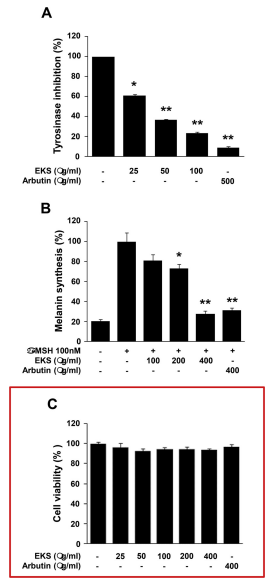
Fig. 1. Effects of ethanol extract of Kummerowia striata on tyrosinase inhibition, cell viability, and melanin synthesis (A) Tyrosinase inhibitory activity of ethanol extract of Kummerowia striata (EKS) was analyzed by measuring the amount of dopachrome generated in the reaction. Arbutin was used as a positive control. (B) Melanin content in B16F10 cells stimulated with 100 nM αMSH. The melanin content was calculated as a percentage of the content in control. (C) B16F10 mouse melanoma cells were treated with EKS (25–400 μg/ ml) and arbutin (400 μg/ml). Cytotoxicity of EKS and arbutin was determined using an MTT assay. Values represent the mean ± SD of three independent replicates. Statistical significance is indicated as *P < 0.05, **P < 0.01, compared with non-treated samples or α-MSH-treated cells.
 \
\
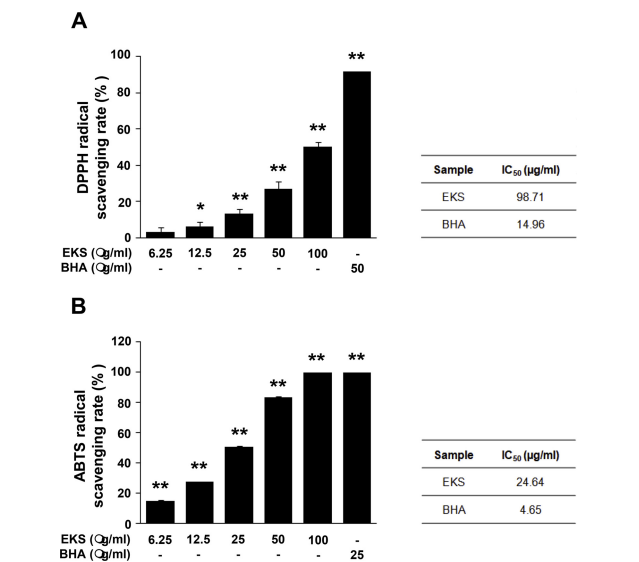
Fig. 2. Anti-oxidant activity of ethanol extract of Kummerowia striata (A and B) Free radical scavenging activity was determined as described. The antioxidant activity was measured by using DPPH radical scavenging activity assay and ABTS+ radical cation test. Butylated hydroxyanisole was used as a positive control. Values represent the mean ± SD of three independent replicates. Statistical significance is indicated as *P < 0.05, **P < 0.01, compared with the non-treated samples.
3. Results
3.1. Anti-melanogenesis effects of EKS
To determine the anti-melanogenic activities of EKS, we employed a mushroom tyrosinase assay using L-tyrosine as the substrate and mushroom tyrosinase as the enzyme source. Since tyrosinase is a key enzyme catalyzing the rate-limiting step in melanin biosynthesis, we first measured the tyrosinase inhibitory ability of EKS. As shown in Fig. 1A, EKS exerted a significant inhibitory effect on tyrosinase activity in a dose-dependent manner. These results suggest that EKS displayed inhibitory effects on mushroom tyrosinase activity, and the inhibitory effect of EKS was similar to that of arbutin used as a positive control.
Next, to determine the effect of EKS on melanin synthesis, the melanin content of EKS-treated B16F10 melanoma cells was quantified. As shown in Fig. 1B, EKS treatment decreased the melanin content in melanoma cells in a dose-dependent manner, indicating that the decrease in cellular melanin might be due to the inhibition of tyrosinase activities. In addition, investigating the effect of EKS on B16F10 melanoma cell viability showed that EKS had no significant cytotoxic effect on B16F10 cells at the concentration used (Fig. 1C). These findings clearly show that EKS exerts anti-melanogenic effects through inhibition of tyrosinase activity and melanin synthesis in B16F10 melanoma cells without inducing cytotoxicity.
3.2. Anti-oxidant activity of EKS
The scavenging activity of EKS was determined using DPPH free radicals (Fig. 2A). EKS exhibited higher antioxidant activity (scavenging activity = 50.22%, IC50 = 98.71 μg/ml). The scavenging capacity of EKS was also assessed using ABTS radical cation (Fig. 2B). The ABTS radical scavenging capacity of EKS was similar to that of the positive control BHA (scavenging capacity = 99.53%, IC50 = 24.64 μg/ml). These results indicate that EKS has higher antioxidant activity.
3.3. Effect of EKS on the expression of melanin synthesis genes
To investigate the molecular mechanisms by which EKS regulates melanogenesis further, we examined the changes in the expression of melanogenic genes and proteins, such as tyrosinase, TRP-1, TRP-2, and MITF, which play pivotal roles in melanogenesis [20]. As shown in Fig. 3A, the mRNA expression of tyrosinase, TRP-1, TRP-2, and MITF was triggered by α-MSH; however, EKS treatment significantly decreased the mRNA expression (100–400 μg/ml). Moreover, EKS showed potent inhibitory activity similar to that of the positive control arbutin. Next, the effect of EKS on the expression of melanogenesis-related proteins was assessed by western blot analysis. As shown in Fig. 3B, EKS treatment markedly inhibited α-MSH-induced expression levels of tyrosinase, TRP-1, TRP-2, and MITF in B16F10 cells. Taken together, these findings demonstrate that the inhibitory effects of EKS on melanogenesis in B16F10 cells might be mediated through the downregulation of melanogenic genes and proteins, such as tyrosinase, TRP1, TRP-2, and MITF.
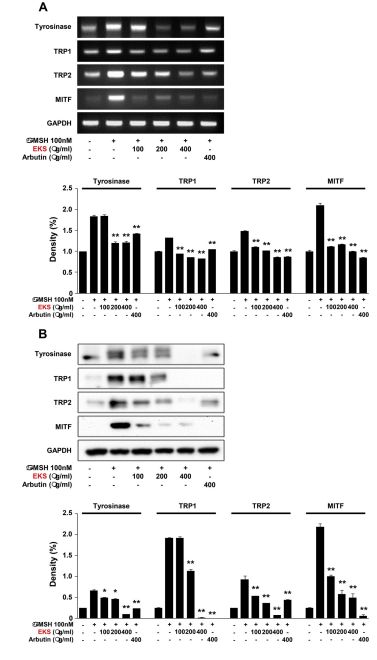
Fig. 3. Effects of ethanol extract of Kummerowia striata on melanin biosynthesis process (A) Expression of tyrosinase, TRP1, TRP2, and MITF at the mRNA level was determined by using RT-PCR. Arbutin was used as a positive control. Tyrosinase, TRP1, TRP2, and MITF mRNAs were analyzed by densitometry protocol. Arbutin was used as a positive control. (B) Expression of tyrosinase, TRP1, TRP2, and MITF at the protein level was determined by western blotting. Arbutin was used as a positive control. Tyrosinase, TRP1, TRP2, and MITF were analyzed by densitometry protocol. Arbutin was used as a positive control. Values represent the mean ± SD of three independent replicates. Statistical significance is indicated as *P < 0.05, **P < 0.01, compared with α-MSH-treated cells.
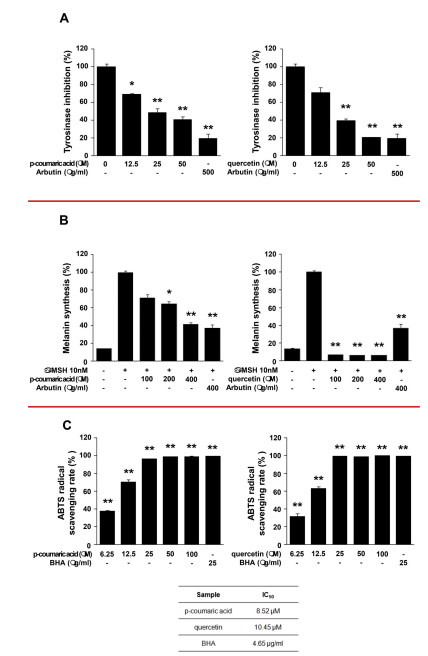
Fig. 4. Tyrosinase inhibition activity and anti-oxidant activity of active compounds of ethanol extract of Kummerowia striata (A) Tyrosinase inhibitory activity of p-coumaric acid and quercetin (12.5–50 μM) were analyzed. (B) The anti-Melanogenic activity of coumaric acid and quercetin (100–400 μM) was analyzed in B16F10 cells. (C) Anti-oxidant activity of p-coumaric acid and quercetin (6.25–100 μM) was measured by using ABTS+ radical cation test. Arbutin and BHA were used as positive control. Values represent the mean ± SD of three independent replicates. Statistical significance is indicated as *P < 0.05, **P < 0.01, compared with the non-treated samples.
3.4. p-coumaric acid and quercetin from EKS exhibited potent anti-melanogenic and anti-oxidant activities
Next, we attempted to identify and purify the functional compounds present in EKS that exhibit potent anti-melanogenic and anti-oxidant properties. The various compounds were identified as luteolin, p-coumaric acid, rosmarinic acid, quercetin, genistein, and (+)-catechin. Among them, p-coumaric acid and quercetin inhibited tyrosinase, and synthesis of melanin and exhibited scavenging capacity similar to arbutin, a well-known depigmenting agent, in a dose-dependent manner (Fig. 4). These results indicate that p-coumaric acid and quercetin are important compounds for anti-melanogenic and anti-oxidant properties of EKS.

4. Discussion
In this study, we aimed to analyze the anti-melanogenic and antioxidant potential of EKS and its two compounds p-coumaric acid and quercetin and found that EKS possesses potent anti-melanogenic and anti-oxidant activities.
Skin pigmentation is mostly caused by melanocytes in the basal layer of the skin, following stimulation by UV radiation. Stimulated keratinocytes secrete α-MSH (a small peptide hormone) [21]. Thus, UV exposure induces melanin production resulting in hyperpigmentation [22]. Recently, many researchers have focused on the development of new and effective whitening compounds, because cosmetics with whitening effects constitute a large part of the cosmetics market. Studies on the inhibition of melanin biosynthesis revealed that arbutin, kojic acid, and many other natural products inhibit melanogenesis and hyperpigmentation. However, the side effects of arbutin [23] and kojic acid [24] have recently been reported, and the use of these substances may be restricted. Therefore, there is a need to develop safe skin whitening materials with no side effects. Recent research has focused on the development of skin-whitening cosmetics from natural materials.
Several studies have demonstrated the various biological activities of K. striata extracts. In particular, K. striata is pharmaceutically effective for inflammation and oxidation [25,26]. However, the effects and molecular mechanisms of K. striata on melanogenesis have not been reported to date. In the present study, we demonstrate for the first time that EKS possesses anti-melanogenic and anti-oxidant activities.
Tyrosinase, TRP-1, and TRP-2 play important roles in melanin biosynthesis [27]. Thus, the mechanism underlying the effect of skin whitening agents involves the inhibition of melanin production by decreasing tyrosinase activity [28]. The expression of tyrosinase, TRP-1, and TRP-2 genes are known to be regulated by MITF [29]. In the present study, the anti-melanogenic activities of EKS were found to be mediated by the inhibition of tyrosinase activity and α-MSH-induced melanin synthesis in B16F10 melanoma cells, without the induction of cytotoxicity (Fig. 1). These anti-melanogenic activities of EKS were found to be mediated by the downregulation of α-MSH-induced mRNA and protein expression of tyrosinase, TRP-1, TRP-2, and MITF (Fig. 3). The anti-oxidant activities were measured by DPPH and ABTS assays. EKS showed strong antioxidant activity similar to BHA, which was used as the positive control (Fig. 2). The active compounds present in EKS were isolated and confirmed as p-coumaric acid and quercetin. Although various biological activities, including cardioprotective [30], anti-inflammatory [31,32], anti-mutagenic [33] anti-oxidant [34,35], and anti-melanogenic [36] activities have been reported for p-coumaric acid and quercetin from various plants, this is the first study to report that p-coumaric acid and quercetin from EKS possess anti-melanogenic and anti-oxidant activities.
In this study, the anti-melanogenic and anti-oxidant activities of EKS were evaluated. EKS exerted anti-melanogenic and anti-oxidant activities via regulation of tyrosinase activity and α-MSH-induced melanin synthesis in B16F10 melanoma cells, without inducing cytotoxicity. The main active compounds were p-coumaric acid and quercetin. Thus, our findings demonstrate for the first time that EKS may be utilized as a potential depigmenting and anti-oxidant agent.

Conflicts of interest
The authors declare no conflict of interest.
Funding
This work was supported by the Technology Development Program (S2393982) funded by the Ministry of SMEs and Startups (MSS, Korea).
Transparency document
The Transparency document associated with this article can be found in the online version.
References
[1] P. Limtrakul, S. Yodkeeree, P. Thippraphan, W. Punfa, J. Srisomboon, Anti-aging and tyrosinase inhibition effects of Cassia fistula flower butanol extract, BMC Complement. Altern. Med. 16 (2016) 497.
[2] A. Gragnani, S. Cornick, V. Chominski, S. Ribeiro de Noronha, S. Alves Corrêa de Noronha, L. Ferreira, Review of major theories of skin aging, Adv. Aging Res. 3 (2014) 265–284.
[3] T.D. Pedrosa, A.O. Barros, J.R. Nogueira, A.C. Fruet, I.C. Rodrigues, D.Q. Calcagno, M.A. Smith, T.P. de Souza, S.B. Barros, M.C. de Vasconcellos, et al., Anti-wrinkle and anti-whitening effects of jucá (Libidibia ferrea Mart.) extracts, Arch. Dermatol. Res. 308 (2016) 643–654.
[4] N. Delalle-Lozica, Local therapy as basic anti-aging prevention, Acta Clin. Croat. 49 (2010) 529–536.
[5] N. Maddodi, A. Jayanthy, V. Setaluri, Shining light on skin pigmentation: the darker and the brighter side of effects of UV radiation, Photochem. Photobiol. 88 (2012) 1075–1082.
[6] C. Dessinioti, A.J. Stratigos, D. Rigopoulos, A.D. Katsambas, A review of genetic disorders of hypopigmentation: lessons learned from the biology of melanocytes, Exp. Dermatol. 18 (2009) 741–749.
[7] A. Nishina, A. Miura, M. Goto, K. Terakado, D. Sato, H. Kimura, Y. Hirai, H. Sato, N. Phay, Mansonone E from Mansonia gages inhibited α-MSH-induced melanogenesis in B16 cells by inhibiting CREB expression and phosphorylation in the PI3K/Akt pathway, Biol. Pharm. Bull. 41 (2018) 770–776.
[8] V.J. Hearing, T.M. Ekel, Mammalian tyrosinase. A comparison of tyrosine hydroxylation and melanin formation, Biochem. J. 57 (1976) 549–557.
[9] M. Kanlayavattanakul, N. Lourith, Plants and natural products for the treatment of skin hyperpigmentation – a review, Planta Med. (2018), https://doi.org/10.1055/a0583-0410 [Epub ahead of print].
[10] M. Kanlayavattanakul, N. Lourith, Skin hyperpigmentation treatment using herbs: a review of clinical evidence, J. Cosmet. Laser Ther. 20 (2018) 123–131.
[11] J.J. Hsiao, D.E. Fisher, The roles of microphthalmia-associated transcription factor and pigmentation in melanoma, Arch. Biochem. Biophys. 563 (2014) 28–34.
[12] L.A. Garraway, H.R. Widlund, M.A. Rubin, G. Getz, A.J. Berger, S. Ramaswamy, R. Beroukhim, D.A. Milner, S.R. Granter, J. Du, C. Lee, et al., Integrative genomic analyses identify MITF as a lineage survival oncogene amplified in malignant melanoma, Nature 436 (2005) 117–122.
[13] X. Zhang, P. Guo, G. Sun, S. Chen, M. Yang, N. Fu, H. Wu, X. Xu, Phenolic compounds and flavonoids from the fruits of Pandanus tectorius Soland, J. Med. Plants Res. 6 (2012) 2622–2626.
[14] H. Li, Q. Ma, Y. Liu, J. Qian, J. Zhou, Y. Zhou, Chemical constituents from Polygonum perfoliatum, Chin. J. Appl. Environ. Biol. 15 (2009) 615–620.
[15] A. Yagi, T. Kanbara, N. Morinobu, Inhibition of mushroom-tyrosinase by aloe extract, Planta Med. 56 (1987) 515–517.
[16] M.S. Blois, Antioxidant determinations by the use of a stable free radical, Nature 181 (1958) 1199–1200.
[17] U. Ozgen, A. Mavi, Z. Terzi, A. Yιldιrιm, M. Coşkun, P.J. Houghton, Antioxidant properties of some medicinal Lamiaceae species, Pharm. Biol. 44 (2006) 107–112.
[18] N.J. Miller, C. Rice-Evans, M.J. Davies, V. Gopinathan, A. Milner, A novel method for measuring antioxidant capacity and its application to monitoring the antioxidant status in premature neonates, Clin. Sci. 84 (1993) 407–412.
[19] S. Dudonne, X. Vitrac, P. Coutière, M. Woillez, J.M. Mérillon, Comparative study of antioxidant properties and total phenolic content of 30 plant extracts of industrial interest using DPPH, ABTS, FRAP, SOD, and ORAC assays, J. Agric. Food Chem. 57 (2009) 1768–1774.
[20] M. Otreba, J. Rok, E. Buszman, D. Wrzesniok, Regulation of melanogenesis: the role of cAMP and MITF, Postepy Hig. Med. Dosw. 66 (2012) 33–40.
[21] J.S. Han, J.H. Sung, S.K. Lee, Antimelanogenesis activity of hydrolyzed ginseng extract (GINST) via inhibition of JNK mitogen-activated protein kinase in B16F10 cells, J. Food Sci. 81 (2016) H2085–H2092.
[22] M. Chatatikun, A. Chiabchalard, Thai plants with high antioxidant levels, free radical scavenging activity, anti-tyrosinase and anti-collagenase activity, BMC Complement. Altern. Med. 17 (2017) 487.
[23] C. Couteau, L.J. Coiffard, Photostability determination of arbutin, a vegetable whitening agent, Farmaco 55 (2000) 410–413.
[24] Y. Higashi, Y. Fujii, Determination of kojic acid in a skin-whitening cosmetic by high-performance liquid chromatography coupled with ultraviolet detection after pre-column derivatization with 4-fluoro-7-nitro-2,1,3-benzoxazole, J. Cosmet. Sci. 63 (2017) 205–212.
[25] J.Y. Tao, L. Zhao, Z.J. Huang, X.Y. Zhang, S.L. Zhang, Q.G. Zhang, Zhang B.H. FeiXiao, Q.L. Feng, G.H. Zheng, Anti-inflammatory effects of ethanol extract from Kummerowia striata (Thunb.) Schindl on LPS-stimulated RAW264.7 cell, Inflammation 31 (2008) 154–166.
[26] J.-H. Lee, J.-S. Park, Antioxidant activities of solvent-extracted fractions from Kummerowia striata (Thunb.) Schindl, Indian J. Sci. Technol. 8 (2015) 28–31.
[27] S. Kippenberger, S. Loitsch, F. Solano, A. Bernd, R. Kaufmann, Quantification of tyrosinase, TRP-1, and Trp-2 transcripts in human melanocytes by reverse transcriptase-competitive multiplex PCR– regulation by steroid hormones, J. Invest.Dermatol. 110 (1998) 364–367.
[28] Y.D. Park, S.Y. Kim, Y.J. Lyou, D.Y. Lee, J.M. Yang, TXM13 human melanoma cells: a novel source for the inhibition kinetics of human tyrosinase and for screening whitening agents, Biochem. Cell Biol. 84 (2006) 112–116.
[29] A. Tuerxuntayi, Y.Q. Liu, A. Tulake, M. Kabas, A. Eblimit, H.A. Aisa, Kaliziri extract upregulates tyrosinase, TRP-1, TRP-2 and MITF expression in murine B16 melanoma cells, BMC Complement. Altern. Med. 14 (2014) 166.
[30] N. Prasanna, D.N. Krishnan, M. Rasool, Sodium arsenite-induced cardiotoxicity in rats: protective role of p-coumaric acid, a common dietary polyphenol, Toxicol. Mech. Methods 23 (2013) 255–262.
[31] S.J. Pragasam, V. Venkatesan, M. Rasool, Immunomodulatory and anti-inflammatory effect of p-coumaric acid, a common dietary polyphenol on experimental inflammation in rats, Inflammation 36 (2013) 169–176.
[32] M. Lee, M. Son, E. Ryu, Kim J.G. Yu SS, B.W. Kang, G.H. Sung, H. Cho, H. Kang, Quercetin-induced apoptosis prevents EBV infection, Oncotarget 6 (2015) 12603–12624.
[33] L.R. Ferguson, I.F. Lim, A.E. Pearson, J. Ralph, P.J. Harris, Bacterial anti mutagenesis by hydroxycinnamic acids from plant cell walls, Mutat. Res. 542 (2003) 49–58.
[34] C. Castelluccio, G. Paganga, N. Melikian, G.P. Bolwell, J. Pridham, J. Sampson, C. Rice-Evans, Antioxidant potential of intermediates in phenylpropanoid metabolism in higher plants, FEBS Lett. 368 (1995) 188–192.
[35] I.M. Erden, A. Kahraman, The protective effect of flavonol quercetin against ultraviolet-induced oxidative stress in rats, Toxicology 154 (2000) 21–29.
[36] S.M. An, Koh JS, and Boo YC: p-coumaric acid not only inhibits human tyrosinase activity in vitro but also melanogenesis in cells exposed to UVB, Phytother. Res. 24 (2010) 1175–1180.
For more information:1950477648nn@gmail.com