Artificial Intelligence-Driven Digital Interactive Design And Public Communication Of Hua Tuo's Five-Animal Frolics
Feb 26, 2025
Abstract: This study operationalizes the digitization of Hua Tuo's traditional Chinese exercise, the Five-Animal Frolics, by harnessing its simulation of the postures and movements of the tiger, deer, bear, monkey, and bird. This approach seeks to explore its latent potential in enhancing physical fitness, psychological well-being, and aesthetic values, thereby facilitating the modern dissemination of intangible cultural heritage and bolstering national fitness initiatives. The research unfolded in four methodical phases: (1) development of visual models for the Five-Animal Frolics; (2) application of artificial intelligence algorithms for motion capture, incorporating techniques for human pose estimation and motion redirection; (3) conceptualization and design of a public interactive fitness device; (4) establishment of physiological and psychological assessment metrics, followed by the application of linear and logistic regression analyses for data evaluation. Utilizing the advantages of artificial intelligence technology, the study achieved a cost-effective digital transformation of the Five-Animal Frolics, leading to the design of an interactive fitness device, and evaluated its effectiveness in health promotion. This research epitomizes the innovative integration of sports science, design theory, and artificial intelligence, offering valuable insights for the preservation of intangible cultural heritage, interdisciplinary integration, and pioneering development in the domain of fitness design.
Keywords: Five Animal Frolics; Artificial Intelligence(AI); Human Pose Estimation; Human Motion Retargeting; Interactive Device
This study, through innovative design concepts, integrates the traditional Hua Tuo's Five-Animal Exercises with modern artificial intelligence technology to develop a highly interactive modern fitness device. Named "MoveFit Joy," this device leverages motion-sensing and gesture recognition technologies with the aim of incorporating the Five-Animal Exercises into people's daily lives, making it convenient to use in public spaces and helping users achieve effective workouts in a short amount of time. By combining contemporary aesthetic design with advanced motion-capture technology, this research seeks to digitize and create an interactive experience of the Five-Animal Exercises, exploring new directions for the preservation of intangible cultural heritage in the digital age.

TCM cistanche functions in bodybuilding
1. The Fitness Value of Traditional Five-Animal Exercises
The Five-Animal Exercises were created by Hua Tuo, a renowned physician of the Han Dynasty, who combined the essence of traditional Dao Yin techniques with ancient philosophical thought. By imitating the postures and movements of five animals-tiger, deer, bear, ape, and bird-the exercises aim to promote health and enhance flexibility. Studies have confirmed the value of the Five-Animal Exercises in fitness, psychological regulation, and aesthetics, demonstrating their significant role in promoting physical and mental well-being. This exercise set is believed to enhance bodily flexibility, strength, and balance, with each animal's movements having specific breathing regulation effects [1], contributing positively to physical health maintenance [2]. Moreover, the Five-Animal Exercises have been shown to improve immune function, quality of life, and the effectiveness of cancer treatments [3] (as shown in Figure 1).
In terms of mental health, the Five-Animal Exercises have been found to exert broad positive effects. Experimental research has shown that training in the Five-Animal Exercises significantly improves the psychological state of female college students with depression [4], aids in respiratory regulation, and enhances concentration. Studies on middle school students have revealed that the exercises help improve overall executive function [5], positively correlating with the physical and mental health of young people [6][7]. Furthermore, when combined with mindfulness-based cognitive therapy, the Five-Animal Exercises significantly reduce negative emotions, improve sleep quality, and enhance behavioral abilities among elderly individuals in nursing homes who experience dementia-related fears, ultimately improving their quality of life [8].
From an aesthetic perspective, the Five-Animal Exercises are considered to possess a unique sense of artistic beauty [9]. In traditional Chinese philosophy, the perception of beauty emphasizes a holistic experience, cognition, feeling, and comprehension, manifesting as a seamless synergy between the mind and body. For example, practicing the Tiger Exercise requires one to first imagine themselves as a fierce tiger, then stretch their torso and limbs, balancing strength and flexibility throughout the exercise. This practice embodies a sense of power and vitality [11]. By mimicking the movements of five animals, the exercises display formal beauty and a dynamic balance of motion and stillness [12], making them both functional and enjoyable. This suitability for people of all ages contributes positively to enhancing happiness in modern society.
It is evident that the traditional Five-Animal Exercises hold significant potential for promotion in contemporary society. However, their widespread adoption still faces challenges. Due to the complexity of the movements, the difficulty of practice, and the need for proper guidance, coupled with a lack of connection to modern lifestyles, the Five-Animal Exercises are often perceived as an ancient Qigong practice primarily associated with older male practitioners. This perception has limited their dissemination among a broader audience.

Fig.1 The Contemporary Fitness Value of Hua Tuo's Five-Animal Frolics
2. Visual Design of the Five-Animal Exercises
First, visual symbols are extracted from the traditional cultural connotations of the Five-Animal Exercises, including elements of form, color, and space. Then, using digital illustration techniques, these extracted symbols are illustrated to represent the movements and directional positions of the Five-Animal Exercises. These intuitive graphics not only help convey the cultural essence of the Five-Animal Exercises but also lay the foundation for the visual design of subsequent interactive devices.
The character designs for the Five-Animal Exercises are based on traditional Chinese visual elements, with a simple and playful style and a flattened visual approach, aimed at enhancing inclusivity. This ensures the design aligns with modern aesthetics and is suitable for families, children, and the elderly. The clothing design for the characters is minimalistic, featuring Han Dynasty-style short tops and training pants paired with traditional headwear. The color scheme adopts the traditional Chinese "Five Colors" palette: red, green (blue), yellow, white, and black. In traditional society, these five colors carry unique symbolic meanings, imbuing the Five-Animal Exercises design with profound emotional value. Additionally, based on the cultural origins of the Five-Animal Exercises, the tiger, deer, bear, ape, and bird correspond to the five traditional directions in Chinese culture: south, east, center, west, and north, reflecting the unique spatiotemporal concepts of ancient China. The relationship between the Five-Animal Exercises and traditional Chinese culture is presented in Table 1.
According to the Newly Compiled Ten Movements of the Five-Animal Exercises published by the General Administration of Sport of China, the dynamic forms of the exercises can be subdivided into 107 static postures, including 21 for the tiger, 20 for the deer, 21 for the bear, 25 for the ape, and 20 for the bird. Among the movements of the five animals, the tiger exhibits a stance of readiness, poised to pounce; the deer shows a state of leaping and bounding with its forelimbs drawn in; the bear demonstrates a leisurely and relaxed posture; the ape assumes a dynamic gesture of gripping tree branches, preparing to move forward; and the bird displays a graceful pose of spreading its wings while standing on one leg (as shown in Table 2, with motion illustrations sourced from Sohu.com). The forms of the movements primarily feature smooth curves, such as the expansive and lively arcs seen in the movements of the deer and the ape, while the vertical straight lines in the tiger's lifting motion and the ape's grasping motion convey a sense of determination and stability. A detailed analysis of the poses is shown in Figure 2.

The basic hand gesture designs include tiger claws, deer antlers, bear paws, ape hooks, and bird wings. The tiger claw hand form, when viewed from the side, features five fingers spread open, with the first two knuckles bent inward toward the palm. The deer antler hand form, viewed from the front, has fingers stretched and spread outward, with the thumb, index finger, and pinky extended while the middle and ring fingers bend inward. The bear paw, viewed from the side, has all five fingers curved and close together, with the thumb's pad touching the tip of the index finger, forming an "O" shape with the palm. The ape hook hand form is based on the bear paw design, with the fingers straightened and close together and the wrist slightly lowered. The bird wing hand form, viewed from the side, features fingers slightly spread and extended, with the thumb, index finger, and pinky slightly raised while the middle and ring fingers are close together and point downward. The design process for these forms is depicted in Figure 3.
Tab.1 Correspondence Between Hua Tuo's Five-Animal Frolics and Traditional Chinese Culture
| Movement | Action Description | Five Elements | Color | Direction | Five Organs | Cultural Meaning |
|---|---|---|---|---|---|---|
| Tiger | Strength and readiness | Wood | Green | South | Liver | Represents bravery and vitality; associated with spring and the upward growth of life. |
| Deer | Warmth and agility | Fire | Red | East | Kidneys | Symbolizes longevity and elegance; associated with summer and wisdom. |
| Bear | Stability and strength | Earth | Yellow | Center | Spleen | Represents strength and perseverance; embodies stability and nourishment. |
| Ape | Agility and liveliness | Metal | White | West | Heart | Represents intelligence and mobility; associated with autumn and quick thinking. |
| Bird | Lightness and soaring | Water | Black | North | Lungs | Symbolizes freedom and grace; associated with winter and the vastness of the sky. |
Tab.2 The Techniques and Movements of Hua Tuo's Five-Animal Frolics
| No. | Animal | Movement Characteristics | Key Movement Points | Meaning of the Movement |
|---|---|---|---|---|
| 1 | Tiger | The tiger exhibits a poised and ready-to-pounce posture. The hands mimic tiger claws, with fingers bent inward. The body leans slightly forward, with arms raised and bent at chest level, and both knees slightly flexed. | Focus on simulating the tiger's fierce and powerful demeanor by extending the body's strength and coordination. | Enhances overall body strength and balance, promoting physical vitality and resilience. |
| 2 | Deer | The deer shows agility and elegance. Arms extend upward, fingers mimic antlers with specific hand gestures, and the body demonstrates a leaping and bounding posture. | Emphasize the smooth and coordinated movement of the arms and legs, mimicking the graceful leaping motion of a deer. | Improves flexibility and joint mobility, enhancing physical elegance and balance. |
| 3 | Bear | The bear exhibits a relaxed and steady gait. Arms move in a rounded motion, with palms mimicking bear paws, while the upper body slightly sways from side to side. | Focus on steady and rhythmic movements, ensuring alignment between the upper and lower body for a balanced posture. | Strengthens core stability and endurance, promoting a sense of calm and groundedness. |
| No. | Animal | Movement Characteristics | Key Movement Points | Meaning of the Movement |
|---|---|---|---|---|
| 4 | Ape | The ape exhibits agility and dexterity. Both hands mimic the shape of hooks, placed in front of the chest, with knees slightly bent. | Focus on the coordinated retraction of the arms and legs. The upper body remains upright, while the legs maintain a light and balanced stance. | Enhances physical agility and flexibility, promoting quick reactions and nimbleness. |
| 5 | Bird | The bird exhibits lightness and grace. Both arms extend outward like wings, while one leg stands upright, and the other slightly bends. | Ensure smooth, flowing arm movements and a steady single-leg stance, maintaining balance and poise throughout. | Improves balance and coordination, promoting a sense of freedom and elegance during the exercise. |
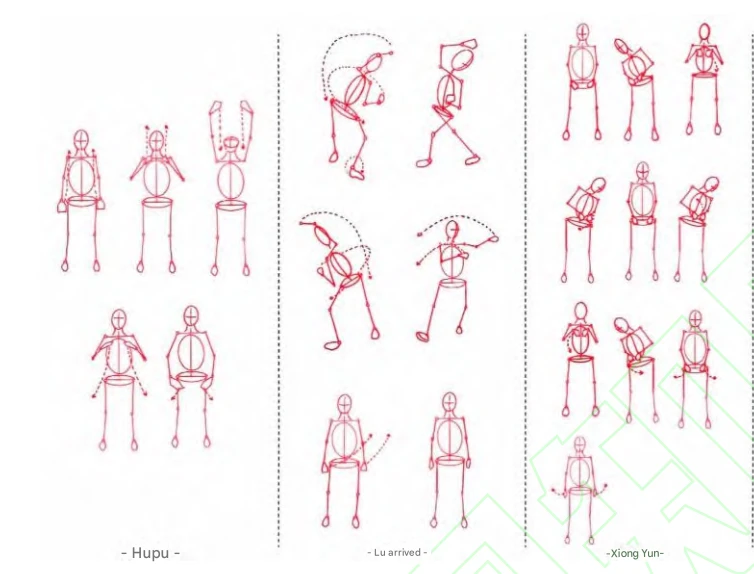
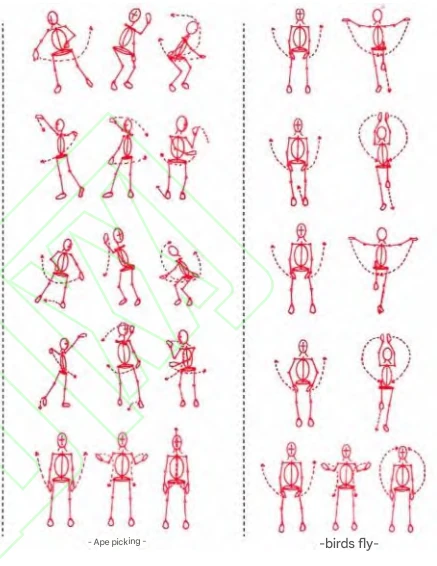
Fig.2 Analysis of Movements and Postures in Hua Tuo's Five-Animal Frolics


Fig.3 Visual Design Process of the Five-Animal Frolics