Autophagy-Lysosomal Pathway As Potential Therapeutic Target in Parkinson’s Disease Part 2
Jun 28, 2022
Please contact oscar.xiao@wecistanche.com for more information
3.4.2. Role of Macroautophagy in PD
The involvement of macroautophagy and its defects have been extensively investigated in neurodegenerative diseases and synucleinopathy, with some studies also referring to PD[141-144]. Accumulating evidence indicates that several components of the macroautophagy pathway are involved in PD(Figure 3). Genetic analyses of PD patients have revealed abnormal expression levels for the genes encoding ATG5, ATG7, ATG12, and MAP1LC3B(Table 2). Two independent exome sequencing studies [145,146] also identified point mutations in the vacuolar protein sorting ortholog 35(VPS35)gene, causing an autosomal dominant form of PD(PARK17)(Table 2). This monogenic subtype of PD is rare, and the precise role of the VPS35 mutations(especially VPS35 D620N) is not yet fully understood(discussed in[147I. Nevertheless, this pathogenic effect highlights the role of the retromer, a highly conserved membrane-associated protein complex in which VPS35 is an intrinsic component, in the α-syn degradation pathway [148,149]. cistanche benefits Studies on DA neurons lacking the VPS35 gene show α-syn accumulation and toxicity, in particular loss of mitochondrial fusion and functions[150]. ATG9 trafficking defects(the ATG9 system is required for phagophore expansion)were also associated with mutant VPS35, leading to α-syn accumulation. Increasing VPS35 levels in PD mice rescued α-syn accumulation and induced neuroprotection, demonstrating that regulating VSP35 may be of interest to treat PD[147,151].

Please click here to know more
Although still a matter of debate, recent data suggest the involvement of more selective autophagy pathways particularly targeting α-syn, that is,synucleinphagy(Table 1)[58]. In Vitro and in vivo studies conducted on microglial cells clearly demonstrated that α-syn was degraded via macroautophagy. Toll-like receptor (TLR)-4 on the microglia recognizes α-syn and activates NF-kB signaling, which in turn alters SQSTM1 transcription. The protein produced, which is present at raised levels, selectively binds to the internalized α-syn leading to its colocalization with autophagosomes. cistanche cholesterol Lack of TLR-4 and SOSTM1 alters autophagy-mediated α-syn degradation [58]. Thus, TLR-4 or SQSTM1 may serve as relevant markers in neurons where αx-syn has accumulated.
3.4.3.Role of CMA in PD
In addition to mitophagy and lysosomal macroautophagy, which have relatively well-established roles in α-syn degradation, CMA also appears to be involved in this vital process. CMA is a central process that degrades proteins harboring a specific combination of five amino acids—the"KFERQ-motif"(Figures 2 and3). This motif allows the chaperone heat shock protein A8(HSPA8)/cognate 70 kDa protein (HSC70)to bind the substrate protein and direct it to the lysosomal membrane, where it encounters lysosome-associated membrane protein type 2A (LAMP2A), which plays a decisive role. The binding of the complex promotes LAMP2A multimerization to form a membrane-bound higher-molecular-order complex. The substrate protein is then unfolded within this complex and translocated into the lysosome. A lysosome-resident HSPA8 isoform (Lys-HSPA8) contributes to the translocation of the substrate protein across the membrane towards the lysosomal lumen, where it is degraded by acidic hydrolases [36,152-155].α-syn contains a KFERO-like motif and its CMA-mediated degradation is significantly reduced for α-syn constructs lacking the KFERQ-like motif, and by LAMP2A knockdown [152,156].
Interestingly, another protein, leucine-rich repeat kinase 2(LRRK2)—which is also linked to familial forms of PD(Table 2)—is degraded in lysosomes as part of CMA. In contrast, the most common pathogenic mutant form of LRRK2, G2019S, is poorly degraded by this pathway[154,157]. CMA activity can be modulated by the rate of assembly/disassembly of the translocation complex [40]. In this context, a key finding for PD was the discovery that the lysosomal binding of both wild-type and several pathogenic mutant LRRK2 forms was increased in the presence of other CMA substrates. These substrates interfere with the organization of the CMA translocation complex as the enhanced binding inhibits the assembly of the CMA translocation complex at the lysosomal membrane. In response to this inhibition, affected cells produced more LAMP2A. A similar feature has been observed in the brains of PD patients with LRRK2 mutations. This mechanism leads to the accumulation of other CMA substrates, including α-syn, that remain bound longer than normal at the surface of the lysosomal membrane awaiting translocation[157]. Thus, in PD, the SCNA gene is not alone in contributing to the pathology, and genes involved in the clearance of aggregated α-syn may also be involved [154]. This finding is significant since both mutant α-syn and aggregated α-syn that have escaped autophagic degradation can hamper the CMA process in neurons, leading to neuronal cell death [158].
Several post-mortem studies have revealed that the levels of rate-limiting CMA components LAMP2A and HSPA8 are reduced in PD patients, especially in the SNpc [156,159,160]. Interestingly, the oxidized mitochondrial regulator MEF2D described above also binds to HSPA8 and is indirectly involved in CMA [161]. Studies on peripheral leukocytes from patients with sporadic PD revealed that LAMP2 transcript and protein levels are significantly reduced compared to the levels measured in healthy individuals [162]. Although in the same study, macroautophagy (measured by MAP1LC3I analysis) appeared to be induced, this conclusion would merit more complete independent confirmation, with the addition of measurement of autophagic flux (not performed in the initial study).

Cistanche can anti-aing
A few other autophagy-related genes and proteins involved in CMA have been associated with PD. For example, the peroxiredoxin-like redox sensor DJ-1 modulates the activity of SQSTM1 and the targeting of ubiquitin-conjugated proteins to macroautophagy under oxidative stress caused by tumor necrosis factor ligand superfamily, member 10 (TNFSF10/TRAIL)[163]. The implication of mutated D-1 (PARK7) in early-onset familial PDis well known (Table 2). DJ-1 is involved in a wide variety of cellular functions, including a role as an antioxidant, chaperone functions, transcriptional regulation, and control of mitochondrial Ca transients, among others. This protein regulates p53-induced mitochondrial dysfunction, stabilizes mitochondria-associated ER membranes, and interacts with anti-apoptotic proteins [164]. In addition to its effects on mitophagy and lysosomal macroautophagy, DJ-1 also modulates CMA through its interactions with LAMP2A and lysosomal HSPA8 [165].In particular, it escorts wild-type α-syn for degradation by CMA. Lack of the DJ-1 gene inhibits CMA activity and α-syn degradation both in vitro and in vivo[165].In contrast, DJ-1 is stabilized in cortical neurons by a CMA-mediated process that involves LAMP2A [166]. Interestingly, mutated α-syn proteins can escape from CMA-mediated degradation, which once again supports the CMA selective autophagy process.
In addition to impaired autophagy due to CMA-related genes in familial PD, alterations to CMA have also been implicated in sporadic PD, which accounts for the majority of PD cases. The etiology is more complicated to define in this setting and may be related to various factors—including environmental (e.g, pesticides) and cellular (e.g, oxidative stress; see above) stressors. The proposed involvement of CMA malfunction in PD pathogenesis is further supported by age-related changes to the LAMP2A protein itself, which lead to a gradual reduction in CMA and subsequent acceleration of the disease in older patients[154,156,157,167,168].
Recently, several notable data have highlighted various immune alterations underlying that PD is associated with autoimmune features and could be considered an autoimmune disease [87]. The presence of serum autoantibodies reacting with LAMP2A has not yet been investigated in PD. cistanche deserticola side effects These autoreactive antibodies have been described recently in the serum of autoimmune patients with lupus and closely related systemic autoimmune diseases[169].
3.4.4.Role of Lysosomes in PD
Regardless of the roles played by the different types of autophagy in PD (macroautophagy, CMA, and even some forms of secretory autophagy[170]), lysosomes play a central role in α-syn degradation. Alterations to the lysosomal enzyme content (particularly hydro-lases) influence the degradation process, leading to the accumulation of protein aggregates which cause neuronal damage [48]. Studies have reported decreased levels of lysosomal hydrolases such as o-mannosidase,β-mannosidase, and β-glucocerebrosidase (GBA) in the cerebrospinal fluid (CSF) from patients with FD. cistanche dosage reddit In contrast, in the same patient's serum, the activity of these hydrolases was not significantly altered [171]. The difference in levels of hydrolases in the CSF is now being used for diagnostic purposes [171]. In contrast, the level of o-syn in CSF from PD patients was found to be greatly diminished [172]. These reduced levels are probably due to a-syn accumulation in LBs[172]. Several genes associated with PD are also directly linked to lysosomal functions. As mentioned above, all the autophagy pathways at some point involve lysosomes, as the point to which the material is delivered for processing by various enzymes[48]. Among the enzymes implicated in these processes, cathepsin D is associated with α-syn degradation. Studies on Drosophila have shown that a lack of cathepsin D leads to the accumulation of unprocessed substrates in lysosomes and late endosomes[10,148].

GBA, encoded by GBAl, is another lysosomal enzyme involved in a-syn degradation. Lack of GBA function or low levels of GBA in the human brain induces the accumulation of an oligomeric form of o-syn [173-175], which in turn interferes with the maturation of GBA[173], leading to a vicious cycle. Heterozygous mutations in ATP10B, which encodes ATP10B (Table 2), a late endo-lysosomal lipid flippase that translocates the lipids glucosylceramide and phosphatidylcholine towards the cytosolic membrane leaflet, have been implicated in PD[13]. These mutations alter the translocation functions of ATP10B, leading to an accumulation of glucosylceramide which can drive lysosomal dysfunction [13]. ATP13A2 (PARK9)(Table 2)is another lysosomal protein that is important in PD. It is responsible for cation transport in lysosome-like vesicles. Mutations in ATP13A2 have been observed in early-onset PD[12]. In Vitro, studies confirmed that increased ATP13A2 protein levels reduce α-syn-induced toxicity [176,177]. Similarly, reduced levels of α-galactosidase A transcript and protein were observed in peripheral blood mononuclear cells of PD patients [178]. In addition, studies on the brain of PD patients revealed that DA neurons contained numerous lysosome-like vesicles and granules, suggesting that even in the final stages of the disease, these neurons undergo active apoptosis and engage in autophagy processes[179].
Human transmembrane protein 175(TMEM175), one of the highly expressed genes that encode lysosome-bound K+ channels has also been linked to PD pathogenesis. Both in vitro and in vivo studies on neurons confirmed that TMEM175 deficiency provokes ox-syn accumulation with defects in macroautophagy, lysosomal degradation, and mitochondrial respiration processes [117].
Another lysosomal protein with significant links to PD is the transcription factor EB (TFEB), which coordinates the expression of lysosomal hydrolases, membrane proteins, and genes involved in autophagy. This master regulator of lysosome biogenesis is regulated by the mammalian target of rapamycin (mTOR)C1 through phosphorylation of specific serine residues [180. A study based on a rodent model of o-syn-induced toxicity confirmed that the autophagy-lysosomal pathway is impaired, with TFEB retained in the cytosol. Therefore, increasing autophagy-mediated degradation of SNCA via TFEB regulation could be a promising strategy for PD prevention and treatment [180-183]. Several direct and indirect TFEB agonists have been described as potent regulators in pre-clinical and clinical trials [183].
Taken together, these observations lead us to conclude that any drugs that increase the functional properties of lysosomes should have a potent effect, halting the progression of PD.
3.5.Is the Autophagy Machinery a Potential Target for Selective Intervention in PD?
The link between PD and autophagy dysfunction still remains largely unknown. Thus, there is insufficient information to answer the question of whether autophagy alteration occurs in all patients with PD, and is not associated only with PD risk genes. In this context, it would be of great interest to examine the autophagic activity at the cellular level in patients with and without mutations in autophagy-linked genes. Despite the complexity of the autophagy defects in PD, this vital cellular system could represent a target of considerable interest for the treatment of the disease. Indeed, to date, although our understanding of the molecular bases of PD and its diagnosis [184,185] is improving, therapeutic aspects of PD remain below expectations, with a limited arsenal of efficient and specific drugs. Thus, current therapies are essentially symptomatic, aiming to partially maintain dopamine levels by limiting its degradation using monoamine oxidase B inhibitors, supplying dopamine precursors using levodopa [186], or dopamine agonists such as ropinirole, pramipexole, or rotigotine [187](Figure 4). Today, numerous strategies, including regenerative medicine-based solutions—such as cell-based implants, fetal grafts, patient-specific tissue-engineered constructs—and some cutting-edge technological approaches involving the delivery of near-infrared light directly into the SN in the brain of PD patients, have been used or are being explored [188,189]. Biologics, such as anti-bodies to a-syn (prasinezumab, developed by Roche and Prothena) have been evaluated but unfortunately demonstrated limited success in a first phase II clinical trial. Other companies are also exploring the same line of possible intervention with monoclonal antibodies to α-syn [190]. cistanche extract benefits However, this line of treatment remains uncertain; in February 2021, the failure of Biogen's Ipanema was announced-this monoclonal antibody has a mode of action similar to Roche's prasinezumab. In parallel, novel pharmacological interventions are being evaluated in clinical trials. Some of these also target α-syn[191]whereas others target TNF, transcription factors, nuclear factor erythroid 2-related factor 2 (NRF2), and PPARy, G protein-coupled receptors, glucocorticoid receptors, glucagon-like peptide 1(GLP1), and inflammasome/NLR family pyrin domain-containing 3(NLRP3)(see[187,192-194]). Microglial NLRP3 is a source of sustained neuroinflammation that can contribute to progressive DA neuron loss [195]. Molecules and biologics targeting B and T lymphocytes are also being investigated. In this context, compounds targeting autophagy remain an unexplored route for the development of innovative treatments for PD.

A number of proof-of-concept studies have been performed with compounds targeting autophagy in vitro in cells and in vivo, generally in genetically-deficient animal models. The molecules tested were designed to target mitophagy, macroautophagy, CMA, or lysosomes (Table3 [196]). In the context of mitophagy, since oxidative stress is one of the principal causes of mitochondrial dysfunction, the agents are assessed mainly to protect against the production of, or neutralize, free radicals. In addition, agents targeting mitochondrial biogenesis, such as nuclear respiratory factors 1 and 2(NRF1, NRF2), TFAM, and PGC1-α(described above) have been investigated (Table 3). This process could also be controlled by tuning a few of its crucial interactions. For example, the tumor suppressor protein p53 is a relevant target as it interacts with PRKN, inhibiting its translocation to the cytosol. Compared to healthy controls, significantly higher levels of p53 protein have been measured in the caudate nucleus in PD patients [197]. Experiments in PD models effectively showed that the inhibition of this interaction activates PRKN-dependent mitophagy and reduces the symptoms of PD[197]. Several other targets linked to the mitophagy pathway have been, or are currently being, explored in relation to PD[197-199]. Emerging promising molecules include selective inhibitors of the mitochondrial deubiquitinase, USP30 which negatively regulates PRKN-mediated mitophagy[132,200]. In addition, agents that target mitochondrial dysfunction rather than mitophagy per se(e.g, nimodipine or tetrahydroisoquinoline; Table 3) were found to have a protective effect against PD [201,202].

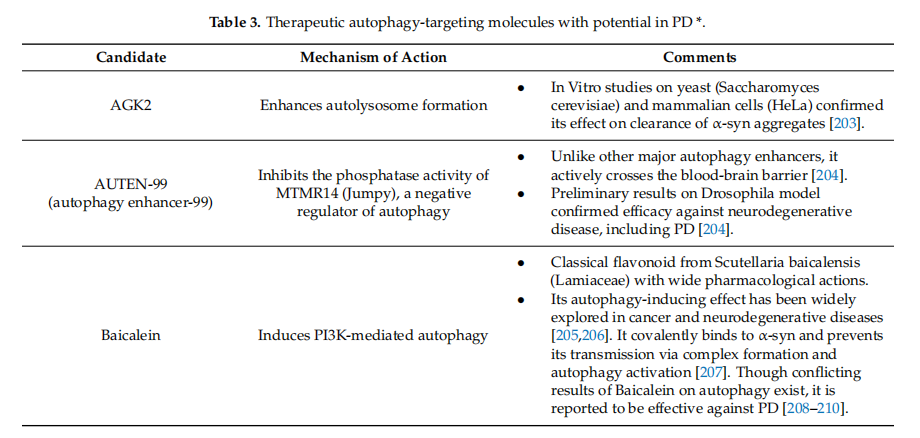
Independent studies on animal models have also demonstrated that enhancing macroautophagy by acting on TFEB or BECN1 can protect neurons against α-syn-induced toxicity [180,275]. Nicolini, ambroxol, curcumin, spermidine, Torin1, 2-hydroxypropyl-β-cyclodextrin (2-HPβCD), or the well-known excipient trehalose are all representative of this pharmacological class (Tables3 and 4) [196,276]. An important molecule to mention here is the Tat-Beclin-1 peptide, a cell-permeable peptide consisting of BECN1(residues 267-284)conjugated to the HIV-1 Tat protein. This peptide construct enhances autophagy initiation by interacting with the autophagy inhibitor Golgi-associated plant pathogenesis-related protein 1(GAPR-1/GLIPR2). This interaction leads to BECN1 distribution throughout the cytosol while also increasing autophagosome formation in neurons. Analogs of this peptide are currently being explored in clinical trials.

Molecules that target CMA are also highly relevant. The decisive role of LAMP2A in o-syn degradation has been clearly demonstrated (see above). Cells and Drosophila over-expressing LAMP2A display a capacity to resist a-syn-induced neurotoxicity or neuronal degeneration and PD-related features [293,294]. These data along with the data presented above, undoubtedly indicate that CMA regulators LAMP2A and HSPA8 represent targets of choice for PD treatments [192,295]. Geranylgeranylacetone, a nontoxic acyclic isoprenoid compound that has been clinically applied as an antiulcer drug in Asian countries, and is a known inducer of HSPs acting via the activation of heat shock transcription factor-1, phorbol 12-myristate 13-acetate and others, could represent exploratory molecules to treat PD via modulation of the CMA pathway [296]. As indicated above, numerous molecules that target mitophagy or lysosomal autophagy pathways are under investigation in preclinical or clinical studies (Tables 3 and 4). To the best of our knowledge, however, none of them have yet been approved and/or are already applied in the treatment of PD.
4. Awaiting Satisfactory Answers—Future Research
A significant number of new research lines suggest novel avenues of the investigation centered on autophagy. In the specific context of PD, we reviewed above some of the key results indicating that targeting the mitophagy and CMA pathways could be a means to protect against α-syn-related toxicity(Appendix B provides a general significance statement). However, some limitations remain, related both to the development of efficient pharmacological molecules, to their administration, and to some theoretical considerations.
In fact, very few molecules are selective to one type of autophagy, or even autophagy as distinct from other cellular pathways, such as apoptosis [48,271,297-301](Figure 4). Consequently, most molecules may display unwanted side effects, especially when they are administered daily in the medium- or long-term to PD patients. The stability of a compound can also represent a limitation for its use. In general, the half-life in the body is around 10-25 min, especially in the liver. It should be mentioned, however, that in most organs and tissues, induction of autophagosome formation is very rapid. Therefore, activation of autophagy remains a rational target strategy when aggregated proteins accumulate. In addition, autophagosomes generally recycle quickly. This represents an advantage with regard to possible toxic events linked to the consequences of induced/activated autophagy. However, it can also be a limitation, in the sense that it will be necessary to extend the treatment periods. In fact, in the particular case of neurons, autophagosome biogenesis is extremely complex, and some heterogeneity has been described depending on the neuronal compartment considered. This aspect remains a matter of debate. Further in vivo information is also required regarding autophagosome formation and dynamics in developing versus mature systems [302].
Autophagy is a very dynamic compartmentalized process; it can be increased in certain organs and tissues but decreased in other organs in the same subject. This differential activation has been described in several models of chronic inflammation and autoimmune diseases, for example in murine models of Sjogren's syndrome [303], chronic inflammatory demyelinating polyneuropathy[304], and chronic house dust mite-induced airway inflammation [305]. With regard to neurons, as indicated above, autophagy is even more complex, with specific stages of the pathway occurring in distinct subcellular compartments. As a consequence, treating an individual with a compound to induce or inhibit autophagy can have a range of individual effects. Due to this variety of effects, treating a subject with an inhibitor can restore abnormally weak levels of autophagic activity in another tissue, as illustrated by the effect of the CMA-modulator peptide P140 [303-305]. P140 which targets CMA and probably indirectly macroautophagy has shown correcting effect on altered CMA activity but displays no effect on the basal, well-balanced, and vital autophagy process. This therapeutic peptide is currently evaluated in phase III clinical trials for lupus. cistanche cholesterol Another critical question that arises is the timing of treatment with regard to the course of the disease. How early should we intervene to see efficacy? This aspect has not really been solved and raises the general question of the benefit-risk of such treatments. The functionality of autophagy that declines with age also represents an aspect that must be taken into consideration in any autophagy-based treatment of PD.
5. General Conclusions
Although the considerations described in this review highlight some gaps in our understanding and appreciation of the potential of autophagy modulators to treat PD, several molecules hold promise for future specific treatment. An important aspect to underline here is that these molecules act on a cellular mechanism and not on the final damage induced. They could therefore be included in early treatment, or even as part of preventive strategies, to avoid or halt disease development.
Interestingly, in addition to the molecules described above in the context of PD, others that target autophagy have shown beneficial effects against neurodegenerative diseases [306-309], and could possibly be considered for review of their indications. These include, for example, reference, Lu AE58054/idalopirdine, SB-742457, latrepirdine, MCI-186/Edaravone, SAGE217, GSK621, AICAR, Propofol, A769662,RSVA314, RSVA405, AUTEN-67, cystatin C, MSL, Digoxin, FTY720, carbamazepine, cimetidine, clonidine, verapamil, SMER28,BRD5631,and AUTEN-67,among others. However, their selectivity, efficacy, and safety must be demonstrated in the context of PD. Extensive work is being undertaken to discover potent new chemical compounds for PD treatment [308,310]. Novel targets that are closely linked to autophagy pathways could also prove to be relevant in PD, for example, protein-O-linked N-acetyl-β-D-glucosaminidase (O-GlcNAcase)[311,312].
From a technical point of view, it is worth recalling here that it is highly recommended to study the efficacy of these novel strategies in several independent models, both in vitro and in vivo if we hope to achieve reproducible results and, in the context of autophagy, to monitor several relevant biomarkers [313-315], as well as measuring the autophagic flux [79,80].
PD affects 1-2 individuals per 1000 in the general population at any time. Its prevalence increases with age. In industrialized countries, it is estimated that the disease affects 0.6%-0.8% of 65-69-year-old individuals and 2.6%-3.5% of 85-89-year-olds. Currently, no specific test exists to diagnose PD, and it cannot be cured. Medications(dopaminergic drugs), as well as a surgical treatment only, act on symptoms. The ultimate goal of ongoing investigations is to develop, ideally non-invasive, therapies that could retune the cellular degradation pathways responsible for clearing abnormally folded or aggregated proteins that are toxic to neurons. Targeting autophagy without altering other vital cellular pathways is a challenge that may be achievable in PD and other neurodegenerative diseases if safe and selective molecules can be appropriately applied and delivered.
This article is extracted from Cells 2021, 10, 3547. https://doi.org/10.3390/cells10123547 https://www.mdpi.com/journal/cells