Cistanche Glycoside For The Inhibition Of Tyrosinase Activity
Apr 07, 2025
2 Results and Discussion
2.1 Effects of PhGs, Gla, and Their Combinations on Tyrosinase Activity
Figure 1 shows the inhibitory effects of PhGs PBS solution, Gla PBS solution, and PhGs/Gla PBS solution on tyrosinase activity.
From Figure 1a, the half-maximal inhibitory concentrations (IC50) of PhGs PBS solution, Gla PBS solution, and Arb PBS solution on tyrosinase activity were (2.192 ± 0.038) g/L, (1.376 ± 0.025) μg/mL, and (0.101 ± 0.003) μg/mL, respectively. The order of tyrosinase inhibition potency was Arb > Gla > PhGs.
From Figure 1b, at a mass concentration of 0.4 mg/mL, the tyrosinase inhibition rates of PhGs/Gla (10:1), PhGs/Gla (5:1), and PhGs/Gla (1:1) PBS solutions were 88.06%, 92.93%, and 94.37%, respectively. The latter two were higher than the inhibition rates of the individual components at the same concentration (36.92% for PhGs PBS solution and 92.71% for Gla PBS solution). Moreover, the inhibition rate of PhGs/Gla (1:1) PBS solution was comparable to that of the positive control Arb.
Based on calculations:

Cistanche Extract With High Level Glycoside For the Inhibition of Tyrosinase Activity
The CI (Combination Index) values for PhGs/Gla (1:5) ~ PhGs/Gla (1:40) PBS solutions were CI > 1, indicating antagonistic effects.
The CI values for PhGs/Gla (40:1) ~ PhGs/Gla (1:1) PBS solutions were CI < 1, indicating synergistic effects.
This demonstrates that when the mass ratio of PhGs to Gla is 40:1, 20:1, 10:1, 5:1, or 1:1, the combination exhibits significant synergistic effects in inhibiting tyrosinase activity.
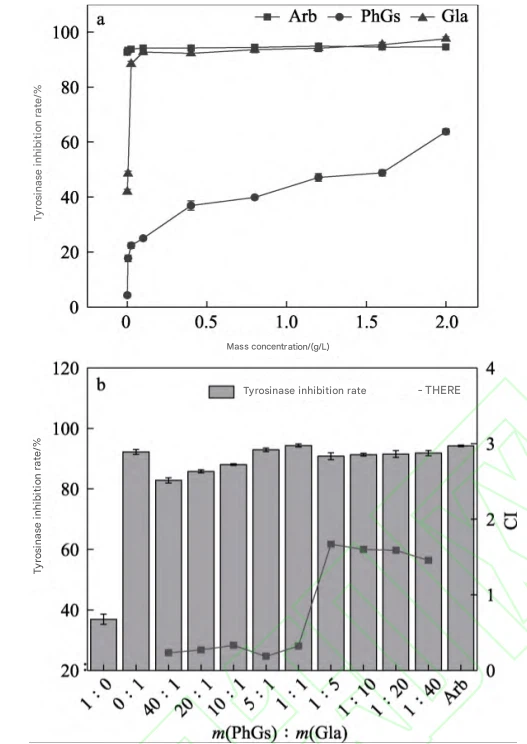
Fig. 1 Inhibition of tyrosinase by PhGs PBS solutions with different mass concentrations, Gla PBS solution (a) and PhGs PBS solution , Gla PBS solution and PhGs/Gla PBS solution with a mass concentration of 0.4 g/L (b) and CI value

2.2 Effects of PhGs, Gla, and Their Combinations on Free Radical Scavenging
Figure 2 illustrates the DPPH radical and ABTS⁺ radical scavenging abilities of PhGs ethanol solution, Gla ethanol solution, and PhGs/Gla ethanol solution.
From Figure 2a, the IC50 values for DPPH radical scavenging of PhGs, Gla, and VC were (21.135 ± 1.164) μg/mL, (55.537 ± 5.230) μg/mL, and (2.852 ± 0.252) μg/mL, respectively. The order of DPPH radical scavenging ability was VC > PhGs > Gla.
From Figure 2b, the IC50 values for ABTS⁺ radical scavenging of PhGs ethanol solution, Gla ethanol solution, and VC ethanol solution were (22.709 ± 0.686) μg/mL, (11.677 ± 0.120) μg/mL, and (3.237 ± 0.345) μg/mL, respectively. The order of ABTS⁺ radical scavenging ability was VC > Gla > PhGs.
From Figure 2c, at a concentration of 0.4 g/L, the DPPH radical scavenging rates of PhGs/Gla (40:1) ~ PhGs/Gla (1:1) ethanol solutions were 87.02% ~ 89.43%, which were higher than the scavenging rates of the individual components (85.32% for PhGs ethanol solution and 83.31% for Gla ethanol solution) and comparable to that of the positive control VC (84.54%). The CI values for PhGs/Gla (1:5) ~ PhGs/Gla (1:40) ethanol solutions were CI > 1, indicating antagonistic effects, while the CI values for PhGs/Gla (40:1) ~ PhGs/Gla (1:1) ethanol solutions were CI < 1, and the DPPH radical scavenging rates were all above 85%, indicating strong DPPH radical scavenging ability.

From Figure 2d, at a concentration of 0.4 g/L, the ABTS⁺ radical scavenging rates of PhGs/Gla (40:1) ~ PhGs/Gla (1:1) ethanol solutions were 99.87% ~ 100.13%, which were higher than those of the individual components (97.81% for PhGs ethanol solution and 97.96% for Gla ethanol solution) and comparable to the positive control VC (99.92%). The CI values for PhGs/Gla (1:5) ~ PhGs/Gla (1:40) ethanol solutions were CI > 1, indicating antagonistic effects, while the CI values for PhGs/Gla (40:1) ~ PhGs/Gla (1:1) ethanol solutions were CI < 1, indicating strong ABTS⁺ radical scavenging ability.
In summary, among the nine combinations of PhGs/Gla, PhGs/Gla (1:1), PhGs/Gla (5:1), and PhGs/Gla (10:1) PBS solutions were selected for subsequent cell experiments due to their relatively high inhibition of tyrosinase activity and strong synergistic effects in antioxidation.
Tyrosinase inhibition rates: 94.37%, 92.93%, and 88.06%, respectively.
DPPH radical scavenging rates: 89.44%, 88.72%, and 88.10%, respectively.
ABTS⁺ radical scavenging rates: 100.13%, 100.01%, and 99.87%, respectively.

2.3 Effects of PhGs, Gla, and Their Combinations on the Viability of B16F10 and HaCaT Cells
Figure 3 shows the effects of PhGs DMEM solution, Gla DMEM solution, and PhGs/Gla DMEM solution on the viability of B16F10 and HaCaT cells.
From Figure 3a–c:
PhGs at concentrations of 78.125 ~ 625 μg/mL (Figure 3a) and Gla at concentrations of 3.125 ~ 25 μg/mL (Figure 3b) did not exhibit cytotoxicity toward B16F10 cells.
PhGs/Gla (1:1), PhGs/Gla (5:1), and PhGs/Gla (10:1) DMEM solutions at a concentration of 25 μg/mL did not exhibit cytotoxicity (Figure 3c).