Cistanche: A Miraculous Parasitic Plant
Mar 05, 2022
Contact: emily.li@wecistanche.com
Parasitic plants do not contain or contain very little chlorophyll, and cannot produce nutrients through photosynthesis. They can only obtain all or most of the nutrients and water they need from other green plants. Cistanche is a typical parasitic plant. At the same time, Cistanche is also a unique tonic Chinese medicinal material, with a history of thousands of years of medicinal use. So, how did Cistanche survive in the harsh desert? How are they related to the host? What is its parasitic mechanism?

A Chinese medicinal plant parasitic on the Haloxylon tree, "Desert Ginseng" Cistanche
Cistanche is a perennial herb belonging to the genus Cistanche in the Lidanaceae family, which mainly includes Cistanche deserticola and Cistanche tubulosa. Cistanche is parasitized on the roots of sand plants such as Haloxylon or Tamarix. It has the reputation of "desert ginseng" and has extremely high medicinal value. Historically, it was a treasure of tribute to the courts of various countries in the Western Regions.
Geographical Distribution of Cistanche and Host Plants Overlap
Cistanche is mainly distributed in dry areas such as warm deserts in the northern hemisphere. Therefore, the geographical distribution of Cistanche and its host plants overlap. Cistanche deserticola parasitizes on the roots of Haloxylon and Haloxylon, mainly distributed in Alxa Left Banner, Ejina Banner, and Urad Rear Banner in central and western Inner Mongolia, Zhangye and Wuwei in Gansu, and northern Xinjiang in Xinjiang And Qinghai and other places. Cistanche tubulosa is parasitic on the roots of Tamarix, a plant of the genus Tamarix, and is widely distributed in northern Africa, the Arabian Peninsula, Central Asia, and South Asia. In China, it is mainly distributed in the southern Xinjiang regions around the Taklimakan Desert such as Hetian and Bazhou, and the Hetian area has the largest yield and the best quality of Cistanche.
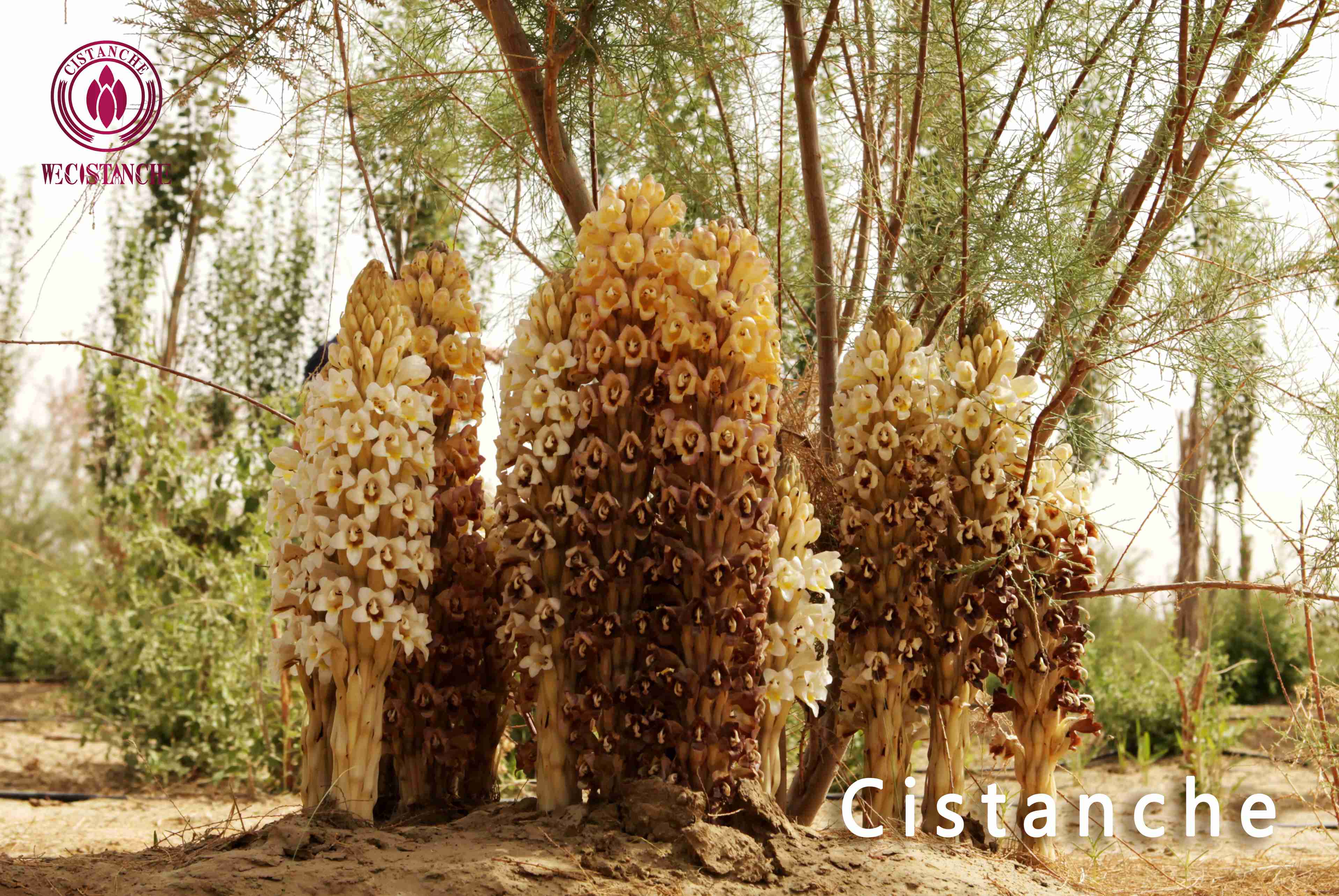
Cistanche is a precious Chinese medicinal material, often used to invigorate the kidney
Cistanche's living habit of taking desert as home
The living habits of the Cistanche deserticola are very peculiar. It mainly grows in the desert areas where Haloxylon ammodendron and Haloxylon ammodendron are distributed. Wild Cistanche prefers to grow on a soft sandy ground with light salinization and is often distributed in lowlands such as semi-fixed dunes, dry river beds, and lake basins. The distribution area of desert Cistanche is usually characterized by an arid climate, low rainfall (≤ 250 mm), large evaporation, long sunshine duration, and large temperature difference between day and night. The soil is mainly gray-brown desert soil and brown desert soil. The unearthed Cistanche has thick fleshy stems and pale yellow or flesh-colored scaly leaves. Cistanche is unearthed from April to May every year. After being unearthed, Cistanche will bloom and bear fruit within about a month, and even if it leaves the soil, it can bloom and bear fruit by its own nutrients. Due to the harsh desert environment, in order to increase the parasitic rate, one plant of Cistanche can produce tens of thousands to hundreds of thousands of tiny seeds.
The living habits of Cistanche tubulosa are similar to those of the host Tamarix. They usually grow in Gobi deserts above 1,000 meters above sea level, on the edge of sand dunes, and low-lying desert areas with sufficient water content. Cistanche is suitable for growing in sandy soils with good permeability and water permeability. It does not require high soil organic matter content; it prefers sufficient light and has strict temperature requirements. Too high or too low temperature will inhibit its growth. Cistanche tubular is not tolerant to severe cold, the suitable growth temperature is 5-28 ℃, and the best temperature for blooming and fruiting is 15-25 ℃. The soil moisture content for its growth in winter should be maintained below 10% to avoid frostbite death of Cistanche due to low winter temperature in the introduction area.

Cistanche is rich in trace elements needed by the human body
The difficult and slow parasitic process of Cistanche
Cistanche is a typical pan-parasitic plant, and all the nutrients needed for its growth are taken from the host. The parasitic rate of Cistanche in nature is low. In order to increase the survival probability, Cistanche usually produces a large number of seeds, which are spread by external forces such as wind and water. These seeds, which have fallen into the sand and ripen after completion, remain in a dormant state (the dormancy period can be up to 10 years) before they receive the chemical signal released by the host plant. Once these seeds feel the chemical signal substances released by the host plant and the suitable growth environment, they immediately start the germination process. Usually, under the action of stimulants secreted by the host plant roots, Cistanche seeds germinate to form radicle-like bodies and produce haustorium at the ends of the rhizomes. The aspirator contacts the host root penetrates the epidermis and cortex of the host root to reach the vascular bundle, and its catheter and sieve are connected with the host catheter and sieve to form a "physiological bridge" for transporting nutrients. Since then, Cistanche has continuously obtained nutrients from the host to complete the parasitism and growth process. Key substances that affect parasitism Seed germination stimulating substances are one of the key factors for parasitic plants to complete the parasitic process. Studies have shown that mature parasitic plant seeds will not germinate without the effect of germination stimulating substances, even if the external environmental conditions are suitable.

Cistanche has the effects of invigorating the kidney, anti-aging, improving sexual function, etc.
Application of Cistanche
The application history of Cistanche in China is relatively long. Since history, it has been used as food by the folks, and the famous medical books of the past have authoritative expressions: The appearance rate of "Cistanche" in Chinese medicine prescriptions for anti-fatigue and kidney tonifying in the past generations of medicine is the first and in anti-fatigue Chinese medicine prescriptions. Moreover, Cistanche is very safe and has no side effects. Because of its high medicinal value, it enjoys the reputation of "desert ginseng".
As early as the early 1980s, Japanese experts discovered the "nutrition factor" from Cistanche tubulosa. Its main active ingredients are echinacoside and verbascoside (this factor can increase the growth rate of kidney cells by 6 times within 24 hours). ). Scientific research proves: "The effective ingredients of Cistanche tubulosa is 8-10 times that of other cistanche. Therefore, long-term drinking of Cistanche has obvious effects of nourishing the kidney, anti-fatigue, strengthening physical strength, and anti-aging.
Since the National Health Commission included Cistanche in the "medicine and food homology" catalog in 2018, the demand for Cistanche in the market has continued to increase. Nowadays, medicated diets, teas, medicinal wines, and health foods made from Cistanche are widely popular in China, Japan, and some Southeast Asian countries.