Cistanche And Constipation: What Modern Science Says About An Ancient Desert Ginseng Remedy
Nov 19, 2026
Introduction: A Common Problem with Few Perfect Answers
Constipation is one of the most widespread digestive complaints in the world. It affects people of every age, but it becomes especially common as we get older, as our diets shift, and as stress and sedentary lifestyles take their toll. Depending on the population studied, between roughly 3% and 11% of adults in China report struggling with constipation, and similar figures appear in many other countries. For millions of people, the experience is frustratingly familiar: hard, dry stools, a reduced urge to go, straining, and a lingering feeling that the bowel has not fully emptied.
Constipation is more than an inconvenience. When it becomes chronic, it can disturb the body's electrolyte balance and acid-base equilibrium, and it frequently affects mood, contributing to irritability, low mood, and poor concentration. In other words, a sluggish gut can quietly undermine overall well-being.
Western medicine offers several tools for constipation, including fiber supplements, osmotic and stimulant laxatives, biofeedback therapy, and in severe cases surgery. These approaches can work quickly, but many come with drawbacks - cramping, dependency, dehydration, or a diminishing response over time. This is one reason so many people turn to traditional herbal medicine, which has a long history of gentle, gut-friendly remedies.
Among the most respected of these is Cistanche - a desert plant so prized in traditional Chinese medicine that it is nicknamed the "desert ginseng." This article explains what Cistanche is, why it has been used for constipation for centuries, and what a modern scientific technique called network pharmacology has revealed about how it actually works at the molecular level.

Meet Cistanche: The "Desert Ginseng"
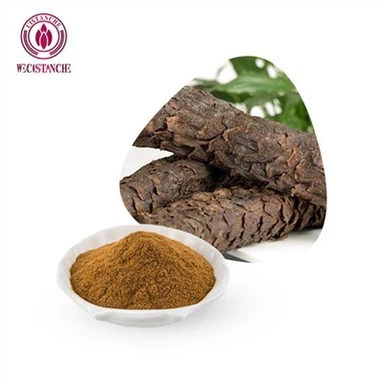
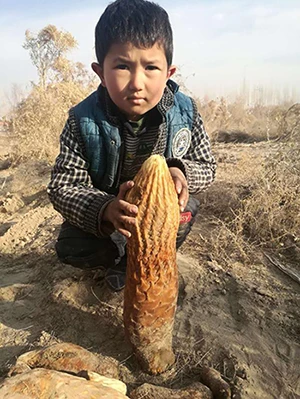
Cistanche (known in Chinese as 肉苁蓉,Rou Cong Rong) is a parasitic plant that grows in arid regions of China and Central Asia. The medicinal part is the fleshy, scaly stem that grows underground, attaching itself to the roots of host plants such as Haloxylon ammodendron, a desert shrub. Because it thrives in harsh desert conditions and is considered highly nourishing, it has earned the popular name "desert ginseng."
Two species are officially recognized in the Chinese Pharmacopoeia: Cistanche deserticola and Cistanche tubulosa. Both are valued for a similar set of traditional actions. In classical Chinese medicine, Cistanche is described as warm in nature and sweet-salty in flavor, and it is said to enter the Kidney and Large Intestine meridians. Its traditional functions include:
Tonifying Kidney Yang (supporting vitality and energy)
Nourishing blood and essence
Moistening the intestines and promoting bowel movement
That last property - "moistening the intestines" - is the key to Cistanche's reputation as a gentle constipation remedy. Unlike harsh stimulant laxatives that force the bowel to empty, Cistanche is traditionally said to "moisten" the stool and ease its passage without causing sudden, forceful bowel movements. In the language of traditional practitioners, it works gently and gradually, which makes it especially suitable for constipation associated with weakness, aging, or dryness.
This traditional reputation is supported by usage statistics. In herbal formulas prescribed for elderly functional constipation, Cistanche appears at a remarkably high frequency - around 57.92% in some analyses. That is a strong signal that generations of clinicians have trusted it as a reliable, well-tolerated option.
Why Constipation Needs Better, Gentler Solutions
Before diving into the science, it is worth understanding why constipation is so hard to treat well. The condition is not a single disease but a symptom with many possible causes. Researchers point to several contributing factors:
Abnormal signaling along the "brain-gut axis"
Dysfunction of the interstitial cells of Cajal, which act as the bowel's natural pacemaker
Imbalances in hormones and neurotransmitters
Altered bowel movement dynamics
Psychological factors such as stress and anxiety
Because the causes are so varied, a one-size-fits-all treatment rarely works for everyone. Harsh laxatives may produce a bowel movement, but they can also cause cramping, electrolyte loss, and dependency if overused. Gentler approaches that support normal bowel function - rather than overriding it - are increasingly attractive to both patients and practitioners.
This is where Cistanche stands out. It is traditionally classified as a gentle, "moistening" herb rather than a "purging" one. The goal of modern research has been to understand, in precise molecular terms, how that gentle effect comes about.

A New Lens: What Is Network Pharmacology?
Traditional herbal medicines are famously complex. A single herb can contain dozens or hundreds of chemical compounds, each of which may interact with multiple proteins in the body. This complexity is both the strength and the challenge of herbal medicine: it explains why herbs can have broad, multi-system benefits, but it also makes it very hard to pin down exactly how they work using conventional "one drug, one target" thinking.
Network pharmacology is a research approach designed to handle this complexity. Instead of asking "which single compound hits which single target," network pharmacology builds a map of the entire system. It uses large databases to identify:
The active chemical compounds in a herb
The proteins and genes those compounds are likely to interact with
The biological pathways those proteins belong to
How all of these elements connect to a particular disease
By connecting compounds to targets to pathways to disease, researchers can visualize a "network" that reveals the herb's overall mechanism of action. This approach has become one of the most popular tools in modern traditional Chinese medicine research, because it finally offers a systematic way to study multi-component, multi-target herbal effects.
The study we review here applied exactly this approach to one specific question: how does Cistanche relieve constipation?
The Study at a Glance
The research was conducted by a team at Shanxi University in China and published in the Journal of Shanxi University (Natural Science Edition) in 2022. The researchers combined database mining, literature review, bioinformatics analysis, network construction, and molecular docking to build a comprehensive picture of Cistanche's anti-constipation mechanism.
Here is the headline result, which we will unpack step by step:
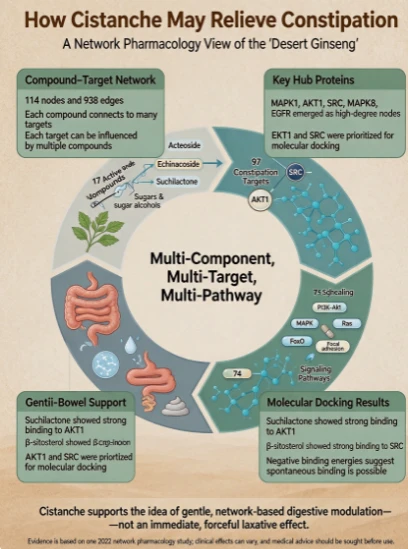
Cistanche contains at least 17 active compounds that act on 97 molecular targets through 74 signaling pathways - including well-known routes such as PI3K-AKT, MAPK, Ras, FoxO, and Focal adhesion - to relieve constipation. Among these, two targets (AKT1 and SRC) emerged as particularly important, and the compounds suchilactone and β-sitosterol showed the strongest binding to them.
In plain language: Cistanche does not work through one magic ingredient. It works through a coordinated network of many compounds touching many targets across many pathways. That is the very definition of the "multi-component, multi-target, multi-pathway" character of traditional Chinese medicine.
Step 1: Identifying the Active Compounds
The first challenge in studying any herb is figuring out which of its many chemicals actually matter. The researchers used two complementary strategies.
First, they searched the TCMSP database (Traditional Chinese Medicine Systems Pharmacology Database and Analysis Platform), which catalogs compounds found in traditional herbs. They filtered the results using two standard drug-likeness criteria: oral bioavailability (OB ≥ 30%) and drug-likeness (DL ≥ 0.18). These filters help identify compounds that are more likely to be absorbed into the body and behave like drug molecules. From the roughly 75 compounds recorded for Cistanche, this filtering surfaced 6 promising candidates.
Second, they dug into the published scientific literature to find compounds that had already been reported to have constipation-relieving activity in Cistanche. This added another 11 compounds, bringing the total to 17 active ingredients.
These 17 compounds span several chemical families, which is typical of a rich medicinal plant:
表格
| Category | Examples |
|---|---|
| Phenylethanoid glycosides | Acteoside (verbascoside), Echinacoside |
| Lignans | Suchilactone, Yangambin |
| Flavonoids | Quercetin |
| Steroids | β-sitosterol |
| Sugars and sugar alcohols | Arabinose, Galactose, Dulcitol, Mannitol, Fructose, Xylose, Glucose, Rhamnose, D-Galacturonic acid |
| Fatty acids | Arachidonate |
| Alkaloids | Marckine |
Two of these deserve special mention for anyone interested in Cistanche quality. Acteoside (verbascoside) and Echinacoside are the phenylethanoid glycosides that the Chinese Pharmacopoeia uses as quality-control markers for Cistanche. They are present in relatively high amounts and are widely regarded as signature compounds of the herb.
The sugars and sugar alcohols are also interesting. Several studies have suggested that Cistanche's oligosaccharides and compounds like dulcitol (galactitol) are among the substances responsible for its laxative effect. Simple sugars such as glucose, fructose, rhamnose, arabinose, xylose, and galactose, along with mannitol and galacturonic acid, have all been linked to bowel-promoting activity in the literature.
Step 2: Finding the Molecular Targets
Having identified 17 compounds, the researchers next asked: which proteins in the human body do these compounds actually affect?
They used a tool called PharmMapper to predict the protein targets of each compound, keeping only predictions with a high confidence score (fit value > 2.5). This produced thousands of candidate targets, which were then cleaned up and standardized to official gene names using the UniProt database. After removing duplicates, they arrived at 415 potential targets for the 17 compounds.
But not all of those 415 targets are relevant to constipation. To narrow the list, the researchers searched two major disease-gene databases - OMIM and GeneCards - using keywords such as "constipation," "colonic inertia," and "dyschezia." They then found the overlap between the 415 compound targets and the constipation-related genes. The result was a focused set of 97 targets that sit at the intersection of "what Cistanche affects" and "what is involved in constipation."
This overlap list is the heart of the analysis. Among the 97 targets are several well-known signaling proteins, including:
HRAS - a key member of the Ras family of signaling switches
AKT1 - a central regulator of cell survival, growth, and metabolism
IGF1R - the insulin-like growth factor 1 receptor
SRC - a tyrosine kinase involved in many cellular processes
MAPK1 - an enzyme in the MAPK signaling cascade
These are not obscure molecules. They are major players in the signaling networks that govern cell growth, inflammation, muscle function, and tissue repair - all of which are relevant to a healthy, functional bowel.
Step 3: Mapping the "Compound–Target" Network
To see how the 17 compounds and 97 targets relate to each other, the researchers built a network diagram. In this network, each compound and each target is a "node," and every connection between them is an "edge."
The resulting network contained 114 nodes (17 compounds + 97 targets) and 938 edges - a dense web of interactions. Some key statistics illustrate just how interconnected Cistanche's effects are:
Each active compound connected, on average, to about 55 targets
Each target connected, on average, to about 10 different compounds
What this means in practice is that Cistanche's compounds do not work in isolation. A single compound can touch dozens of proteins, and a single important protein can be influenced by many different compounds at once. This built-in redundancy is thought to be one reason herbal medicines can be so broadly effective and relatively gentle - the effect is spread across a network rather than concentrated in a single, all-or-nothing interaction.
Step 4: Identifying the "Hub" Proteins
Not all nodes in a network are equally important. Some proteins act as "hubs" - they connect to many other proteins and therefore sit at the center of the action. To find these hubs, the researchers built a protein–protein interaction (PPI) network using the STRING database and analyzed it with Cytoscape software.
In this network, the importance of each protein is measured by its "degree" - the number of other proteins it directly connects to. The PPI network contained 87 nodes and 426 edges, and the five proteins with the highest degree were:
MAPK1 (degree 37)
AKT1 (degree 34)
SRC (degree 32)
MAPK8 (degree 30)
EGFR (degree 28)
These five proteins were flagged as the most likely "key targets" through which Cistanche exerts its therapeutic effect. Two of them - AKT1 and SRC - would go on to receive special attention in the molecular docking step.
Step 5: Understanding the Pathways
Proteins rarely act alone. They work in cascades and networks called signaling pathways, which relay signals from outside the cell to the machinery inside. To understand the bigger picture, the researchers performed two types of enrichment analysis - GO (Gene Ontology) enrichment and KEGG pathway enrichment.
GO Enrichment: What Biological Processes Are Affected?
GO analysis groups genes by their biological roles. The analysis found a total of 1,741 enriched GO terms, including 1,602 biological processes, 29 cellular components, and 110 molecular functions. The most prominent categories included:
Gland development and reproductive system development
Response to oxidative stress and response to reactive oxygen species
Response to steroid hormones
Epithelial cell proliferation and muscle cell proliferation
At the cellular-component level, the enriched terms included membrane rafts, membrane microdomains, focal adhesions, and vesicle lumens. At the molecular-function level, they included protein tyrosine kinase activity, protein serine/threonine kinase activity, endopeptidase activity, and phosphatase binding.
Several of these are directly relevant to gut health. Oxidative stress, for example, is known to contribute to intestinal dysfunction, and steroid-hormone signaling is involved in the regulation of many gastrointestinal processes. The enrichment of "focal adhesion" and "membrane raft" terms also points to effects on cell structure and cell signaling at the intestinal surface.
KEGG Enrichment: Which Signaling Pathways Are Involved?
KEGG analysis maps genes onto known biological pathways. Here, the researchers identified 74 enriched pathways. When ranked by the number of involved targets, the top pathways were:
PI3K-Akt signaling pathway
Ras signaling pathway
MAPK signaling pathway
FoxO signaling pathway
Focal adhesion
These are not random results - they form a coherent story about how Cistanche might support bowel function.
The PI3K-Akt pathway is one of the most important signaling routes in the body. It regulates cell growth, survival, and metabolism, and it influences many downstream effectors such as mTOR, FoxO, and Caspase-9. Studies in animals with slow-transit constipation have shown that reducing the over-activation of PI3K-Akt in colon tissue can relieve constipation symptoms, suggesting that modulating this pathway is relevant to bowel motility.
The MAPK pathway is a classic three-tier kinase cascade involved in cell growth, differentiation, and stress responses. In rodent models of slow-transit constipation, the expression of MAPK-related proteins in colon tissue has been found to correlate negatively with stool water content - meaning that altered MAPK activity is linked to the dryness and difficulty of passage that define constipation.
The Ras and Focal adhesion pathways sit further upstream. Ras proteins act as molecular switches at the top of many growth-factor signaling cascades, and focal adhesion kinase (FAK) helps cells sense and respond to their physical environment. Together, these pathways can feed into and activate downstream MAPK and PI3K-Akt signaling. This suggests a possible chain of events: Cistanche's compounds may act on Ras and focal-adhesion signaling, which in turn modulate MAPK and PI3K-Akt activity to improve bowel function.
In short, the pathway analysis shows that Cistanche's anti-constipation effect is not a single switch being flipped. It is a coordinated adjustment across several interconnected signaling networks.

Step 6: Zeroing In on AKT1 and SRC
By combining the results of the PPI network and the compound–target–pathway network, the researchers identified AKT1 and SRC as the two most critical targets for Cistanche's effect on constipation. Both appeared among the top-ranked targets in every analysis.
AKT1 is a serine/threonine protein kinase. It is a central node in cell survival, glucose metabolism, and many other processes. Previous research has shown that reducing the expression of PI3K and AKT in the colon tissue of rats with slow-transit constipation can ease symptoms, implicating AKT1 in the condition.
SRC is a tyrosine kinase. One proposed mechanism links SRC activation to the release of prostaglandin E2 (PGE2), which in turn inhibits the sodium-potassium pump (Na⁺/K⁺-ATPase) - an effect that can improve constipation by altering the transport of water and electrolytes in the gut.
Because these two proteins emerged as central hubs, the researchers chose them for the final, most rigorous test: molecular docking.
Step 7: Molecular Docking - The "Lock and Key" Test
Molecular docking is a computer simulation that asks a simple question: how well does this small molecule fit into this protein's binding pocket? Think of it as a virtual "lock and key" test. If a compound fits a protein well, the two can bind spontaneously, which is strong evidence that the compound can directly influence that protein.
The results were reassuring. The researchers docked the 17 active compounds against both AKT1 and SRC. Here are the highlights:
For AKT1, the best binder was suchilactone, with a binding energy of -4.46 kJ/mol, followed by D-galacturonic acid, quercetin, and arabinose.
For SRC, the best binder was β-sitosterol, with a binding energy of -5.04 kJ/mol, followed by suchilactone, marckine, and quercetin.
In docking studies, a more negative binding energy indicates a more stable, more favorable interaction (a value below zero means the binding can occur spontaneously). The fact that most of Cistanche's active compounds bound reasonably well to AKT1 and SRC - and that suchilactone and β-sitosterol bound particularly strongly - provides computational confirmation that these compounds can directly engage the herb's key targets.
This is a satisfying result because it closes the loop. The network analysis predicted that AKT1 and SRC matter; the docking experiment confirmed that Cistanche's compounds can physically bind to them.
The Big Picture: Multi-Component, Multi-Target, Multi-Pathway
Stepping back, what does all of this tell us about how Cistanche relieves constipation?
The answer can be summarized in three words that researchers use to describe traditional Chinese medicine as a whole: multi-component, multi-target, multi-pathway.
Cistanche does not rely on a single active ingredient. Instead:
Its 17 compounds work together, spanning phenylethanoid glycosides, lignans, flavonoids, steroids, sugars, fatty acids, and an alkaloid.
These compounds engage 97 targets, many of which are major signaling hubs.
Through those targets, they modulate 74 pathways, with the most prominent being PI3K-Akt, MAPK, Ras, FoxO, and Focal adhesion.
Two central targets - AKT1 and SRC - stand out, and molecular docking confirms that compounds like suchilactone and β-sitosterol can bind to them directly.
This distributed, network-based mode of action is very different from a pharmaceutical that hits one receptor hard. It is gentler by design, and it helps explain both Cistanche's traditional reputation for "moistening without purging" and its broad applicability to chronic, functional constipation.
What This Means in Plain Terms
For a reader who simply wants to know whether Cistanche might help with constipation, here is the practical takeaway:
There is a credible scientific basis for Cistanche's traditional use. Modern network pharmacology has mapped a plausible molecular mechanism linking Cistanche's active compounds to constipation-relevant targets and pathways.
It appears to work gently and broadly. The multi-target, multi-pathway profile aligns with the traditional description of Cistanche as a "moistening" herb that eases bowel movement without harsh purging - an important consideration for older adults and people with chronic, functional constipation.
The key active ingredients are known. Acteoside and echinacoside (the phenylethanoid glycosides), along with sugars and sugar alcohols, are central to Cistanche's identity and have documented bowel-promoting relevance. β-sitosterol and suchilactone show particularly strong binding to the key targets AKT1 and SRC.
It is not a quick "flush." The science suggests Cistanche supports normal bowel function through gradual, coordinated effects on signaling networks, rather than forcing a sudden bowel movement. Users should therefore expect gentle, gradual support rather than an immediate, dramatic effect.
Cistanche deserticola vs. Cistanche tubulosa: A Practical Note
One question that often comes up is which species of Cistanche to choose. The study focused on Cistanche deserticola, but both C. deserticola and C. tubulosa are recognized in the Chinese Pharmacopoeia and share the same traditional functions, including moistening the intestines to relieve constipation.
The two species do differ somewhat in their chemical profiles. Cistanche tubulosa is particularly noted for its high content of phenylethanoid glycosides such as echinacoside and acteoside, which are the pharmacopoeia's quality markers for the herb. For supplement makers and consumers interested in these signature compounds, C. tubulosa extracts are a popular choice precisely because of their concentrated phenylethanoid glycoside content.
That said, the network pharmacology study we have reviewed focused on the deserticola species and a specific set of 17 compounds, so the most direct scientific evidence presented here relates to Cistanche deserticola. Both species have a long history of use for digestive support, and both are regarded as gentle, nourishing, bowel-moistening herbs in traditional practice.
Frequently Asked Questions
Q: Is Cistanche safe for constipation? Cistanche has a long history of traditional use and is generally considered gentle and well tolerated. However, as with any supplement, pregnant or nursing women, people with medical conditions, and anyone taking medication should consult a qualified healthcare provider before use.
Q: How long does it take for Cistanche to work for constipation? Because Cistanche is traditionally regarded as a gentle, "moistening" herb rather than a harsh laxative, its effect tends to build gradually. Results can vary from person to person, and it is best viewed as a long-term digestive-support herb rather than a quick fix.
Q: Does Cistanche work like a stimulant laxative? No. Stimulant laxatives force bowel contractions and can cause cramping and dependency with overuse. Cistanche's traditional profile - and the network pharmacology data - point to a gentler, multi-pathway mechanism that supports normal bowel function.
Q: Which is better for constipation, Cistanche deserticola or Cistanche tubulosa? Both species share the same traditional functions and are recognized for moistening the intestines. The reviewed study focused on C. deserticola, while C. tubulosa is notable for its high phenylethanoid glycoside content. The choice often comes down to product quality, standardization, and personal response.
Q: Can I take Cistanche with other constipation remedies? If you are combining Cistanche with other laxatives, fiber supplements, or medications, it is wise to do so under the guidance of a healthcare professional to avoid excessive laxative effects or interactions.
Conclusion
Constipation is a common, often chronic, and surprisingly complex problem - and it deserves more than a one-note solution. Cistanche, the "desert ginseng" of traditional Chinese medicine, has been used for centuries as a gentle, bowel-moistening remedy, and modern science is now catching up with that tradition.
The network pharmacology study reviewed here offers a detailed, evidence-based explanation of how Cistanche may work. Its 17 active compounds engage 97 targets and 74 pathways, with a special role for the PI3K-Akt, MAPK, Ras, FoxO, and Focal adhesion pathways and for the key proteins AKT1 and SRC. Molecular docking further confirmed that compounds such as suchilactone and β-sitosterol can bind directly to these targets.
The result is a compelling portrait of a genuinely multi-component, multi-target, multi-pathway herbal medicine - one that supports digestive health gently and comprehensively. For anyone seeking a natural, well-researched option for occasional or chronic constipation, Cistanche is a name worth knowing.