Cistanche And Colorectal Cancer: PD-1 Patent Research Explained
Nov 17, 2026
Can Cistanche Help Colorectal Cancer Immunotherapy? What a Herbal Patent Actually Shows
Meta Description
Explore a six-herb formula containing Cistanche studied with PD-1 blockade, its mouse-model results, evidence gaps, and safety considerations.
Cistanche colorectal cancer research
herbs and colorectal cancer immunotherapy
PD-1 herbal formula research
can Cistanche help colorectal cancer
herbal supplements with Keytruda
MSI-H dMMR colorectal cancer immunotherapy
T cell exhaustion and herbal research
patented herbal formula cancer evidence
natural cure for colorectal cancer;
Cistanche cancer treatment;
reverse immunotherapy resistance naturally;
best herbs to replace cancer treatment.
Can Cistanche Help Colorectal Cancer Immunotherapy? What a Herbal Patent Actually Shows
If you or a family member is receiving treatment for colorectal cancer, you may have encountered claims that herbs can "boost immunity" or make immunotherapy work better.
One Chinese patent text describes a six-herb preparation containing Cistanche, also known as Rou Cong Rong, investigated alongside anti-PD-1 treatment in a mouse tumor model.
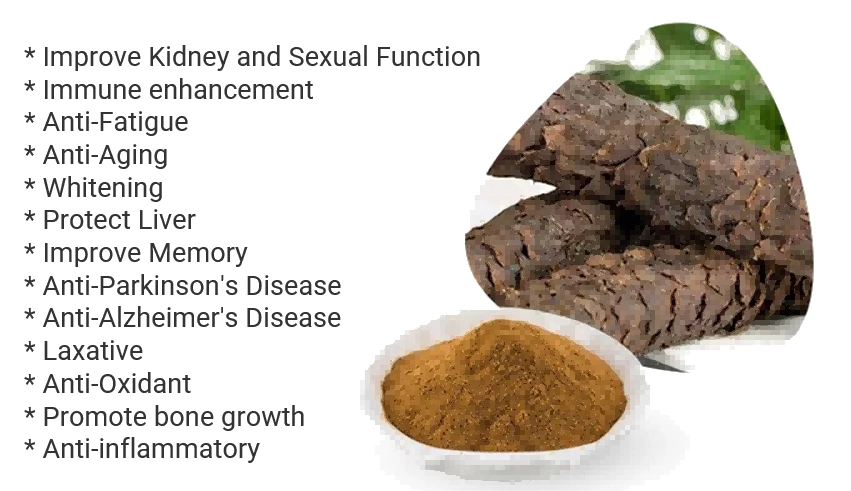
Cistanche Benefits
The important distinction is this: the document describes preclinical research on a complete herbal formula. It does not establish that Cistanche supplements improve colorectal cancer treatment in people.
This article explains the formula, its reported results, the scientific questions that remain, and what patients and botanical developers should understand before drawing conclusions.
Medical safety notice: Do not start this formula or any other herbal product during cancer treatment without review by your oncology team. This article does not provide a treatment regimen, a human dose, or a recommendation to replace or modify prescribed care.
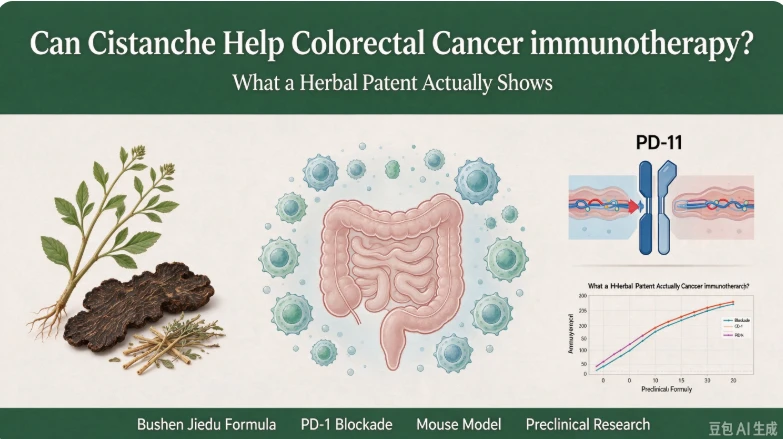
Key Takeaways
The preparation contains six medicinal ingredients, not Cistanche alone.
The supplied experiments involved mice, not a human clinical trial.
The patent reports smaller tumors and changes in T-cell-associated measurements in the combination group.
Important questions remain about the antibody used, the definition of T-cell exhaustion, assay methods, manufacturing reproducibility, and safety.
A patent is not proof of clinical effectiveness or regulatory approval.
Products intended to improve cancer-treatment outcomes require an appropriate medicinal development pathway.
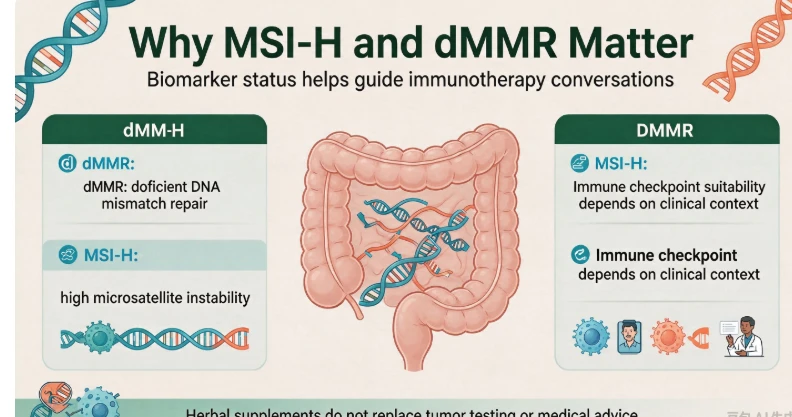
Why MSI-H and dMMR Matter in Colorectal Cancer
Two terms frequently appear in discussions of colorectal cancer immunotherapy:
dMMR: deficient DNA mismatch repair.
MSI-H: high microsatellite instability.
These features indicate abnormalities in the systems that normally repair certain DNA errors. They are important biomarkers when clinicians consider immune checkpoint treatment.
PD-1 inhibitors can help release inhibitory signals affecting immune cells. However, their suitability and expected benefit depend on the cancer's molecular characteristics, disease setting, treatment history, and the specific regimen.
Treatment has also continued to evolve. For example, the US National Cancer Institute reported the 2025 FDA approval of nivolumab plus ipilimumab for unresectable or metastatic MSI-H/dMMR colorectal cancer. Pembrolizumab is also an established option in appropriate settings.
A herbal supplement does not determine eligibility for immunotherapy and should not be used to substitute for tumor testing.
Source: National Cancer Institute: Immunotherapy Combination Approved for MSI-H/dMMR Colorectal Cancer.
What Does the Patent Describe?
The preparation is called Bushen Jiedu Formula, a name associated with the traditional Chinese medicine concepts of supporting kidney-related functions and resolving "toxicity."
These traditional terms should not be confused with evidence of kidney treatment or removal of specific biochemical toxins.
The formula contains:
| Chinese name | English identification |
|---|---|
| Shu Di Huang | Prepared Rehmannia root |
| Nü Zhen Zi | Glossy privet fruit |
| Shan Ci Gu | Medicinal material identified in the patent as Iphigenia indica; botanical identity requires verification |
| Rou Cong Rong | Cistanche, identified as Cistanche deserticola |
| Ba Yue Zha | Akebia fruit |
| She Mei | Indian mock strawberry, identified as Duchesnea indica |
The patent describes water extraction followed by an ethanol-related separation process and drying.
The experimental preparation was made according to Example 2, using the following relative amounts:
| Ingredient | Parts by weight |
|---|---|
| Prepared Rehmannia root | 180 |
| Glossy privet fruit | 90 |
| Shan Ci Gu | 90 |
| Cistanche | 120 |
| Akebia fruit | 90 |
| Indian mock strawberry | 90 |
These are manufacturing ratios, not a patient prescription or an established human dose.
What Did the Mouse Experiments Report?
The supplied text describes MC38 mouse colorectal cancer cells implanted under the skin of male C57BL/6J mice.
The combination experiment included four groups:
Vehicle control.
Herbal formula alone.
An anti-PD-1 treatment identified in the document as pembrolizumab.
Herbal formula plus the stated anti-PD-1 treatment.
Each group contained five mice.
Reported Tumor Measurements
| Group | Tumor weight, g | Final tumor volume, mm³ |
|---|---|---|
| Vehicle control | 1.01±0.081.01 \pm 0.081.01±0.08 | 610.42±49.10610.42 \pm 49.10610.42±49.10 |
| Herbal formula | 0.43±0.100.43 \pm 0.100.43±0.10 | 283.97±56.66283.97 \pm 56.66283.97±56.66 |
| Anti-PD-1 | 0.45±0.110.45 \pm 0.110.45±0.11 | 228.18±71.97228.18 \pm 71.97228.18±71.97 |
| Combination | 0.22±0.070.22 \pm 0.070.22±0.07 | 165.31±47.07165.31 \pm 47.07165.31±47.07 |
The combination group had the lowest reported final tumor weight and volume.
However, these are short-term animal measurements. They do not establish improved response rates, survival, or treatment safety in people.
The supplied tables use a "plus or minus" notation without clearly identifying whether it represents standard deviation or standard error.
Reported Immune-Cell Measurements
The patent also reports a lower percentage of cells it labels "exhausted T cells" and a higher percentage of cells it labels "functional T cells" in the combination group.
| Group | Reported CD3/CD8/PD-1-positive population, % | Reported CD3/CD8/IFN-γ-positive population, % |
|---|---|---|
| Vehicle control | 7.88±0.407.88 \pm 0.407.88±0.40 | 19.88±1.4919.88 \pm 1.4919.88±1.49 |
| Herbal formula | 4.62±0.364.62 \pm 0.364.62±0.36 | 27.52±1.2327.52 \pm 1.2327.52±1.23 |
| Anti-PD-1 | 5.79±0.355.79 \pm 0.355.79±0.35 | 24.06±1.8724.06 \pm 1.8724.06±1.87 |
| Combination | 2.92±0.482.92 \pm 0.482.92±0.48 | 31.32±3.2731.32 \pm 3.2731.32±3.27 |
These findings are hypothesis-generating. Their interpretation depends on appropriate antibody selection, sample preparation, gating, and functional confirmation.
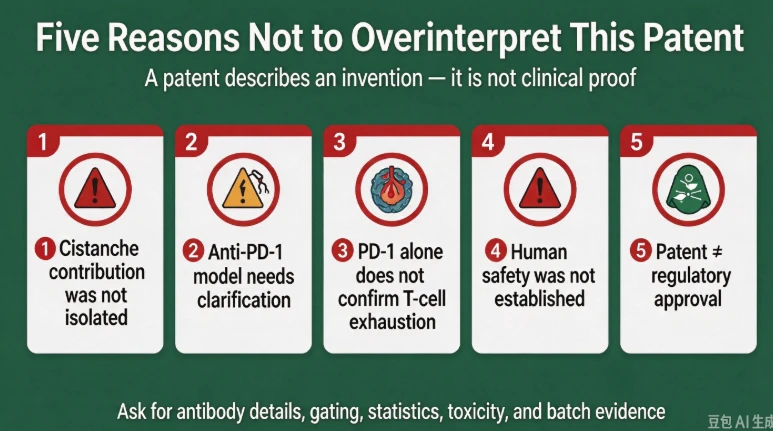
Five Reasons Not to Interpret This as a Proven Cancer Supplement
1. The Study Did Not Isolate Cistanche's Contribution
Because the preparation contained six ingredients, the reported effects cannot be assigned to Cistanche alone.
The supplied experiments do not include a Cistanche-only group or a formula-without-Cistanche group.
2. The Antibody and Mouse Model Need Clarification
The document identifies the treatment as pembrolizumab but describes ordinary C57BL/6J mice.
Pembrolizumab targets human PD-1. Its ability to produce relevant PD-1 blockade in an ordinary mouse model cannot be assumed.
The exact antibody, its species reactivity, and the model must therefore be verified before accepting the proposed PD-1 mechanism.
3. PD-1 Expression Alone Does Not Prove T-Cell Exhaustion
PD-1 can be expressed by activated as well as exhausted T cells.
A reduction in PD-1-positive cells is not, by itself, proof that dysfunctional T cells have recovered their antitumor activity.
4. Human Safety Was Not Established
The supplied text does not provide a clinical safety study or a comprehensive toxicology package.
Herbal products used during cancer treatment may introduce adverse effects or interactions. The National Cancer Institute specifically discusses the possibility of interactions between cancer therapies and dietary supplements.
Source: NCI: Cancer Therapy Interactions With Foods and Dietary Supplements.
5. A Patent Is Not a Clinical Approval
Patent documents describe inventions and legal claims. They are not equivalent to regulatory approval, independent replication, or a well-controlled human trial.
The supplied material does not establish whether the application was granted, whether its claims remain in force, or whether any resulting medicinal product has been approved.
Can Herbs Be Used With Keytruda?
There is no safe general answer that applies to every herb, formulation, patient, or treatment plan.
Before using a botanical product, provide your oncology team with:
The complete ingredient list.
Botanical species and plant parts.
Extract specifications.
The proposed dose.
Other medicines and supplements you take.
Available safety information.
An absence of published interaction reports does not establish compatibility.
Do not assume that a product is safe because it is described as natural, traditional, or patented.
Questions to Ask Your Oncology Team
Has my tumor been tested for MSI and mismatch repair status?
Which immunotherapy regimen is appropriate for my disease setting?
Could this herbal product interfere with treatment or side-effect assessment?
Is there a relevant clinical trial for the proposed combination?
What symptoms should prompt urgent contact with the treatment team?
Can a pharmacist review the complete supplement formulation?
(54) Title of the Invention
A Chinese Herbal Compound Preparation for Improving the Efficacy of Anti-PD-1 Monoclonal Antibody Immunotherapy in Colorectal Cancer
(57) Abstract
The invention relates to the field of traditional Chinese medicine and, specifically, to a Chinese herbal compound preparation capable of improving the efficacy of PD-1 monoclonal antibody treatment for colorectal cancer.
The preparation consists of six medicinal ingredients: prepared Rehmannia root, glossy privet fruit, Shan Ci Gu, Cistanche, Akebia fruit, and Indian mock strawberry.
It can effectively reduce the number of exhausted T cells in the body and activate antitumor immune responses. When used in combination with a PD-1 monoclonal antibody, it has a marked inhibitory effect on colorectal cancer growth.
It may be used as an adjunctive medicinal treatment for patients with deficient DNA mismatch repair (dMMR)/high microsatellite instability (MSI-H) colorectal cancer, thereby addressing the clinical problem of limited responses to immunotherapies such as PD-1 treatment.
The combination with a PD-1 monoclonal antibody has broad application prospects.
Claims
Claim 1
Use of a Chinese herbal compound preparation in the manufacture of a medicament for improving the efficacy of PD-1 monoclonal antibody treatment for colorectal cancer, characterized in that the preparation comprises the following medicinal raw materials in parts by weight:
Prepared Rehmannia root: 180 parts.
Glossy privet fruit: 90 parts.
Shan Ci Gu: 90 parts.
Cistanche: 120 parts.
Akebia fruit: 90 parts.
Indian mock strawberry: 90 parts.
Claim 2
Use of a Chinese herbal compound preparation in combination with a PD-1 monoclonal antibody in the manufacture of a medicament for treating colorectal cancer, characterized in that the preparation comprises the following medicinal raw materials in parts by weight:
Prepared Rehmannia root: 180 parts.
Glossy privet fruit: 90 parts.
Shan Ci Gu: 90 parts.
Cistanche: 120 parts.
Akebia fruit: 90 parts.
Indian mock strawberry: 90 parts.
Claim 3
The use according to Claim 1 or Claim 2, characterized in that the preparation method comprises the following steps:
Mix the medicinal raw materials in the specified proportions and place them in a herbal decoction vessel. Perform three decoctions.
For the first decoction, add water equivalent to eight times the total weight of the medicinal materials, bring to a boil, simmer over low heat, and filter off the liquid.
For the second decoction, add water equivalent to seven times the total weight of the medicinal materials, bring to a boil, simmer over low heat, and filter off the liquid.
For the third decoction, add water equivalent to six times the total weight of the medicinal materials, bring to a boil, simmer over low heat, and filter off the liquid.
Combine the liquids obtained from the three decoctions and evaporate over low heat until a thick consistency is reached.
Add an equal amount of absolute ethanol, mix thoroughly, and allow to stand overnight for precipitation.
On the following day, remove the supernatant, recover the ethanol by distillation, concentrate, and allow to stand for 24 hours to complete precipitation before filtration.
Concentrate the precipitate using a rotary evaporator with an 80°C water bath to obtain a thick extract with a relative density of 1.4 at 25°C.
Vacuum-dry at 50°C to obtain a powdered Chinese herbal compound extract, thereby producing the preparation.
Translator's note: the source does not clearly establish which liquid or solid fraction is retained at every stage of the ethanol-separation procedure.
Description
A Chinese Herbal Compound Preparation for Improving the Efficacy of Anti-PD-1 Monoclonal Antibody Immunotherapy in Colorectal Cancer
Technical Field
[0001] The invention relates to the field of traditional Chinese medicine and, more specifically, to a Chinese herbal compound preparation for improving the efficacy of anti-PD-1 monoclonal antibody immunotherapy in colorectal cancer, together with its preparation method and applications.
Background Art
[0002] Colorectal cancer is a malignant tumor of the lower gastrointestinal tract that commonly occurs in the colon and rectum.
Early clinical manifestations often include changes in bowel habits, changes in stool characteristics-such as narrow stools, bloody stools, or mucus-containing stools-abdominal pain, and abdominal masses.
In recent years, changes in dietary patterns and lifestyle have been accompanied by a rapid increase in colorectal cancer incidence and mortality.
It is the second leading cause of cancer-related death worldwide and carries a relatively high risk of recurrence and metastasis.
According to the statistics cited in the source, China has approximately 560,000 new colorectal cancer cases annually, accounting for as much as 31% of the global total, and approximately 290,000 deaths, accounting for 9.5% of deaths from all malignant tumors.
Current treatment remains primarily surgical, with chemotherapy, targeted therapy, and immunotherapy used as additional approaches.
Nevertheless, colorectal cancer mortality has not shown a clear decline, and prevention and treatment continue to face substantial challenges.
[0003] Immune checkpoint inhibitors (ICIs), including PD-1 monoclonal antibodies, can enhance antitumor immune responses by activating T cells in patients.
The source reports response rates of 50–60% and states that preliminary efficacy has been demonstrated in certain patients with colorectal cancer.
Deficient DNA mismatch repair (dMMR) and high microsatellite instability (MSI-H) are considered important predictors of sensitivity to ICI immunotherapy.
Patients with dMMR/MSI-H colorectal cancer have higher tumor mutational burdens, greater neoantigen burdens, and more lymphocyte infiltration. Consequently, their sensitivity to ICIs is substantially greater than that of other patients.
However, the source states that 40–60% of patients with dMMR/MSI-H colorectal cancer respond poorly to immunotherapy and that, even where initial benefit occurs, as many as 50% of patients with advanced colorectal cancer develop secondary resistance to PD-1 monoclonal antibodies.
Therefore, actively seeking more effective strategies for colorectal cancer prevention and treatment and improving immunotherapy effectiveness are of considerable clinical importance for prolonging survival and reducing mortality.
[0004] Traditional Chinese medicine has a distinctive understanding of tumor pathogenesis, including imbalances between yin and yang, disturbances in the movement of qi and blood, and dysfunction of the organ systems.
Disease development is understood as the combined result of the struggle between the body's protective qi and pathogenic influences.
As the traditional saying states, "When protective qi remains within, pathogenic influences cannot invade."
Treatment therefore begins from a holistic perspective and emphasizes protecting congenital qi and improving the body's immune state to resist disease, a concept that the source regards as consistent with Western immunotherapy.
The source states that numerous clinical studies show substantial advantages of traditional Chinese medicine in improving immune status and describes it as an effective approach for treating or assisting the treatment of colorectal cancer.
A large retrospective cohort study cited without bibliographic details reportedly found a 32% lower mortality risk among patients with cancer who used Chinese herbal medicine than among those who did not.
The source further states that Chinese herbal medicine can enhance T-cell function, increase the peripheral blood lymphocyte proportion, increase natural killer cell activity, and improve the CD4/CD8 ratio, thereby strengthening immunity.
[0005] In the later stages of colorectal cancer, deficiency of kidney qi and accumulation of internal "toxicity" are described as the principal traditional syndrome characteristics in most patients.
Accordingly, supporting protective functions, eliminating pathogenic influences, tonifying the kidney, resolving "toxicity," and addressing its perceived source are presented as key treatment principles.
Formulas such as Liu Jun Zi Tang, Jianpi Jiedu Formula, and Bushen Jiedu Formula may be used.
The source describes distinctive advantages in preventing metastasis, improving quality of life, and extending survival.
However, because Chinese herbal medicines contain multiple constituents and act through multiple targets and pathways, their precise role in improving tumor immunotherapy and its relationship with modern molecular biology remain incompletely understood.
Summary of the Invention
[0006] The purpose of the invention is to meet clinical needs and improve the current clinical management of colorectal cancer by providing a Chinese herbal compound preparation, referred to as Bushen Jiedu Formula, that improves the efficacy of PD-1 monoclonal antibody treatment.
The invention aims to address limited response and resistance to immunotherapies such as PD-1 treatment in patients with dMMR/MSI-H colorectal cancer.
The source describes broad application prospects for combination use with a PD-1 monoclonal antibody.
[0007] Under the guidance of traditional Chinese medicine theory and based on the syndrome manifestations observed in patients with dMMR/MSI-H colorectal cancer, the invention combines:
Prepared Rehmannia root, identified as Rehmannia glutinosa Libosch.
Glossy privet fruit, identified as Ligustrum lucidum.
Shan Ci Gu, identified as Iphigenia indica Kunth.
Cistanche, identified as Cistanche deserticola Ma.
Akebia fruit, identified as Akebia quinata (Thunb.) Decne.
Indian mock strawberry, identified as Duchesnea indica (Andr.) Focke.
The source states that the resulting preparation markedly inhibits colorectal cancer growth and activates antitumor immune responses, is safe and reliable, and has no obvious toxic or adverse effects.
It proposes use in patients with dMMR/MSI-H colorectal cancer receiving PD-1 monoclonal antibody treatment, with the expectation of improving treatment efficacy and prolonging survival.
[0008] In a first aspect, the invention provides a Chinese herbal compound preparation for improving the efficacy of PD-1 monoclonal antibody treatment for colorectal cancer, comprising the following medicinal raw materials in parts by weight:
[0009] Prepared Rehmannia root: 50–500 parts.
[0010] Glossy privet fruit: 50–300 parts.
[0011] Shan Ci Gu: 50–500 parts.
[0012] Cistanche: 50–500 parts.
[0013] Akebia fruit: 50–300 parts.
[0014] Indian mock strawberry: 50–500 parts.
[0015] Further, the preparation comprises the following medicinal raw materials in parts by weight:
[0016] Prepared Rehmannia root: 100–300 parts.
[0017] Glossy privet fruit: 100–200 parts.
[0018] Shan Ci Gu: 100–200 parts.
[0019] Cistanche: 100–300 parts.
[0020] Akebia fruit: 100–200 parts.
[0021] Indian mock strawberry: 100–200 parts.
[0022] More particularly, the preparation comprises:
[0023] Prepared Rehmannia root: 240 parts.
[0024] Glossy privet fruit: 120 parts.
[0025] Shan Ci Gu: 120 parts.
[0026] Cistanche: 180 parts.
[0027] Akebia fruit: 120 parts.
[0028] Indian mock strawberry: 120 parts.
[0029] In a preferred embodiment, the preparation comprises:
[0030] Prepared Rehmannia root: 240 parts.
[0031] Glossy privet fruit: 120 parts.
[0032] Shan Ci Gu: 120 parts.
[0033] Cistanche: 180 parts.
[0034] Akebia fruit: 120 parts.
[0035] Indian mock strawberry: 120 parts.
[0036] In another preferred embodiment, the preparation comprises:
[0037] Prepared Rehmannia root: 180 parts.
[0038] Glossy privet fruit: 90 parts.
[0039] Shan Ci Gu: 90 parts.
[0040] Cistanche: 120 parts.
[0041] Akebia fruit: 90 parts.
[0042] Indian mock strawberry: 90 parts.
[0043] In another preferred embodiment, the preparation comprises:
[0044] Prepared Rehmannia root: 120 parts.
[0045] Glossy privet fruit: 60 parts.
[0046] Shan Ci Gu: 60 parts.
[0047] Cistanche: 90 parts.
[0048] Akebia fruit: 60 parts.
[0049] Indian mock strawberry: 60 parts.
[0050] The preparation may be manufactured using conventional methods in the field, together with conventional pharmaceutical excipients, to produce standard pharmaceutical dosage forms.
[0051] More specifically, the preparation may take the form of tablets, capsules, soluble oral powders, powders, granules, syrups, or suspensions.
[0052] The preparation may also contain pharmaceutically acceptable excipients.
[0053] In a second aspect, the invention provides a preparation method comprising the following steps.
[0054] Mix the medicinal raw materials in the proportions described above and place them in a herbal decoction vessel. Perform three decoctions.
For the first decoction, add water equivalent to eight times the total weight of the medicinal materials, bring to a boil, simmer over low heat for a specified period-preferably 50–60 minutes-and filter off the liquid.
For the second decoction, add water equivalent to seven times the total weight of the medicinal materials, bring to a boil, simmer over low heat for a specified period-preferably 45–55 minutes-and filter off the liquid.
For the third decoction, add water equivalent to six times the total weight of the medicinal materials, bring to a boil, simmer over low heat for a specified period-preferably 40–50 minutes-and filter off the liquid.
Combine the three decoction liquids and evaporate over low heat until thick.
Add an equal amount of absolute ethanol, mix thoroughly, and allow to stand overnight for precipitation.
On the following day, remove the supernatant, recover ethanol by distillation, concentrate, and allow to stand for 24 hours to complete precipitation before filtration.
Concentrate the precipitate using a rotary evaporator with an 80°C water bath to obtain a thick extract with a relative density of 1.4 at 25°C.
Vacuum-dry at 50°C to obtain a powdered Chinese herbal compound extract, thereby producing the preparation.
[0055] In a third aspect, the invention provides use of the preparation described above in the manufacture of a medicament for improving the efficacy of PD-1 monoclonal antibody treatment for colorectal cancer.
[0056] More specifically, the medicament is intended, when combined with a PD-1 monoclonal antibody, to markedly inhibit colorectal cancer growth, reduce the number of exhausted T cells, and activate antitumor immune responses.
[0057] In a fourth aspect, the invention provides use of the preparation described above in the manufacture of a medicament for adjunctive treatment of colorectal cancer.
[0058] More specifically, the adjunctive medicament is intended to enhance PD-1 monoclonal antibody efficacy and improve antitumor immune responses.
[0059] In a fifth aspect, the invention provides use of the preparation described above in combination with a PD-1 monoclonal antibody in the manufacture of a medicament for treating colorectal cancer.
[0060] In the traditional formulation rationale, prepared Rehmannia root nourishes yin, tonifies the kidney, replenishes essence, and enriches marrow, serving as the principal ingredient.
Glossy privet fruit nourishes the liver and kidney, strengthens the lower back and knees, darkens the hair and beard, and benefits vision.
Shan Ci Gu clears heat, resolves "toxicity," reduces abscesses, and disperses masses.
These two ingredients complement each other and serve as the minister ingredients.
Cistanche tonifies kidney yang, replenishes essence and blood, and moistens the intestines.
Akebia fruit soothes the liver, regulates qi, promotes blood movement, and relieves pain.
Indian mock strawberry clears heat, resolves "toxicity," cools the blood, stops bleeding, disperses blood stasis, and reduces swelling.
These three ingredients combine clearing and replenishing functions and serve as assistant and envoy ingredients.
Together, the formula is described as tonifying the kidney, strengthening the foundation, resolving "toxicity," and dispersing masses.
Translator's note: the source phrase concerning glossy privet fruit contains an apparent typographical error; the translation follows the likely intended traditional wording.
[0061] The advantages of the invention are as follows.
[0062] 1. Bushen Jiedu Formula is described as a compound preparation developed from many years of clinical experience in treating colorectal cancer, with definite and stable clinical efficacy.
The preparation can effectively reduce exhausted T cells and activate antitumor immune responses.
Combined with a PD-1 monoclonal antibody, it markedly inhibits colorectal cancer growth.
It may serve as an adjunctive medicinal treatment for patients with dMMR/MSI-H colorectal cancer, addressing limited responses to immunotherapies such as PD-1 treatment.
In animal experiments, the invention showed an apparent benefit in enhancing inhibition of tumor growth when combined with a PD-1 monoclonal antibody.
The source therefore describes broad application prospects.
[0063] 2. Pharmacological investigations of the preparation reportedly confirmed marked inhibition of colorectal cancer growth in mice and enhancement of antitumor immune responses, with clear improvements in T-cell activity and function.
[0064] 3. The invention allows direct processing of the medicinal raw materials and uses a simple preparation process.
Brief Description of the Drawing
[0065] Figure 1 shows the inhibition of tumor volume in colorectal cancer model mice by the preparation combined with a PD-1 monoclonal antibody.
Source-integrity note: Figure 1 was referenced but not supplied.
Detailed Embodiments
[0066] Specific embodiments of the invention are described in detail below with reference to the examples.
Example 1: Preparation of the Chinese Herbal Compound Extract, Method 1
[0067] Example 1 concerns the first preparation method.
[0068] Weigh the medicinal raw materials according to the following proportions in parts by weight; the source identifies the weighed quantities in grams.
[0069] Prepared Rehmannia root, 240 parts; glossy privet fruit, 120 parts; Shan Ci Gu, 120 parts; Cistanche, 180 parts; Akebia fruit, 120 parts; Indian mock strawberry, 120 parts.
[0070] Mix the ingredients in the stated proportions and place them in a herbal decoction vessel. Perform three decoctions.
For the first decoction, add water equivalent to eight times the total weight of the ingredients, bring to a boil, simmer over low heat for 50 minutes, and filter off the liquid.
For the second decoction, add water equivalent to seven times the total weight, bring to a boil, simmer over low heat for 45 minutes, and filter off the liquid.
For the third decoction, add water equivalent to six times the total weight, bring to a boil, simmer over low heat for 40 minutes, and filter off the liquid.
Combine the three liquids and evaporate over low heat until thick.
Add an equal amount of absolute ethanol, mix thoroughly, and allow to stand overnight for precipitation.
The following day, remove the supernatant, recover ethanol by distillation, concentrate, and allow to stand for 24 hours to complete precipitation before filtration.
Concentrate the precipitate using a rotary evaporator with an 80°C water bath to obtain a thick extract with a relative density of 1.4 at 25°C.
Vacuum-dry at 50°C to obtain a powdered Chinese herbal compound extract.
Example 2: Preparation of the Chinese Herbal Compound Extract, Method 2
[0071] Example 2 concerns the second preparation method.
[0072] Weigh the medicinal raw materials according to the following proportions in parts by weight; the source identifies the weighed quantities in grams.
[0073] Prepared Rehmannia root, 180 parts; glossy privet fruit, 90 parts; Shan Ci Gu, 90 parts; Cistanche, 120 parts; Akebia fruit, 90 parts; Indian mock strawberry, 90 parts.
[0074] Mix the ingredients in the stated proportions and place them in a herbal decoction vessel. Perform three decoctions.
For the first decoction, add water equivalent to eight times the total weight of the ingredients, bring to a boil, simmer over low heat for 60 minutes, and filter off the liquid.
For the second decoction, add water equivalent to seven times the total weight, bring to a boil, simmer over low heat for 55 minutes, and filter off the liquid.
For the third decoction, add water equivalent to six times the total weight, bring to a boil, simmer over low heat for 50 minutes, and filter off the liquid.
Combine the three liquids and evaporate over low heat until thick.
Add an equal amount of absolute ethanol, mix thoroughly, and allow to stand overnight for precipitation.
The following day, remove the supernatant, recover ethanol by distillation, concentrate, and allow to stand for 24 hours to complete precipitation before filtration.
Concentrate the precipitate using a rotary evaporator with an 80°C water bath to obtain a thick extract with a relative density of 1.4 at 25°C.
Vacuum-dry at 50°C to obtain a powdered Chinese herbal compound extract.
Example 3: Preparation of the Chinese Herbal Compound Extract, Method 3
[0075] Example 3 concerns the third preparation method.
[0076] Weigh the medicinal raw materials according to the following proportions in parts by weight; the source identifies the weighed quantities in grams.
[0077] Prepared Rehmannia root, 120 parts; glossy privet fruit, 60 parts; Shan Ci Gu, 60 parts; Cistanche, 90 parts; Akebia fruit, 60 parts; Indian mock strawberry, 60 parts.
[0078] Mix the ingredients in the stated proportions and place them in a herbal decoction vessel. Perform three decoctions.
For the first decoction, add water equivalent to eight times the total weight of the ingredients, bring to a boil, simmer over low heat for 55 minutes, and filter off the liquid.
For the second decoction, add water equivalent to seven times the total weight, bring to a boil, simmer over low heat for 50 minutes, and filter off the liquid.
For the third decoction, add water equivalent to six times the total weight, bring to a boil, simmer over low heat for 45 minutes, and filter off the liquid.
Combine the three liquids and evaporate over low heat until thick.
Add an equal amount of absolute ethanol, mix thoroughly, and allow to stand overnight for precipitation.
The following day, remove the supernatant, recover ethanol by distillation, concentrate, and allow to stand for 24 hours to complete precipitation before filtration.
Concentrate the precipitate using a rotary evaporator with an 80°C water bath to obtain a thick extract with a relative density of 1.4 at 25°C.
Vacuum-dry at 50°C to obtain a powdered Chinese herbal compound extract.
Example 4: Preparation of the Chinese Herbal Compound Extract, Method 4
[0079] Example 4 concerns the fourth preparation method.
[0080] Weigh the medicinal raw materials according to the following proportions in parts by weight; the source identifies the weighed quantities in grams.
[0081] Prepared Rehmannia root, 500 parts; glossy privet fruit, 300 parts; Shan Ci Gu, 200 parts; Cistanche, 300 parts; Akebia fruit, 300 parts; Indian mock strawberry, 200 parts.
[0082] Mix the ingredients in the stated proportions and place them in a herbal decoction vessel. Perform three decoctions.
For the first decoction, add water equivalent to eight times the total weight of the ingredients, bring to a boil, simmer over low heat for 55 minutes, and filter off the liquid.
For the second decoction, add water equivalent to seven times the total weight, bring to a boil, simmer over low heat for 50 minutes, and filter off the liquid.
For the third decoction, add water equivalent to six times the total weight, bring to a boil, simmer over low heat for 45 minutes, and filter off the liquid.
Combine the three liquids and evaporate over low heat until thick.
Add an equal amount of absolute ethanol, mix thoroughly, and allow to stand overnight for precipitation.
The following day, remove the supernatant, recover ethanol by distillation, concentrate, and allow to stand for 24 hours to complete precipitation before filtration.
Concentrate the precipitate using a rotary evaporator with an 80°C water bath to obtain a thick extract with a relative density of 1.4 at 25°C.
Vacuum-dry at 50°C to obtain a powdered Chinese herbal compound extract.
Example 5: Preparation of the Chinese Herbal Compound Extract, Method 5
[0083] Example 5 concerns the fifth preparation method.
[0084] Weigh the medicinal raw materials according to the following proportions in parts by weight; the source identifies the weighed quantities in grams.
[0085] Prepared Rehmannia root, 100 parts; glossy privet fruit, 50 parts; Shan Ci Gu, 50 parts; Cistanche, 100 parts; Akebia fruit, 50 parts; Indian mock strawberry, 50 parts.
[0086] Mix the ingredients in the stated proportions and place them in a herbal decoction vessel. Perform three decoctions.
For the first decoction, add water equivalent to eight times the total weight of the ingredients, bring to a boil, simmer over low heat for 55 minutes, and filter off the liquid.
For the second decoction, add water equivalent to seven times the total weight, bring to a boil, simmer over low heat for 50 minutes, and filter off the liquid.
For the third decoction, add water equivalent to six times the total weight, bring to a boil, simmer over low heat for 45 minutes, and filter off the liquid.
Combine the three liquids and evaporate over low heat until thick.
Add an equal amount of absolute ethanol, mix thoroughly, and allow to stand overnight for precipitation.
The following day, remove the supernatant, recover ethanol by distillation, concentrate, and allow to stand for 24 hours to complete precipitation before filtration.
Concentrate the precipitate using a rotary evaporator with an 80°C water bath to obtain a thick extract with a relative density of 1.4 at 25°C.
Vacuum-dry at 50°C to obtain a powdered Chinese herbal compound extract.
Example 6: Preparation of the Chinese Herbal Compound Extract, Method 6
[0087] Example 6 concerns the sixth preparation method.
[0088] Weigh the medicinal raw materials according to the following proportions in parts by weight; the source identifies the weighed quantities in grams.
[0089] Prepared Rehmannia root, 300 parts; glossy privet fruit, 200 parts; Shan Ci Gu, 100 parts; Cistanche, 50 parts; Akebia fruit, 100 parts; Indian mock strawberry, 100 parts.
[0090] Mix the ingredients in the stated proportions and place them in a herbal decoction vessel. Perform three decoctions.
For the first decoction, add water equivalent to eight times the total weight of the ingredients, bring to a boil, simmer over low heat for 55 minutes, and filter off the liquid.
For the second decoction, add water equivalent to seven times the total weight, bring to a boil, simmer over low heat for 50 minutes, and filter off the liquid.
For the third decoction, add water equivalent to six times the total weight, bring to a boil, simmer over low heat for 45 minutes, and filter off the liquid.
Combine the three liquids and evaporate over low heat until thick.
Add an equal amount of absolute ethanol, mix thoroughly, and allow to stand overnight for precipitation.
The following day, remove the supernatant, recover ethanol by distillation, concentrate, and allow to stand for 24 hours to complete precipitation before filtration.
Concentrate the precipitate using a rotary evaporator with an 80°C water bath to obtain a thick extract with a relative density of 1.4 at 25°C.
Vacuum-dry at 50°C to obtain a powdered Chinese herbal compound extract.
Example 7: Preparation of the Chinese Herbal Compound Extract, Method 7
[0091] Example 7 concerns the seventh preparation method.
[0092] Weigh the medicinal raw materials according to the following proportions in parts by weight; the source identifies the weighed quantities in grams.
[0093] Prepared Rehmannia root, 500 parts; glossy privet fruit, 100 parts; Shan Ci Gu, 500 parts; Cistanche, 500 parts; Akebia fruit, 200 parts; Indian mock strawberry, 500 parts.
[0094] Mix the ingredients in the stated proportions and place them in a herbal decoction vessel. Perform three decoctions.
For the first decoction, add water equivalent to eight times the total weight of the ingredients, bring to a boil, simmer over low heat for 55 minutes, and filter off the liquid.
For the second decoction, add water equivalent to seven times the total weight, bring to a boil, simmer over low heat for 50 minutes, and filter off the liquid.
For the third decoction, add water equivalent to six times the total weight, bring to a boil, simmer over low heat for 45 minutes, and filter off the liquid.
Combine the three liquids and evaporate over low heat until thick.
Add an equal amount of absolute ethanol, mix thoroughly, and allow to stand overnight for precipitation.
The following day, remove the supernatant, recover ethanol by distillation, concentrate, and allow to stand for 24 hours to complete precipitation before filtration.
Concentrate the precipitate using a rotary evaporator with an 80°C water bath to obtain a thick extract with a relative density of 1.4 at 25°C.
Vacuum-dry at 50°C to obtain a powdered Chinese herbal compound extract.
Example 8: Preparation of the Chinese Herbal Compound Extract, Method 8
[0095] Example 8 concerns the eighth preparation method.
[0096] Weigh the medicinal raw materials according to the following proportions in parts by weight; the source identifies the weighed quantities in grams.
[0097] Prepared Rehmannia root, 50 parts; glossy privet fruit, 60 parts; Shan Ci Gu, 60 parts; Cistanche, 50 parts; Akebia fruit, 50 parts; Indian mock strawberry, 50 parts.
[0098] Mix the ingredients in the stated proportions and place them in a herbal decoction vessel. Perform three decoctions.
For the first decoction, add water equivalent to eight times the total weight of the ingredients, bring to a boil, simmer over low heat for 55 minutes, and filter off the liquid.
For the second decoction, add water equivalent to seven times the total weight, bring to a boil, simmer over low heat for 50 minutes, and filter off the liquid.
For the third decoction, add water equivalent to six times the total weight, bring to a boil, simmer over low heat for 45 minutes, and filter off the liquid.
Combine the three liquids and evaporate over low heat until thick.
Add an equal amount of absolute ethanol, mix thoroughly, and allow to stand overnight for precipitation.
The following day, remove the supernatant, recover ethanol by distillation, concentrate, and allow to stand for 24 hours to complete precipitation before filtration.
Concentrate the precipitate using a rotary evaporator with an 80°C water bath to obtain a thick extract with a relative density of 1.4 at 25°C.
Vacuum-dry at 50°C to obtain a powdered Chinese herbal compound extract.
[0099] The source states that testing confirmed the same pharmacological effects for the ingredient quantities used in the examples above.
Example 9: Preparation of Tablets or Capsules
[0100] Example 9 concerns preparation of tablets or capsules.
[0101] Take the powdered Chinese herbal compound extract obtained in any of Examples 1–8, add pharmaceutical excipients, and compress into tablets or fill into capsules.
Example 10: Preparation of Soluble Oral Powders, Powders, or Granules
[0102] Example 10 concerns preparation of soluble oral powders, powders, or granules.
[0103] Take the powdered extract obtained in any of Examples 1–8, add pharmaceutical excipients, and prepare soluble oral powders, powders, or granules.
Example 11: Preparation of Syrups or Suspensions
[0104] Example 11 concerns preparation of syrups or suspensions.
[0105] Take the powdered extract obtained in any of Examples 1–8 and add pharmaceutical excipients-white sugar, honey, the excipient named "苯甲丙酸" in the source, or ethylparaben-to prepare a syrup or suspension.
Translator's note: "苯甲丙酸" is retained in Chinese because its intended pharmaceutical identity is unclear and must be checked against the original document.
Example 12: Animal Experiment-Inhibition of Subcutaneous Tumor Growth in Mice With Colorectal Cancer by the Herbal Formula
[0106] Example 12 investigates inhibition of subcutaneous tumor growth by the formula.
[0107] Tumor cell line: mouse colorectal cancer MC38 cells.
The cells were maintained in high-glucose DMEM containing 10% fetal bovine serum and 1% penicillin/streptomycin, with routine passage in an incubator at 37°C and 5% carbon dioxide.
[0108] Subcutaneous tumor model: specific-pathogen-free male C57BL/6J mice, 6–8 weeks old, with body weights of 21±221 \pm 221±2 g, were purchased from Shanghai SLAC Laboratory Animal Co., Ltd.
Mice were housed in separate cages in the animal barrier facility of Shanghai University of Traditional Chinese Medicine, at a room temperature of 25±125 \pm 125±1°C and relative humidity of 50±1050 \pm 1050±10%.
Before tumor-cell injection, hair was removed from the area beneath the left axilla to ensure that the subcutaneous injection site was hair-free.
The site was disinfected with a cotton ball containing 75% alcohol. A 1 mL syringe was used to inject a tumor-cell suspension subcutaneously, at a dose of 2×1062 \times 10^62×106 cells per mouse.
The injection site was gently massaged to distribute the cells evenly under the skin, establishing the subcutaneous tumor model.
Tumor length and width were measured every three days. Tumor volume was calculated as:
V=L×W2×0.52V = L \times W^2 \times 0.52V=L×W2×0.52
When tumors reached 50–100 mm³, treatment by oral gavage was initiated.
At the end of the experiment, the subcutaneous tumors were carefully dissected out and weighed.
[0109] Therapeutic effects of Bushen Jiedu Formula, prepared according to Example 2, on subcutaneous tumor growth were evaluated by assigning 15 C57BL/6J mice to three groups.
[0110] Model group: physiological saline by oral gavage, 0.2 mL per mouse, once daily.
[0111] Herbal group: Bushen Jiedu Formula by oral gavage, 1.5 g/kg, administered in 0.2 mL per mouse, once daily.
[0112] Positive-control group: pembrolizumab PD-1 monoclonal antibody by intraperitoneal injection, 100 μg per mouse, administered in 0.1 mL per mouse, once every three days.
[0113] During treatment, inhibition of subcutaneous tumor growth by Bushen Jiedu Formula and the general condition of the mice were observed.
[0114] Seven days after establishing the subcutaneous tumor model, tumor growth was uniform across the groups and treatment began.
The model group received 0.2 mL of physiological saline per mouse daily by gavage.
The herbal group received the formula at 1.5 g/kg daily by gavage.
The positive-control group received 100 μg of pembrolizumab per mouse by intraperitoneal injection every three days.
Treatment continued for two weeks.
The source reports varying degrees of inhibition of tumor growth across the groups during treatment.
Tumor weights and final tumor volumes were:
Model group: 1.01±0.081.01 \pm 0.081.01±0.08 g and 610.42±49.10610.42 \pm 49.10610.42±49.10 mm³.
Bushen Jiedu Formula group: 0.43±0.100.43 \pm 0.100.43±0.10 g and 283.97±56.66283.97 \pm 56.66283.97±56.66 mm³.
PD-1 monoclonal antibody group: 0.45±0.110.45 \pm 0.110.45±0.11 g and 228.18±71.97228.18 \pm 71.97228.18±71.97 mm³.
The results are stated to appear in Table 1.
Source-integrity note: Table 1 and paragraphs [0115]–[0117] were not supplied. The numerical results above are translated from the supplied narrative; a missing original table is not reconstructed as if provided.
Example 13: Animal Experiment-Inhibition of Subcutaneous Tumor Growth by the Herbal Formula Combined With a PD-1 Monoclonal Antibody
[0118] Example 13 investigates inhibition of subcutaneous tumor growth by the formula combined with a PD-1 monoclonal antibody.
[0119] Tumor cell line: mouse colorectal cancer MC38 cells.
The cells were maintained in high-glucose DMEM containing 10% fetal bovine serum and 1% penicillin/streptomycin, with routine passage at 37°C and 5% carbon dioxide.
[0120] Subcutaneous tumor model: specific-pathogen-free male C57BL/6J mice, 6–8 weeks old, with body weights of 21±221 \pm 221±2 g, were purchased from Shanghai SLAC Laboratory Animal Co., Ltd.
Mice were housed in separate cages in the animal barrier facility of Shanghai University of Traditional Chinese Medicine, at 25±125 \pm 125±1°C and relative humidity of 50±1050 \pm 1050±10%.
Hair was removed from beneath the left axilla before injection. The injection site was disinfected with 75% alcohol.
A 1 mL syringe was used to inject a tumor-cell suspension subcutaneously, containing 2×1062 \times 10^62×106 cells per mouse.
The injection site was gently massaged to distribute the cells evenly beneath the skin.
Tumor length and width were measured every three days, and volume was calculated as:
V=L×W2×0.52V = L \times W^2 \times 0.52V=L×W2×0.52
When tumors reached 50–100 mm³, treatment by gavage was initiated.
At the end of the experiment, tumors were carefully dissected out and weighed.
[0121] The effects of Bushen Jiedu Formula, prepared according to Example 2, were evaluated by assigning 20 C57BL/6J mice to four groups.
[0122] Model group: physiological saline by gavage and intraperitoneal injection; gavage, 0.2 mL per mouse once daily; intraperitoneal injection, 0.1 mL per mouse once every three days.
[0123] Herbal group: Bushen Jiedu Formula by gavage, 1.5 g/kg, administered in 0.2 mL per mouse once daily.
[0124] Positive-control group: pembrolizumab PD-1 monoclonal antibody by intraperitoneal injection, 100 μg per mouse, administered in 0.1 mL per mouse once every three days.
[0125] Combination group: Bushen Jiedu Formula by gavage together with pembrolizumab by intraperitoneal injection.
The formula was administered at 1.5 g/kg in 0.2 mL per mouse once daily.
The PD-1 monoclonal antibody was administered at 100 μg in 0.1 mL per mouse once every three days.
[0126] During treatment, inhibition of subcutaneous tumor growth by the combination and the general condition of the mice were observed.
[0127] Seven days after establishing the model, tumor growth was uniform across the groups and treatment began.
The model group received 0.2 mL of physiological saline daily by gavage and 0.1 mL intraperitoneally every three days.
The herbal group received 1.5 g/kg of the formula daily by gavage.
The positive-control group received 100 μg of pembrolizumab intraperitoneally every three days.
The combination group received 1.5 g/kg of the formula daily by gavage and 100 μg of pembrolizumab intraperitoneally every three days.
Treatment continued for two weeks.
The source reports varying degrees of tumor-growth inhibition, with a more pronounced therapeutic effect in the combination group.
Tumor weights and final volumes were:
Model group: 1.01±0.081.01 \pm 0.081.01±0.08 g and 610.42±49.10610.42 \pm 49.10610.42±49.10 mm³.
Herbal group: 0.43±0.100.43 \pm 0.100.43±0.10 g and 283.97±56.66283.97 \pm 56.66283.97±56.66 mm³.
PD-1 monoclonal antibody group: 0.45±0.110.45 \pm 0.110.45±0.11 g and 228.18±71.97228.18 \pm 71.97228.18±71.97 mm³.
Combination group: 0.22±0.070.22 \pm 0.070.22±0.07 g and 165.31±47.07165.31 \pm 47.07165.31±47.07 mm³.
The source states that combination treatment had a significant advantage over PD-1 treatment alone in inhibiting colorectal cancer growth.
[0128] Table 2. Subcutaneous Tumor Weight and Volume in Each Group
[0129]
| Group | n | Tumor weight, g | Final tumor volume, mm³ |
|---|---|---|---|
| Model | 5 | 1.01±0.081.01 \pm 0.081.01±0.08 | 610.42±49.10610.42 \pm 49.10610.42±49.10 |
| Herbal formula | 5 | 0.43±0.100.43 \pm 0.100.43±0.10* | 283.97±56.66283.97 \pm 56.66283.97±56.66* |
| PD-1 monoclonal antibody | 5 | 0.45±0.110.45 \pm 0.110.45±0.11* | 228.18±71.97228.18 \pm 71.97228.18±71.97* |
| Herbal formula plus PD-1 monoclonal antibody | 5 | 0.22±0.070.22 \pm 0.070.22±0.07† | 165.31±47.07165.31 \pm 47.07165.31±47.07† |
[0130] Note: * P<0.05P < 0.05P<0.05 versus the model group; † P<0.05P < 0.05P<0.05 versus the PD-1 monoclonal antibody group.
Translator's note: † represents the triangular comparison marker in the supplied image. The meaning of the "±" statistic is not specified in the supplied material.
Example 14: Animal Experiment-Effects of the Herbal Formula Combined With a PD-1 Monoclonal Antibody on Exhausted T Cells in Colorectal Cancer Model Mice
[0131] Example 14 investigates effects on exhausted T cells.
[0132] Tumor cell line: mouse colorectal cancer MC38 cells, maintained in high-glucose DMEM containing 10% fetal bovine serum and 1% penicillin/streptomycin, with routine passage at 37°C and 5% carbon dioxide.
[0133] Specific-pathogen-free male C57BL/6J mice, 6–8 weeks old, with body weights of 21±221 \pm 221±2 g, were purchased from Shanghai SLAC Laboratory Animal Co., Ltd.
They were housed in separate cages in the animal barrier facility of Shanghai University of Traditional Chinese Medicine, at 25±125 \pm 125±1°C and relative humidity of 50±1050 \pm 1050±10%.
Hair was removed from beneath the left axilla before tumor-cell injection, and the site was disinfected with 75% alcohol.
A 1 mL syringe was used to inject 2×1062 \times 10^62×106 tumor cells per mouse subcutaneously. The site was gently massaged to distribute the cells evenly.
Tumor length and width were measured every three days, and volume was calculated as:
V=L×W2×0.52V = L \times W^2 \times 0.52V=L×W2×0.52
When tumors reached 50–100 mm³, treatment by gavage was initiated.
At the end of the experiment, tumors were carefully dissected out, washed with precooled phosphate-buffered saline (PBS), and cut into small pieces.
A digestion solution containing collagenase IV at 200 U/mL was added. Tissue was digested at 37°C for 60 minutes.
The resulting cell suspension was filtered through a 70 μm cell strainer and collected.
Viability Dye EF780 was used to distinguish live and dead cells.
CD3-Cy5.5 and CD8-FITC were used to label T cells, and PD-1-PE was used to label the cells designated as exhausted T cells.
Cells were incubated at 4°C for 30 minutes and analyzed by flow cytometry.
[0134] The effects of Bushen Jiedu Formula, prepared according to Example 2, were evaluated by assigning 20 C57BL/6J mice to four groups.
[0135] Model group: physiological saline by gavage and intraperitoneal injection; gavage, 0.2 mL per mouse once daily; intraperitoneal injection, 0.1 mL per mouse once every three days.
[0136] Herbal group: Bushen Jiedu Formula by gavage, 1.5 g/kg, administered in 0.2 mL per mouse once daily.
[0137] Positive-control group: pembrolizumab PD-1 monoclonal antibody by intraperitoneal injection, 100 μg per mouse, administered in 0.1 mL per mouse once every three days.
[0138] Combination group: Bushen Jiedu Formula by gavage at 1.5 g/kg in 0.2 mL per mouse once daily, together with pembrolizumab by intraperitoneal injection at 100 μg in 0.1 mL per mouse once every three days.
[0139] Seven days after model establishment, tumor growth was uniform across the groups and treatment began.
The model group received physiological saline by gavage at 0.2 mL per mouse daily and by intraperitoneal injection at 0.1 mL per mouse every three days.
The herbal group received 1.5 g/kg of the formula daily by gavage.
The positive-control group received 100 μg of pembrolizumab intraperitoneally every three days.
The combination group received the formula at 1.5 g/kg daily by gavage and pembrolizumab at 100 μg intraperitoneally every three days.
Treatment continued for two weeks.
At the end of the experiment, tumors were dissected out and processed for flow cytometry to determine the percentage of exhausted T cells, defined in the source as CD3-positive, CD8-positive, and PD-1-positive cells.
The source reports that the model group had a significantly elevated exhausted T-cell percentage, accounting for 7.88±0.407.88 \pm 0.407.88±0.40% of the total cell population, which it interprets as weakened T-cell-mediated antitumor immunity.
The percentages were lower in the herbal and PD-1 groups, at 4.62±0.364.62 \pm 0.364.62±0.36% and 5.79±0.355.79 \pm 0.355.79±0.35%, respectively.
The combination group showed a marked reduction. Compared with PD-1 treatment alone, combination treatment significantly reduced the percentage to 2.92±0.482.92 \pm 0.482.92±0.48%.
[0140] Table 3. Proportion of Exhausted T Cells Within Tumors in Each Group
[0141]
| Group | n | Exhausted T-cell percentage, % |
|---|---|---|
| Model | 5 | 7.88±0.407.88 \pm 0.407.88±0.40 |
| Herbal formula | 5 | 4.62±0.364.62 \pm 0.364.62±0.36* |
| PD-1 monoclonal antibody | 5 | 5.79±0.355.79 \pm 0.355.79±0.35* |
| Herbal formula plus PD-1 monoclonal antibody | 5 | 2.92±0.482.92 \pm 0.482.92±0.48† |
[0142] Note: * P<0.05P < 0.05P<0.05 versus the model group; † P<0.05P < 0.05P<0.05 versus the PD-1 monoclonal antibody group.
Editorial note: "exhausted T cells" is the source's designation. PD-1 positivity alone does not establish exhaustion, and the denominator and gating strategy require clarification.
Example 15: Animal Experiment-Effects of the Herbal Formula Combined With a PD-1 Monoclonal Antibody on Functional T Cells in Colorectal Cancer Model Mice
[0143] Example 15 investigates effects on functional T cells.
[0144] Tumor cell line: mouse colorectal cancer MC38 cells, maintained in high-glucose DMEM containing 10% fetal bovine serum and 1% penicillin/streptomycin, with routine passage at 37°C and 5% carbon dioxide.
[0145] Specific-pathogen-free male C57BL/6J mice, 6–8 weeks old, with body weights of 21±221 \pm 221±2 g, were purchased from Shanghai SLAC Laboratory Animal Co., Ltd.
They were housed in separate cages in the animal barrier facility of Shanghai University of Traditional Chinese Medicine, at 25±125 \pm 125±1°C and relative humidity of 50±1050 \pm 1050±10%.
Hair was removed from beneath the left axilla before injection, and the site was disinfected with 75% alcohol.
A 1 mL syringe was used to inject 2×1062 \times 10^62×106 tumor cells per mouse subcutaneously. The site was gently massaged to distribute the cells evenly.
Tumor length and width were measured every three days, and volume was calculated as:
V=L×W2×0.52V = L \times W^2 \times 0.52V=L×W2×0.52
When tumors reached 50–100 mm³, treatment by gavage was initiated.
At the end of the experiment, tumors were carefully dissected out, washed with precooled PBS, and cut into small pieces.
A digestion solution containing collagenase IV at 200 U/mL was added, and tissue was digested at 37°C for 60 minutes.
The resulting suspension was filtered through a 70 μm cell strainer and collected.
Viability Dye EF780 was used to distinguish live and dead cells.
CD3-Cy5.5 and CD8-FITC were used to label T cells, and IFN-γ-PE was used to label the cells designated as functional T cells.
Cells were incubated at 4°C for 30 minutes and analyzed by flow cytometry.
[0146] The effects of Bushen Jiedu Formula, prepared according to Example 2, were evaluated by assigning 20 C57BL/6J mice to four groups.
[0147] Model group: physiological saline by gavage and intraperitoneal injection; gavage, 0.2 mL per mouse once daily; intraperitoneal injection, 0.1 mL per mouse once every three days.
[0148] Herbal group: Bushen Jiedu Formula by gavage, 1.5 g/kg, administered in 0.2 mL per mouse once daily.
[0149] Positive-control group: pembrolizumab PD-1 monoclonal antibody by intraperitoneal injection, 100 μg per mouse, administered in 0.1 mL per mouse once every three days.
[0150] Combination group: Bushen Jiedu Formula by gavage at 1.5 g/kg in 0.2 mL per mouse once daily, together with pembrolizumab by intraperitoneal injection at 100 μg in 0.1 mL per mouse once every three days.
[0151] Seven days after model establishment, tumor growth was uniform across the groups and treatment began.
The model group received physiological saline by gavage at 0.2 mL per mouse daily and by intraperitoneal injection at 0.1 mL per mouse every three days.
The herbal group received 1.5 g/kg of the formula daily by gavage.
The positive-control group received 100 μg of pembrolizumab intraperitoneally every three days.
The combination group received 1.5 g/kg of the formula daily by gavage and 100 μg of pembrolizumab intraperitoneally every three days.
Treatment continued for two weeks.
At the end of the experiment, tumors were dissected out and processed for flow cytometry to determine the percentage of functional T cells, defined in the source as CD3-positive, CD8-positive, and IFN-γ-positive cells.
The source reports that functional T cells were significantly suppressed in the model group, accounting for only 19.88±1.4919.88 \pm 1.4919.88±1.49% of the total cell population.
It interprets this finding as a reduction in the number of T cells participating in antitumor immune responses and as suggesting a poor prognosis.
The proportions increased in the herbal and PD-1 groups to 27.52±1.2327.52 \pm 1.2327.52±1.23% and 24.06±1.8724.06 \pm 1.8724.06±1.87%, respectively.
The combination group showed a marked increase. Compared with PD-1 treatment alone, combination treatment significantly increased the proportion to 31.32±3.2731.32 \pm 3.2731.32±3.27%.
[0152] Table 4. Proportion of Functional T Cells Within Tumors in Each Group
[0153]
| Group | n | Functional T-cell percentage, % |
|---|---|---|
| Model | 5 | 19.88±1.4919.88 \pm 1.4919.88±1.49 |
| Herbal formula | 5 | 27.52±1.2327.52 \pm 1.2327.52±1.23* |
| PD-1 monoclonal antibody | 5 | 24.06±1.8724.06 \pm 1.8724.06±1.87* |
| Herbal formula plus PD-1 monoclonal antibody | 5 | 31.32±3.2731.32 \pm 3.2731.32±3.27† |
[0154] Note: * P<0.05P < 0.05P<0.05 versus the model group; † P<0.05P < 0.05P<0.05 versus the PD-1 monoclonal antibody group.
Editorial note: "functional T cells" is the source's designation. The supplied method does not fully describe intracellular cytokine staining, stimulation, secretion blockade, or gating.
[0155] Preferred embodiments of the invention have been described in detail above.
However, the invention is not limited to those embodiments.
Persons skilled in the art may make various equivalent modifications or substitutions without departing from the spirit of the invention.
Such equivalent modifications or substitutions are included within the scope defined by the claims of the application.
六,适合附在英文Blog后的企业研发解读
What Botanical Developers Can Learn From This Patent
This section is an editorial development analysis, not part of the original patent.
The commercial value of this document lies in its research questions-not in an immediately marketable cancer supplement.
Start With the Intended Regulatory Category
A product intended to improve anti-PD-1 treatment outcomes is being developed for a disease-related purpose.
It should not be positioned as an ordinary dietary supplement merely by replacing "treatment" with "support," "conditioning," or "immune wellness."
In the United States, dietary supplement structure/function claims cannot explicitly or implicitly claim to treat a disease. A disclaimer does not neutralize an otherwise misleading cancer-treatment claim.
Sources:
FDA: Structure/Function Claims.
FDA: Products Claiming to "Cure" Cancer Are a Cruel Deception.
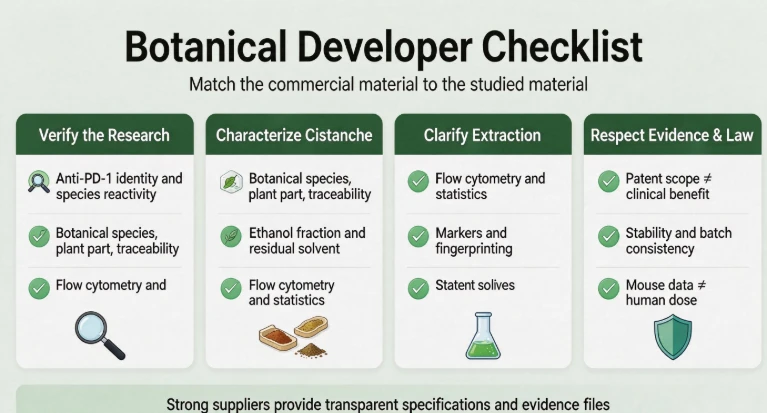
Verify the Research Before Optimizing the Formula
Before investing in scale-up, confirm:
The exact anti-PD-1 antibody used.
Its activity against the relevant species.
Cell-line authentication.
Whether the MC38 preparation was molecularly characterized for the proposed disease context.
Randomization, blinding, exclusions, and raw data.
The statistical test and meaning of the reported variability.
Whether the repeated identical results across Examples 12 and 13 represent shared experimental data or separate experiments.
Complete flow-cytometry methods and gating.
Whether antibody binding could affect PD-1 detection.
Whether improved combination outcomes meet a predefined criterion for synergy.
Match the Commercial Material to the Studied Material
The patent specifies Cistanche deserticola. A different species, a different plant part, or a different extraction process is not automatically equivalent.
For a Cistanche supplier, useful documentation includes:
Botanical identity.
Traceability.
Plant-part specification.
Processing history.
Extraction details.
Chromatographic fingerprint.
Suitable marker analysis.
Contaminant testing.
Stability information.
Batch-specific certificates of analysis.
Echinacoside or acteoside may be useful chemical markers where appropriate, but their content is not a validated measure of clinical anticancer effectiveness.
Resolve the Extraction Process
The source's ethanol step needs clarification before a reproducible manufacturing process can be established.
A development team should determine:
The exact ethanol-to-concentrate ratio.
Whether the ratio is based on mass or volume.
Final ethanol concentration.
Which fraction is retained.
Which fraction contains relevant constituents.
Recovery yield and material balance.
Effects of heat exposure.
Residual solvent.
Batch-to-batch compositional variation.
A well-characterized process is essential because different retained fractions may produce different biological and safety profiles.
Investigate Safety Alongside Efficacy
Tumor measurements alone do not establish tolerability.
Relevant work may include toxicology, organ-function assessment, hematology, immune effects, and combination-treatment evaluation.
Botanical identity and potential toxic constituents are especially important for Shan Ci Gu, which the source identifies as Iphigenia indica.
Do not assume that a traditional name, water extraction, or ethanol precipitation makes an ingredient safe.
Respect Patent Rights and Evidence Limits
Before commercial implementation, obtain a freedom-to-operate review in the intended markets.
The broad ratios described in the specification are not automatically the same as the legally enforceable claim scope.
Likewise:
Patent protection does not establish clinical benefit.
A medicinal development concept does not establish supplement eligibility.
A complete-formula result does not substantiate a single-ingredient claim.
Mouse data do not establish a human dose.
The strongest supplier proposition is reproducible ingredient quality and transparent documentation-not a promise to enhance cancer treatment.