Cistanche, Epimedium, And Drynaria: Natural Herbal Combination For Osteoporosis Prevention And Bone Health
Oct 12, 2026
Introduction: The Growing Global Burden of Osteoporosis
Osteoporosis (OP) represents one of the most widespread metabolic bone disorders affecting modern aging populations worldwide. Characterized by progressive bone mass loss, deteriorated bone micro‑architecture, increased bone fragility and significantly elevated fracture risk, osteoporosis imposes heavy physical, financial and psychological burdens on middle‑aged and elderly communities across every continent. As global life expectancy rises, the public‑health relevance of osteoporosis continues expanding. Epidemiological observations show that osteoporosis prevalence climbs sharply with advancing age: statistics indicate roughly 15 %‑50 % prevalence among populations younger than 50 years old, while for people aged above 60 years, osteoporosis incidence can exceed 56 %. Elderly individuals with osteoporosis face high likelihood of hip, spinal and wrist fractures; many fracture patients lose mobility and independent living capacity after injury.
Conventional mainstream anti‑osteoporosis pharmaceutical interventions include bisphosphonates, Denosumab, teriparatide and abaloparatide. These synthetic medications function either by suppressing excessive bone resorption carried out by osteoclasts or by stimulating osteoblast‑driven new‑bone formation. Nevertheless, synthetic anti‑bone‑loss drugs carry well‑documented practical limitations: long‑term administration may trigger adverse reactions such as renal toxicity, gastrointestinal irritation, musculoskeletal pain and atypical fracture risks for certain patient subgroups. Clinical professionals keep searching for complementary, milder intervention options for long‑term bone‑health management.
Traditional Chinese Medicine (TCM) offers centuries‑long accumulated empirical knowledge regarding bone‑weakness conditions. Classic TCM theory holds that "kidney governs bones"; tonifying kidney essence reinforces skeletal strength. Three well‑known TCM medicinal herbs - Cistanche deserticola (Herba Cistanches, Roucongrong, desert ginseng), Epimedium herb (Yinyanghuo, horny goat weed), and Drynaria fortunei rhizome (Gusuibu) - have been frequently combined in herbal prescriptions for alleviating soreness of waist and knees, bone fragility and age‑related bone deterioration.
For decades, researchers have attempted decoding the molecular‑level working logic behind multi‑herbal TCM formulas. Unlike single‑compound Western pharmaceuticals, herbal mixtures exert biological effects via hundreds of chemical substances interacting with dozens of human gene targets simultaneously. Network pharmacology is a modern bio‑informatic research technique built precisely for investigating this "multi‑component, multi‑target" feature of botanical medicines, paired with molecular docking simulation to verify physical binding affinity between plant small‑molecule compounds and human protein receptors.
This article translates findings published in a peer‑reviewed Chinese medical study investigating the Cistanche‑Epimedium‑Drynaria herbal combination against osteoporosis, explaining technical outputs in accessible popular‑science language. Readers will understand which bioactive compounds are suspected key players, what human gene and protein targets these herbal ingredients interact with, which cellular signaling pathways get modulated, and what molecular docking simulations reveal about compound‑protein binding. We will also discuss current research gaps and future development outlook for this promising natural bone‑support herbal formula.
1. Basic Background: Osteoporosis Pathophysiology and Three Key TCM Bone‑Tonifying Herbs
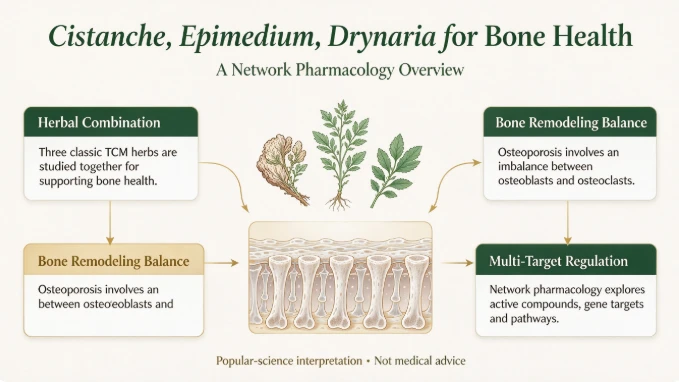
1.1 How osteoporosis develops: imbalance between osteoblasts and osteoclasts
Human bone tissue maintains constant remodeling throughout the whole lifespan. Two primary cell types control bone turnover equilibrium:
Osteoblasts: bone‑building cells, responsible for synthesizing bone matrix, depositing mineral substances, generating new bone tissue.
Osteoclasts: bone‑resorbing cells, which break down aged or damaged bone tissue, releasing stored calcium into blood circulation.
Under healthy physiological status, bone formation rate matches bone resorption rate, preserving stable bone density and intact trabecular micro‑structure. Osteoporosis emerges once balance collapses: osteoclast activity outpaces osteoblast regeneration capacity, leading to net bone mass reduction, thinner trabeculae, porous bone texture and greater fracture vulnerability国家科研论.... Multiple risk factors tip this balance: estrogen decline in post‑menopausal women, aging‑related hormone shifts, insufficient calcium or vitamin D intake, oxidative stress, chronic low‑grade inflammation, renal function decline and sedentary lifestyles. Post‑menopausal women constitute one highest‑risk demographic for osteoporosis onset, because rapid estrogen withdrawal removes critical inhibitory control over osteoclast proliferation.
1.2 Profile of three herbs in the anti‑osteoporosis combination
1.2.1 Cistanche deserticola (Herba Cistanches, Roucongrong): "Desert Ginseng"
Cistanche is a parasitic succulent plant thriving in arid desert zones across Northwest China. Named "desert ginseng" in folk tradition, Compendium of Materia Medica (Ben‑Cao‑Gang‑Mu) documented Cistanche for treating kidney‑yang deficiency, lumbago, knee weakness and physical exhaustion. Its major bioactive substances include phenylethanoid glycosides, sterols, polysaccharides and lignan compounds such as suchilactone, beta‑sitosterol, quercetin. Modern lab animal experiments have proven Cistanche total glycosides and polysaccharides can activate Wnt/β‑catenin signaling pathways, improve bone micro‑structure and mitigate bone loss in osteoporosis animal modelsPMC.
1.2.2 Epimedium herb (Yinyanghuo, Horny Goat Weed)
Epimedium ranks among the most‑studied TCM herbs for bone health. TCM therapeutic properties include tonifying kidney‑yang, strengthening tendons and bones, dispelling wind‑dampness. Flavonoid compounds dominate its pharmacologically‑relevant components: icariin, kaempferol, luteolin, chryseriol. Icariin is its most famous marker compound. Existing pre‑clinical research confirms Epimedium extracts can regulate immunity, suppress inflammatory responses, promote osteoblast differentiation and constrain over‑active osteoclast formation across multiple bone‑disease experimental modelsPMC.
1.2.3 Drynaria fortunei rhizome (Gusuibu)
Drynaria fortunei is a fern‑derived medicinal rhizome widely prescribed for bone‑injuries and bone‑weakness disorders in East‑Asian traditional medicine. Its core chemical repertoire covers flavonoids, terpenoids and phenolic acids. Compounds such as naringenin, eriodictyol, kaempferol, luteolin occur abundantly within Drynaria rhizome raw material. Multiple network‑pharmacology papers and cell‑culture assays indicate Drynaria extracts modulate osteoblast‑osteoclast balance to counteract osteoporosis progression国家科研论....
Combined together, these three herbs represent a classic multi‑ingredient TCM strategy: instead of hitting one single biological switch, dozens of plant‑derived small molecules work collectively to restore balanced bone‑remodeling physiology. However, before network‑pharmacology computational approaches, scientists struggled to map out the complete interaction network between herbal chemical components and human osteoporosis‑related genes.
2. What Is Network Pharmacology and Molecular Docking? Simplified Explanation for General Readers
Most conventional drug‑discovery workflows follow one‑drug‑one‑target logic: identify one disease‑causing protein, screen chemical molecules that bind precisely onto this protein target, optimize compound potency for drug development. This paradigm works well for many single‑pathway illnesses yet poorly fits complex chronic diseases and multi‑component herbal therapies.
Network pharmacology adapts bioinformatics databases to systematically map:
All verified bio‑active chemical ingredients of herbal medicines;
Every human‑protein target each chemical compound potentially interacts with;
All known human genes and proteins associated with a given disease (osteoporosis in this case);
Calculate overlapping shared targets between herbal‑medicine targets and disease‑related targets.
After obtaining shared target genes, researchers build Protein‑Protein Interaction (PPI) networks visualizing how these target proteins connect and regulate each other inside human cells. Researchers further run Gene Ontology (GO) enrichment analysis and Kyoto Encyclopedia of Genes and Genomes (KEGG) pathway enrichment analysis. GO analysis sorts target‑gene functions into three categories: biological processes (BP), cellular components (CC), molecular functions (MF). KEGG analysis sorts targets into well‑described intracellular signaling pathways, helping researchers see which cellular regulatory circuits get perturbed by herbal‑medicine intervention国家科研论....
Molecular docking simulation serves as computational follow‑up validation step. It uses computer algorithms to simulate three‑dimensional spatial fitting between small‑molecule herbal compounds (ligands) and the spatial structure of target human proteins (receptors). Researchers calculate binding‑energy values: lower negative kcal/mol binding‑energy numbers mean tighter, more stable physical binding between compound and protein, which suggests higher probability of real‑world biological interaction inside living cells. Important reminder: network‑pharmacology plus molecular docking remain in‑silico computer simulation work. Positive simulation outputs generate testable hypotheses, but cannot replace wet‑lab cell experiments, animal trials or human clinical studies for definitive proof of therapeutic effect

3. Key Research Outcomes from Cistanche‑Epimedium‑Drynaria Network‑Pharmacology Study
The original research paper applied standard network‑pharmacology workflow. Researchers sourced herbal‑ingredient information via TCMSP (Traditional Chinese Medicine Systems Pharmacology Database). They applied filtering thresholds: Oral Bioavailability OB ≥ 30 % and Drug‑Likeness DL ≥ 0.18 to retain compounds most likely to produce physiological effect inside human bodies after oral ingestion. Disease‑related osteoporosis gene targets were retrieved from GeneCards database. Venny software computed intersection between herbal compound targets and osteoporosis‑disease targets. STRING database built PPI networks; Cytoscape software visualized ingredient‑target‑disease interaction maps. DAVID database processed GO enrichment and KEGG pathway enrichment. AutoDock software completed molecular‑docking affinity evaluation for selected core compounds and protein targets. Below we unpack major outputs in non‑technical wording.
3.1 Screening of bio‑active herbal ingredients and shared disease‑drug targets
After filtering by OB and DL criteria, researchers identified 46 total effective bio‑active chemical constituents across the three‑herb combination: 22 active compounds from Epimedium herb, 18 from Drynaria fortunei rhizome, six bio‑active ingredients isolated from Cistanche deserticola. The full dataset includes sterols, flavonoids, lignans and other phytochemical classes.
Among these 46 ingredients, seven compounds stood out as core candidate bio‑active components: suchilactone, quercetin, luteolin, kaempferol, eriodictyol, eriodyctiol, naringenin. Noticeably, multiple flavonoid molecules (quercetin, luteolin, kaempferol, naringenin, eriodictyol) appear on this core‑component list. Flavonoids represent widely‑investigated plant secondary metabolites known for anti‑oxidant, anti‑inflammatory and bone‑modulating bio‑activities in previous botanical research. Suchilactone originates primarily from Cistanche deserticola, while flavonoid substances get distributed across all three medicinal herbs, explaining synergistic multi‑source supply of identical bio‑active molecules within this compound formula.
Total predicted target genes linked to the herbal mixture numbered 274; osteoporosis‑associated human disease genes collected from GeneCards totalled 3093 genes. Venny 2.1.0 software calculated their intersection: 225 shared overlapping target genes. This large overlap set vividly demonstrates that the herbal mixture can interact with hundreds of human gene products connected to osteoporosis pathology, confirming its multi‑target working pattern. These 225 shared genes become central analytical objects for downstream PPI network and enrichment analysis.
3.2 Protein‑protein interaction network and core hub targets
The 225 intersecting genes were imported into STRING database for constructing protein‑protein‑interaction network. After filtering, 51 key node proteins and 704 protein‑to‑protein interaction edges remained within core network. Higher "degree value" for one node means this protein connects to many other partner proteins, implying central regulatory status in biological networks. Top‑ranked nodes by degree value included MAPK3, AKT1, TNF, EGFR and SRC. From ingredient‑target‑disease network built inside Cytoscape software, researchers highlighted five especially critical hub protein targets: AKT1, ESR2, MMP‑9, AR and mTOR国家科研论....
We briefly explain biological meaning for these hub‑target proteins:
AKT1: AKT serine‑threonine kinase 1, central component of PI3K‑Akt signaling cascade. This pathway acts as master metabolic switch governing osteoblast survival, cell apoptosis suppression, bone‑marrow mesenchymal‑stem‑cell osteogenic differentiation, inflammation modulation. Abnormal AKT‑pathway function closely correlates with bone‑loss pathology.
ESR2 (Estrogen Receptor 2, ER‑beta): Estrogen receptor‑beta. Estrogen‑receptor signaling represents the well‑known hormone axis controlling post‑menopausal bone homeostasis. Herbal phyto‑estrogen‑like compounds may bind ESR2 to partially compensate for physiological estrogen decline, restraining excessive osteoclast activation.
MMP‑9 (Matrix Metalloproteinase‑9): matrix‑degrading protease. MMP‑9 participates in bone‑matrix degradation, mediates osteoclast‑driven bone‑resorption processes. Elevated MMP‑9 expression correlates with high‑turnover osteoporosis states; inhibiting excessive MMP‑9 activity could slow pathological bone breakdown.
AR (Androgen Receptor): Androgen receptor signaling maintains male bone density; it also participates in general bone‑cell metabolism regulation for both sexes.
mTOR: Mammalian target of rapamycin, major sensor for cellular nutrition, oxidative stress and autophagy. mTOR signaling modulates osteoblast proliferation, survival and apoptosis; dysregulated mTOR signaling contributes to osteoporosis progression.
Identifying these hub proteins illustrates that Cistanche‑Epimedium‑Drynaria herbal formula potentially touches hormone‑receptor signaling, cell survival/apoptosis control, extracellular‑matrix degradation and nutrient‑stress sensing inside bone‑related cells.

3.3 GO functional enrichment analysis results
GO enrichment analysis classifies biological roles fulfilled by 51 core target‑hub genes. Computation returned 489 biological‑process (BP) entries, 53 cellular‑component (CC) entries and 100 molecular‑function (MF) entries.
Translating major enriched GO entries into plain‑language description:
Biological Process (BP): Top enriched biological events cover positive regulation of RNA polymerase‑II transcription, negative regulation of cell apoptotic process, cellular response to chemical stimulus, inflammatory‑response modulation. This tells us herbal‑mixture targets heavily influence gene‑transcription reprogramming, preventing bone‑cell apoptosis and tuning inflammatory responses. Chronic low‑grade inflammation fuels osteoporosis development; suppressing pathological osteocyte apoptosis preserves viable bone‑cell populations.
Cellular Component (CC): Enriched locations include macromolecular protein complexes, mitochondrial compartments, plasma‑membrane receptor complexes. Mitochondrial health determines osteoblast survival against oxidative damage; plasma‑membrane receptors receive hormone and cytokine signals governing bone‑cell fate.
Molecular Function (MF): Enriched molecular‑activity terms focus on protein‑kinase binding activity, sequence‑specific DNA‑binding transcription‑factor activity. Most hub‑target proteins act as kinases, receptors or transcription factors, mediating signal transmission from cell surface deep into cell nucleus to change gene‑expression profiles of bone‑related cells.
The GO enrichment output paints this picture: the herbal formula does not only affect one isolated biochemical reaction. Instead it reshapes broad‑scale gene‑expression patterns, modulates cell death‑survival balance and dampens pro‑inflammatory biological signals within bone‑related cells.
3.4 KEGG signaling‑pathway enrichment results
KEGG pathway‑enrichment analysis mapped core‑hub genes onto documented intracellular signaling pathways, returning total 149 statistically‑significant enriched pathways. Several bone‑biology‑relevant pathways deserve special attention:
PI3K‑Akt signaling pathway: This pathway appears repeatedly across osteoporosis‑pharmacology literature. PI3K‑Akt signaling boosts osteoblast survival, supports angiogenesis inside bone tissue, restrains osteoclast differentiation. Multiple published TCM‑extract studies report bone‑protective effects mediated via PI3K‑Akt pathway activation.
Estrogen signaling pathway: Directly corresponds to post‑menopausal osteoporosis pathophysiology. Phyto‑active substances from three herbs may mimic or modulate estrogen‑receptor‑dependent signaling to counteract bone loss after estrogen drop‑off.
HIF‑1 signaling pathway: Hypoxia‑inducible factor‑1 pathway controls bone angiogenesis, bone‑marrow micro‑environment homeostasis, osteoblast‑osteoclast crosstalk.
Additional enriched pathways include cancer‑related pathways, lipid‑atherosclerosis pathways. Note that cancer‑pathway enrichment frequently shows up within network‑pharmacology outputs for bone‑protective herbal research, because many shared cell‑cycle, apoptosis and inflammation‑regulating genes operate both in tumor‑cell biology and bone‑remodeling biology. This enrichment signal does not mean herbs treat cancer; it reflects overlapping molecular machinery between different disease contexts.
KEGG results confirm that Cistanche‑Epimedium‑Drynaria exerts suspected anti‑osteoporosis influence through coordinating multiple interconnected signaling cascades rather than manipulating only one single cellular route.

3.5 Molecular‑docking simulation outcomes: compound‑protein binding affinity
Researchers selected core protein‑receptor targets AKT, ESR, MMP‑9 and four representative core small‑molecule ligands: suchilactone, quercetin, luteolin, kaempferol for molecular‑docking simulation test. Binding‑energy values (unit kcal/mol) quantify predicted binding stability; generally speaking binding‑energy values below −4.0 kcal/mol indicate relatively stable ligand‑receptor complex formation in‑silico.
The docking‑simulation data table shows key findings:
For target MMP‑9: suchilactone (−4.98 kcal/mol), luteolin (−4.31 kcal/mol), kaempferol (−4.19 kcal/mol), quercetin (−3.42 kcal/mol). Three of four compounds achieve binding‑energy lower than −4.0 kcal/mol. This result strongly suggests these flavonoid and lignan‑type molecules can physically dock into MMP‑9 protein active pocket, raising hypothesis that herbal ingredients may inhibit MMP‑9 protease function to reduce bone‑matrix degradation.
AKT target yields moderate‑strength docking scores: suchilactone (−3.46 kcal/mol), luteolin (−3.53 kcal/mol).
ESR receptor shows comparatively weaker binding‑energy for these four selected molecules.
Visualized docking 3‑D diagrams demonstrate hydrogen‑bond formation and spatial matching between small‑molecule structures and amino‑acid residues lining MMP‑9 protein binding‑cavity. Molecular‑docking results highlight MMP‑9 as one high‑priority target for follow‑up wet‑lab experimental verification. Still we need to stress again: docking‑simulation represents computational prediction only, and cannot replace real‑world biological assays.
4. Comprehensive Discussion: Interpreting Network‑Pharmacology Findings for Cistanche‑Epimedium‑Drynaria against Osteoporosis
Combining GO enrichment, KEGG pathway analysis and molecular‑docking outputs, we can reconstruct a hypothetical mechanistic narrative for this three‑herb TCM formula's anti‑osteoporosis potential. Please remember this is hypothesis derived from in‑silico data, not clinically‑proven treatment mechanism.
The herbal mixture delivers dozens of orally bio‑available phytochemicals, prominently flavonoid compounds (quercetin, luteolin, kaempferol, naringenin, eriodictyol) plus suchilactone from Cistanche deserticola. These chemical components enter human tissue and interact with hub protein targets including AKT1, ESR2, MMP‑9, AR and mTOR. Downstream biological consequences may include several parallel lines of action:
First, modulation of PI3K‑Akt and mTOR signaling pathways improves survival of osteoblast lineage cells, inhibits excessive osteoblast apoptosis, maintains functional bone‑building cell population. Second, phyto‑active ingredients interact with estrogen‑and‑androgen receptors (ESR2, AR), partially compensating hormone‑signal insufficiency linked with age‑related or post‑menopausal bone loss. Third, core compounds may bind and suppress MMP‑9 protease activity, slowing pathological degradation of bone extracellular matrix. Fourth, multi‑component intervention tunes inflammatory signaling networks, lowering pro‑inflammatory cytokine activities which drive over‑production and hyper‑activation of bone‑destroying osteoclasts. Collectively these suspected biological effects help re‑balance the osteoblast‑osteoclast remodeling equilibrium, mitigate bone‑mass loss and theoretically lower fracture risk.
These computational outputs align with previously‑published independent pre‑clinical studies. Other research teams demonstrated luteolin promotes bone‑marrow stem‑cell osteogenic differentiation through PI3K‑Akt pathway modulation; quercetin regulates bone‑cell autophagy‑apoptosis balance for bone protection; Cistanche total glycosides improve bone micro‑structure in senescence‑accelerated mouse osteoporosis models by activating Wnt/β‑catenin signaling; Epimedium‑derived icariin suppresses osteoclastogenesis via multiple intracellular cascades; Drynaria extracts restrain osteoclast formation in glucocorticoid‑induced osteoporosis animal models through PI3K‑Akt pathway interference. Consistency across separate research works strengthens plausibility for the network‑pharmacology‑generated hypothesis.
Nevertheless, significant limitations constrain interpretation of network‑pharmacology study outputs, and these deserve clear explanation for general‑science readers:
All results originate from computer database mining and simulation, not direct wet‑lab experiment. Databases accumulate published literature data; prediction outputs require cell‑culture testing, animal‑model intervention and ultimately human clinical trials to validate whether these predicted compound‑target interactions truly happen inside living organisms. Network‑pharmacology generates hypotheses, not definitive proof of efficacy.
The simulation cannot reflect real‑world herbal‑preparation complexity: herb‑material quality variation, extraction procedure, dosage, compound‑compound synergistic or antagonistic interactions, human‑body absorption, metabolism and excretion of phytochemical substances are not fully modeled in‑silico.
This research does not provide safe‑effective human‑use dosage guidance for the three‑herb combination. No human‑subject clinical trial data is presented within original paper. Readers cannot self‑medicate using Cistanche‑Epimedium‑Drynaria herbal products to treat diagnosed osteoporosis without professional medical supervision.
Enriched KEGG entries contain many pathways unrelated to bone biology. This reflects broad multi‑target feature of plant‑derived natural compounds: same phytochemical can take part in dozens of physiological processes across diverse organ systems, which simultaneously implies possibility of off‑target biological impacts.

5. Research Outlook and Practical Take‑Home Messages
Osteoporosis remains a huge unmet medical need for aging societies globally. Synthetic anti‑osteoporosis drugs carry safety‑concern trade‑offs for long‑term continuous application, therefore natural‑product‑based bone‑health interventions attract growing research interest. TCM compound formulas like Cistanche‑Epimedium‑Drynaria embody holistic multi‑target therapeutic philosophy. Network‑pharmacology and molecular‑docking computational tools serve as cost‑effective preliminary screening instruments, helping researchers narrow thousands of possible compound‑target combinations down to high‑priority candidates for subsequent laboratory work.
Looking forward, several research directions should be pursued:
Conduct in‑vitro cell experiments applying Cistanche‑Epimedium‑Drynaria herbal extracts and purified core compounds (quercetin, luteolin, suchilactone etc.) onto osteoblast and osteoclast cell‑culture systems, measuring changes in target‑protein expression, cell‑proliferation, differentiation and apoptosis phenotypes, verifying PI3K‑Akt, MMP‑9, estrogen‑relevant signaling‑pathway alterations.
Perform osteoporosis‑animal‑model intervention studies (ovariectomy‑induced post‑menopausal osteoporosis rodent models), assessing bone‑mineral‑density, trabecular‑bone micro‑structure parameters, serum bone‑turnover biomarker levels and target‑protein expression changes in bone tissue samples.
If pre‑clinical data supports therapeutic potential, standardized‑herbal‑preparation formulation development, quality‑control‑method establishment, toxicology‑safety evaluation and finally well‑designed human‑clinical‑trial programs would become necessary steps before any clinical‑application consideration.
For ordinary readers searching bone‑health knowledge:
Osteoporosis is serious chronic medical illness. Please always follow advice from orthopedics or endocrinology medical specialists for diagnosis and standard‑treatment planning.
Natural herbal substances including Cistanche, Epimedium and Drynaria should be regarded as potential complementary‑research objects at current stage, not proven replacement therapy for prescription osteoporosis medications. Do not discontinue prescribed anti‑osteoporosis pharmaceutical drugs on your own initiative for herbal supplements.
Bone health maintenance primarily relies on adequate calcium and vitamin‑D nutrition, weight‑bearing physical exercise, smoking cessation and moderate alcohol consumption, alongside regular bone‑mineral‑density screening for high‑risk demographic groups.
Conclusion
This popular‑science article summarizes in‑silico network‑pharmacology and molecular‑docking research investigating three classic TCM medicinal herbs - Cistanche deserticola, Epimedium herb and Drynaria fortunei rhizome - for anti‑osteoporosis molecular mechanisms. Computational analysis identified 46 candidate bio‑active constituents within this herbal combination, with seven core phytochemical compounds (suchilactone, quercetin, luteolin, kaempferol, eriodictyol, eriodyctiol, naringenin). Researchers predicted 225 shared drug‑disease intersecting gene‑targets; hub proteins AKT1, ESR2, MMP‑9, AR, mTOR stand out as central molecular nodes. GO functional enrichment indicates influences upon gene transcription, cell‑apoptosis regulation and inflammatory‑response biology. KEGG pathway enrichment highlights PI3K‑Akt signaling pathway, estrogen signaling pathway and HIF‑1 signaling pathway as major suspected intervention routes. Molecular‑docking simulation demonstrates stable predicted binding between MMP‑9 protein and suchilactone, quercetin, luteolin and kaempferol molecules.
All these outputs support hypothesis that Cistanche‑Epimedium‑Drynaria herbal mixture works against osteoporosis via multi‑component, multi‑target and multi‑pathway regulatory patterns. However, all findings derive from bio‑informatics computation. Further cell‑level experiments, animal‑model research and human‑clinical investigations remain indispensable for confirming real‑world pharmacological efficacy and safety profile. This herbal formula represents an exciting research direction for developing complementary bone‑health interventions rooted in traditional‑Chinese‑medicine heritage.