Cistanche For Uric Acid Support: Formulation & Evidence
Nov 12, 2026
Meta Description: Explore a Cistanche–Poria goat milk formulation, mouse-study findings, processing parameters, and sourcing questions for uric acid support product R&D.
Suggested URL Slug: /cistanche-poria-uric-acid-functional-food-formulation/
Primary Keyword: Cistanche extract for uric acid support
Secondary Keywords:
Cistanche and Poria formulation
herbal ingredients for uric acid support
functional goat milk powder
Cistanche extract supplier
uric acid support product development
Cistanche and Poria for Uric Acid Support: A Formulation Case Study for Functional Food Brands
Developing a botanical product for uric acid support requires more than selecting ingredients with traditional uses. Brands need a defined formulation, a reproducible manufacturing process, meaningful biological evidence, and a realistic path to commercialization.
A Chinese patent text describing a goat milk powder containing Cistanche and Poria extracts offers a useful development case. It combines a two-ingredient traditional medicinal extract with whole goat milk powder and reports results from a hyperuricemia mouse model.
For functional food brands, supplement developers, and OEM/ODM manufacturers, its main value is practical: it connects ingredient selection with extraction conditions, dairy processing parameters, and several uric-acid-related biological endpoints.
The evidence is preclinical. The supplied text does not establish efficacy in humans, an effective human serving size, or the independent efficacy of Cistanche extract.
Goat Milk

Cistanche Extract Benefits

At a Glance: What Does the Formulation Offer?
The disclosed formulation consists of:
20–30 parts by weight of a traditional Chinese medicinal extract
70–80 parts by weight of whole goat milk powder
The extract is prepared from:
Poria
Cistanche
The disclosed Poria-to-Cistanche mass ratio is 1:(0.5–2), with 1:1 identified as preferred.
Rather than extracting the ingredients separately and blending the resulting powders, the document describes mixing the raw medicinal materials before sequential ultrasound and water-bath extraction.
That distinction matters for sourcing. A commercial blend of separately manufactured Poria and Cistanche extracts should not automatically be treated as equivalent to the co-extracted material used in this formulation.
1. Why This Case Matters to Product Developers
The formulation addresses two different development needs.
The first is biological: identifying a combination worth investigating for uric acid support.
The second is technological: incorporating traditional medicinal ingredients into a familiar powdered food format.
For a brand, a milk-based powder offers a different product concept from a capsule or conventional herbal decoction. For a manufacturer, however, that concept also introduces questions about extract solids, flavor, dispersion, dairy compatibility, processing stability, and shelf life.
The patent text provides starting conditions for several of these manufacturing steps. It does not provide complete commercial validation, sensory testing, or shelf-life data.
Its strongest use is therefore as an R&D reference, not a ready-to-launch formula.

2. The Two Disclosed Formulations
Formulation A: Higher Extract Proportion
Example 1 uses:
Whole goat milk powder: 70 parts by weight
Traditional Chinese medicinal extract: 30 parts by weight
Cistanche different specs of extract
High content means stronger effects
Click to visit the listings of different cistanche extract

Formulation B: Lower Extract Proportion
Example 2 uses:
Whole goat milk powder: 80 parts by weight
Traditional Chinese medicinal extract: 20 parts by weight
Both examples use a 1:1 Poria-to-Cistanche raw-material ratio.
In the animal experiment, Example 1 is assigned to the "high-dose" group and Example 2 to the "low-dose" group.
However, the supplied text does not state the administered milk-powder dose in mg/kg or g/kg. These labels should therefore not be interpreted as fully specified exposure levels.
A Critical Formulation Question: What Does "Extract" Mean?
The process produces an aqueous filtrate, but the formulation is expressed in parts by weight of "extract."
The supplied text does not clearly state whether that weight refers to:
The filtered extraction liquid;
A concentrated liquid extract; or
A dry extract or dry-solids equivalent.
Before reproducing the formula, establish the extract's solids content and the mass basis used in the formulation.
Without that information, nominally identical "20%" or "30%" extract additions could deliver substantially different quantities of extracted material.
3. What Did the Animal Study Report?
The study used 10-week-old C57BL/6J mice, divided into six groups of 10 animals each.
The groups were:
Normal control;
Hyperuricemia model;
Lower-extract formula;
Higher-extract formula;
Plain goat milk powder;
Allopurinol positive control.
The treatment groups received their respective milk powders during weeks 1–3, before model induction began. During weeks 4–7, the model groups received:
Potassium oxonate: 250 mg/kg
Adenine: 100 mg/kg
The relevant intervention followed one hour later.
This is important for interpretation: the experiment includes pretreatment before model induction and continued intervention during induction. It is not solely a treatment study in animals with already established hyperuricemia.
Serum Uric Acid
The text reports that:
Serum uric acid was significantly higher in the model group than in the normal control group.
Both formulated milk-powder groups had significantly lower serum uric acid than the model group.
The plain goat milk group also had significantly lower serum uric acid than the model group.
The higher-extract group was described as showing a more pronounced reduction.
The stated significance threshold was P < 0.05 for the comparisons reported as significant.
What this means for developers: the complete formulation produced a reported uric-acid-lowering signal in the mouse model. However, because plain goat milk also showed activity, the results cannot be attributed entirely to the herbal extract.
The supplied narrative does not establish statistically significant superiority of the formulated powders over plain goat milk.
Blood Urea Nitrogen and Kidney-Related Findings
The model group showed significantly increased blood urea nitrogen relative to the normal control group.
Both formulated milk-powder groups showed significantly lower blood urea nitrogen than the model group, with P < 0.05 reported.
The text also describes an improvement in the kidney index relative to the model group.
These findings support further investigation of kidney-related effects in this model. They do not establish a clinically demonstrated kidney-protective benefit.
Although serum creatinine appears among the measured endpoints and in the Figure 1 description, the supplied results narrative does not give a clear treatment-effect conclusion for that marker.
Xanthine Oxidase and Adenosine Deaminase
The study reports significantly elevated hepatic activities of:
Xanthine oxidase, or XOD
Adenosine deaminase, or ADA
in the model group compared with the normal control group.
Both formulated milk-powder groups showed significantly lower activities than the model group, with P < 0.05 reported.
This provides a mechanistic lead related to uric acid production. It does not demonstrate which ingredient or compound caused the changes, or whether direct enzyme inhibition occurred.
GLUT9 and ABCG2 Gene Expression
The reported renal gene-expression findings were:
Model induction increased GLUT9 mRNA expression.
Model induction decreased ABCG2 mRNA expression.
Both formulated milk-powder groups shifted these expression levels toward the normal range.
The patent proposes that these changes may help explain improved urate handling.
However, mRNA expression is not a direct measurement of transporter protein activity or urinary uric acid excretion. The mechanism remains a hypothesis supported by gene-expression observations.
Inflammatory Markers
The results section reports that the model group had:
Increased IL-1β
Increased TNF-α
Decreased IL-10
Both formulated milk-powder groups reportedly attenuated these changes.
There is a reporting inconsistency to resolve before reproducing the work: the sample-analysis paragraph lists serum IL-6, IL-1β, and TNF-α, whereas the later results section discusses kidney-tissue IL-1β, TNF-α, and IL-10.
The original laboratory records and figures would be needed to verify the sample matrix and assay panel.
4. Does the Study Prove Synergy Between Cistanche, Poria, and Goat Milk?
Not from the supplied experiment alone.
The patent text claims that the complete combination performs better than individual ingredients or any two-component combination. However, the disclosed six-group design does not include all the necessary comparisons.
Different herb and fruit benefits in health supplements

Missing groups include:
Cistanche alone;
Poria alone;
Cistanche plus Poria without milk;
Cistanche plus goat milk;
Poria plus goat milk.
Consequently, the available study description supports investigation of the combined formulation, but it does not establish a formal three-component synergistic effect.
For brands, this distinction protects credibility. A more defensible description is:
"A Cistanche–Poria goat milk formulation showed preclinical activity in a hyperuricemia mouse model."
Avoid presenting it as:
"Clinically proven synergistic uric acid reduction."
5. Extraction and Processing Parameters Worth Taking into Pilot Development
The patent is particularly useful because it discloses a processing sequence rather than an ingredient list alone.
Step 1: Prepare the Combined Extract
The preferred example conditions are:
Poria:Cistanche mass ratio: 1:1
Medicinal materials:water mass ratio: 1:35
Ultrasonic power: 185 W
Ultrasonic extraction time: 30 minutes
Subsequent water-bath temperature: 100°C
Water-bath extraction time: 30 minutes
The solid residues are removed by filtration.
The broader claimed windows are:
Ultrasonic power: 180–190 W
Medicinal powder:water mass ratio: 1:(30–40)
Ultrasonic extraction time: 20–40 minutes
Water-bath temperature: 95–100°C
Water-bath extraction time: 20–40 minutes
These conditions offer a laboratory starting point. For scale-up, nominal ultrasonic power alone is insufficient: batch volume, equipment geometry, frequency, operating mode, and delivered energy should also be established.
The text does not provide these additional parameters or quantitative extraction-yield comparisons.
Step 2: Incorporate the Extract into the Milk Base
The example process combines the extract with whole goat milk powder and adds hot water at a stated material-to-liquid ratio of:
1 g of material to 7 mL of water
The extract-weight basis must be clarified before this ratio is used in a production calculation.
Step 3: Filter, Homogenize, and Heat-Treat
The example conditions are:
Filtration: 200-mesh screen
Homogenization temperature: 65°C
Homogenization pressure: 20 MPa
Heat treatment: 95°C for 10 seconds
Although the patent calls the heat-treatment step "sterilization," that wording does not by itself establish commercial sterility. Microbiological performance must be validated for the actual process and finished product.
Step 4: Freeze-Dry and Sieve
The example freeze-drying conditions are:
Pre-freezing: −45°C
Primary drying: 0°C, 20 Pa
Secondary drying: 30°C, 10 Pa
Final sieving: 150 μm screen
Freeze-drying may be useful during development, but the document does not compare its cost, product quality, or ingredient retention with spray-drying.
A change in drying technology requires fresh validation rather than an assumption of equivalence.
6. What Should Buyers Ask a Cistanche Extract Supplier?
A useful procurement brief should address the following points.
Botanical Identity and Traceability
Request:
Exact Cistanche species;
Plant part;
Geographic origin;
Identity-testing method;
Batch traceability.
The supplied patent text identifies Cistanche by its Chinese medicinal name but does not specify a Latin species.
Extraction Match
Clarify:
Whether the supplied product is a water extract;
Whether it is manufactured separately or co-extracted with Poria;
Whether ultrasound is used;
Extraction yield;
Dry extract ratio;
Solids content;
Added carriers or excipients.
A separately produced extract may still be useful for development, but it should not be described as identical to the investigated co-extract without supporting data.
China-official Cistanche Extract factory pictures
Click to visit the cistanche factory


Supportive Service Of Wecistanche-The largest cistanche exporter in the China:
Email:wallence.suen@wecistanche.com
Chemical Characterization
Ask for a relevant analytical fingerprint and, where appropriate, quantified marker compounds.
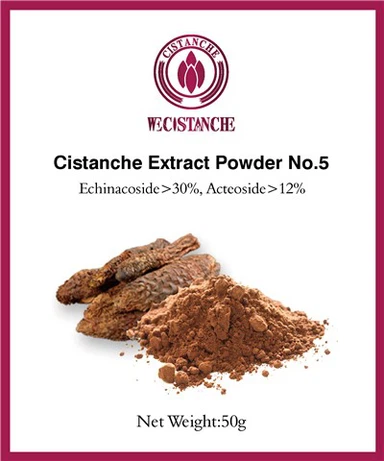
For Cistanche, a supplier may offer specifications involving echinacoside and acteoside, also known as verbascoside. However:
The patent does not report their concentrations, establish a minimum effective level, or demonstrate that either compound explains the observed results.
Marker standardization helps define the ingredient. It does not automatically validate a uric acid claim.
Food-Application Performance
Request or generate data on:
Dispersion and sedimentation;
Flavor and color;
Compatibility with the intended dairy base;
Stability during the proposed heat process;
Moisture and water activity;
Packaging and storage stability.
These are development requirements, not outcomes demonstrated in the supplied patent.
Safety and Regulatory Documentation
Confirm:
Ingredient eligibility in the destination market;
Relevant contaminant and microbiological specifications;
Allergen requirements;
Intended serving size and safety support;
Labeling and advertising restrictions.
"Natural" does not establish safety, and goat milk remains a dairy ingredient requiring appropriate allergen consideration.
7. How Should a Brand Communicate the Evidence?
For a technical article, the strongest approach is specific attribution:
"The supplied patent text reports that a Cistanche–Poria goat milk formulation significantly reduced serum uric acid relative to the model control in a mouse study."
That is more informative than a vague "scientifically backed" statement.
Avoid unsupported claims such as:
"Clinically proven to lower uric acid";
"Treats gout naturally";
"Repairs kidney damage";
"Works better than allopurinol";
"Chemical-free and therefore safe."
A patent disclosure is not regulatory approval, independent replication, or a substitute for human clinical evidence.
For the United States, the FDA distinguishes structure/function claims from disease claims, and substantiation is required for permissible claims. A disclaimer does not make a disease-treatment claim acceptable. Conventional foods and dietary supplements also have different requirements. See the FDA's Structure/Function Claims guidance.
Even language such as "supports healthy uric acid levels" requires review of the supporting evidence, product category, overall presentation, and applicable local rules.
8. A Practical Development Roadmap
For a company interested in this concept, the next steps are:
Verify the patent document. Obtain the publication number, original figures, legal status, and ownership information.
Resolve formulation ambiguities. Confirm extract solids, raw-material identities, and the meaning of the stated ingredient ratios.
Build a matched pilot batch. Start with the disclosed extraction and processing conditions where feasible.
Characterize the product. Measure chemical fingerprints, composition, physical performance, and microbiological quality.
Evaluate safety and stability. Establish a suitable evidence package for the intended serving and market.
Test the relevant claims. Use appropriate controls to distinguish milk effects, herbal effects, and any interaction.
Generate human evidence where needed. Animal findings alone do not establish consumer efficacy.
Review intellectual property and regulatory requirements before launch.
Turning a Patent Concept into a Product Development Brief
The commercial value of this case lies in its combination of defined ingredients, disclosed processing conditions, and multiple preclinical endpoints.
For a serious buyer, the next step is not simply purchasing a high-assay extract. It is identifying an ingredient specification that matches the intended formulation, production process, and evidence strategy.
'
Planning a Cistanche-based functional food project?
Include the following in your supplier inquiry:
Target country or region;
Intended product category;
Dairy or dairy-free format;
Proposed serving size;
Preferred extraction method;
Required marker specifications;
Pilot-batch requirements;
Documentation and testing needs.
A well-defined technical brief makes it easier to evaluate suppliers and move from an ingredient concept to a reproducible product.
Source note: This article analyzes the Chinese patent text supplied for translation. Its publication number, legal status, original figures, and underlying numerical data were not available for this review. Reported efficacy findings are from an animal experiment, not a human clinical trial.