Cistanche Glycoside Rg1 Ameliorates Aging‑induced Liver Fibrosis By Inhibiting The NOX4/NLRP3 Inflammasome in SAMP8 Mice Ⅱ
May 29, 2023
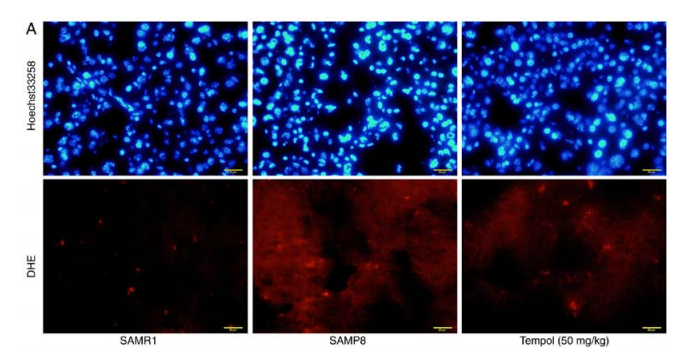


Figure 4. Effect of Rg1 treatment on ROS production in the liver of SAMP8 mice. (A) Accumulation of ROS production in the liver was measured via DHE fluorescence and Hoechst 33258 staining (Scale bar, 20 µm; Magnification, x400). (B) Mean density of ROS production (red fluorescence) in the liver. Data are presented as the mean ± SD; n=3. **P<0.01 vs. SAMR1; ##P<0.01 vs. SAMP8. Rg1, Cistanche glycoside Rg1; SAMP8, senescence‑accelerated mouse prone 8; SAMR1, senescence‑accelerated resistant mouse 1; DHE, dichloroethylene.
Rg1 treatment downregulates the expression levels of NLRP3,ASC, caspase‑1 and IL‑1β in the liver of SAMP8 mice. It has been reported that activation of the NLRP3 inflammasome plays an important role in senescence‑related renal fibrosis (42). Therefore, the present study further investigated the expression levels of NLRP3‑related proteins to confirm whether the NLRP3 inflammasome is involved in age‑related liver fibrosis.The results showed that the expression levels of NLRP3,ASC, caspase‑1 and IL‑1β in liver tissues were significantly upregulated in the SAMP8 group compared with the SAMR1 group (Fig. 6A‑E). Compared with the SAMP8 group, the tempol, apocynin and Rg1 (5 and 10 mg/kg) treatment groups had significantly downregulated expression levels of NLRP3, ASC, caspase‑1 and IL‑1β in the liver tissues of SAMP8 mice (Fig. 6A‑E). Immunohistochemical staining was performed to measure the expression levels of NLRP3 in liver tissues. The results were consistent with the expression of NLRP3 measured using western blotting. The expression of NLRP3 was significantly upregulated in the liver of the SAMP8 group compared with the SAMR1 group (Fig. 7A and B), and tempol, apocynin and Rg1 (5 and 10 mg/kg) treatment significantly downregulated the expression levels of NLRP3 (Fig. 7A and B). These results suggested that NLRP3 inflammasome activation may be closely related to liver fibrosis during aging and Rg1 may improve liver fibrosis by inhibiting the activation of the NLRP3 inflammasome.To further investigate whether the inflammatory response was involved in liver fibrosis during aging, the expression levels of NF‑κB and p‑NF‑κB were measured in liver tissues using western blotting. The results revealed that there were no significant differences in the expression levels of NF‑κB among the groups (Fig. 8A and B). However, the expression levels of p‑NF‑κB were significantly increased in the SAMP8 group compared with the SAMR1 group (Fig. 8A and C), and tempol, apocynin and Rg1 (5 and 10 mg/kg) treatment significantly downregulated the expression level of p‑NF‑κB/NF‑κB compared with the SAMP8 group (Fig. 8A and C). The results suggested that Rg1 may inhibit inflammation in the liver during aging by decreasing the phosphorylation of NF‑κB.


Figure 7. Effects of Rg1 treatment on the expression levels of NLRP3 in the liver of SAMP8 mice. (A) Expression of NLRP3 in the liver (Scale bar, 50 µm; Magnification, x400). (B) Mean density of the NLRP3‑positive staining area in the liver. Data are presented as the mean ± SD; n=4. **P<0.01 vs. SAMR1;#P<0.05, ##P<0.01 vs. SAMP8. Rg1, Cistanche glycoside Rg1; SAMP8, senescence‑accelerated mouse prone 8; SAMR1, senescence‑accelerated resistant mouse 1;NLRP3, NLR family pyrin domain containing 3.
Aging can promote the dysfunction of numerous organs,such as the liver, kidney and brain (43). Aging has been demonstrated to increase the susceptibility to hepatic inflammation or fibrosis (5). Liver fibrosis destroys the structure of the liver, leading to the loss of liver cells and disruption of liver function, ultimately resulting in liver failure (44). However, the mechanisms of aging‑induced liver injury and fibrosis are still unclear and there are no effective drugs for treating aging‑related liver fibrosis. Therefore, it is important to explore the mechanism of liver aging and find appropriate medicines to prevent liver injury and fibrosis at an early age to reduce the incidence of age‑related liver diseases.

Cistanche Anti-aging Supplements For Sale

Rg1, one of the main active components of cistanche, has been previously investigated for its anti‑inflammatory and antioxidant properties and has been found to exert a protective effect on the liver (45). Previous studies have shown that Rg1 could inhibit the transformation of hepatic stellate cells into myofibroblasts and inhibit liver fibrosis in CCl 4‑induced mice (45,46). Our previous study indicated that Rg1 ( 5 and 10 mg/kg) treatment significantly improved aging‑induced renal injury and fibrosis in SAMP8 mice (35). The present study was designed to study the effect and mechanism of Rg1 (5 and 10 mg/kg) treatment on aging‑related liver injury and fibrosis in SAMP8 mice during aging. The results indicated that Rg1 (5 and 10 mg/kg) treatment could protect against aging‑induced liver injury and fibrosis, especially the Rg1 (10 mg/kg) group. These results also discovered that the arrangement of hepatocytes was abnormal and disordered and most of the cells appeared to have vacuole‑like degeneration in the SAMP8 group, while Rg1 treatment showed a significant improvement in liver histopathology. In addition, the results discovered that NOX4/NLRP3 inflammasome signaling, which is closely associated with age‑related liver injury and liver fibrosis (20), was significantly inhibited by Rg1 (5 and 10 mg/kg) treatment, especially in the Rg1 (10 mg/kg) group. These results suggested that Rg1 treatment may be effective in preventing aged‑related injury and fibrosis in a dose‑dependent manner, possibly by inhibiting NOX4 and the NLRP3 inflammasome.

Previous studies have shown that aging is an important factor that is closely associated with the generation and progression of liver fibrosis (5,47); however, there is currently a lack of effective therapeutic options. cistanche is one of the most widely used natural products, due to its wide range of pharmacological effects and biological activities that can delay aging (48). The active ingredient, Rg1, has been reported to exert protective effects on TGF‑β‑induced HSC‑T6 cells and CCl 4‑induced liver fibrosis in male Kunming mice (31). In the present study,the results indicated that the liver tissues were significantly damaged and showed signs of fibrosis in 8‑month‑old SMP8 mice, such as disordered cell arrangement, vacuolar degeneration and excess extracellular collagen IV deposition, sharing a number of similarities with the findings of Dumeus et al (49).

Notably, Rg1 treatment for 9 weeks was found to significantly attenuate liver injury and extracellular matrix accumulation in SAMP8 mice. It was previously shown that TGF‑β1 promoted liver fibrosis through Smad2 phosphorylation (p‑Smad2) and collagen synthesis, and depleting TGF‑β1 could reduce liver fibrosis (50). In the present study, the results demonstrated that Rg1 treatment significantly decreased the expression of TGF‑β1 in the liver of SAMP8 mice. Tempol is an active oxygen scavenger, which has been reported to reduce the production of ROS in H 2O2‑treated hippocampal neurons due to its ROS scavenging capacity (51). Apocynin is often used as an inhibitor of NADPH oxidase, and it has been shown to possess a clear and obvious antioxidant effect on a variety of central nervous system diseases, including Parkinson's disease and Alzheimer's disease (52‑54).
The current study also demonstrated that tempol and apocynin exerted similar protective effects on aging‑induced liver injury. These data suggested that Rg1 treatment may significantly protect against aging‑induced liver injury and fibrosis in elderly mice.

These results are consistent with previous studies (35), and provide further support for the role of the NLRP3 inflammasome in the occurrence of aging‑related liver injury in SAMP8 mice (78). The improvement of inflammation and inhibition of NLRP3 inflammasome activation have been observed to exert protective effects on target organs (76).

Similarly, the present study found that treatment with tempol, apocynin and Rg1 significantly downregulated the expression levels of IL‑1β, ASC, caspase‑1 and NLRP3 in the liver tissues of SAMP8 mice. It is well known that theNF‑κB transcription factor family is a central regulator of the inflammatory process (79). Phosphorylation of NF‑κB at serine 536 is thought to be required for NF‑κB activation and nuclear translocation (80). It has been reported that selective inhibition of NF‑κB activity can suppress CCl4‑induced liver fibrosis (81). In this study, the results revealed that the expression of p‑NF‑κB, which promotes the formation of the NLRP3 inflammasome, was significantly upregulated in the liver tissues of aging mice and was significantly decreased after Rg1 treatment for 9 weeks in SAMP8 mice.
Altogether, these findings indicated that the NLRP3 inflammasome may be an important target and is closely involved in aging‑induced liver injury. Furthermore, inhibition of the NLRP3 inflammasome may be an important underlying mechanism of Rg1 in preventing aging‑related liver injury and fibrosis.
However, the current study has several limitations. For example, it only provided animal experimental results demonstrating that Rg1 ameliorated aging‑related liver fibrosis ue to the inhibition of NOX4 and NLRP3 inflammasome activation in SAMP8 mice. In addition, the biochemical indicators and serological indicators that represent liver function, inflammation and oxidative stress levels were not measured.
Future research will aim to further study the effect of Rg1 treatment on aging‑induced liver function, inflammation and oxidative stress‑related indicators in the serum, such as aspartate aminotransferase, alanine transaminase, IL‑1β and superoxide dismutase. Furthermore, NOX4 inhibitors or NOX4 knockout experiments will be performed to further investigate the exact underlying protective mechanism of Rg1 against liver injury in vitro and in vivo.
Acknowledgments

Funding
References
1. Stahl EC, Haschak MI, Popovic B, and Brown BN: Macrophages in the aging liver and age-related liver disease. Front Immunol 9.2795 2018.
2.Tominaga K and Suzuki Hl: TGF-B signaling in cellular senescence and aging-related pathology. Int J Mol Sci 20: 5002, 2019.
3. Iwasaki K.Brenner DA and Kisseleva T: What's new in liver fibrosis? The origin of myofibroblasts in liver fibrosis.I Gastroenterol Hepatol 27 (Suppl 2): S65-S68 2012.Aydin MM and Akcal KC: Liver fibrosis. Turk J Gastroenterol 2914-21.2018.
4.Kim IH, Xu J, Liu X, Koyama Y, Ma HY, Diggle K, You YH.5Schilling JM, Jeste D, Sharma K , et ak Aging increases the susceptibility of hepatic inflammation, liver fibrosis and aging in response to a high-fat diet in mice. Age (Dordr) 38: 291-302, 2016
.6. Stefanatos R and Sanz A: The role of mitochondrial ROS in the aging brain. FEBS Lett 592: 743-758. 2018.
7. Davalli P Mitic T, Caporali A, Lauriola A and DArca D: ROScell senescence, and novel molecular mechanisms in aging and age-related diseases. Oxid Med Cell Longev 2016: 3565127, 2016.Kudryavtseva AV Krasnov GS.Dmitriev AA. Alekseev BYKardymon OL, Sadritdinova AF Fedorova MS, Pokrovsky AVMelnikova NV, Kaprin AD, et al: Mitochondrial dysfunction and oxidative stress in aging and cancer. Oncotarget 7: 44879-449052016.Luangmonkong T, Suriguga S, Mutsaers HAM, Groothuis GMMOlinga P, and Boersema M: Targeting oxidative stress for the treatment of liver fibrosis. Rev Physiol Biochem Pharmacol 17571-102,2018.