Cistanche Phenylethanoid Glycosides: Why They Work So Well In The Lab — And How Delivery Systems Are Fixing Their Biggest Flaw
Nov 20, 2026
Cistanche has earned its nickname "desert ginseng" over centuries of use. Modern science has now identified the main reason for its reputation: a family of compounds called phenylethanoid glycosides, or PhGs. They are powerful, versatile, and increasingly well understood. But they have one serious weakness - the body barely absorbs them.
This article explains what PhGs are, what they do, why their low bioavailability has held them back, and how modern delivery systems are finally solving the problem. Whether you are a formulator, a buyer, or simply curious about how herbal ingredients really work inside the body, this is the missing piece of the Cistanche story.
What Is Cistanche, and Why Is Everyone Talking About It?
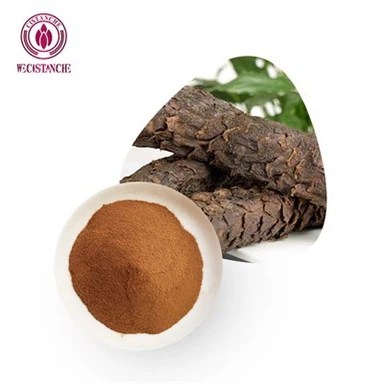
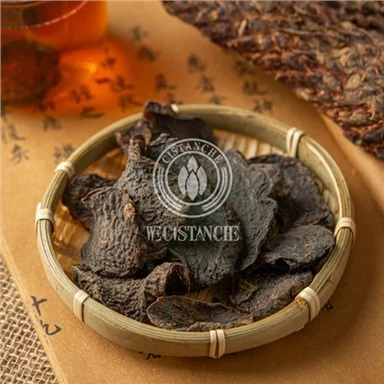
Cistanche is a parasitic plant that grows in some of the harshest desert and saline environments on Earth. It attaches to the roots of host plants and survives where few other living things can. In traditional herbal practice, its fleshy stem has long been used as a tonic, particularly for vitality, reproductive health, and healthy aging.
Several species are used, but the most studied are Cistanche deserticola and Cistanche tubulosa. They have been recorded in classical herbal texts for well over a thousand years, and their reputation in East Asian medicine is substantial.
In 2023, Cistanche deserticola was formally added to China's list of substances approved for both food and medicinal use. That regulatory step matters because it expanded Cistanche beyond traditional medicine into the mainstream food and supplement market. Today, Cistanche is increasingly found in functional foods, dietary supplements, and personal-care products around the world.
The Active Ingredients: Phenylethanoid Glycosides (PhGs)
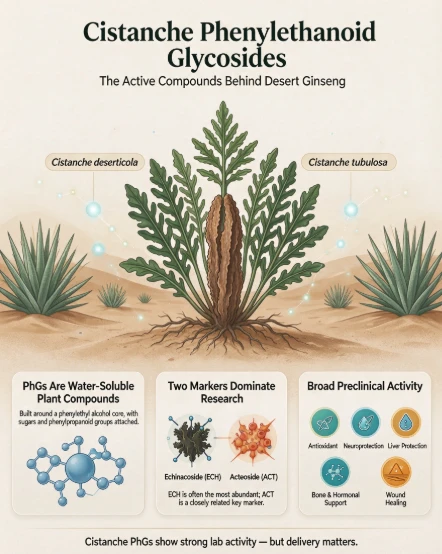
When researchers ask what makes Cistanche work, the answer usually comes back to a specific group of molecules: phenylethanoid glycosides, commonly shortened to PhGs.
PhGs are natural, water-soluble compounds built around a phenylethyl alcohol core, decorated with sugars and other chemical groups. They are not unique to Cistanche - they appear in many plants - but Cistanche is remarkable for how rich and varied its PhG content is.
The structure of a typical PhG has four main building blocks:
A phenylethyl alcohol "head" (the aglycone)
A central glucose sugar
A rhamnose sugar
A phenylpropanoid unit, such as a caffeoyl group
Different combinations and decorations of these building blocks produce an enormous family of related molecules. Across the plant kingdom, scientists have identified close to 500 different PhGs. In Cistanche alone, more than 55 distinct PhG structures have been characterized.
The Two Big Names: Echinacoside and Acteoside
Within this large family, two compounds dominate Cistanche and drive most of the research interest:
Echinacoside (ECH) - the most abundant PhG in many Cistanche species
Acteoside (ACT) - also known as verbascoside, and the second key marker compound
These two molecules are closely related. In fact, they share so much of their structure that the relationship between them is central to understanding Cistanche chemistry. Echinacoside is essentially acteoside with an extra sugar unit attached. When echinacoside loses that sugar - through enzymatic action or digestion - it becomes acteoside.
This structural relationship is not just chemistry trivia. It turns out to be deeply relevant to how these compounds behave in the human body, as we will see later.
Both compounds are now used as official quality-control markers. The 2025 edition of the Chinese Pharmacopoeia lists echinacoside and acteoside as the reference compounds for assessing Cistanche quality. In some Cistanche material, echinacoside can reach as high as 3% by weight - a meaningful concentration for a natural product.
What PhGs Can Do: The Health Promise
The reason PhGs attract so much attention is that they show a remarkably broad range of biological activities. Much of the evidence comes from laboratory and animal studies, but the pattern is consistent enough to be genuinely compelling.
Antioxidant Action
PhGs are strong antioxidants. They can directly neutralize harmful free radicals and, just as importantly, they can activate the body's own antioxidant defenses. Studies show they boost the activity of natural protective enzymes such as superoxide dismutase (SOD) and glutathione peroxidase, often through a master regulator called Nrf2. This dual approach - direct scavenging plus activating the body's own systems - is one reason PhGs are seen as a meaningful antioxidant ingredient.
Oxidative stress is a common underlying factor in aging and many chronic diseases, so antioxidant activity is not just a marketing term here; it connects to the deeper mechanisms of how PhGs may help.
Neuroprotection and Brain Health
One of the most active areas of PhG research concerns the brain. Neuroinflammation and oxidative damage are central to conditions like Alzheimer's disease, Parkinson's disease, and stroke-related injury. PhGs have been shown in multiple models to reduce neuroinflammation, protect neurons, and support the cholinergic system involved in memory and cognition.
For example, echinacoside has been reported to improve memory and reduce amyloid deposition in Alzheimer's disease models. Acteoside has shown anti-inflammatory effects in brain cell models. These findings have made Cistanche one of the most studied traditional herbs for cognitive and neurological support.
Anticancer Potential
PhGs have also demonstrated anticancer activity in laboratory studies. They appear to work through several mechanisms, including stopping cancer cell division, triggering programmed cell death (apoptosis), and blocking pathways that allow tumors to grow and spread.
Echinacoside, in particular, has been tested against liver, breast, colorectal, and ovarian cancer cell lines with promising results. Acteoside has shown selective activity against certain cancer cells as well. It is important to emphasize that this is early-stage research - these are cell and animal studies, not human clinical trials - but the direction is encouraging.
Liver Protection
The liver is the body's central metabolic organ, and it is highly vulnerable to oxidative and chemical damage. Echinacoside has shown protective effects in multiple models of liver injury, helping to reduce oxidative stress markers and inflammatory signals while preserving liver function. This has positioned Cistanche PhGs as a potential hepatoprotective ingredient.
Bone Health and Hormonal Balance
Research on bone health has produced some intriguing findings. In animal models of postmenopausal osteoporosis, echinacoside improved bone density and bone structure, with effects reported to be stronger than a commonly used comparison compound. The mechanism may involve an estrogen-like action, which fits with Cistanche's traditional use for hormonal and reproductive wellness.
Wound Healing and More
PhGs have also been linked to wound healing, heart protection against ischemic injury, and support for male reproductive function. The breadth of these activities is unusual for a single family of plant compounds.
The Hidden Flaw: Low Bioavailability
Given this impressive list, you might expect PhGs to be widely used. But there is a catch, and it is a big one.
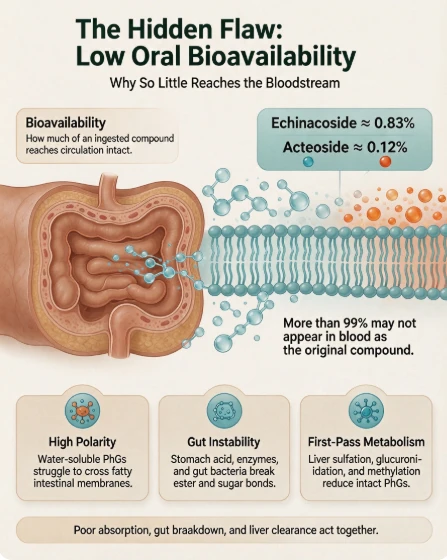
Bioavailability is the measure of how much of an ingested compound actually reaches the bloodstream and can be used by the body. For many nutrients and drugs, bioavailability is reasonably high. For PhGs, it is remarkably low.
When echinacoside was given orally to rats, its absolute bioavailability was measured at only about 0.83%. Acteoside fared even worse, at roughly 0.12%. In plain terms, more than 99% of what you swallow never reaches your circulation as the original compound.
This is a classic problem in natural-product research. Many plant compounds show beautiful activity in a test tube but perform poorly in the body because they are destroyed, poorly absorbed, or rapidly cleared before they can do their work. PhGs are a textbook example.
Why PhGs Are So Hard to Absorb
Three main factors explain the poor absorption of PhGs.
High Polarity
PhGs are water-soluble and highly polar molecules. While this makes them easy to dissolve in water, it also makes them hard to cross cell membranes, which are largely made of fat. A molecule that loves water but dislikes fat has trouble slipping through the fatty wall of the intestine. As a result, PhGs rely mainly on slow, passive diffusion rather than efficient active transport.
Laboratory measurements put the intestinal permeability of these compounds in a range typically classified as "poorly absorbed." Echinacoside's maximum permeability in one intestinal model was only about 3.23 × 10⁻⁶ cm/s - far below the threshold for a well-absorbed compound.
Rapid Breakdown in the Gut
PhGs are not particularly stable in the digestive tract. Their chemical structure contains bonds - ester bonds and sugar linkages - that are easily broken. Stomach acid, digestive enzymes, and especially the bacteria of the gut microbiome all work to dismantle these molecules before they can be absorbed.
In practical terms, a large fraction of an oral dose of PhGs is chemically "shredded" in the gut into smaller pieces, many of which are then simply excreted.
Extensive First-Pass Metabolism
Even the portion that does get absorbed faces another hurdle: the liver. Everything absorbed from the intestine passes through the liver first, in a process called the "first-pass effect." The liver is extremely efficient at chemically modifying foreign molecules to prepare them for excretion. For PhGs, this means extensive reactions like sulfation, glucuronidation, and methylation - changes that deactivate and clear the original compound.
The combination of poor absorption, gut breakdown, and liver metabolism means that very little intact PhG survives the journey.
What Actually Happens After You Swallow PhGs
The fate of PhGs in the body has been mapped in detail through pharmacokinetic studies. The picture is fascinating, and it changes how we should think about these compounds.
The Metabolic Pathway
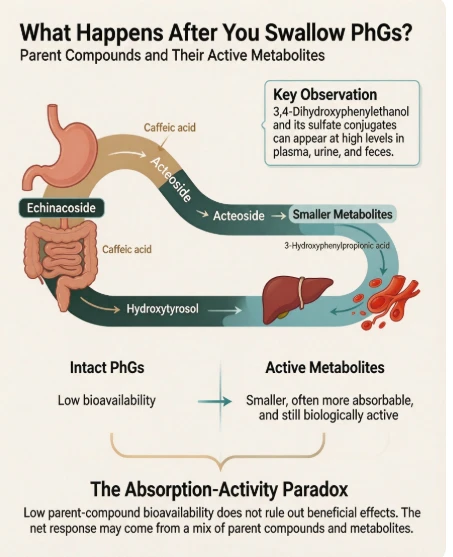
When echinacoside enters the digestive system, it does not stay intact for long. It is progressively broken down through hydrolysis:
First, echinacoside loses a sugar unit and becomes acteoside
Then acteoside is further broken down into smaller pieces, including caffeic acid, hydroxytyrosol, and 3-hydroxyphenylpropionic acid
Studies incubating echinacoside and acteoside with human gut bacteria found exactly these breakdown products. In rats, oral echinacoside produced a series of hydrolysis products detected in feces, confirming that a substantial portion is metabolized in the gut rather than absorbed intact.
Acteoside itself, when absorbed, is rapidly processed by the liver through sulfation, glucuronidation, oxidation, and methylation. One study identified as many as 35 different metabolites after oral acteoside administration.
The Key Metabolite: 3,4-Dihydroxyphenylethanol
One finding stands out. Among all the breakdown products, 3,4-dihydroxyphenylethanol (and its sulfate conjugates) appears in the highest concentrations in plasma, urine, and feces. This is important because this small molecule is believed to retain much of the antioxidant activity of the original compound.
In other words, the health effects of Cistanche PhGs may not come primarily from the intact PhGs themselves, but from their active metabolites. This "absorption-activity paradox" is common in natural product science: a compound can be poorly absorbed yet still exert effects through its breakdown products.
The Absorption-Activity Paradox, Explained
This is a crucial concept for anyone buying or selling Cistanche products.
On one hand, intact PhGs have extremely low bioavailability. On the other hand, the health benefits associated with Cistanche are real and reproducible in many studies. How can both be true?
The answer is that the story does not end with the intact molecule. When PhGs are broken down in the gut, they produce a pool of smaller active compounds - like hydroxytyrosol and caffeic acid - that are themselves biologically active and may be better absorbed than the parent molecule.
So the "low bioavailability" of the parent PhG is not the whole story. The net biological effect depends on the combination of the intact compound and its metabolites. This insight is central to understanding - and improving - Cistanche products.
The Solution: Delivery Systems
If you cannot easily change the molecule, you can change how it is delivered. This is the logic behind delivery systems, and it is the most active frontier in PhG research today.
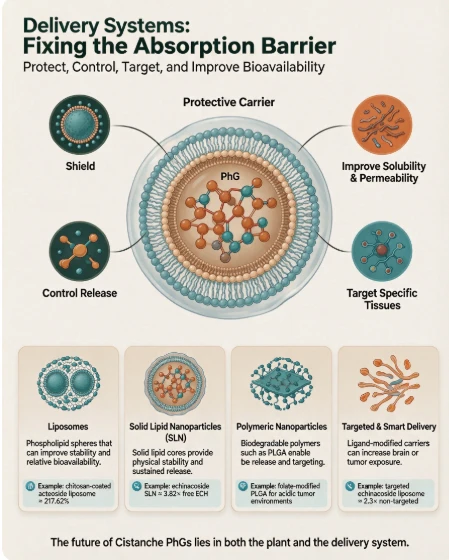
A delivery system is essentially a protective package that carries an active compound through the digestive tract and releases it where and when it is needed. The goals are simple to state:
Protect the compound from stomach acid, enzymes, and gut bacteria
Improve its solubility and ability to cross membranes
Control when and where it is released
Target specific tissues, such as the brain or a tumor
By wrapping PhGs in tiny carriers, researchers have been able to dramatically improve their stability and, in many cases, their bioavailability. Let's look at the main types.
Liposomes
Liposomes are microscopic spheres made from phospholipids - the same material that makes up cell membranes. This gives them two useful properties at once: a water-loving interior that can hold water-soluble compounds like PhGs, and a fat-loving outer layer that helps them merge with cell membranes.
Because they are biocompatible and can be absorbed more easily, liposomes have been widely used to deliver PhGs. Research results include:
An acteoside liposome about 120 nanometers in size, which significantly improved the stability of acteoside and prolonged its pain-relieving effect in a nerve-injury model
A chitosan-coated acteoside liposome that achieved a relative bioavailability of 217.62% - more than double the unencapsulated compound - while also improving storage stability
An echinacoside liposome modified with a targeting peptide, designed to cross the blood-brain barrier and deliver more echinacoside into the brain
Liposomes are a mature, well-understood technology, and they are a natural first choice for improving PhG delivery. Their main limitations are relatively low encapsulation efficiency, challenges in controlling release rate, and sensitivity during storage.
Solid Lipid Nanoparticles (SLN)
Solid lipid nanoparticles take the liposome concept a step further. Instead of a liquid lipid interior, they use a solid lipid core. This gives them greater physical stability and can provide more controlled, sustained release.
For echinacoside, SLN formulations have produced encouraging results. One formulation achieved a particle size of about 53 nanometers with an encapsulation efficiency of 55.5%. Another reached 80% encapsulation and showed sustained release over 36 hours, with a relative bioavailability improved to 3.82 times that of free echinacoside.
SLNs have also been explored for eye delivery, where they successfully transported echinacoside into eye cells - a demonstration of their versatility.
Polymeric Nanoparticles
Another major category uses synthetic or natural polymers to build the carrier. The most common is PLGA, a biodegradable polymer widely used in medicine.
PLGA nanoparticles loaded with echinacoside have been made in sizes around 90–100 nanometers, with the ability to release their cargo gradually over time. By adding targeting molecules to the surface - such as folic acid, which many cancer cells overexpress - researchers can direct the nanoparticles toward specific tissues.
One folate-modified echinacoside PLGA nanoparticle showed pH-responsive release: it released more of its cargo in acidic conditions typical of tumor environments, and its anticancer effect was reported to be about 2.1 times stronger than free echinacoside.
Targeted and Smart Delivery
The most advanced systems go beyond simple protection to active targeting. Some examples from the research:
Brain targeting: By attaching specific peptides or ligands, researchers have built PhG carriers that bind to receptors on the blood-brain barrier and are transported into the brain. One echinacoside liposome system achieved brain concentrations 2.3 times higher than a non-targeted version.
Nose-to-brain delivery: Some formulations are designed for intranasal administration, taking advantage of the direct pathway from the nasal cavity to the brain, bypassing the blood-brain barrier.
Tumor targeting: Carriers decorated with folic acid or other ligands can accumulate preferentially in tumors.
This is where delivery science gets genuinely exciting: instead of flooding the whole body with a compound, you can send it where it is needed.
Beyond Classic Carriers: The Next Generation
The delivery field is moving fast, and researchers are exploring newer approaches that go beyond liposomes and standard nanoparticles.
Nanofibers and Cyclodextrins
One strategy embeds the active compound in polymer nanofibers. Cyclodextrins - ring-shaped sugar molecules - can act as molecular "hosts" that hold a guest compound inside their cavity, protecting it and improving solubility. These cyclodextrin complexes can then be incorporated into fibers or other matrices for controlled release.
Inorganic Carriers
Inorganic materials, such as mesoporous silica and metal-based nanoparticles, offer another route. Mesoporous silica has a highly ordered pore structure that can be loaded with active compounds and released slowly. One echinacoside system combined gold nanoparticles with mesoporous silica, achieving a small size and targeted delivery to brain tissue in an Alzheimer's model.
Polyphenol-Based Systems
Perhaps the most elegant development is the realization that PhGs themselves - being polyphenols - can serve as building blocks for delivery systems, not just as cargo.
Polyphenols have hydroxyl groups that can form hydrogen bonds and aromatic rings that provide hydrophobic character. This dual nature lets them bind to proteins, metal ions, polymers, and nucleic acids to form stable, functional complexes. In other words, the same chemistry that makes PhGs active can also make them into carriers - for themselves or for other ingredients.
Metal-polyphenol networks, in particular, are an emerging area. By coordinating polyphenols with metal ions like zinc, researchers can build self-assembled nanostructures with useful properties for drug delivery.
Safety: What the Data Shows
Whenever new delivery technologies are discussed, safety is a legitimate concern. The good news from the research so far is reassuring.
Acute toxicity testing of Cistanche PhG extracts has shown a very favorable safety profile. In one study, mice were given PhG extracts continuously for 14 days with no deaths, and the maximum tolerated dose reached 119.46 grams per kilogram - a dose equivalent to about 882 times the typical human dose. This suggests that PhGs themselves have low acute toxicity.
Delivery systems built from food-grade or biocompatible materials have also performed well in preliminary safety testing. A PhG nanoemulsion showed no toxicity within the tested dose range, and intranasal administration caused no notable damage to nasal tissue or major organs.
That said, the authors of the review are appropriately cautious. They note that the long-term, in-body safety of many delivery systems has not yet been fully evaluated, and that the transport mechanisms of these carriers through the intestine need more study. These are normal, healthy caveats for an emerging field.
What This Means for Buyers and Formulators
If you are sourcing Cistanche ingredients or building products with them, this research has practical implications.
Understand the bioavailability story. A Cistanche extract that looks great on paper may deliver very little intact PhG to the bloodstream. This is not a reason to dismiss Cistanche - the metabolites matter too - but it is a reason to be thoughtful about formulation.
Ask about standardization. Quality Cistanche ingredients are standardized to echinacoside and/or acteoside content. Know which marker your product relies on, and verify it with a Certificate of Analysis.
Consider enhanced formulations. If your product promises meaningful PhG delivery, a liposomal or nanoparticle-enhanced formulation may offer a real advantage. Look for suppliers who can provide data on particle size, encapsulation efficiency, and ideally bioavailability improvement.
Be honest in marketing. The benefits of PhGs are well documented in preclinical research, but human clinical data is still limited. Claims should be measured and compliant, especially in regulated markets.
The Road Ahead
The review article points to several directions for future work, and they are worth understanding if you follow this space.
First, there is a need for standardized evaluation methods. Different studies currently use different models and different measurements, which makes results hard to compare. More consistency would accelerate progress.
Second, long-term safety of delivery systems needs more attention. Early data are positive, but thorough safety evaluation is essential for consumer products.
Third, targeting precision can still be improved. While targeted systems have shown clear benefits, getting the active compound to exactly the right place at exactly the right time remains an engineering challenge.
Finally, the insight that PhGs can be both cargo and carrier opens a new avenue: using polyphenols themselves to build next-generation delivery platforms.
Frequently Asked Questions
What are phenylethanoid glycosides?
Phenylethanoid glycosides (PhGs) are water-soluble plant compounds built around a phenylethyl alcohol core with attached sugars and other groups. They are the main active components of Cistanche. The two most important are echinacoside and acteoside.
Why is Cistanche PhG bioavailability so low?
Three main reasons: PhGs are highly polar and poorly absorbed across the gut wall, they are rapidly broken down by stomach acid, enzymes, and gut bacteria, and what is absorbed undergoes extensive first-pass metabolism in the liver.
If PhGs are poorly absorbed, how do they work?
Their health effects appear to come partly from their active breakdown products. For example, echinacoside is broken down to acteoside and then to smaller compounds like caffeic acid and hydroxytyrosol, which themselves have biological activity.
What are delivery systems, and why do they help?
Delivery systems wrap the active compound in a protective carrier - such as a liposome or nanoparticle - to shield it from degradation, improve absorption, control release, and sometimes target specific tissues. This can substantially improve bioavailability.
What is the difference between echinacoside and acteoside?
They are closely related PhGs. Echinacoside has one more sugar unit than acteoside. When echinacoside loses that sugar, it becomes acteoside. This conversion happens naturally during digestion and can also be done with enzymes.
Is Cistanche safe?
Research indicates low acute toxicity, with animal studies showing very high tolerated doses. However, human clinical safety data for high-dose or long-term use, and for novel delivery systems, is still limited. Always consult a healthcare professional before use.
Conclusion

Cistanche phenylethanoid glycosides sit at an interesting crossroads. On one side, they are among the most promising natural compounds for antioxidant, neuroprotective, liver, and metabolic support. On the other side, their poor oral bioavailability has long limited their practical usefulness.
The delivery-system revolution is changing that. Liposomes, solid lipid nanoparticles, polymeric carriers, and next-generation polyphenol-based systems are steadily overcoming the absorption barrier, turning a fundamental weakness into an engineering challenge with increasingly elegant solutions.
For anyone working with Cistanche, the takeaway is clear: the future of this ingredient is not just in the plant - it is in how we package it.
Disclaimer: This article is for educational and informational purposes only. These statements have not been evaluated by the U.S. Food and Drug Administration. This product is not intended to diagnose, treat, cure, or prevent any disease. Always consult a qualified healthcare professional before using any dietary supplement.