Verbascoside In Cistanche Tubulosa: How Enzyme Technology Unlocks A Rare, High-Value Bioactive Compound
Nov 20, 2026
Cistanche tubulosa has been used for centuries as a prized tonic herb, but most of the attention has always gone to one molecule: echinacoside. Meanwhile, a closely related compound called verbascoside - arguably even more interesting for health - sits quietly in the background, present only in tiny amounts.
This article explains what verbascoside is, why it is so difficult to obtain in meaningful quantities, and how a modern enzymatic conversion method can transform the abundant echinacoside in Cistanche tubulosa directly into verbascoside. If you buy, formulate, or sell Cistanche extracts, this is the technology quietly changing how high-purity verbascoside is made.
What Is Cistanche tubulosa?
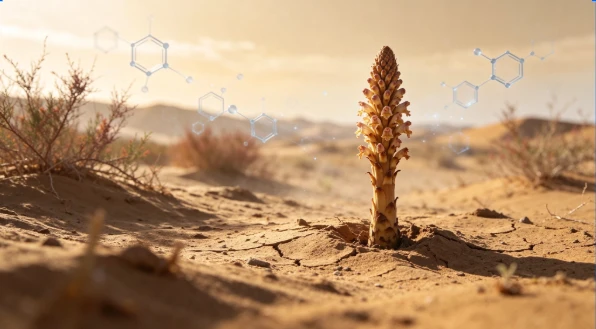
Cistanche tubulosa is a parasitic desert plant in the Orobanchaceae family. Unlike regular plants that grow in ordinary soil, it attaches itself to the roots of host plants and draws water and nutrients from them. This unusual lifestyle has made it a survivor of some of the harshest, driest environments on Earth.
In traditional herbal medicine, the fleshy stem of Cistanche is the part used. It has long been valued as a tonic, particularly for supporting vitality, healthy aging, and reproductive wellness. Because of its reputation and relative rarity, it is sometimes referred to in popular writing as "desert ginseng."
Two species are officially recognized in pharmacopoeia standards: Cistanche deserticola and Cistanche tubulosa. In recent years, Cistanche tubulosa has become increasingly important to the supplement industry because it is more widely cultivated and because its profile of active compounds is especially rich in a group of molecules known as phenylethanoid glycosides.
The Real Stars: Phenylethanoid Glycosides (PhGs)
When scientists talk about "the active ingredients" in Cistanche, they are usually talking about phenylethanoid glycosides, often abbreviated as PhGs. These are water-soluble plant compounds built around a phenylethyl alcohol core, decorated with sugar units.
PhGs are not unique to Cistanche - they appear in many plants, including olive leaves, lemon verbena, and plantain - but Cistanche is remarkable for how concentrated they are. In Cistanche tubulosa, two members of this family dominate:
Echinacoside - the most abundant PhG in the plant
Verbascoside - a closely related PhG present at much lower levels
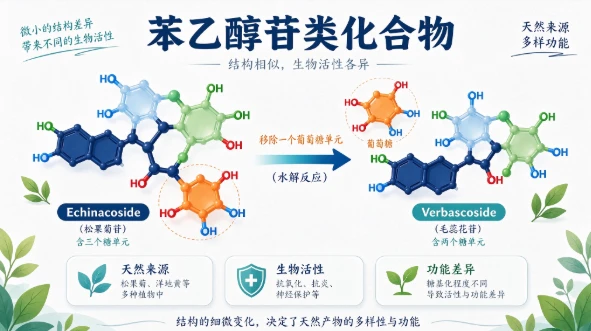
Both share a similar molecular backbone. The key difference is simple but important: echinacoside carries an extra sugar unit compared with verbascoside. Chemically, this means verbascoside is essentially echinacoside with one glucose molecule removed.
That small difference matters more than it might seem. It changes how much of the compound is present in the plant, how it behaves in the body, and how difficult it is to produce in pure form.
Echinacoside vs. Verbascoside: One Family, Two Very Different Stories
If you look at a typical high-quality Cistanche tubulosa extract, the analytical report will usually show a striking imbalance. Echinacoside might account for a large share of the total active content, while verbascoside appears only as a minor component.
A representative extract can contain roughly 38% echinacoside but only about 1.9% verbascoside. In other words, for every part of verbascoside, there may be twenty times more echinacoside.
This imbalance has a practical consequence. For years, manufacturers and researchers focused almost entirely on extracting and concentrating echinacoside, simply because it was the compound they had in abundance. Verbascoside, despite its attractive properties, was left largely unexplored - not because it was less valuable, but because it was hard to get enough of it.
Why Verbascoside Is Worth the Effort
So why go to the trouble of producing verbascoside at all? The short answer is that verbascoside has one of the most interesting activity profiles among the Cistanche PhGs. Research has linked it to several areas of health support.
Antioxidant Support
Verbascoside is a strong scavenger of free radicals. In experimental models, it has been shown to help protect cells from oxidative damage. Oxidative stress is a broad term for the imbalance between harmful free radicals and the body's defenses, and it is associated with aging and many chronic conditions. Compounds that can neutralize excess free radicals are therefore of wide interest.
Anti-Inflammatory Activity
Several studies have investigated verbascoside's ability to moderate inflammatory responses. Inflammation is a normal and necessary defense mechanism, but when it becomes chronic or excessive, it can contribute to tissue damage. Verbascoside has been studied for its potential to help calm these overactive inflammatory signals, particularly in the gut.
Blood Sugar and Blood Lipid Regulation
Some of the most cited research on verbascoside comes from animal studies on metabolism. In diabetic mouse models, verbascoside-containing preparations have been associated with improvements in blood glucose and blood lipid levels. While these are early-stage findings, they point toward a role in metabolic health.
Support for Male Health
Traditional use of Cistanche has long emphasized male reproductive wellness. Interestingly, verbascoside has been identified in research as one of the components with androgen-like activity, meaning it appears to interact with pathways involved in male hormone function. This aligns with the traditional reputation of Cistanche as a herb for men's health.
Neuroprotective Potential
The broader PhG family, including verbascoside, has also drawn attention in neurological research. Early studies have explored whether these compounds may help protect nerve cells, with potential relevance to conditions of cognitive decline and neurodegeneration. This area is still developing, but it adds to the scientific interest in verbascoside.
It is worth noting that most of these findings come from laboratory and animal studies. Human clinical evidence is still limited. Nevertheless, the direction of the research explains why verbascoside is now considered a high-value target ingredient.
The Core Problem: A Valuable Compound Present in Tiny Amounts
The challenge with verbascoside is not that it is useless - it is that it is scarce. In the raw plant, and even in concentrated extracts, verbascoside typically sits in the low single digits as a percentage.
There are only a few ways to get more of it:
Direct extraction and purification. This works, but because the starting concentration is so low, the yield is small and the process can be inefficient and costly.
Chemical synthesis. Verbascoside can be assembled in a lab, but multi-step synthesis is complex and usually impractical for commercial scale.
Biotransformation. Use an enzyme to convert the abundant echinacoside into verbascoside.
That third option is the breakthrough. Instead of trying to scrape together the tiny amount of verbascoside that already exists, you take the large amount of echinacoside and chemically "trim" it down to verbascoside. Because the two molecules are so similar, this conversion is elegant and efficient.
A Cleaner Approach: Enzymatic Conversion
The idea behind enzymatic conversion is simple: use a biological catalyst to perform one precise chemical change, and nothing else.
In this case, the target change is the removal of one glucose unit from echinacoside. When that single sugar is clipped off, the remaining molecule is verbascoside. This is exactly the kind of job enzymes are good at - specific, controlled, and selective.
To perform this reaction, researchers turned to a group of enzymes called β-glucosidases. As the name suggests, these enzymes specialize in breaking the bond that attaches a glucose molecule to another molecule. Given the right β-glucosidase, the glucose on echinacoside can be cleanly removed.
The result is a conversion process with several advantages over traditional methods:
High specificity - the enzyme targets the desired bond without randomly destroying other valuable components.
Mild conditions - no harsh reagents or toxic solvents are required.
Scalability - enzyme reactions are well suited to industrial batch processing.
Sustainability - the process avoids many of the waste and safety issues of chemical synthesis.
Where the Enzyme Comes From: A Heat-Loving Microbe
Not all β-glucosidases are suitable for this job. The one that proved most effective in this research has an unusual origin: a microorganism called Thermotoga petrophila, a thermophilic bacterium that thrives at extremely high temperatures.
Thermophiles are organisms that live in hot environments, such as geothermal springs. The enzymes they produce have evolved to remain stable and active at temperatures that would destroy ordinary enzymes. This is a crucial property for industrial use.
In the study, the β-glucosidase gene from Thermotoga petrophila was cloned and expressed in a laboratory host organism, allowing the enzyme to be produced in useful quantities. The resulting enzyme is thermostable, meaning it keeps working at elevated temperatures - a feature that turns out to be very practical, as we will see.
How the Conversion Works, Step by Step
The conversion process itself is straightforward to describe, even if the underlying chemistry is sophisticated.
First, you start with either purified echinacoside or, more practically, a Cistanche tubulosa extract that is rich in echinacoside. The material is dissolved in a buffered solution to keep the acidity stable. Then the thermostable β-glucosidase is added. Under the right conditions, the enzyme goes to work, clipping the terminal glucose from echinacoside molecules one by one.
After a few hours, the reaction is stopped, and the liquid now contains a dramatically higher concentration of verbascoside than it did before. The enzyme has essentially "upgraded" the abundant echinacoside into the rarer, more sought-after verbascoside.
Finding the Sweet Spot: Optimizing the Reaction
Enzymes are sensitive to their environment. To get the most efficient conversion, researchers tested four key variables: temperature, pH, enzyme dose, and reaction time. Each one matters, and the optimal combination was identified through careful experimentation.
Temperature: Hot, but Not Too Hot
Enzymes are proteins, and proteins unfold - or "denature" - when they get too hot. Once denatured, an enzyme loses its activity. On the other hand, if the temperature is too low, the reaction proceeds slowly.
For this particular β-glucosidase, the optimal temperature turned out to be 85°C. This is unusually high for an enzyme, which is exactly why the thermostable enzyme from Thermotoga petrophila was chosen. At 85°C, the enzyme worked at its fastest. Below that temperature, activity was lower; above it, the enzyme began to lose stability, and performance dropped off sharply.
pH: The Importance of Acidity
Enzyme activity is also strongly influenced by pH. Too acidic or too alkaline, and the enzyme's structure is disrupted.
The best results were achieved at pH 5.5, a mildly acidic environment. At this pH, the enzyme reached peak activity. When the pH moved above or below 5.5, conversion efficiency fell noticeably. In practice, this means the reaction solution is prepared with a buffer to hold the pH steady at the ideal level.
Enzyme Dose: Enough, but Not Wasteful
Adding more enzyme generally speeds up a reaction - up to a point. The study found that for every gram of echinacoside, 0.2 mL of enzyme solution was the practical optimum.
Below this dose, conversion was incomplete. Above it, the gains became marginal. Using more enzyme than necessary would simply add cost without meaningfully improving the result. Finding this balance is important for commercial production, where enzyme cost is a real consideration.
Reaction Time: Four Hours to Completion
Time is the final variable. The conversion is not instantaneous; the enzyme needs time to process the substrate.
The data showed that conversion rose steadily over the first few hours and reached nearly complete levels at around 4 hours. After four hours, extending the reaction produced only tiny additional gains. So four hours became the standard reaction time - long enough for essentially full conversion, short enough to keep production moving.
The Optimal Recipe, Summarized
Putting all of this together, the researchers established a clear optimal condition:
0.2 mL of enzyme solution per 1 gram of echinacoside
Temperature: 85°C
pH: 5.5
Reaction time: 4 hours
Under these conditions, the hydrolysis rate of echinacoside reached 95.6% - meaning the overwhelming majority of the starting material was successfully converted.
Real-World Results: A Dramatic Jump in Verbascoside Content
The most compelling part of the study is what happened when the enzyme was applied to a real Cistanche tubulosa extract rather than purified echinacoside.
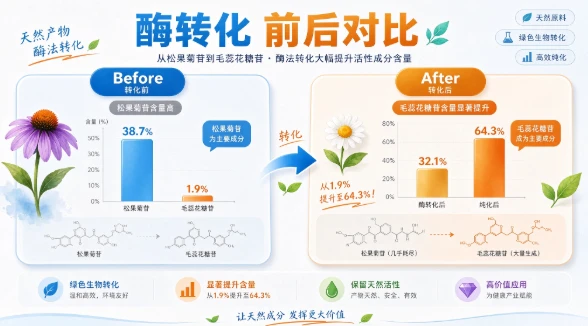
Before treatment, the extract contained about 38.7% echinacoside and only 1.9% verbascoside - the familiar imbalance.
After four hours of enzymatic conversion, the picture was transformed. The echinacoside was almost entirely consumed, and the verbascoside content jumped to about 32.1%. In a single, relatively simple step, the concentration of verbascoside increased more than sixteen-fold.
The process did not stop there. The reaction liquid was then passed through a purification step using a macroporous resin and eluted with ethanol. After concentration and drying, the resulting crude product reached a verbascoside content of 64.3%.
That is a striking outcome: from a starting extract in which verbascoside was barely a trace component, the process produced a material where verbascoside was the dominant ingredient.
Confirming the Result: How Scientists Verify the Product
In any technical process, it is not enough to assume the reaction worked. The product must be identified and measured with confidence. Two analytical techniques were central to this verification.
HPLC: Measuring What Is Actually There
High-performance liquid chromatography, or HPLC, is the workhorse of plant-extract analysis. It separates the different compounds in a sample and measures how much of each is present.
In this study, HPLC was used both to track the disappearance of echinacoside and the appearance of verbascoside during the reaction. The chromatograms showed the echinacoside peak shrinking and the verbascoside peak growing, a clear visual record of the conversion. HPLC also confirmed the 95.6% hydrolysis rate and the improved verbascoside content in the treated extract.
NMR: Confirming the Molecular Structure
While HPLC tells you how much is present, it does not fully prove the identity of the molecule. For that, the researchers used nuclear magnetic resonance spectroscopy, or NMR.
NMR is a powerful technique that reveals the detailed structure of a molecule by examining how its atoms respond to a magnetic field. The NMR data obtained for the enzyme product matched the known reference data for verbascoside, confirming that the compound produced by the enzyme really was verbascoside and not some similar molecule.
Together, HPLC and NMR gave a complete picture: the process produces real, verifiable verbascoside in high yield.
Why "Thermostable" Changes Everything for Production
One detail in this story deserves special attention, because it is the key to why this method is commercially attractive: the enzyme's thermostability.
In a typical extraction plant, Cistanche is processed with hot water or ethanol to draw out the active compounds. After extraction, the hot liquid would normally need to be cooled before any sensitive biological material could be added. Cooling takes time and energy, and every extra step adds cost.
Because this β-glucosidase remains active at 85°C, the hot extract can be treated directly, without cooling. The enzyme can be added right into the warm extraction liquid, where it begins working immediately. This makes the process simple, fast, and easy to integrate into existing production lines.
That single property - the ability to work in hot liquid - is what turns an interesting laboratory technique into a practical industrial method.
A Broader Effect: More Than Just One Conversion
There is another subtlety worth understanding. Cistanche tubulosa extract does not contain only echinacoside. It also contains other compounds built around the same glucose-bearing structure, including a group known as tubulosides.
Because the β-glucosidase acts on glucose bonds generally, it can convert some of these related compounds as well, not just echinacoside. The result is that the enzymatic treatment may shift the overall composition of the extract in beneficial ways, increasing the total pool of verbascoside-type compounds.
This also points to an interesting direction for future research: mapping exactly how the full chemical profile of Cistanche changes after enzymatic treatment could reveal additional value beyond the headline verbascoside number.

What This Means for Extract Buyers and Formulators
If you are buying Cistanche tubulosa extract - or finished products containing it - this technology has practical implications.
First, it explains why you now see verbascoside appearing as a specification on some extract labels, alongside the more traditional echinacoside. A few years ago, verbascoside content was rarely highlighted because it was so low. With enzymatic conversion, high-verbascoside extracts have become a realistic product.
Second, it gives you a way to interpret COAs (Certificates of Analysis) more intelligently. A standard Cistanche tubulosa extract will typically show high echinacoside and low verbascoside. A specialized, enzyme-converted extract will show the opposite - high verbascoside, with echinacoside largely depleted. Both are "Cistanche tubulosa extract," but they are very different products with different intended uses.
Third, it highlights the importance of knowing which active compound you actually want. If your product's value proposition is built around echinacoside, a conventional high-echinacoside extract is appropriate. If you are marketing the benefits associated with verbascoside, you need a source that actually delivers meaningful verbascoside content - and enzyme-converted extract is one of the most practical ways to get it.
Choosing a Quality Source: What to Look For
The extract industry can be confusing, and "high quality" is easy to claim but harder to verify. When sourcing Cistanche extracts, a few checks can help.
Ask for a real COA. Any reputable supplier should provide a Certificate of Analysis showing the actual tested content of the key actives. For verbascoside-focused products, look specifically for the verbascoside percentage, and check whether the test method (usually HPLC) is stated.
Clarify the production method. If you are buying a high-verbascoside extract, it is reasonable to ask whether it is produced by direct extraction or by enzymatic conversion. Both are legitimate, but they can differ in yield, consistency, and price. A transparent supplier should be able to explain their process.
Watch for vague language. Terms like "Cistanche extract," "standardized extract," or "high potency" mean little without specific numbers. A trustworthy supplier will be able to state the echinacoside and verbascoside percentages precisely.
Consider consistency between batches. Natural raw materials vary. A supplier with good quality control should be able to show that their product remains consistent from batch to batch, not just in a single favorable sample.
The Bigger Picture: Enzymes Are Reshaping Herbal Extraction
The verbascoside example is part of a broader trend in the botanical industry. For decades, herbal processing relied mainly on physical and chemical methods: grinding, soaking, heating, and solvent extraction. These methods are effective, but they can be crude.
Enzymatic methods add a new dimension of precision. Instead of just pulling everything out of the plant, enzymes can be used to transform one compound into another, to remove unwanted components, or to unlock compounds that are otherwise trapped in the plant matrix.
This is sometimes described as "green chemistry," because enzyme-based processes often use water, mild temperatures, and renewable catalysts rather than harsh solvents. For manufacturers, this can mean lower environmental impact and cleaner products. For buyers, it means access to ingredients that were previously impractical to produce.
The conversion of echinacoside into verbascoside is a textbook example of what this approach can achieve: taking an abundant natural compound and turning it, in a single efficient step, into a rarer and more valuable one.
Frequently Asked Questions
Is verbascoside the same as acteoside?
Yes. Verbascoside and acteoside are two names for the same compound. In Cistanche research, the term "verbascoside" is common; in some other plant contexts, "acteoside" is used more often. If you see either name on a label, it refers to the same molecule.
What is the difference between echinacoside and verbascoside?
They are closely related phenylethanoid glycosides. The main structural difference is that echinacoside contains one extra glucose unit. When that glucose is removed - for example, by a β-glucosidase enzyme - echinacoside is converted into verbascoside.
How is high-verbascoside Cistanche extract made?
One of the most efficient methods is enzymatic conversion. A thermostable β-glucosidase is added to Cistanche extract, where it converts the abundant echinacoside into verbascoside. In the study described here, this raised verbascoside from 1.9% to 32.1%, and further purification produced a crude material at 64.3%.
Is verbascoside safe?
Verbascoside is a naturally occurring plant compound that has been studied for its health-related properties. However, most evidence comes from laboratory and animal research. As with any supplement ingredient, you should consult a qualified healthcare professional before use, especially if you have a medical condition or take medication.
Why is the enzyme reaction done at such a high temperature?
The enzyme used in this research comes from a thermophilic microorganism, which means it is naturally stable at high temperatures. Its optimal activity is at 85°C. This is actually an advantage, because hot Cistanche extract can be treated directly without cooling.
Conclusion
Verbascoside has long been one of the most promising - and most underappreciated - compounds in Cistanche tubulosa. Its antioxidant, anti-inflammatory, metabolic, and male-health-related properties make it a compelling ingredient, but its naturally low concentration made it hard to obtain.
Enzymatic conversion changes that equation. By using a thermostable β-glucosidase to clip a single glucose unit from the abundant echinacoside, manufacturers can now produce verbascoside efficiently and at meaningful scale. The result - a jump from 1.9% to 32.1% verbascoside, and up to 64.3% after purification - is a clear demonstration of what modern biocatalysis can do for the botanical industry.
For anyone sourcing Cistanche extracts, the practical takeaway is simple: know which compound your product is built around, and verify it with real analytical data. With the right supplier and the right specification, verbascoside is no longer a trace curiosity - it is a realistic, high-value ingredient for today's supplement market.

Disclaimer: This article is for educational and informational purposes only. These statements have not been evaluated by the U.S. Food and Drug Administration. This product is not intended to diagnose, treat, cure, or prevent any disease. Always consult a qualified healthcare professional before using any dietary supplement.