Cistanche: The Desert Herb Behind A New Generation Of Wellness Supplements
Nov 17, 2026
A complete guide to what cistanche is, the science behind its traditional uses, and what to look for in a quality product.
If you have spent any time researching adaptogenic herbs, immune support, or natural anti-aging ingredients, you have probably come across a plant with an unfamiliar name: cistanche. Sometimes called "desert ginseng," cistanche has quietly moved from a little-known traditional Chinese medicine into one of the most talked-about botanical ingredients in the modern supplement industry.
For centuries, cistanche has been prized across East Asia as a gentle, nourishing tonic. Today, researchers are studying it for a much broader set of benefits, including energy, brain function, digestion, and healthy aging. In China alone, dozens of officially approved health-food products now use cistanche as a key ingredient.
This article is a plain-English introduction to cistanche. We will explain what the plant is, where it grows, what its active compounds are, what the research suggests, how safe it is, and how to choose a quality product. No lab coat required.
What Is Cistanche?
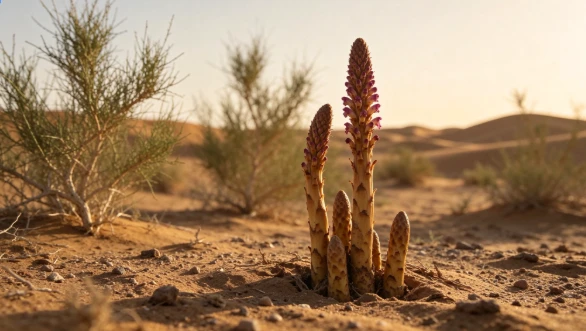
Cistanche is a genus of perennial parasitic plants belonging to the Orobanchaceae (broomrape) family. That word "parasitic" sounds alarming, but in botany it simply means the plant cannot make all of its own food and instead attaches to the roots of a host plant to survive.
Cistanche grows by latching onto the roots of tough, sand-fixing shrubs such as Haloxylon ammodendron (commonly called saxaul or "suosuo"), various Tamarix (tamarisk) species, and other desert brush. This unusual lifestyle is exactly why cistanche is so at home in some of the harshest environments on Earth: the arid deserts and semi-deserts of northwestern China and neighboring regions.
There are roughly 22 cistanche species worldwide. In China, the most important varieties are:
Cistanche deserticola - the best-known species and the one most people mean when they simply say "cistanche." It is native mainly to Inner Mongolia, Xinjiang, Gansu, and Qinghai.
Cistanche tubulosa - a species with a larger natural supply, now widely cultivated and officially recognized alongside C. deserticola in the Chinese Pharmacopoeia.
Cistanche salsa and a few other related species, which are used in some regions but are less common commercially.
The part of the plant that is harvested and used is the fleshy, succulent stem - not the leaves or flowers. In dried form, it looks like a long, brownish, finger-like stalk, and it is almost always sold as slices, powder, or extract rather than as a whole fresh plant.
Because it grows in deserts and has earned a reputation as a powerful, energizing tonic, cistanche is frequently nicknamed "desert ginseng" in English-language marketing. It is worth noting, however, that cistanche is not botanically related to true ginseng (Panax). The nickname is about reputation, not genetics.
A History That Spans Two Thousand Years
Cistanche is not a new discovery. It has been part of the traditional Chinese materia medica for well over two millennia, and its reputation has remained remarkably consistent over that entire period.
The plant first appears in the Shennong Bencao Jing (The Divine Farmer's Classic of Materia Medica), one of the oldest surviving Chinese pharmacological texts, compiled roughly 2,000 years ago. In that text, cistanche was placed in the "superior" or top category - a class reserved for substances considered safe enough for long-term use and valued for nourishing the body rather than merely treating illness. The classic description praised it for "tonifying the five fatigues and seven injuries" and noted that it could be taken over a long period to lighten the body.
Centuries later, the celebrated physician Li Shizhen described cistanche in his monumental Bencao Gangmu (Compendium of Materia Medica). He explained the origin of its name: the herb's action was said to be nourishing but gentle - it replenishes without being harsh or overpowering. The Chinese name itself, rou cong rong, can be understood as carrying this sense of a calm, measured, unhurried effect. Li Shizhen and other traditional authorities consistently recorded cistanche as non-toxic.
In the framework of traditional Chinese medicine, cistanche is described as sweet and salty in flavor, and warm in nature. It is said to enter the kidney and large-intestine channels, where its main traditional roles are:
Tonifying kidney yang - supporting vitality, energy, and reproductive function.
Nourishing essence and blood - replenishing the body's deeper reserves.
Moistening the intestines and relieving constipation - supporting regular, comfortable bowel movements.
Historically, these applications covered a range of everyday concerns: low energy, weakness and soreness in the lower back and knees, digestive sluggishness, and dry-type constipation. Over the centuries, people also developed many culinary ways to use it, including stewing it with meat, simmering it into soups and congee, steeping it in wine, and brewing it as a tea.
What matters for a modern reader is this: cistanche is not a passing fad. It sits on one of the longest continuous safety-and-use records in the herbal world, and that history is one reason researchers have been so interested in understanding exactly what it contains and how it works.
Where the "Desert Ginseng" Comes From
To understand why cistanche has become such an important modern ingredient, it helps to know a little about its unusual supply story.
For most of its history, cistanche was harvested from the wild. But wild cistanche is a slow, sparse plant, and decades of over-harvesting - driven by rising demand - pushed wild populations to the edge. The situation became serious enough that wild Cistanche deserticola was listed as a Class II nationally protected plant in China.
That protection did not spell the end of cistanche, however. Instead, it accelerated a remarkable agricultural success story.
Researchers and farmers developed reliable methods for cultivating cistanche by planting the host shrubs (especially saxaul and tamarisk) and then inoculating their roots with cistanche seeds. Over the past two decades, large-scale cultivation has spread across Inner Mongolia, Xinjiang, and other arid regions. The result has been a steady, renewable supply of high-quality cistanche that no longer depends on stripping the wild.
There is a beautiful side effect to all of this. The host plants - saxaul, tamarisk, and their relatives - are among the most effective sand-fixing plants in the world. Planting them on a massive scale helps stabilize soil, reduce desertification, and restore degraded land. In other words, growing cistanche has become part of the solution to the very environmental problems its desert home faces.
This is a meaningful point for anyone buying cistanche products today: cultivated cistanche is not only more sustainable, it is often more consistent in quality than wild-harvested material, because growers can control the species, the host plant, the harvest time, and the processing conditions.

The Science: What's Inside Cistanche?
For a long time, cistanche was known mainly through tradition. Modern chemistry has now begun to explain why the plant behaves the way it does. Researchers have identified a rich collection of active compounds, and a handful of these are now considered the plant's "signature" ingredients.
Phenylethanoid glycosides: the headline act
The most studied group of compounds in cistanche is the phenylethanoid glycosides, often abbreviated as PhGs. These are water-soluble plant compounds with a wide range of demonstrated biological activities, and they are widely regarded as the primary drivers of cistanche's effects.
Two PhGs in particular stand out:
Echinacoside (sometimes written echinacosid), and
Acteoside, also known as verbascoside.
Both compounds are now used as marker compounds - the chemical fingerprints used to verify that a cistanche product is genuine and to measure its potency. In fact, the Chinese Pharmacopoeia specifically uses echinacoside and acteoside as the official identity-and-quality markers for cistanche.
In the body, PhGs have been studied for antioxidant, anti-inflammatory, neuroprotective, and cell-protective effects. They are also the compounds most closely associated with cistanche's traditional reputation for supporting vitality and healthy aging.
Polysaccharides: the immune and energy molecules
Cistanche also contains significant amounts of polysaccharides - long chains of sugar molecules that are found in many medicinal mushrooms and herbs. Plant polysaccharides are of particular interest to researchers because of their ability to modulate the immune system. Studies on cistanche polysaccharides suggest they can support immune-cell activity and help the body maintain a balanced immune response.
Galactitol and oligosaccharides: the digestive helpers
One of cistanche's oldest uses is relieving constipation, and chemistry has now explained why it works. Cistanche contains large amounts of a sugar alcohol called galactitol, along with a group of oligosaccharides (short sugar chains). These compounds raise the osmotic pressure inside the intestines, which helps draw water into the bowel, soften the stool, and gently stimulate movement - a mechanism that supports regularity without the harsh, cramping effect of some stimulant laxatives.
A supporting cast
Beyond these headline compounds, cistanche also contains iridoids, lignans, amino acids, and various minerals and trace nutrients. Together, this complex mixture is typical of many traditional botanicals: the whole plant is often more than the sum of its individually isolated parts.
What Does the Research Suggest? Six Areas of Interest
It is important to be clear about the state of the science. Much of cistanche's evidence base comes from laboratory studies, animal experiments, and its long traditional-use record. Large, gold-standard human clinical trials are still limited. With that caveat in mind, here are the areas where research interest is strongest.
1. Fighting fatigue and supporting physical energy
One of the most common modern uses of cistanche is for fatigue and endurance. Animal studies have shown that cistanche extracts can extend swimming time and reduce markers of physical exhaustion. This aligns closely with its traditional role as a kidney-yang tonic - a category of herbs historically used to restore energy and resilience. In the Chinese health-food system, "relieving physical fatigue" and "anti-fatigue" are among the most common official function claims made for cistanche products.
2. Supporting a balanced immune system
Cistanche polysaccharides and phenylethanoid glycosides have both been studied for immunomodulation - helping the immune system respond appropriately, neither under-reacting nor over-reacting. Animal research has shown that cistanche components can support the activity of certain immune cells and, in aging models, help restore immune function closer to youthful levels. This is why "enhancing immunity" and "immune regulation" appear so frequently on approved cistanche products in China.
3. Anti-aging and antioxidant protection
Oxidative stress - the accumulation of damage from unstable molecules called free radicals - is one of the central drivers of aging. Cistanche is rich in compounds with antioxidant activity, particularly the PhGs. Laboratory studies have demonstrated that cistanche extracts can neutralize free radicals and reduce oxidative damage in cells. In animal models of aging, cistanche has been shown to improve certain age-related changes. While no herb can "stop aging," supporting the body's own antioxidant defenses is a plausible and well-studied mechanism for healthy aging.
4. Brain health and memory
This is one of the most exciting frontiers in cistanche research. The phenylethanoid glycosides, especially echinacoside and acteoside, have shown neuroprotective effects in laboratory studies - meaning they appear to help protect nerve cells from damage and support their survival. Some animal experiments have found that cistanche extracts improve learning and memory performance. This has made cistanche a plant of interest for researchers studying age-related cognitive decline, and "supporting memory" is another function claim seen on approved cistanche health products.
5. Digestive regularity
As mentioned above, cistanche has been used for centuries to relieve constipation, and the mechanism is now well understood. The galactitol and oligosaccharide content gently draws water into the intestines and encourages movement. This makes cistanche an appealing option for people who want a gentle, non-habit-forming way to support regularity - a contrast to harsh stimulant laxatives.
6. Liver protection and kidney support
A number of studies have explored cistanche's protective effects on the liver, with research suggesting that its glycosides can help shield liver cells from certain types of damage. Meanwhile, its traditional reputation as a kidney tonic remains a major part of its identity. Here it is important to be precise about terminology: in traditional Chinese medicine, the "kidney" is a broad functional concept involving energy, vitality, reproduction, and bone health - it is not identical to the anatomical kidneys in Western medicine. Cistanche's traditional "kidney-tonifying" role should be understood in that classical framework.
Is Cistanche Safe?
For a plant with such a long history, safety is the question most buyers ask first - and it is also the question with some of the most reassuring answers.
The traditional record. Cistanche has been classified as a "top-grade," non-toxic herb since the earliest Chinese pharmacopoeias, and it has been consumed as both food and medicine for around two thousand years. Generations of use in stews, soups, teas, and medicinal wines have produced no documented pattern of serious harm.
Modern toxicology studies. Contemporary researchers have put cistanche through the standard battery of modern safety tests, and the results are consistently reassuring:
In acute oral toxicity studies, cistanche showed no lethal effects at very high doses. In one study, the maximum tolerated dose in mice exceeded 20 grams per kilogram of body weight - hundreds of times greater than any realistic human intake.
In 90-day feeding studies, no significant toxic effects were observed.
In reproductive and developmental studies, no harmful effects were seen in pregnant animals or their offspring.
In genetic toxicity testing, results were negative, meaning no evidence of DNA damage.
In a clinical observation, continuous use of cistanche over an extended course showed no harm to heart, liver, or kidney function.
Regulatory recognition. Perhaps the strongest signal of safety is regulatory. In 2019, China's National Health Commission included Cistanche deserticola in a pilot program recognizing substances that are traditionally used both as food and as medicine - a category that requires substantial safety evidence. This status confirms that cistanche can be consumed directly as a food, not only as a medicine.
As with any botanical, certain groups should exercise caution. Approved cistanche products in China commonly list children, pregnant women, and nursing mothers as "not suitable" populations - not because of any demonstrated harm, but out of an abundance of caution and a lack of studies in these groups. If you fall into one of these categories, or if you take prescription medication, you should consult a healthcare professional before use.
Cistanche in Modern Health Supplements
Cistanche has made the leap from herbal pharmacy to modern supplement aisle in a big way. The best-documented example is the Chinese health-food market, where products are regulated and officially approved before they can make function claims.
According to a review of the Chinese health-food registration database, 47 officially approved products listed cistanche as an ingredient at the time of the review - 45 domestic products and 2 imported ones. That is a substantial number for a single botanical, and it reflects both consumer demand and official confidence in the ingredient.

The most common function claims
When regulators approve a cistanche health food, they must approve the specific function claim it is allowed to make. Across the 47 products, the claims fall into a clear pattern:
Relieving physical fatigue / anti-fatigue - by far the most common theme, appearing in dozens of products.
Enhancing immunity / immune regulation - the second major category.
Delaying aging - supporting healthy aging, often combined with other claims.
Relieving constipation / improving gastrointestinal function - reflecting cistanche's traditional laxative role.
A smaller number of products also carry claims related to memory support, bone density, and blood lipid regulation, usually in combination with other ingredients.
Many of these products combine cistanche with other botanicals to create broader formulas. Pure, single-ingredient cistanche products exist but are relatively rare - most manufacturers blend it for a more well-rounded effect.
The many forms of cistanche products
One reason cistanche has become so popular is its versatility. Approved products come in nearly every supplement format imaginable:
表格
| Format | Approximate share |
|---|---|
| Herbal liquor / tonic wine | ~43% |
| Capsules | ~23% |
| Tablets | ~15% |
| Tea | ~11% |
| Granules | ~6% |
| Oral liquid | ~2% |
For international buyers, capsules, tablets, powders, and standardized extracts are generally the most practical formats, since herbal liquor and traditional tea are less common in Western supplement routines.
How potency is measured
When you look at a quality cistanche product, you should see the active compounds standardized and listed on the label. In approved products, the key marker compounds - echinacoside and acteoside, plus sometimes crude polysaccharides - are quantified. Published data shows that these can vary widely from product to product, which is exactly why standardization matters: a label that names the percentage of echinacoside or acteoside is a sign of a product that has been tested and controlled, rather than a random scoop of raw powder.
How to Choose a Quality Cistanche Supplement
Not all cistanche is created equal. Here is a practical checklist to help you sort good products from weak ones.
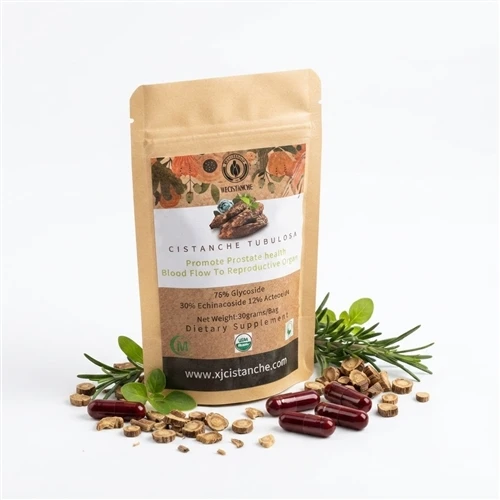
1. Check the species. Cistanche deserticola and Cistanche tubulosa are the two species officially recognized in the Chinese Pharmacopoeia and the two most extensively studied. A reputable product will tell you which one it uses.
2. Look for standardized actives. Choose products that state the standardized content of echinacoside and/or acteoside (often expressed as a percentage). This is the single most reliable indicator of quality.
3. Prefer cultivated over wild. Cultivated cistanche is more sustainable, more consistent, and does not put pressure on protected wild populations. Many quality brands now emphasize "cultivated" or "sustainably grown" sourcing.
4. Consider the extraction method. Water or water-alcohol extracts are standard and well-supported by research. The extract ratio (for example, "10:1 extract") tells you how much raw herb was concentrated into the extract.
5. Buy from transparent suppliers. Look for brands that provide a Certificate of Analysis (COA), third-party testing, and clear sourcing information. In the international market, these documents are the best protection against adulterated or mislabeled material.
6. Mind the fine print. Legitimate cistanche products make careful, moderate claims. Be skeptical of anything that promises dramatic overnight results - that is a red flag, not a feature.
A Note on Regulations and Health Claims
If you are reading this in North America, Europe, or another Western market, there is an important distinction to understand.
The function claims described in this article - "relieving fatigue," "enhancing immunity," "delaying aging," and so on - are claims approved under China's health-food regulatory system, based on a combination of traditional use, pharmacological research, and safety evidence. They are not necessarily the claims a product may legally make in other countries.
In the United States, dietary supplements are regulated under a different framework, and manufacturers are generally not permitted to claim that a product treats, prevents, or cures any disease. In the European Union and other markets, health claims are subject to their own authorization processes, many of which are strict about botanical ingredients.
This matters for two reasons. First, it explains why the same cistanche product may carry detailed function language in one country and only modest, general statements in another. Second, it is a reminder to read labels critically and to treat cistanche as what it is: a well-regarded botanical with a long traditional history and growing scientific interest - not a magic cure.

Frequently Asked Questions
What is cistanche used for? Traditionally, cistanche is used to support energy and vitality, nourish the body, and relieve constipation. Modern interest focuses on fatigue, immune support, healthy aging, memory, and digestive regularity.
Is cistanche the same as ginseng? No. Cistanche is sometimes called "desert ginseng," but it is a completely different plant. The nickname reflects its energizing reputation, not any botanical relationship.
How long does cistanche take to work? Cistanche is traditionally considered a gentle, nourishing tonic rather than a fast-acting stimulant. In traditional use, effects are understood to build gradually with consistent use over weeks or months. Individual responses vary.
Is cistanche safe to take daily? Cistanche has a very long safety record and modern toxicology studies have found no significant toxicity at normal doses. However, pregnant or nursing women and children are typically advised to avoid it, and anyone with a medical condition or taking medication should consult a healthcare provider first.
What is the difference between Cistanche deserticola and Cistanche tubulosa? Both are officially recognized species with similar traditional uses and active compounds. C. deserticola is the classic species, while C. tubulosa is more widely cultivated and has a larger natural supply. Both contain echinacoside and acteoside, though the exact profiles differ slightly.
Can cistanche help with constipation? This is one of its best-documented traditional uses. Its galactitol and oligosaccharide content gently draws water into the intestines and supports regular bowel movements.
What should I look for on a label? Species name, standardized echinacoside/acteoside content, extract ratio, and transparent sourcing with third-party testing or a Certificate of Analysis.
Conclusion: An Ancient Desert Herb for the Modern Wellness Era
Cistanche occupies a rare position in the world of botanicals. It is simultaneously one of the oldest herbs in continuous use - with a safety and efficacy record stretching back two thousand years - and one of the most actively researched ingredients in the modern supplement industry.
Its journey is also a story with a satisfying arc. A plant that was once over-harvested to the brink is now widely cultivated on desert land, where the very act of growing it helps stabilize soil and fight desertification. A herb long known only through tradition is now understood at the molecular level, with its key compounds identified, standardized, and measured. And an ingredient once confined to East Asian medicine cabinets has become a global wellness staple, valued for energy, immunity, healthy aging, brain function, and digestive comfort.
For anyone exploring natural ways to support vitality and well-being, cistanche deserves a close look - not as a miracle, but as a genuinely interesting botanical with a deep history, a reassuring safety profile, and a fast-growing body of science behind it. As with any supplement, the key is to choose a quality, standardized product from a transparent supplier, and to keep your expectations grounded in what the evidence actually supports.
The desert has been quietly growing this remarkable plant for thousands of years. Thanks to modern science and sustainable cultivation, the rest of the world is finally catching up.
Disclaimer: This article is for informational and educational purposes only and is not intended as medical advice, diagnosis, or treatment. Statements about cistanche's traditional uses and health-food function claims reflect historical use and the regulatory framework of the People's Republic of China, and have not been evaluated by the U.S. Food and Drug Administration or the European Food Safety Authority. This product is not intended to diagnose, treat, cure, or prevent any disease. Always consult a qualified healthcare professional before beginning any new supplement, especially if you are pregnant, nursing, taking medication, or managing a medical condition.