Cistanche Tubulosa: A Short Popular-Science Biography Of The Desert Herb
Nov 16, 2026
1. Opening: an underground stem beneath the sea of sand
On the southern edge of the Taklamakan Desert, the wind never really stops. Dunes walk, water refuses to stay, and the surface can reach sixty degrees Celsius by day and drop below ten by night. In a place most people call dead land, a plant grows that rarely shows its true body, yet has fed the medical traditions of the Western Regions for two thousand years - Cistanche tubulosa.

It is not impressive to look at. The whole plant stays underground for most of its life. It has no true root and no green leaf capable of photosynthesis; all it carries is a thick, fleshy stem covered in yellow-brown scales. It does not fight for sunlight. Its single strategy is to push a haustorium into the root of a tamarisk, quietly borrowing water and nutrients, fattening its own body, and then pushing up a purple-and-white spike in early summer to finish flowering, fruiting, and seed dispersal in little more than thirty days.
The Shennong Bencao Jing listed it among the highest grade of drugs; the Bencao Gangmu says it is called congrong, 「slow and at ease」, because it 「tonifies without being harsh」. More than two thousand years later, it has moved from the old herbals into the Chinese Pharmacopoeia, and into an industry that makes sense for both ecological restoration and rural incomes. This essay is about the plant itself, its host, the tamarisk, and the ecological arithmetic that holds them together.

The villagers of Hotan Village in Xinjiang are digging and harvesting Cistanche tubulosa
2. Name and standing: a short history of naming
Its accepted name is Cistanche tubulosa (Schrenk) R. Wight, in the family Orobanchaceae, genus Cistanche, a perennial parasitic herb. About four species of the genus occur in China and roughly twenty-seven worldwide, and every one of them is fully or hemi-parasitic. In other words, parasitism is not a defect of this plant - it is its entire way of living.
Each part of the Chinese name carries a reason.
Tubulosa (tubular-flowered): a reference to its long, funnel-shaped corolla tube, one of the most visible marks that separate it from its congeners.
Rou congrong: it emerges tender like meat, thick and fleshy, warm but not heating, tonifying but not harsh, warming but not drying - hence the idea of 「composure」 (congrong), later written with a grass radical.
Dayun: a folk name across the northwest. Uyghur villagers in Hotan call it tushkan zediki - 「the yellow carrot that rabbits eat」 - because wild rabbits eat it eagerly.
Hongliu dayun, Nanjiang dayun, ying dayun (「hard dayun」): names that come from its habit of parasitising tamarisk (hongliu, 「red willow」) and from the hard, non-pliable texture of its dried stem.
Traditional Uyghur medicine lists it as a tonic herb; the name 「desert ginseng」 comes from its value and its mildness. One warning is worth repeating: in Chinese herb markets the whole genus is often loosely called 「congrong」, but the botanical origin changes the evaluation of efficacy, a point taken up below.

Harvest of Cistanche tubulosa
3. Who is the host: not saxaul, but tamarisk
This is the single most important piece of identification in the whole article, and it is what separates Cistanche tubulosa most clearly from the more familiar 「roucongrong」.
Tamarix, commonly called 「red willow」 (hongliu), is a shrub of the family Tamaricaceae; plantations in Hotan mainly use saltcedar, Tamarix ramosissima. It is cold-hardy, drought-tolerant, wind- and sand-resistant and salt-alkali tolerant; even when buried by moving sand its branches keep growing out of the dune, which is why it is the first-choice species for windbreaks and sand fixation and the preferred plant for desertification control in southern Xinjiang. In summer it bears pink spike-flowers - the most colourful living thing in a very colourless landscape.

Host of Desert Ginseng and Cistanche tubulosa- Red Willow
Cistanche tubulosa parasitises the roots of this shrub. In Xinjiang it occurs throughout the region but is concentrated in Minfeng, Yutian, the lower Keriya River and the Andir area, growing in tamarisk thickets and on dune sands where water is comparatively available, at around 1,200 m altitude. More broadly, it is distributed across northern Africa, the Arabian Peninsula, Pakistan, India and as far as the Russian part of Central Asia; in China its natural range is limited to the counties around the southern rim of the Taklamakan, south of the Tianshan.
A direct comparison makes the identity obvious:

|
Item |
C. tubulosa (tubular-flowered) |
C. deserticola (desert-living) |
|
Main host |
Tamarix (red willow, e.g. T. ramosissima) |
Haloxylon (saxaul, H. ammodendron / H. persicum) |
|
Main producing area |
Southern Xinjiang (Hetian, Yutian, Minfeng, Shaya) |
W. Inner Mongolia, Ningxia, Gansu, N. Xinjiang |
|
Trade name |
Ying dayun, hongliu dayun, Nanjiang dayun |
Ruan dayun, you congrong |
|
Dried stem shape |
Spindle- to flat-spindle- or flat-column-shaped, 5–25 cm |
Flat-cylindrical, slightly curved, 3–15 cm |
|
Vascular bundles in cross-section |
Scattered, dot-like; grey-brown, granular |
Arranged in wavy rings, often infolded |
|
Texture |
Hard, inelastic, does not break easily |
Heavy, hard, slightly pliant |
|
Pharmacopoeia status |
Added in 2005 as the second origin of Roucongrong |
Listed since the 1990 edition |
Note: diagnostic characters are compiled from the Chinese Pharmacopoeia and the Guangdong Institute for Drug Control[citation:14]; the arrangement of vascular bundles in cross-section is the most practical way to tell the two sliced drugs apart in a dispensary or on the market.
4. What it looks like: a morphological checklist
Dug up whole, what you see is a thick fleshy stem. The authoritative botanical description runs as follows:
Plant 60–100 cm tall, the above-ground part only 30–35 cm; stem unbranched, 3–4 cm in diameter at the base.
Leaves milky white, turning brown when dry, triangular, 2–3 cm long and about 5 mm wide; those on the upper stem narrow to triangular-lanceolate or lanceolate - the so-called 「scale armour」 is these highly reduced leaves.
Spike 12–18 cm long; bracts oblong-lanceolate or ovate-lanceolate, edges pubescent; two bracteoles.
Calyx tubular, split to near the middle at the apex; corolla tubular-funnel-shaped, up to 4 cm long; lobes tinged purple in bud, turning brown when dry.
Stamens four; filaments inserted 7–8 mm from the tube base; anthers ovate, densely covered in yellowish-white long hairs, the anther cells blunt-rounded at the base and lacking a small point - the last character is the most reliable species marker.
Capsule oblong; seeds numerous, nearly round, turning black-brown when dry, netted on the surface.
Flowering May–June, fruiting July–August.

Chinese herb cistanche
Why does it survive at all? The answer is in the seed. The seed-coat wall is honeycombed, and the endosperm is coated in wax - a structure built precisely to withstand desert drought, heat and huge diurnal temperature swings. One plant produces 50,000 to 100,000 seeds, each tiny enough to mix with sand grains and travel on the wind; quantity is how it hedges against a vanishingly low rate of successful parasitism.
5. How it stays alive: a case of 「mutual induction」
A full life of Cistanche tubulosa comes apart into six steps.
Step one: the seed falls into sand and enters a long, deep dormancy. A seed just shed has an immature embryo and normally needs two winters before the embryo is ready; even then, it will not germinate by itself.
Step two: it waits for a signal. Germination only begins when the seed senses chemical cues from the host root system, under suitable temperature, moisture, and pH - a kind of gatekeeping built into obligate parasitism.
Step three: the host moves too. Field and laboratory inoculation work by the Tu Pengfei team at Peking University showed that Cistanche seeds can induce new hairy roots of the host to grow towards them; when a hairy root comes within about 0.5 cm of a seed, the seed senses the cue, sends out a germ-tube-like haustorium, grips the root, penetrates the root epidermis and joins its own vascular bundle to the host's. This is the 「two-way induction」 between parasite and host, and it corrects the older picture of parasitism as a one-sided dependence.
Step four: a physiological bridge is built. From then on, Cistanche tubulosa makes none of its own food; water and nutrients come entirely through the haustorium from the tamarisk root.

Step five: emergence and flowering. A tubercle-like (sucker) is thought to bear one or several cone-like juveniles; the first and second years are spent entirely underground, and in the third spring an emergence reaches the surface if the burial is shallow. The inflorescence is indeterminate, with the lower and middle flowers opening first; from emergence to seed set takes little more than thirty days.
Step six: the cycle. After flowering and fruiting, the above-ground stem hollows and rots away; once the underground stem loses vigour, it is decomposed by soil microbes. But as long as the basal tubercle is not destroyed, it keeps producing new stems and repeats the whole process, and a stem that has been harvested can also regenerate from the same tubercle.
How low is the success rate in the wild? Under natural conditions, a seed the size of a sand grain must land within about 0.5 cm of a newly formed capillary root of tamarisk and receive the right signal before it will germinate at all; the natural germination rate is below one in a thousand. This is the basic reason it is listed as an endangered species and included in the Convention on International Trade in Endangered Species.
6. As medicine: two thousand years and a 「mild formula」
The medicinal part is the dried fleshy stem with its scaly leaves. It is sweet and salty in flavour, warm in nature, and acts on the kidney and large-intestine meridians; its effects are to tonify kidney yang, replenish essence-blood and moisten the intestines to ease defecation. The old herbals say the same thing in one continuous line:
Shennong Bencao Jing: treats 「the five kinds of exhaustion and seven kinds of injury」, tonifies the middle, relieves cold-heat pain in the body, nourishes the five viscera, strengthens yin, boosts essence-qi and uterine masses, and 「lightens the body with prolonged use」.
Mingyi Bielu: dispels pathogenic qi from the bladder, relieves lumbago, stops dysentery.
Yaoxing Lun (Zhen Quan): boosts marrow, brightens complexion, treats uterine bleeding in women and impotence in men, greatly tonifying, governs red and white discharge.

Desert living cistanche
Bencao Gangmu: 「it tonifies without being harsh, hence the name congrong」.
「Mild tonification」 means warm without heating, tonifying without harshness, warming without drying, slippery without causing leakage; taken over time it rarely causes heat or dry mouth, and it suits both men and women - it is used for male impotence and for female infertility alike. Among all the kidney-tonifying formulae in the old tradition, it is the one used most often.
Modern pharmacological work has focused on several directions: improving learning and memory, anti-Alzheimer and anti-ageing effects, anti-fatigue, immunomodulation, neuroprotection and liver protection, and easing defecation. The laxative mechanism deserves a separate note - it does not purge like Rhei or Senna. Instead, it increases osmotic pressure in the gut, reduces water absorption and promotes peristalsis, so the stool softens and passes easily without damage to the body; it is particularly suited to the elderly, the postpartum and the weak.
What are its active substances? The answer is the phenylethanoid glycosides (PeGs), with echinacoside as the major component. In vitro work found that echinacoside at concentrations above 10⁻⁶ M stimulates growth-hormone secretion in rat pituitary cells, acting through the ghrelin receptor - one testable molecular route for the traditional claim of 「anti-ageing」.
In composition, the two close relatives differ quite a lot. One study of 68 batches of Xinjiang C. tubulosa gave mean mass fractions of echinacoside and acteoside of 3.32% and 0.91%, respectively, while C. deserticola is richer in polysaccharides. This also explains the different market prices and reputations: C. deserticola is scarcer and polysaccharide-rich; C. tubulosa yields more, has a higher total PeG content, and is the mainstay for health-product raw material and finished drug production. A necessary warning: the Chinese Pharmacopoeia requires the sum of echinacoside and acteoside in C. tubulosa to be not less than 1.50%, but only 0.30% for C. deserticola. The standards differ, so the percentages cannot be compared directly.

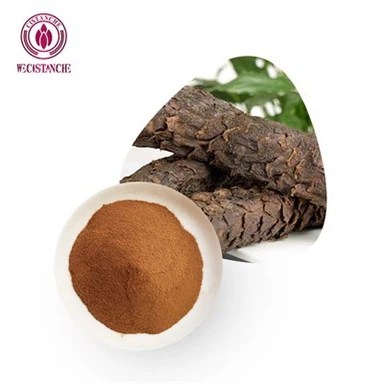
Cistanche tubulosa extract
Click here to view Cistanche Tubulosa Extract Natural Supplement Powder
【Ask for more】 Email:cindy.xue@wecistanche.com / WhatsApp: 0086 18599088692 / WeChat: 18599088692
7. Harvest and preparation: the right hour
The hour of harvest decides whether it is a good drug. The best material is taken before emergence or just as it emerges; once the stem has flowered and fruited above ground, its stored nutrients are heavily consumed and the quality drops markedly. Around Hotan, the traditional season is spring, with the best harvest between April and early June; autumn (September–October) gives a smaller crop, and the rule is to take the large and leave the small, take the dense and leave the thin.
Preparation is just as particular: the inflorescence or 「congrong head」 must be removed so it does not keep drawing on the stem, then the stems are spread on clean sand to dry; after a month or more they turn from yellow to a fleshy brown - 「sweet dayun」. They may also be cleaned, soaked in water, sliced lengthwise and dried, or processed into wine-prepared or black-bean-processed pieces.
Three practical points on selection and storage:

Fresh Cistanche
Read the cross-section: in C. tubulosa, the vascular bundles are scattered dots; in C. deserticola, they form wavy rings. This is the most reliable distinction.
Watch for adulterants: Cistanche salsa is sometimes passed off as the real drug; its vascular bundles are polygonal, and its composition and efficacy are not equivalent.
Prevent spoilage: the drug is rich in sugars and easily becomes damp, mouldy or infested, so keep it sealed in a cool, dry place and check it regularly, especially around the rainy season; lightly damp material can be air-dried or steamed through and dried again.
In use, 10 g decocted in water, steeped in liquor, or cooked with food is common practice; classic food-medicine recipes include Congrong mutton congee, Congrong stewed with sheep kidney, and Congrong stewed with black-bone chicken, all working on the idea of warming yang and tonifying the kidneys and essence. A note on safety: it is not suitable for people with yin deficiency and effulgent fire, chronic loose stool or hypersexuality; neither for minors nor for women during menstruation; and copper or iron vessels should not be used for decocting. This is popular-science information, not a substitute for medical advice.
8. From wild to cultivated: a thirty-one-year technical account
Before cultivation was solved, Cistanche came entirely from wild collection. On one side, wild populations fell sharply; on the other, digging for the stems disturbed tamarisk roots and made an already fragile desert ecology worse. There was only one way out: cultivation.
But growing a parasitic plant artificially was, in the international academic literature, a long-standing hard problem - and that was before adding the Taklamakan rim. From land preparation and planting tamarisk to inoculation, irrigation, and the first harvest takes a full three years; a small deviation and the whole effort is lost.
The real turn came from understanding the biology of parasitism. The project 「Key Technologies for the Whole-Industry-Chain Development of the Desert Endangered Parasitic Chinese Medicine Cistanche」, led by Tu Pengfei over thirty-one years, won the second prize of the State Scientific and Technological Progress Award in 2025 - the highest award the field has received. Its three contributions are worth recording:
Mechanism: it was the first to clarify the two-way induction between Cistanche and its host at the molecular level, giving the theoretical basis for large-scale inoculation.
Cultivation: it solved seed-germination control, precise inoculation, water-fertiliser management and mechanical harvesting; seed germination rose from under 20% to over 85%, inoculation success to over 95%, and yield per mu from 18 kg to more than 500 kg. The system contains over 170 standard operating procedures and has passed national GAP certification.
Processing: a high-temperature enzyme-inactivation technique raised the retention of active constituents more than tenfold, and fingerprinting was introduced as a 「 chemical ID card」 for the raw material.
The industry has real scale now. Cultivated Cistanche in Xinjiang covers more than 1.4 million mu, mostly C. tubulosa, and its dried output is over 80% of the national total, forming three concentrated production zones around the Tarim, Turpan and Junggar basins. Yutian, known as the 「home of dayun in China」, has expanded to 260,000 mu; Shaya has grown from 77,000 mu in 2023 to 200,000 mu in 2026; and in 2026 the Cistanche of both Yutian and Shaya was listed in the national 「One County, One Authentic Medicinal」 programme.
The details are just as concrete. Trials with different inoculation blends and soaking times showed that a 500 mg/L solution of inoculant A gave an average of 13.3 infection sites per plant and a 79.1% inoculation rate for C. tubulosa; soaking for 24 hours reached 82.0%; the optimal depth was 40 cm, while at 80 cm and 100 cm the inoculation rate was zero in both cases. The plant tolerates sand, but it also has a well-defined comfort zone that can be measured.
9. The ecological account: tamarisk woods and a feedback loop

Harvest of Cistanche tubulosa
There is a calculation here that matters more than 「how many kilograms per mu」.
The model of inoculating Cistanche tubulosa onto tamarisk is the southern-Xinjiang route to doing sand control and raising incomes at the same time: it makes use of desert resources while keeping the sand-fixing effect of the shrubs intact. In natural distribution, a dune often carries only one tamarisk bush, and the next may be four or five kilometres away - but a dune that has tamarisk on it generally stops moving. That is the key step in fixing sand.
The Cistanche industry offers a market-based answer to a problem that pure public-works forestry could never solve: to get congrong you must first plant tamarisk; as the tamarisk stands grow, their sand-fixing benefit appears by itself; with a better environment and better technical support the congrong improves in quality and finds a market; and to expand production you plant more tamarisk. Part of this logic is a long-term habit: workers digging among the bushes use a light hand and never cut the tamarisk's main root, because a severed root means no new stems the next year - and after digging they push the sand back around the root.
One problem has to be faced squarely: a long period of parasitism weakens the tamarisk. The answer in the literature is a rotation between tamarisk and saxaul - after several years of tamarisk, every other row is cut and replaced with saxaul, which also hosts dayun; once that is established, the next row is converted, and so on, so the industry becomes self-sustaining. This is worth copying: it puts 「planting trees - parasitism - restoring the land」 on the same timetable instead of treating them as three things that get in each other's way.
And one popular misunderstanding needs correcting. Combating desertification is not about turning the desert 「green and lush」. On the southern rim of the Taklamakan, where annual rainfall is very low and evaporation is extreme, planting large areas of thirsty poplars is neither scientific nor sustainable. Native drought-tolerant shrubs such as tamarisk and saxaul are the right plants for the place; pure conservation planting is hard to maintain, and the Cistanche industry is what turns sand control from a pure cost into something that pays back.
10. A quick reference and corrections of common mistakes
|
Question |
Answer |
|
Is C. tubulosa a 「tubular flower」? |
「Tubulosa」 refers to the long, funnel-shaped corolla tube; it does not mean the plant contains tube-like structures. |
|
Does it parasitise tamarisk or saxaul? |
C. tubulosa mainly parasitises tamarisk (red willow); C. deserticola is the one on saxaul. |
|
Which is better, the hard or the soft dayun? |
They differ in composition: tubulosa has higher total PeGs and higher yield; deserticola is richer in polysaccharides and scarcer. They are not ranked simply. |
|
How to tell them in cross-section? |
Tubulosa: scattered dot-like bundles. Deserticola: wavy rings, often infolded. |
|
When is harvest best? |
Before emergence or just as it emerges; quality falls sharply once it flowers above ground. |
|
Is wild material more valuable? |
Wild resources are already endangered; unregulated digging also damages tamarisk and dune soils. Standardised cultivation is the sustainable source. |
|
Can it be taken long-term by oneself? |
Not suitable for yin-deficiency with effulgent fire, chronic loose stool or hypersexuality; not for minors or women during menstruation; not a substitute for medical care. |
Note on conservation status: Cistanche tubulosa is a Class-II nationally protected wild plant in China and is listed as Vulnerable (VU) on the IUCN Red List. Wild collection must comply with the law, and resource protection comes before harvesting.
11. Closing: composure is a calculation that balances
Two thousand years ago it was written into the Shennong Bencao Jing as a tribute sent from the Western Regions to the Central Plains. Two thousand years later it is written into the Chinese Pharmacopoeia, and into the ledger of tamarisk bushes on the edge of the Taklamakan.
Nearly all its life is spent underground. It does not fight for light, and it does not grab land; it simply joins its haustorium firmly to the root of a tamarisk, finishes flowering and seeding in a little over thirty days, and waits for the tubercle to send up another stem the next year. What it gives to the herbals is a mild tonic; what it gives to the sand is a way of cycling that can be kept going: plant tamarisk, inoculate congrong, protect the main root when you dig, return the sand, and come again next year.
Composure, perhaps, is exactly this - not rushing, and not fudging the accounts, so that the dune stays where it is and the people living beside it can stay too.
References
Administration of the Gansu Qilianshan National Nature Reserve, Key Protected Wild Plants of the Qilian Mountains National Park (Gansu).
Pharmacopoeia Commission of the PRC, 「Knowing the Drug, Tasting the Herb: Roucongrong」.
Research Status of Cistanche tubulosa, Chinese Journal of Eco-Agriculture.
Guangdong Institute for Drug Control, Macroscopic and Microscopic Identification of Cistanche tubulosa.
Hetian (Hotan) Government, 「Hetian Dayun」.
National Forestry and Grassland Administration, 「Seeking New Opportunities for Bioremediation in the Taklamakan」.
South China Botanical Garden, CAS, 「Tamarix ramosissima」.
Research by the Tu Pengfei team and the 2025 State Scientific and Technological Progress Award (second prize) project dossier.
Study on Inoculation Technique of Cistanche and Root Vigour of Tamarix.
Morphological Development of the Parasitic Growth of Cistanche, Bulletin of Botany.
「Cistanche Species, the Ginseng of the Desert…」, PMC, 2019.
「Echinacoside Isolated from Cistanche tubulosa…」, PMC, 2019.
「Optimisation of Processing Technology of Slices of Cistanche tubulosa…」, Lishizhen Medicine and Materia Medica Research, 2025.
「Comparison of Phenylethanoid Glycoside Contents in Cistanche from Different Species, Origins and Growth Periods」.
Hetian Uyghur Medicine, food-medicine recipes and harvest/preparation notes.