Cistanche Tubulosa: Can Desert Herb Ethanol Extract Help Against Exercise‑Induced Physical Fatigue?
Oct 30, 2026
What pre‑clinical animal research tells us about stamina, energy metabolism and workout recovery
Disclaimer: This article serves purely for educational and informational purposes. It is not medical advice. The findings described come exclusively from mouse‑based pre‑clinical laboratory studies. Results observed in animal models do not guarantee identical effects for human beings. Cistanche tubulosa extract is a botanical dietary ingredient and cannot replace medical treatment for chronic fatigue, muscle injuries, metabolic disorders or other health conditions. If you are an athlete, take prescription medications, suffer from organ disease, pregnant or breastfeeding, always consult a qualified healthcare practitioner before adding any herbal supplement to your daily routine.
Introduction: The Challenge of Exercise‑Induced Fatigue
Exercise‑induced fatigue describes the temporary drop in maximum muscle contraction power and physical performance that emerges after sustained physical exertion. Beyond simple muscle tiredness, it triggers wide‑ranging shifts across whole‑body metabolism, energy storage and organ status. For fitness enthusiasts, competitive athletes and people with physically demanding lifestyles, delayed fatigue onset and faster post‑workout recovery remain highly sought‑after goals.
Modern sports nutrition commonly uses caffeine, branched‑chain amino acids and single‑molecule antioxidant supplements to fight workout fatigue. These products often target only one single metabolic pathway. Many users seek natural multi‑action herbal alternatives that support energy storage while mitigating exercise‑related metabolic stress.
Cistanche tubulosa, also widely known as desert ginseng, is a well‑documented parasitic medicinal herb originating from the arid regions of Northwest China. For thousands of years in Traditional Chinese Medicine, practitioners valued it as a tonic for physical weakness, low stamina and energy depletion. Its complex chemical composition includes phenylethanoid glycosides, sterols, polysaccharides and amino acids, many of which deliver antioxidant and metabolism‑regulating properties. Even though traditional use suggested potential anti‑fatigue benefits, controlled experimental evidence specifically for exercise‑driven physical tiredness remained limited until recent pre‑clinical animal work.
This article unpacks one treadmill‑based mouse research project investigating ethanol extract from Cistanche tubulosa. We will explain what exercise‑induced fatigue is, introduce the study setup, break down key lab observations, interpret fatigue‑related biological markers, discuss proposed working mechanisms, clarify critical research limitations, and outline practical takeaways for consumers. Keep in mind: all data shown comes from mouse experiments; human clinical trials are still lacking.
What Is Exercise‑Induced Fatigue and How Do Scientists Measure It?
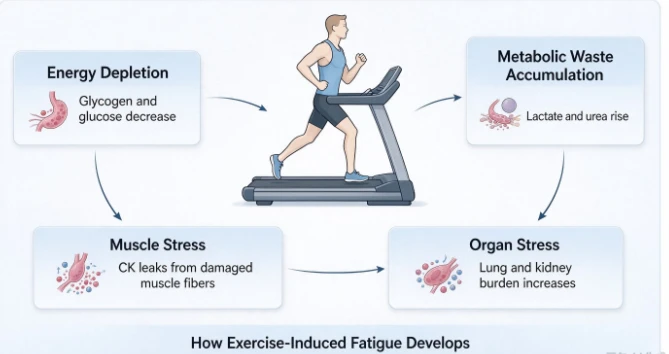
When physical exertion pushes the body toward exhaustion, two major types of change take place: energy reserves get depleted, and metabolic waste products start accumulating inside blood and tissues. Researchers rely on well‑validated biological biomarkers to quantify how severe fatigue has become in laboratory animal models.
Key fatigue markers explained in simple terms:
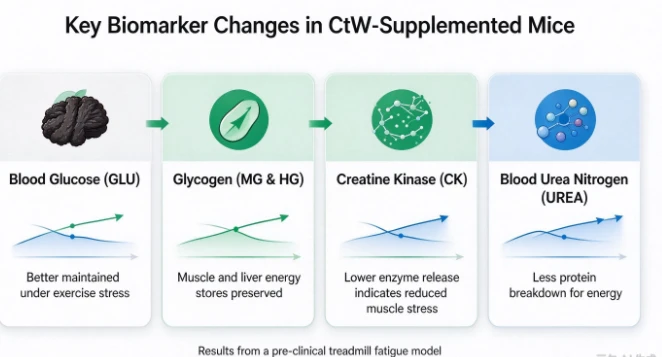
Blood Glucose (GLU): Primary circulating fuel for muscles. Prolonged heavy exercise pulls down blood glucose levels; low glucose directly contributes to exhaustion sensations.
Muscle Glycogen (MG) & Hepatic Glycogen (HG): Glycogen is the body's stored carbohydrate energy bank. Muscle glycogen fuels direct muscle contraction; liver glycogen maintains stable blood sugar during long workouts. Sharp glycogen depletion is a classic signature of advanced physical fatigue.
Creatine Kinase (CK): An enzyme locked inside muscle fibers. When intense exercise damages muscle cell membranes, CK leaks out into blood serum. Higher serum CK readings signal greater muscle tissue stress and injury from over‑exertion.
Lactate Dehydrogenase (LDH): Enzyme central to anaerobic energy metabolism. Falling LDH levels often correspond to worsening fatigue status under exhaustive exercise conditionsPMC.
Blood Urea Nitrogen (UREA / BUN): Generated when the body breaks down protein for energy when glycogen stores run low. Elevated urea nitrogen levels indicate the body is under heavy physical strain and burning protein for fuelFrontiers.
Lactate (LAC): Metabolic by‑product generated during high‑intensity anaerobic exercise. Though its exact role in fatigue is nuanced, lactate accumulation is routinely tracked as a marker of exercise load.
Beyond blood biochemistry, scientists also record real‑world performance metrics: total running time, total running distance until complete exhaustion, and physiological organ changes. Histological tissue observation further reveals how strenuous exercise impacts internal organs such as lung tissue.
Treadmill running represents one gold‑standard laboratory method for building exercise‑fatigue animal models. Unlike forced swimming tests, graded‑speed treadmill protocols precisely adjust running speed, slope and exercise duration to create standardized, progressive physical stress for test animals.

About Cistanche Tubulosa: The Desert Parasitic Herb
Cistanche tubulosa is a root‑parasitic herb growing in desert environments across Xinjiang and surrounding regions of China. It draws nutrition by attaching itself to the roots of desert shrubs. The fleshy stem of the plant is harvested for herbal applications.
Ethanol extraction is a common industrial processing technique for this herb. By soaking crushed dried plant material in ethanol solution, researchers dissolve many of its lipophilic and glycoside‑based bioactive compounds. After filtering, solvent evaporation yields concentrated liquid ethanol extract, which was the test material used in this mouse fatigue study.
Major known bioactive constituents within Cistanche tubulosa ethanol extract include phenylethanoid glycosides (echinacoside, acteoside), plant sterols, polysaccharides and flavonoid‑type molecules. Many of these compounds have demonstrated antioxidant and anti‑inflammatory effects in separate cell and animal studies. What remained unclear was whether this combined ethanol extract could delay physical exhaustion brought on by progressive treadmill exercise.
Overview of the Mouse Treadmill Anti‑Fatigue Research
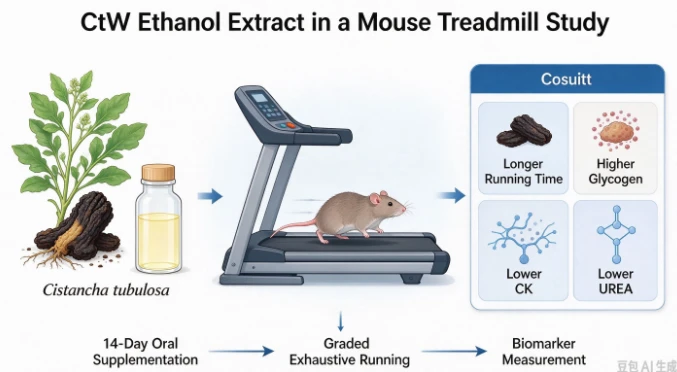
This pre‑clinical trial used 60 healthy male Kunming mice to evaluate whether orally‑administered Cistanche tubulosa ethanol extract (CtW) could mitigate exercise‑induced fatigue.
Study Group Design
Animals were randomly separated into five experimental groups:
NE (Non‑Exercise group): No treadmill running; given daily saline only. Baseline control for normal physiological values.
EC (Exercise Control group): Underwent full graded treadmill exercise protocol; given daily saline only. This group represented untreated fatigued animals.
E+CtW‑L (Low‑dose extract group): Exercise plus low‑dose CtW ethanol extract.
E+CtW‑I (Intermediate‑dose extract group): Exercise plus medium‑dose CtW ethanol extract.
E+CtW‑H (High‑dose extract group): Exercise plus high‑dose CtW ethanol extract.
Mice in the three CtW groups received oral gavage administration once every morning for a continuous period of 14 days before starting the exhaustive treadmill challenge. Dosage concentrations were set as low:0.08 g/mL, intermediate:0.16 g/mL, high:0.32 g/mL, with standardized volume adjusted according to each mouse's body weight. The EC and NE control groups received identical volumes of ordinary saline solution.
The 10‑Stage Graded Treadmill Fatigue Protocol
After two‑week supplementation period finished, mice completed a well‑established 10‑phase progressive treadmill running test. Both running speed and track incline increased step‑by‑step across each stage, creating gradually rising physical stress. Stages one through nine ran for fixed 3‑minute segments with rising slope and velocity. At stage 10, animals kept running until they reached complete physical exhaustion. Researchers judged exhaustion by observable signs: repeated refusal to keep running, abdomen pressing flat against the treadmill belt, slow response to mild electrical stimulation, and inability to maintain required running pace.
Half of the mice within each CtW‑supplemented group stopped running at stage 9 (the point where control exercise animals first showed clear fatigue symptoms). The remaining half continued onward all the way to full exhaustion in stage 10. After animals were humanely sacrificed, research teams collected serum, muscle, liver, kidney, lung, heart, spleen and gastrointestinal tissues. They measured serum fatigue biomarkers, hepatic and muscle glycogen content, relative organ weight ratios, and prepared stained lung tissue microscope slides to examine tissue micro‑structural damage.
Statistical analysis compared differences between groups. P‑values below 0.05 marked statistically significant differences; P‑values below 0.01 indicated highly significant differences between test groups.
Key Observations from the Fatigue‑Model Control Group
First, researchers validated that their treadmill protocol successfully created reliable exercise‑induced fatigue in the EC exercise‑only control mice.
When arriving at stage 9 of the treadmill program, EC mice displayed obvious fatigue‑related behavioral signs. Compared against the non‑exercising NE baseline group:
Serum UREA (blood urea nitrogen) and CK (creatine kinase) levels rose extremely high. These increases reflect muscle cell leakage and elevated protein breakdown under heavy physical load.
Blood glucose (GLU), LDH activity, muscle glycogen (MG) and liver glycogen (HG) dropped sharply. This demonstrated major depletion of the body's stored carbohydrate energy reserves.
Lactate levels showed an upward statistical trend, though the change did not reach formal statistical significance (P=0.099).
Organ weight data also reflected physical strain from exhaustive exercise. Compared with NE mice, EC exercise‑only animals presented significantly reduced final body weight. Their relative liver weight and relative kidney weight decreased noticeably.
Microscopic lung tissue examination uncovered clear tissue damage in the EC exercise‑control mice. Lung slides showed expanded alveoli, fractured alveolar walls, merged air sac spaces, widened interstitial gaps, plus lymphocyte inflammatory cell infiltration within lung tissue. This indicated that severe exhaustive exercise also triggered measurable stress‑related histological injury to lung tissue in mice. These findings confirmed the 10‑stage treadmill protocol successfully built a valid exercise‑fatigue animal model for subsequent extract testing.
How Cistanche Tubulosa Ethanol Extract Changed Fatigue‑Related Outcomes
Researchers analysed results both at stage 9 (initial fatigue threshold for untreated animals) and stage 10 (full exhaustive endpoint).
Findings at Stage 9: Delaying Onset of Fatigue
At stage 9, the exercise‑control EC group already exhibited clear fatigue markers. However, mice receiving CtW ethanol extract (low‑, medium‑, high‑dose groups) did not show the same fatigue profile.
Compared with EC group:
CtW‑treated animals maintained significantly higher blood glucose levels.
Serum UREA concentrations were lower, meaning less excessive protein breakdown for energy.
LDH enzyme activity remained substantially higher, preserving better metabolic enzyme function.
Medium‑dose and high‑dose CtW groups retained significantly higher muscle glycogen (MG). Low‑dose and medium‑dose groups preserved higher liver glycogen (HG) stores.
CK levels trended downward in CtW groups, signalling reduced muscle‑membrane damage from strenuous exercise.
For organ health metrics at stage 9, the medium‑dose CtW group showed statistically higher relative lung weight and relative kidney weight compared to EC exercise‑only controls. No significant organ‑weight shifts appeared for heart, liver, spleen or gastrointestinal tissues across comparison groups.
In short, at the exact exercise stage where untreated animals became fatigued, CtW‑supplemented mice kept most key biochemical markers much closer to the non‑exercise baseline values. This laboratory observation indicates CtW extract delayed the biochemical onset of exercise‑triggered fatigue in mice.
Findings at Stage 10: Performance at Complete Exhaustion
All mice kept running until total exhaustion in stage 10. Even when animals ultimately reached fatigue, measurable benefits from prior CtW supplementation remained visible:
Extended exercise performance: Compared to EC control animals, CtW extract groups achieved statistically longer total running time and longer total running distance before hitting full exhaustion. Medium‑dose and high‑dose groups showed highly significant improvements in endurance performance.
Muscle‑damage markers improved: Every CtW dosage group displayed significantly lower serum CK levels versus EC group, pointing toward reduced exercise‑provoked muscle fiber injury.
Metabolic waste reduction: Low‑dose and medium‑dose CtW groups had significantly reduced serum UREA levels, indicating lowered protein catabolism during exhaustive exertion.
Energy storage preservation: Medium‑dose CtW animals maintained significantly higher muscle glycogen and liver glycogen content relative to EC controls, better preserving critical carbohydrate energy reservoirs.
LDH values remained higher in CtW groups compared with EC exercise‑only animals.
Notably, even with extract supplementation, once mice achieved full exhaustion in stage 10, their blood glucose did fall below non‑exercise baseline levels. CtW extract delayed fatigue onset and improved endurance capacity, yet it could not completely block metabolic exhaustion once exercise stress continued long enough.
Proposed Biological Mechanisms Behind CtW Anti‑Fatigue Effects
Based on these biomarker changes, researchers outlined several plausible ways that Cistanche tubulosa ethanol extract may produce anti‑fatigue outcomes in mice. Please note these are interpretations from observational animal data and not definitively proven molecular mechanisms.
Preserving glycogen energy reserves The most prominent change observed was better retention of liver glycogen and muscle glycogen in CtW‑treated mice. Glycogen is the primary fuel bank for sustained physical activity. By slowing glycogen consumption during graded exercise, CtW extract helps animals sustain performance longer before energy stores collapse and fatigue sets in.
Reducing markers of muscle cell stress and damage Lower post‑exercise CK serum concentration suggests less disruption to muscle cell membrane integrity. Intense exercise causes micro‑tears to muscle fibers; CtW ethanol extract may mitigate that exercise‑driven muscle injury response.
Modulating protein metabolism under physical stress Reduced blood urea nitrogen (UREA) levels indicate the supplemented animals relied less heavily on breaking down body protein for energy during heavy exercise. When glycogen runs low, bodies switch over to burning protein, which raises urea waste. CtW appears to slow this shift toward protein catabolism.
Supporting organ resilience under exercise stress At stage 9, medium‑dose CtW treatment maintained higher relative lung and kidney organ weight compared with untreated exercised mice. Exhaustive exercise imposes physiological stress on multiple internal organs. The data hints CtW extract may help organs cope with extreme physical load, though this requires further tissue‑level investigation.
Antioxidant and anti‑inflammatory background activity Prior separate research on CtW bioactive compounds such as phenylethanoid glycosides has documented antioxidant and anti‑inflammatory properties. Severe exercise generates oxidative stress and local inflammation. These compound properties could indirectly ease fatigue by blunting exercise‑provoked oxidative damage.
Critical Research Limitations You Must Understand
This animal study delivers interesting pre‑clinical clues, yet there are substantial limitations you must keep in mind when interpreting this information for real‑world human use.
Only mouse‑model data exists; no human clinical evidence All results are from Kunming laboratory mice. Mice and human physiology differ significantly in metabolism, absorption, tissue response and exercise physiology. Positive outcomes in mice do not guarantee identical effects for human athletes or fitness users. Human randomized controlled trials are still missing for CtW ethanol extract anti‑fatigue applications.
Dosage gap between mice and humans The three dosage levels tested were oral gavage doses calibrated for mouse body weight. Direct one‑to‑one conversion to human supplement serving sizes cannot be safely done from this paper alone. We cannot know what human oral dose, if any, would reproduce the biomarker changes seen in these mice.
Ethanol extract ≠ raw whole herb The trial used concentrated 75%‑ethanol liquid extract of Cistanche tubulosa. Commercial consumer supplements vary widely: some use water extracts, others ethanol extracts, raw herb powder, or standardized‑glycoside extracts. Different manufacturing methods create different chemical profiles. Findings from this specific ethanol extract cannot automatically extend to every cistanche‑containing supplement product sold on the market.
Study measured biomarkers and endurance performance endpoints, but did not fully dissect molecular pathways The research documents physiological changes but does not pinpoint exactly which individual chemical compound inside CtW produces these anti‑fatigue effects. The observed benefit could result from combined synergy of multiple phytochemicals rather than one single active molecule.
Short‑term supplementation period Mice only received 14 consecutive days of extract. We cannot draw conclusions regarding long‑term multi‑month supplementation effects, cumulative safety, or sustained anti‑fatigue benefits over extended usage.
No safety profiling for diseased subjects Test animals were healthy young male mice. The study provides zero safety information for people with kidney disorders, liver disease, hormonal imbalances, or people taking prescription medications. For human consumers with underlying health conditions, safety risks remain uncharacterized.
Practical Takeaways for Fitness Enthusiasts & Supplement Shoppers
What can ordinary readers reasonably take away from this mouse‑based pre‑clinical research?
In controlled laboratory mouse conditions, oral ethanol extract from Cistanche tubulosa demonstrated measurable anti‑fatigue properties: it delayed biochemical fatigue onset, extended running time and distance to exhaustion, preserved muscle and liver glycogen reserves, lowered post‑exercise creatine kinase and blood urea nitrogen levels.
This supports the traditional TCM reputation of cistanche as a stamina‑support tonic, but this is animal‑level pre‑clinical evidence only. Do not treat these findings as proof it will improve human workout performance.
If you are considering cistanche‑based supplements for sports‑related purposes:
Separate marketing claims from underlying science. Most product advertising cites animal research; human supporting data is scarce.
Pay attention to extract type: ethanol extract, water extract, and raw herb powder differ greatly in chemical composition. Product labels often lack full standardized component testing.
Never replace sleep, balanced nutrition, proper training programming or post‑workout recovery practices with herbal supplements. No botanical extract substitutes good foundational fitness habits.
If you live with chronic illness, take prescription drugs, or are pregnant or nursing, seek formal medical advice before starting any cistanche supplement.
Future Research Directions
This treadmill mouse study opens doors for further scientific exploration of Cistanche tubulosa anti‑fatigue potential. Several key research steps remain to be completed:
Isolate individual bioactive components from CtW ethanol extract and test each compound separately to identify which molecules drive glycogen‑preserving, muscle‑protective effects. Investigate whether effects come from single compounds or multi‑component herbal synergy.
Repeat fatigue‑challenge experiments across different animal models, including female subjects, to verify whether anti‑fatigue benefits are consistent across sexes.
Perform deeper histological and molecular biology work to understand how CtW extract protects lung and kidney tissue under exhaustive exercise stress.
Carry out pharmacokinetic research to study absorption, tissue distribution and metabolism of CtW‑derived compounds. This will help scientists calculate reasonable candidate dosage ranges for eventual human trials.
Progress toward well‑designed human randomized controlled trials. Measure real‑world endurance performance, blood fatigue biomarkers, safety profiles and tolerability in exercising human volunteers.

Conclusion
Exercise‑induced physical fatigue remains a complex physiological problem shaped by energy‑store depletion, metabolic waste buildup, muscle micro‑damage and organ‑level stress. Conventional sports‑nutrition supplements often target only one single fatigue pathway. Medicinal herbs such as Cistanche tubulosa attract research interest due to their multi‑constituent, multi‑system mode of action.
This pre‑clinical mouse study using graded treadmill exhaustion demonstrated that 14‑day oral supplementation with Cistanche tubulosa ethanol extract delayed the onset of exercise‑induced fatigue, extended total running time and distance until exhaustion, conserved liver and muscle glycogen reserves, and reduced key blood markers for muscle injury and excessive protein catabolism in mice. Medium‑dose supplementation produced the most consistent beneficial shifts across many measured biomarkers.
Still, all these promising observations are generated inside a laboratory mouse model. We cannot directly translate these results to human athletes or fitness users. Substantial scientific work including human clinical trials is still required before we can confirm whether CtW extract delivers comparable anti‑fatigue and endurance‑enhancing effects in human bodies.
For consumers, this research highlights interesting pre‑clinical potential of desert‑sourced Cistanche tubulosa. Nevertheless, always maintain realistic expectations for herbal supplements, and prioritize evidence‑based training, nutrition and sleep as your primary strategy for fighting workout fatigue and boosting physical endurance.