Cistanche Tubulosa Polysaccharides: The Science Of Ultrasonic Extraction, Structure, And How They Fight Fatigue
Oct 28, 2026
If you have ever felt that foggy, heavy kind of tiredness that a good night's sleep does not fully erase, you already know why fatigue research is one of the fastest-growing areas in food science. Fatigue is not just about being sleepy - it is a complex state that involves how your muscles produce energy, how much stress your cells are under, and how efficiently your body clears metabolic waste.
For centuries, the desert herb Cistanche has been used in traditional Chinese medicine to support vitality, stamina, and healthy aging. Modern science has now identified the molecules behind that reputation. Among them, a class of compounds called polysaccharides has emerged as one of the most promising.
A recent study from Xinjiang Agricultural University took this a step further. Instead of simply measuring what is inside Cistanche tubulosa - the species of cistanche most commonly cultivated for supplements - the researchers asked two practical questions: what is the most efficient way to extract its polysaccharides, and do those polysaccharides actually help the body fight fatigue?
Their answers, confirmed through careful laboratory work and animal studies, offer a clear, science-backed picture of why Cistanche tubulosa polysaccharides deserve a closer look.
This article breaks the research down into plain language: what the plant is, why polysaccharides matter, how the extraction was optimized, what the sugars look like at the molecular level, and - most importantly - what the evidence says about fatigue.
Part 1: Meet the Plant - Cistanche Tubulosa, the "Desert Ginseng"
A Parasitic Wonder of the Arid West
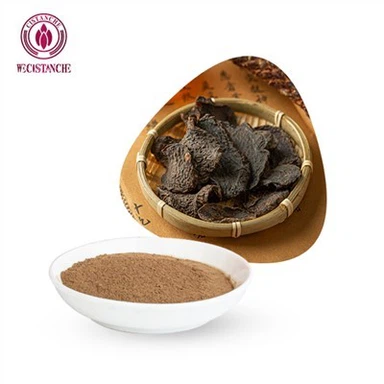
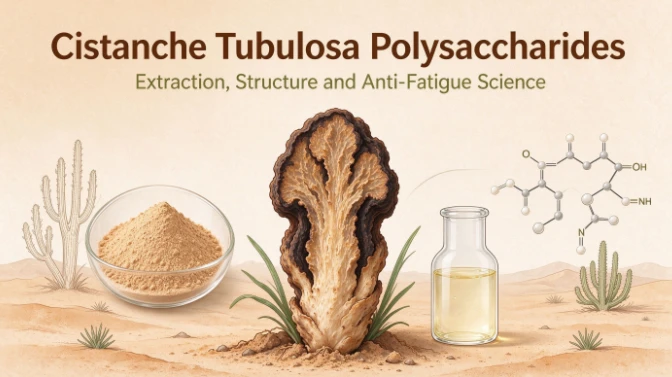
Cistanche tubulosa (管花肉苁蓉) is a parasitic plant that belongs to the Orobanchaceae family. Like its close relative Cistanche deserticola, it does not grow on its own. Instead, it attaches its roots to hardy desert hosts - most commonly the saxaul tree (Haloxylon species) - and draws water and nutrients from them.
It is native to the dry, sun-drenched regions of northwest China, particularly Xinjiang, where it has been harvested and used for centuries. Its long history in traditional medicine, combined with modern nutritional interest, has earned it the nickname "desert ginseng" - a nod to both its rarity and its reputation as a tonic for strength and vitality.
What Makes It Special?
The plant's value lies not in one single molecule but in a rich cocktail of bioactive compounds. The main families include:
Phenylethanoid glycosides - most notably echinacoside and verbascoside (acteoside) - which are the signature actives of cistanche and the focus of much research on antioxidants and brain health.
Polysaccharides - long chains of sugar molecules that are increasingly recognized for their roles in immune support, antioxidant activity, blood-sugar regulation, and, as this study shows, fighting fatigue.
Iridoids and other minor compounds - which round out the plant's complex chemistry.
Of these, polysaccharides are the star of the research we are about to explore.
Part 2: Why Polysaccharides Matter
Polysaccharides are large carbohydrates made up of many sugar units linked together. Think of them as the carbohydrate equivalent of long chains of beads - each bead is a simple sugar like glucose or mannose, and the way they are arranged determines the chain's structure and behavior.
Over the past two decades, plant polysaccharides have been shown to do much more than supply energy. Studies report they can:
Support the immune system
Act as natural antioxidants, helping neutralize free radicals
Help regulate blood sugar
Contribute to anti-fatigue effects during exercise
For cistanche, polysaccharides are considered one of the primary classes of active compounds behind the herb's pharmacological effects. But here is the catch: getting those polysaccharides out of the tough plant tissue is not always easy. The extraction method matters enormously - it determines how much you get, how pure it is, and whether the delicate sugar structures survive the process.
This is exactly the problem the Xinjiang researchers set out to solve.
Part 3: The Challenge of Extraction - and Why Ultrasound Helps
The Old Way: Hot Water, Long Hours
The traditional way to extract plant polysaccharides is hot-water extraction - essentially steeping the powdered plant in hot water for a long time. It works, but it has real downsides:
It takes a long time (often two hours or more).
It consumes a lot of energy.
It can degrade heat-sensitive polysaccharides, damaging their structure and, in turn, their biological activity.
Other methods - reflux extraction, microwave-assisted extraction, and combined ultrasonic-microwave extraction - have been tried with varying success. One earlier study found that ultrasonic-microwave co-extraction achieved a yield of about 11%, better than hot water, but it required high power (around 550 W) and more sophisticated equipment.
Why Ultrasound Is Different
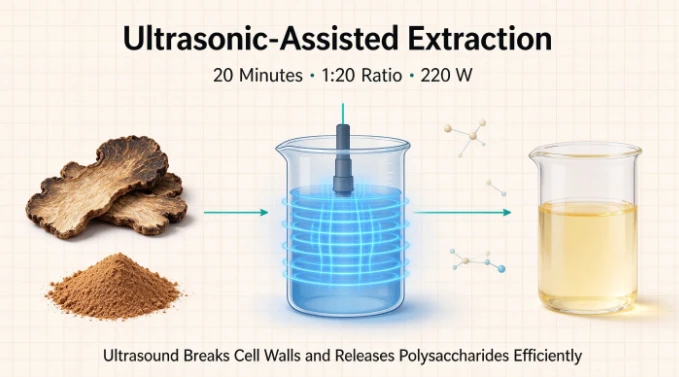
Ultrasonic-assisted extraction works on a simple but powerful principle: high-frequency sound waves create microscopic bubbles in the liquid - a phenomenon called cavitation. When these bubbles collapse, they release focused bursts of energy that break down plant cell walls from the inside, allowing the polysaccharides to dissolve into the water more quickly and completely.
The advantages are attractive:
Much shorter extraction time
Lower processing temperatures, protecting heat-sensitive molecules
Better yields with less solvent
Simpler equipment and operation
But to get the best result, the process needs to be tuned: the right ultrasonic time, the right ratio of plant to liquid, and the right power. Getting these parameters wrong wastes both material and energy.
Part 4: How the Researchers Found the "Sweet Spot"
Rather than guessing, the team used a systematic approach combining single-factor experiments and a statistical technique called response surface methodology (RSM).
Step 1: Single-Factor Experiments
First, the researchers tested each variable one at a time:
Solid-to-liquid ratio: Yield rose as the ratio increased, peaked at 1:20 (about 5.7%), then declined. Beyond that point, extra water actually diluted the polysaccharides so much that they no longer precipitated cleanly with alcohol - a subtle but important loss.
Ultrasonic power: Yield climbed steadily as power rose from 125 W to 200 W. Pushing to 225 W gave only a tiny gain, not statistically significant. Weighing efficiency against energy cost, the team settled on 200 W as the working level.
Ultrasonic time: Yield increased up to about 20 minutes (reaching about 8.4%), then plateaued. Longer times added little, because extraction had essentially reached saturation - and prolonged sonication risked degrading the sugars.
These experiments identified the rough neighborhood of the optimum.
Step 2: Response Surface Optimization
With those clues, the team built a more sophisticated statistical model - a Box–Behnken design with three factors (time, solid-to-liquid ratio, and power) and three levels each. This approach maps out the entire "landscape" of yield across all possible combinations and identifies interactions between the factors - not just their individual effects.
The model performed beautifully. It was highly significant, the fit was excellent (R² ≈ 0.997), and the lack-of-fit test was not significant - meaning the model accurately captured the real relationships. It revealed that all three factors mattered, and that power interacted significantly with both time and ratio.
Step 3: The Optimal Recipe
The model predicted an optimal yield at roughly 20 minutes, a 1:22 ratio, and about 220 W. To keep things practical and energy-efficient, the researchers adjusted to 20 minutes, a 1:20 ratio, and 220 W.
The verification run confirmed the recipe: the actual yield was 8.55%, very close to the model's prediction of 8.95% - a difference of just 0.4%, strong proof that the model worked.
Why These Numbers Matter
This optimized process offers clear advantages over traditional methods:
Time: 20 minutes of ultrasonic extraction versus 120 minutes of hot-water extraction - a reduction of about 83% in extraction time.
Yield: Comparable to or better than hot-water extraction, achieved in a fraction of the time.
Energy: The 220 W power is far lower than the 550 W needed for ultrasonic-microwave co-extraction, cutting energy use while still delivering a strong result.
For anyone involved in producing cistanche supplements, this is practical, industrial-ready information.
Part 5: Separating the Sugars - One Polysaccharide Becomes Four
Raw polysaccharide extract is a mixture. To study individual molecules, the researchers purified the crude extract using a DEAE-52 cellulose chromatography column. This technique separates polysaccharides based on their charge and affinity for the column material, using water and increasingly salty solutions to wash out different fractions.
The process yielded four distinct polysaccharide fractions:
表格
| Fraction | Type | Yield (%) | Recovery (%) |
|---|---|---|---|
| CPN | Neutral polysaccharide | 40.3 | 78.3 |
| CPA-1 | Acidic polysaccharide | 22.6 | 89.6 |
| CPA-2 | Acidic polysaccharide | 13.7 | 65.4 |
| CPA-3 | Acidic polysaccharide | 9.2 | 52.7 |
In plain terms, the crude extract split into one neutral fraction (CPN) and three acidic fractions (CPA-1, CPA-2, CPA-3). The neutral fraction made up the largest share - 40.3% - and recovered well during purification.

Part 6: Which Fraction Is the Best Antioxidant?
Antioxidant activity is a key indicator of whether a polysaccharide has real biological potential. The team tested all four fractions using two standard laboratory assays - the DPPH and ABTS free-radical-scavenging tests - and ranked them by the concentration needed to achieve 50% scavenging (the IC50; a lower value means stronger activity).
The ranking was consistent across both assays:
CPA-2 > CPN > CPA-1 > CPA-3
Two findings stand out:
The acidic fraction CPA-2 was the strongest antioxidant. Its activity likely comes from its carboxyl (–COOH) groups, which can donate protons to neutralize free radicals - a known mechanism for acidic polysaccharides.
The neutral fraction CPN was a close second. This is more surprising. Neutral polysaccharides generally have weaker antioxidant activity than acidic ones, but CPN made up for it through its molecular structure. It contains a significant portion of low-molecular-weight sugars - smaller chains that dissolve easily, cross cell membranes readily, and present a large contact surface to free radicals.
Because CPN had the highest yield (40.3%), a good recovery rate (78.3%), and strong antioxidant activity, the researchers chose CPN for the deeper structural analysis and the fatigue study that followed.
Part 7: A Molecular Portrait of CPN
Before testing whether CPN could fight fatigue, the team wanted to know exactly what it was made of. Three analytical techniques painted the picture.
Infrared Spectroscopy: Confirming It Is a Polysaccharide
Fourier-transform infrared (FTIR) spectroscopy revealed the classic signature of a polysaccharide:
A broad, strong absorption around 3400 cm⁻¹ from the O–H bonds of sugar molecules
Characteristic C–H stretching and bending bands
Peaks indicating pyranose ring structures - the six-membered rings typical of many plant polysaccharides
An α-glycosidic linkage signal around 848 cm⁻¹
In short, the analysis confirmed that CPN is a genuine, well-formed polysaccharide with the expected chemical fingerprint.
Molecular Weight: A Two-Part Story
Using high-performance gel permeation chromatography (HPGPC), the researchers found that CPN is not one uniform molecule but contains two components with very different molecular weights:
A larger component with a weight-average molecular weight of about 6,253 Da, showing moderate polydispersity (spread of sizes)
A smaller component of about 1,177 Da, with a narrow, uniform size distribution - making up the majority of the material (about 78%)
This two-part structure turns out to be functionally meaningful, as we will see in the fatigue discussion.
Monosaccharide Composition: Mostly Glucose
Using ion chromatography, the team identified the building blocks of CPN:
Glucose: 99.75% of the monosaccharides
Mannose: 0.25%
So CPN is essentially a glucose-dominant polysaccharide with a small mannose component - a structure consistent with other cistanche polysaccharides reported in the literature, though the exact composition varies with extraction method and source.
Part 8: The Big Question - Does CPN Fight Fatigue?
Antioxidant activity is one thing; a real effect on the body is another. To find out whether CPN actually helps with fatigue, the researchers turned to a well-established animal model: the weight-loaded forced swimming test in mice.
How the Test Works
Mice were divided into five groups:
A blank control group (given saline)
A positive control group (given a reference polysaccharide from shiitake mushrooms)
Three groups given CPN at low (150 mg/kg), medium (300 mg/kg), and high (600 mg/kg) doses
After 15 days of treatment, each mouse was fitted with a weight equal to 7% of its body mass and placed in a pool to swim until exhaustion. The time from entering the water to the point of exhaustion is a direct measure of endurance and fatigue resistance.

The Results: Clear and Consistent
The swimming times told a clear story:
Blank control: about 324 seconds
Low-dose CPN: 348 seconds (not statistically significant)
Medium-dose CPN: 409 seconds - significantly longer than control
High-dose CPN: 489 seconds - highly significantly longer (about 51% longer than control)
Shiitake polysaccharide (positive control): 500 seconds
In plain terms, CPN significantly extended how long the mice could swim, and the effect grew with dose - a classic sign of a genuine biological effect.
Beyond Swimming: The Biochemistry of Fatigue
The researchers didn't stop at timing. They measured three biochemical markers that underlie fatigue:
Blood urea nitrogen (BUN) - A byproduct of protein breakdown during prolonged exercise. Higher levels indicate the body has started using muscle protein for energy, a sign of fatigue. CPN at medium and high doses significantly reduced BUN compared to control.
Blood lactate (BLA) - Produced when muscles work harder than the body's oxygen supply allows. Accumulation is a direct driver of that burning, heavy feeling in muscles. High-dose CPN significantly lowered blood lactate.
Liver glycogen - The body's primary stored form of quick energy, drawn upon during exertion. More glycogen means more fuel for endurance. CPN at medium and high doses significantly increased liver glycogen.
Taken together, the results are coherent: CPN helped the mice swim longer while improving the underlying markers of fatigue - less protein breakdown, less lactate accumulation, and more stored energy.
Part 9: Why Does It Work? - Connecting Structure to Effect
The researchers offered a thoughtful interpretation of why CPN works, connecting its structure directly to its function.
Antioxidant Relief: Reducing the Damage
Intense exercise generates a flood of reactive oxygen species (free radicals) that damage cell structures and lower energy efficiency - a process called oxidative stress. Because CPN showed strong antioxidant activity, it likely helps by neutralizing these free radicals and protecting cells from exercise-induced damage. Its neutral, stable structure also makes it more resistant to the body's acids and temperature changes than many acidic polysaccharides, helping it stay active as it travels through the digestive system.
Fuel Management: Fast Energy, Then Sustained Energy
CPN's two-part molecular structure may be its cleverest feature:
The low-molecular-weight component (about 78% of the material) has short chains that dissolve easily and are absorbed quickly. It can be rapidly converted to glucose and provide fast energy - the kind needed at the start of exertion.
The larger component breaks down more slowly in the digestive tract, releasing sugars gradually and providing sustained energy for longer endurance.
This "fast release plus slow release" pattern helps prevent the sudden energy drop that triggers fatigue. Glucose, the dominant monosaccharide, can be rapidly routed into glycogen synthesis and directly into the energy pathways muscles use. The small mannose fraction may support this further by helping regulate the enzymes that control glycogen storage and breakdown.
One Proposed Mechanism: Antioxidant + Energy Regulation
Combining these threads, the researchers proposed a dual mechanism for CPN's anti-fatigue effect:
Reduce damage: by clearing free radicals and protecting mitochondria (the cell's energy factories)
Enhance supply: by boosting liver glycogen reserves and optimizing how energy is produced and delivered
This "reduce damage on one side, boost supply on the other" model is elegant and consistent with all their observations - though they are careful to note that more research is needed to confirm it fully.

Part 10: What This Means for You
So what does all of this mean if you are thinking about Cistanche tubulosa supplements?
1. Extraction Quality Matters More Than You Might Think
The way a polysaccharide is extracted changes its structure, and its structure changes its activity. A well-optimized, gentle extraction (like the ultrasound method here) preserves the delicate sugar structures better than harsh, prolonged hot-water extraction. When you choose a supplement, the extraction and processing method is a genuine quality factor - not just marketing.
2. Polysaccharides Are a Real, Measurable Active
Beyond the famous phenylethanoid glycosides (echinacoside and verbascoside), polysaccharides are a scientifically validated component of cistanche with their own distinct benefits - in this case, documented antioxidant and anti-fatigue activity. A high-quality product should tell you about its polysaccharide content, not just its glycoside content.
3. The Evidence Is Building, Step by Step
This study is a carefully designed piece of the puzzle: it optimized extraction, purified the polysaccharides, characterized their structure, and confirmed anti-fatigue activity in an animal model. It adds real, reproducible data to the body of evidence on cistanche. As always, animal results don't automatically translate to humans, but they justify the further research - and eventual human trials - needed to confirm the effects.
4. Context Still Matters
No supplement works in a vacuum. Sleep, diet, training load, and overall lifestyle are the foundations of energy and recovery. A botanical like cistanche is best understood as a thoughtful addition to that foundation, not a replacement for it.
Part 11: The Road Ahead
The Xinjiang study leaves several promising doors open:
Separate and study the two molecular-weight components of CPN to understand exactly which one delivers which benefit.
Move from animal models toward human studies to confirm the anti-fatigue effects in real people.
Explore combinations of cistanche polysaccharides with its glycosides, and with other botanicals, to find synergistic formulations.
Scale the optimized extraction process for industrial production, which the study's practical parameters (20 minutes, 1:20 ratio, 220 W) make feasible.
For producers and formulators, this research is directly actionable - it offers a validated, energy-efficient extraction recipe and a clear story about the active molecules behind cistanche's traditional reputation.

Final Thoughts: From Desert Herb to Modern Fatigue Science
For over a thousand years, Cistanche tubulosa has been treasured as a tonic for strength and stamina. What modern science is now doing is turning that ancient reputation into something measurable: identified molecules, optimized processes, and testable effects.
The polysaccharides inside this desert plant are more than just sugar - they are structurally complex molecules with demonstrated antioxidant power and a genuine, dose-dependent effect on endurance and the biochemistry of fatigue. And because they can now be extracted efficiently and gently, they are practical targets for real products.
Whether you are a formulator looking for an evidence-backed functional ingredient, a supplier telling your sourcing story, or simply someone curious about the science behind a traditional desert herb, Cistanche tubulosa polysaccharides offer a compelling example of how old wisdom and new science can meet - one careful experiment at a time.
This article is for informational and educational purposes only and is based on published research on the ultrasonic-assisted extraction, structural characterization, and anti-fatigue activity of Cistanche tubulosa polysaccharides. It is not medical advice and does not diagnose, treat, or prevent any disease. Consult a qualified healthcare professional before using any supplement, especially if you are pregnant, nursing, taking medication, or managing a health condition.