Concomitant Proton Pump Inhibitors And Outcome Of Patients Treated With Nivolumab Alone Or Plus Ipilimumab For Advanced Renal Cell Carcinoma
Feb 20, 2022
Contact:jerry.he@wecistanche.com
Veronica Mollica1 · Matteo Santoni2 · Marc R. Matrana3 · Umberto Basso4 · Ugo De Giorgi5 · Alessandro Rizzo1 · Marco Maruzzo4 · Andrea Marchetti1 · Matteo Rosellini1 · Sara Bleve5 · Diana Maslov3 · Karine Tawagi3 · Ernest Philon3 · Zoe Blake6 · Francesco Massari1
Accepted: 26 November 2021
© The Author(s), under exclusive licence to Springer Nature Switzerland AG 2021

Cistanche can improve kidney function
Abstract
Background Immune checkpoint inhibitors (ICIs) represent the standard of care as first- or second-line treatment in patients with renal cell carcinoma (RCC). Proton pump inhibitors (PPIs) are among the most prescribed drugs worldwide and are known to affect gut microbiota, which is gaining interest in its association with outcomes for patients on ICIs.
Objective The aim of this study was to evaluate the impact of PPIs on outcomes in RCC patients receiving immunotherapy. Patients and Methods We retrospectively collected data from patients with metastatic RCC who received the combination of ipilimumab and nivolumab for first-line treatment (Cohort 1) or single-agent nivolumab for second-line or third-line treatment (Cohort 2) from fve international centers with expertise in the treatment of RCC. Data about clinicopathological characteristics, PPI use, and outcome on ICIs were collected. The endpoints of the study were objective response rate (ORR), progression-free survival (PFS), and overall survival (OS).
Results Two hundred and eighteen patients (71% male, median age 61 years) were included in the analysis, 62 in Cohort 1 (including 25 patients receiving PPIs) and 156 in Cohort 2 (including 88 patients receiving PPIs), and were followed up for a median of 42 months. In Cohort 1, no diference was observed in ORR (48% vs 57%; p = 0.203), PFS (12.2 vs 8.5 months; p = 0.928), or OS (not reached [NR] vs 27.3 months; p = 0.84). In Cohort 2, no diference was observed in ORR (32% vs 28%; p = 0.538), PFS (6.7 vs 9.0 months; p = 0.799), or OS (16.0 vs 26.0 months; p = 0.324).
Conclusions In patients with RCC, concomitant PPI use did not seem to affect survival outcomes on ICIs, either as combination therapy or monotherapy.K
Key Points
We investigated the impact of proton pump inhibitors (PPIs) on the clinical outcome of renal cell carcinoma (RCC) patients receiving immunotherapy.
According to our results, PPIs do not seem to influence immune checkpoint inhibitor activity in RCC patients, which is consistent with some of the previously available data.

1 Introduction
Renal cell carcinoma (RCC) incidence is increasing, with about 76,000 new cases estimated in 2021 in the United States (US) [1, 2]. Immune checkpoint inhibitors (ICIs) are the new standard of care in the treatment of metastatic RCC, either as monotherapy or combination treatment, and the rapidly changing landscape of systemic therapy in RCC has prompted clinicians to consider the expansion of immuno- therapy to the earlier stages of the disease (for example, in the adjuvant setting). Several immune-based combinations, including dual checkpoint blockade (nivolumab plus ipili- mumab) or ICI plus tyrosine kinase inhibitors (TKIs) (pem- brolizumab plus axitinib, avelumab plus axitinib, nivolumab plus cabozantinib, pembrolizumab plus lenvatinib) have been found to be associated with favorable outcomes in frst- line treatment [3–7]. Following the results of these combina- tion approaches, the frst-line treatment of metastatic RCC was revolutionized, but comparisons among these thera- peutic options are not available; thus, the decision-making process takes into account several prognostic and clinical factors [8–10]. In later lines of therapy, nivolumab mono-therapy was superior to everolimus, thus becoming one of the main treatment strategies for pretreated patients [11].
The gut microbiota is composed of a wide spectrum of bacteria and microorganisms that physiologically reside in the gastrointestinal tract and regulate several functions, including drug metabolism, as well as activity and toxicity of antitumoral compounds [12]. Preclinical and clinical evi- dence indicated that ICI activity can be modified by gastro- intestinal microbiota. In fact, several retrospectives and a few prospective studies demonstrated that antibiotic treatment can infuence ICI efcacy by altering the normal bacterial microenvironment and, consequently, the immune system activity [13–15].
Proton pump inhibitors (PPIs), largely used for gastro- intestinal disorders, including gastro-esophageal reflux or gastric ulcers, act by modifying gastric acidity through the inhibition of hydrogen–potassium pumps with subsequent suppression of acid production [16]. This dysregulation of the gastric pH leads to modification of the gut microbiota with a decreased alpha diversity. In particular, it has been pointed out that PPI use can lead to an increased prevalence of Lactobacillales (especially Streptococcaceae), Actino- bacteria (in particular Actinomycetales), and Clostridiales (especially Ruminococcaceae) [17, 18]. This altered micro- biota composition can lead not only to an increased risk of Clostridium difcile infections but also to a modifed response to ICIs due to an alteration of the immune system response. Moreover, quantitative metagenomics of patient stool samples provided evidence that some bacteria species seem to be more immunogenic, eliciting a higher immune response, such as Bifidobacterium, Akkermansia, and Bacte- roides [13, 19, 20]. In particular, the presence of Akkerman- sia muciniphila has been correlated to favorable outcomes in patients with non-small cell lung carcinoma or RCC [13]. We conducted a retrospective study to analyze the efect of PPIs on survival outcomes for patients with metastatic RCC receiving nivolumab plus ipilimumab in first-line treatment or nivolumab monotherapy in second or third-line therapy.
2 Patients and Methods
2.1 Study Population
We retrospectively analyzed data from patients aged ≥ 18 years with a histologically confrmed diagnosis of RCC and histologically or radiologically confirmed metastatic dis- ease, treated with the combination of first-line nivolumab plus ipilimumab or nivolumab as second- or third-line therapy. This international real-world study collected data from fve institutions from Italy and the US involved in the treatment of advanced RCC (Bologna—Italy; Macerata—
Italy; New Orleans—USA; Padova—Italy; Meldola—Italy).
Data collection included data from 1 January 2010 to 21 July 2021.We retrospectively extracted data from paper and electronic charts. For each institution, we created a database and collected patient data on histology, nephrectomy sta- tus, initial Eastern Cooperative Oncology Group (ECOG) performance status, International Metastatic RCC Database Consortium (IMDC) criteria, sites of metastases, and con- comitant PPI use. Patients without sufficient data on tumor assessment or response to therapy were excluded from our analysis.
The study population was divided into two cohorts: Cohort 1 included patients receiving the combination of nivolumab plus ipilimumab as first-line therapy, and Cohort 2 was composed of patients treated by nivolumab mono-therapy as second- or third-line therapy.
As frst-line therapy, nivolumab (3 mg per kilogram of body weight) plus ipilimumab (1 mg/kg) were administered intravenously every 3 weeks for four doses, followed by nivolumab (3 mg/kg) every 2 weeks. A nivolumab mon- otherapy fat-dosing of 240 mg every 2 weeks or 480 mg monthly was administered in patients receiving second- or third-line immunotherapy. Treatment interruptions were car- ried out following National Comprehensive Cancer Network (NCCN) guidelines according to type and severity of adverse events. Treatment was continued until there was evidence of clinical or radiological tumor progression on computed tomography (CT) or magnetic resonance imaging (MRI) scans, unacceptable toxicities, or death. Follow-up was con- ducted through periodic physical and laboratory tests every 4–6 weeks. Imaging was performed following standard local procedures every 8–12 weeks.
Information regarding PPI therapy as concomitant medi- cation was retrieved from medical records and collected at every clinical visit. PPI administration was started either before or concomitantly to ICI start; patients that started PPIs during the course of immunotherapy were excluded from the study. In case of missing or incomplete informa- tion, patients were excluded from the study.
The study was approved by the local Institution Review Boards and was conducted in accordance with the principles of the Declaration of Helsinki (6th revision, 2008).
2.2 Study Endpoints
Tumor radiological imaging was performed based on the RECIST 1.1 criteria [21]. Data on tumor response (complete or partial responses, stable or progressive disease) were col- lected and analyzed. Progression-free survival (PFS) was defned as the time from the start of treatment to progression or death from any cause. Patients without tumor progression or death or lost to follow-up at the time of the analysis were censored at their last follow-up date. Overall survival (OS) was defned as the time from the start of therapy to death from any cause.
2.3 Statistical Analysis
The Kaplan-Meier method with Rothman’s 95% confidence intervals (CI) was used to estimate PFS and OS, while com- parisons were performed using the log-rank test. Univariate analysis was carried out by Cox proportional hazards mod- els. The chi-square test was used to compare categorical end- points, and significance levels were set at a 0.05 value, with all p values being two-sided. The MedCalc version 19.6.4
(MedCalc Software, Broekstraat 52, 9030 Mariakerke, Bel-
gium) was employed for the statistical analysis.
3 Results
3.1 Study Population
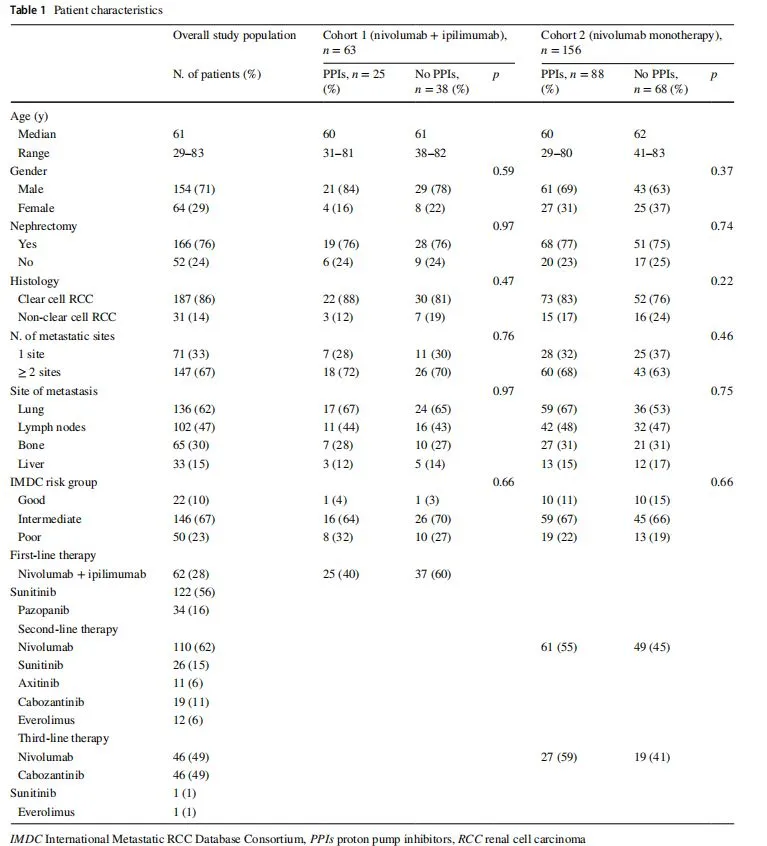
Two hundred and eighteen patients were included in our analysis. The median age was 61 years (range 29−83); 154 patients (71%) were males. Tumor histology was pre- dominantly clear cell (177, 81%); tumor histology in the 41 patients with non-clear cell RCC was papillary type I and II (16 patients), clear cell RCC with sarcomatoid diferentia- tion (11 patients), chromophobe (6 patients), XP11.3 trans- location (1 patient), and unclassifed (7 patients). Number of metastatic sites was two or more in 147 patients (62%). Lung (62%), lymph nodes (47%), and bone (30%) were the most common sites of metastasis. According to IMDC criteria, 22 patients (10%) were at favorable risk, 146 (67%) at inter- mediate risk, and 50 (23%) had poor-risk features. Patients’ characteristics are summarized in Table 1.
Cohort 1 included 62 patients who had received the combination of nivolumab plus ipilimumab as frst-line therapy, while Cohort 2 included 156 patients who received nivolumab monotherapy in the second (71%) or third-line setting (29%). A total of 113 patients (52%) received con- comitant PPIs; of them, 25 (22%) were in Cohort 1 and 88 (78%) in Cohort 2. No signifcant diferences were found in terms of clinico-pathological features between patients receiving concomitant PPIs in both cohorts (Table 1).
3.2 Response to Therapy
One hundred and three patients (46%) were dead at time of data cut-of. In Cohort 1, 19 patients (30%) were receiving ongoing treatment at time of data cut-of, while 22 (35%) and 5 patients (8%) received a second-line or third-line therapy, respectively (Table 1). We observed 33 partial responses (53%), 12 stable diseases (19%) and 17 progressive diseases (28%) as best tumor response, with an ORR of 53% and a disease control rate (DCR) of 72%. Partial responses to the combination of nivolumab plus ipilimumab were observed in 12 of the 25 patients receiving concomitant PPIs (48%) and in 21 of the 37 patients not receiving PPIs (57%), though it was not a statistically signifcant diference (p = 0.203).
In Cohort 2, 42 patients (30%) were continuing treatments at the time of data cut-of; 43 patients (28%) treated with nivolumab as second-line therapy received successive third- line therapies (Table 1). Overall, we registered 47 partial responses (30%), 37 (34%) of them in the second-line set- ting and 10 (22%) in third-line setting. Stable disease was observed in 48 patients (31%), 31 (32%) with nivolumab as second-line and 17 (37%) as third-line therapy. Progressive disease was the best tumor response in 50 patients, 31 (34%) in the second- and 19 (41%) in the third-line setting. Partial responses were reported in 28 of the 88 patients receiving concomitant PPIs (32%) and in 19 of the 68 patients not receiving PPIs (28%); this diference was not statistically signifcant (p = 0.538).

3.3 Survival Analysis
The median follow-up time from RCC diagnosis was 42.1 months (range 35.0−159.1). The median OS from the start of nivolumab plus ipilimumab treatment was 27.3 months (95% CI 17.8−28.1). No signifcant diferences were found between patients with or without concomitant PPIs (not reached [NR], 95% CI NR−NR vs 27.3 months, 95% CI 17.3−28.1; p = 0.842, Fig. 1). At univariate analy- sis, only IMDC criteria were predictors of OS, while the
IMDC International Metastatic RCC Database Consortium, PPIs proton pump inhibitors, RCC renal cell carcinoma
administration of concomitant PPIs was not correlated with patients’ outcome (p = 0.842, Table 2).
In Cohort 1, the median PFS from the start of nivolumab plus ipilimumab was 10.4 months (95% CI 5.9−21.5). As for OS, no signifcant diferences were observed between patients with or without concomitant PPIs (12.2 months, 95% CI 2.3−16.3 vs 8.5 months, 95% CI 5.8−21.5; p = 0.928, Fig. 1). At univariate analysis, no factors were found to be signifcantly correlated with PFS (Table 2).

Fig. 1 Overall survival and progression-free survival of mRCC patients treated with frst-line nivolumab plus ipilimumab (Cohort 1) based on the assumption of concomitant PPIs. mRCC metastatic renal cell carcinoma, PPIs proton pump inhibitors

In Cohort 2, the median OS was 20.8 months (95% CI 12.6−26.8). Furthermore, it was 16.0 months (95% CI 9.4−23.5) in patients receiving concomitant PPIs and 26.0 months (95% CI 14.5−47.0) in patients not receiving PPIs (p = 0.324, Fig. 2). At univariate analysis, only the correlation between IMDC criteria and OS was approaching signifcance (p = 0.068, Table 3).
The median PFS was 7.1 months (95% CI 4.6−61.1) and was signifcantly longer in patients with clear cell histol- ogy (8.9 months, 95% CI 6.1−61.1 vs 4.6 months, 95% CI 2.8−45.5; p = 0.004, Fig. S1 in the electronic supplemen- tary material). Similar to Cohort 1, no signifcant diferences were found between patients with or without concomitant PPI use (6.7 months, 95% CI 4.6−61.5 vs 9.0 months, 95% CI 3.7−45.5; p = 0.799, Fig. 2). At univariate analysis, RCC histology was signifcantly associated with PFS (p = 0.004), while concomitant PPIs and other analyzed factors were not correlated (Table 3).
4 Discussion
We assessed the efect of PPI use on ICI treatment in patients with metastatic RCC and showed that in patients treated with either ICI combination treatment or monotherapy, there was no diference in terms of OS, PFS, and ORR between patients with or without concomitant PPI use.
PPIs are widely used in clinical practice for gastrointesti- nal disorders and also for symptoms arising during antican- cer treatment, including drug- or tumor-induced dyspepsia. PPI-induced hypochlorhydria has been shown to alter gut microbiota by reducing its alpha diversity, which in turn has been associated with reduced beneft on ICIs in multiple cancer types [17]. In everyday clinical practice, the use of antibiotics within 30 days from the start of treatment was associated with worse outcomes in patients afected by dif- ferent tumor types and receiving ICIs, supporting the nega- tive prognostic role of microbiota-altering drugs in this set- ting [14]. Indeed, the role of PPIs on ICI activity in patients

Fig. 2 Overall survival and progression-free survival of mRCC patients treated with nivolumab monotherapy as second- or third-line therapy (Cohort 2) basing on the assumption of concomitant PPIs. mRCC metastatic renal cell carcinoma, PPIs proton pump inhibitors

w
with diferent solid tumors has been widely investigated in retrospective series, although results were mixed [22–27]. Remarkably, an individual-participant data analysis from IMvigor 210 [28] and IMvigor 211 [29] trials of single- agent atezolizumab in 1360 patients with urothelial carci- noma showed that PPI use was associated with worse OS in
patients receiving atezolizumab, but not in those receiving chemotherapy, suggesting a negative efect of PPIs on out- comes in ICI-treated patients with urothelial carcinoma [30].
The efect of PPIs has been previously investigated in patients with metastatic RCC treated with TKIs, which was the standard of care for many years. Also in this population, PPIs did not appear to infuence treatment response, even though TKIs are oral drugs for which gastric pH plays a cru- cial role in the absorption process [31]. Similar to what was observed in patients with urothelial carcinoma [30], altera- tions in gut microbiota composition caused by TKIs and antibiotics negatively afected ICI outcomes in patients with RCC in a retrospective series [32]. Nevertheless, Kulkarni et al. investigated the role of antibiotics and PPI on the out- comes of 148 and 55 patients with non-small-cell lung can- cer and RCC, respectively, who received ICI treatment [25]. While antibiotics use was found to afect PFS, PPI use did not infuence outcomes. Furthermore, a recent meta-analysis conducted by Li and colleagues on the efect of PPIs on ICI outcomes, which included fve studies for a total of 1167 cancer patients, demonstrated no impact of PPI use on OS or PFS [33]. The studies collected for the analysis included patients with non-small-cell lung cancer, melanoma, RCC, and other tumors, that presented contrasting results [33–38]. Despite including patients with diferent tumor types and only a small subset of patients with RCC, these results are concordant with those of the present study and support our fndings in a larger population.
The main strengths of our study are the large sample size consisting only of patients with RCC, as well as the level of expertise on RCC malignancies through the involved onco- logic centers.
Our study’s limitations are mainly due to its retrospec- tive nature. First, we did not perform a centralized review of radiological imaging and histology; in addition, data about the concomitant use of medications other than PPIs that could infuence the efcacy of immunotherapy (e.g., antibiotics) was not collected. The population of Cohort 1 was limited, including only 62 patients due to the relatively recent introduction of the nivolumab plus ipilimumab com- bination in clinical practice. Lastly, there was not a prior estimation of the sample size that would be needed to assess the hypothesis that PPI use could change ICI efcacy in RCC patients. Based on these premises, the lack of a signifcant efect may just refect that the sample size and the statistical power were not sufcient.
Furthermore, another factor to keep in mind and that should be investigated in future specifc studies is the impact of gut microbiota alteration due to PPI use on ICI activity, considering the preliminary evidence that microbiota com- position seems to be a factor that infuences the response to immunotherapy. In this regard, metagenomics analy- ses could further increase the knowledge on the bacterial composition modifcations consequent to PPI use and their correlation with clinical outcomes of patients treated with immunotherapy.

5 Conclusion
While a prospective validation of our fndings would be desirable, our study suggest that PPIs do not seem to infu- ence ICI activity in RCC patients, which is consistent with some of the previously available data. Given the wide use of these drugs to treat and prevent gastrointestinal toxicities and diseases, these fndings may be useful in everyday clini- cal practice for clinicians treating RCC patients with ICIs.
Supplementary Information The online version contains supplemen- tary material available at https://doi.org/10.1007/s11523-021-00861-y.
Declarations
Funding No external funding was used in the preparation of this manu- script.
Conflict of interest Veronica Mollica, Matteo Santoni, Marc R. Matra- na, Umberto Basso, Ugo De Giorgi, Alessandro Rizzo, Marco Maru-
zzo, Andrea Marchetti, Matteo Rosellini, Sara Bleve, Diana Maslov,
Karine Tawagi, Ernest Philon, Zoe Blake, and Francesco Massari de- clare that they have no conficts of interest that might be relevant to the contents of this manuscript.
Ethics approval and consent to participate Not required. Informed consent was not required due to the retrospective nature of the study.
Availability of data and material Data are available upon reasonable request.
Code availability Not applicable.
Author contributions Conception and design: VM, MS, and FM. Col-
lection and assembly of data: VM, MS, and FM. Provision of study
material or patients: all authors. Data analysis and interpretation: MS and FM performed the data analysis, all authors interpreted the data.
Manuscript writing: VM, MS, and FM. Review of manuscript draft: all authors. Final approval of manuscript: all authors. Accountable for
all aspects of the work: all authors.