Critical Interpretative Synthesis Of Herd Immunity For COVID‑19 Pandemic
Apr 10, 2023
Abstract
Introduction:
Countries globally are evaluating the concept of herd immunity and its critical role in the control of the pandemic. The current paper attempts to conduct a critical interpretative synthesis (CIS) on the role of herd immunity in the current COVID‑19 pandemic.
Methods:
CIS is a tool for developing a theoretical framework using interpretation drawn from relevant empirical and non‑empirical sources. This review is done by formulating review questions for the literature search. Purposive sampling of literature was done followed by a reciprocal translational analysis of extracted data.
Immunity can refer to the body's ability to deal with aging, damaged, dead, and degenerated self-cells, and at the same time recognize and deal with mutant cells and virus-infected cells in the body. We think that immunity is the body's ability to resist viruses. Our research has found that Cistanche can enhance the body's immunity. The total glycosides of Cistanche, polysaccharides of Cistanche, and verbascoside can significantly reduce the content of MDA in the liver and brain tissue, and the content of MDA in the heart and brain tissue. The activity of telomerase in the middle is significantly increased, the phagocytic function of peritoneal macrophages is enhanced, and the proliferative response of lymphocytes and the content of IL-2 in peripheral blood is significantly increased, thereby enhancing the immune function of the body.

Click to know what is cistanche
Results:
Herd immunity is indirect protection from a contagious infectious disease when a population is immune either through vaccination or natural immunity developed through previous infection. The reproduction number for COVID‑19 in India was found to be 2.56 and the herd immunity threshold was 61%. Discussion: Exposing 71% young population in India to the SARS‑CoV‑2 infection can achieve herd immunity but with high morbidity as well as mortality. Vaccines are under process. Feco‑oral transmission and reinfection of COVID-19 are major factors in developing or breaking the circle of herd immunity in the community. “Immunity passport” can give a false sense of security. Surveillance and seroprevalence studies assess immunity status, gradual exposure of infection to the younger populations, and collaborative partnerships among organizations are a few strategies to acquire herd immunity.
Conclusion:
Herd immunity is a measure for prevention and control of the COVID‑19 pandemic against the backdrop of mortality and morbidity. The vaccine can be a boon but if herd immunity is to be acquired by the natural infection then preparedness is necessary.
Keywords:
COVID‑19, herd immunity, reproductive number.
Introduction
The pandemic of COVID‑19 started as pneumonia of unknown.
origin on 19th December 2019 in Wuhan, China. On 30th January, WHO declared it a Public Health Emergency of International Concern, and within 2 weeks on 12th February 2020, WHO renamed the disease COVID‑19. In seven months, COVID‑19 infection was transmitted to 215 countries all over the world with more than 32 million confirmed cases (24th September 2020) and a near-death count heading towards 1 million.[1] India is contributing 17.76% of total cases of COVID-19 and struggling hard to contain the community transmission of the infection with a case-doubling rate of 46 days.[2‑4]
India is a country with many challenges in its healthcare system. With one of the lowest GDP investments for the health of 1.28%,[5] India’s healthcare system is not capable toofdaddressinghe the surge capacity of patients during the COVID‑19 pandemic. The technical, financial, and human resources needed far exceed the current capacity of health care in the country. Hence, initial measures were focused on ‘flattening the curve’ for COVID‑19 cases. As the pandemic evolved there was a change in the focus of the pandemic where testing, contact tracing, isolation, and treatment were prioritized.
Another major concern is the challenge in the implementation of health promotion interventions for the control of COVID‑19 along with their sustainability. The practice of frequent handwashing in India as per norms is challenged by the scarcity of water supply and the absence of continuous running water in taps. Wearing masks for prolonged periods is uncomfortable due to extreme weather conditions. Physical distancing is another challenge in the Indian scenario due to the culture of big families and high population density in urban areas and slums. The lockdown was initiated in India at the earliest with high stringency index from 24th March 2020[3] to prevent transmission of infection by keeping off the crowd. But lockdown measures are not sustainable for developing economies like India with poor social support systems for the underprivileged.
In this scenario, another available option to combat the SARS‑CoV‑2 virus is herd immunity which can be either artificially acquired through vaccines or naturally acquired by getting exposed to the infection. Vaccines are still under development so countries globally are evaluating the concept of herd immunity and its critical role in the control of pandemics. The current paper attempts to conduct a critical interpretative synthesis(CIS) on the role of herd immunity in the current COVID‑19 pandemic. CIS is a tool for developing a theoretical framework using insights and interpretation drawn from a wide spectrum of relevant empirical and non‑empirical sources.[4] An exhaustive review of this is needed with due importance given to media reports, interviews of experts, and blogs to bridge the information gap in the limited time frame available.[6]

Methods
The Critical interpretative synthesis (CIS) method was used to review the literature and generate various themes for herd immunity. It was completed in the following steps:
Formulation of review question
The questions were framed for the search for the literature. A 360‑degree review was done around the following questions
• Can herd immunity be used as one of the strategies to control the COVID‑19 pandemic?
• What paradigms and approaches are used to achieve herd immunity?
• What are the challenges in acquiring herd immunity in India?
Literature search
Search engines like PubMed, EMBASE, Google Scholar, and Cochrane databases were used for peer‑reviewed articles regarding herd immunity. Blogs and interviews by subject experts were analyzed critically and only relevant matter to the review questions was included. International and National portals of health organizations, the Census Commission of India, and the Ministry of Health and Family Welfare, Government of India were used to extract statistical data. A web search with Google was undertaken to identify the views of epidemiologists on herd immunity. The data regarding herd immunity and technical terms associated with it were retrieved using keywords ‘herd immunity’, ‘R0’, ‘COVID‑19’, and ‘pandemic’.
Sampling
The number of articles considered for review was based on the inclusion criteria viz. content addressing the review questions along with study design. A purposive sampling technique was used until saturation of the content was observed.
Quality determination
Priority was given to the relevance of the topic for screening the articles, blogs, and interviews rather than methodology or results. This was done purposefully to include the maximum available content on herd immunity to contribute to the synthesis of the theory.
Data extraction
A repetitive and thorough analysis of the retrieved data was done by highlighting the important concepts, making notes, and adding notes and comments as and when required.
Conducting interpretative synthesis
Reciprocal translational analysis (RTA)[6,7] was used. The key metaphors, themes, or concepts in each study report were identified. An attempt was then made to understand the concepts. Similar concepts of different studies based on the themes were studied and analyzed and the concept that was ‘most adequate’ was chosen.[6]

Results
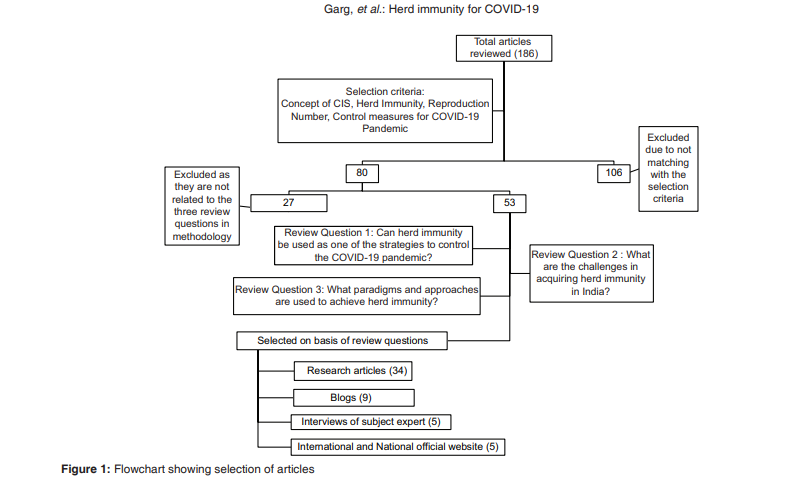
The initial review was done for 186 articles, blogs, newsletters, press notes, interviews of experts in the field of epidemiology, and official websites of international and national health organizations, out of which 80 were selected based on the concept of CIS, herd immunity, and reproduction number. The literature was again screened for the review questions mentioned in the methodology and finally, 34 research articles, 5 interviews of subject experts, 9 blogs, and data from 5 international and national official websites were used to form the themes. [Figure 1]
Definition of herd immunity
Herd immunity is indirect protection from a contagious infectious disease that happens when a population is immune either through vaccination or immunity developed through previous infection.[8] Understanding herd immunity requires consideration of infection dynamics, modes of transmission, as well as the acquisition of immunity by individuals in the population.[9] Sustained transmission of any disease is prevented once the pathogenic organism is unable to find susceptible hosts because of isolation, quarantine, vaccination, or natural immunity after exposure to infection. Isolation and quarantine open doors for reinfection but vaccination or natural immunity after exposure leads to herd immunity offering protection in the long run.
Reproduction number (R0) and Herd Immunity threshold
The reproduction number (R0) is defined as the average number of new infections generated by one infected individual during the entire infectious period in a fully susceptible population. The basic reproduction number reflects the ability of the infection to spread in the infectious period under no control.[10‑12] R0 estimates were important in previous pandemics of H1N1 Influenza (2009) and SARS (2003). Similarly, effective reproduction number (Re) is defined as the average number of secondary cases generated by a single index case over an infectious period in a partially immune population. The epidemiologists are focusing now on the Re of SARS‑CoV‑2 which keeps on changing with the dynamics of the unfolding pandemic as it is dependent on the virulence of the infectious agent, susceptibility of the population to infection, demographics, socioeconomic factors, and climatic changes.[13]
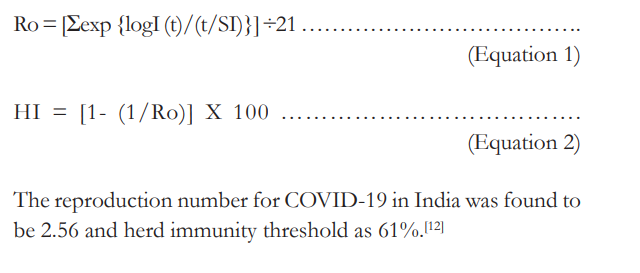
The approach used to estimate the basic reproduction number in the model is to calculate the average R0 based on the daily cumulative cases for 21 days described in Equation 1.
The herd immunity threshold is estimated based on reproduction number by equation 2. Serial Interval (SI) is the time between the onset of a primary and secondary case. Due to the unavailability of detailed data on this parameter we have used SI as 4.4 days as reported in previous studies.[11,12] The herd immunity threshold indicates the resistance to the spread of an infectious disease within a population that results if a sufficiently high proportion of individuals are immune to the disease, especially through vaccination.[12]
Herd immunity as a preventive tool for infections
Herd immunity as a protective tool against infectious diseases differs according to R0 (Reproduction number explained before). Some of the infectious diseases showing protection with herd immunity are described below:
Measles
R0 for measles is 12‑18, which means that each person with measles on average will infect 12–18 other people in a susceptible population.[14] Thus target coverage of measles vaccination is to cover at least 95% population for herd immunity.[14‑16]
Mumps
Mumps has R0 of 10‑12. Thus, for mumps, the herd immunity threshold of 92% is required for the population to be immune to stop disease transmission.[17]
Swine flu (H1N1)
By the time WHO declared a pandemic of Swine Flu in June 2009,74 countries had reported laboratory-confirmed infections.[18] People in Norway successfully developed partial herd immunity to the H1N1 virus through vaccinations and natural immunity. Thus H1N1 swine flu has produced antibodies that are protective against various strains making later outbreaks less severe.[19‑21]
COVID‑19 on Diamond Princess Cruise
Diamond Princess Cruise ship, with 3711 people on board experienced an outbreak of COVID‑19. The median R0 of COVID‑19 was 2.28 (95% CI of 2.06–2.52) during the early stage.[22] Despite R0 being 2.28 out of a total of 3711 people on board 712 (19.18%) were symptomatic patients and 331 (8.9%) were asymptomatic but tested positive for COVID-19.[22] The rest of the 72% population on the ship remained unaffected even after being exposed to the infection. Diamond Princess being a ‘natural cohort’ can be an example of herd immunity which is to be acquired in case of COVID‑19.
Discussion
Anticipating herd immunity in India for COVID 19 pandemic
As per the Census data of India 2011, 84.5% population is from the age group of 5 to 65 years. So even if the vulnerable population is left i.e., less than 5 years (10.7%) and more than 65 years (4.8%),[23] then as per equation 2, a herd immunity threshold of 61% can be easily achieved in India by exposing rest of the population and also excluding people with comorbidities. Currently (as of 23rd September 2020) it is seen that 4106 per million population are affected by COVID‑19 with 125 deaths per million population.[24] A huge chunk of the population is yet to be exposed to achieve the target of herd immunity. Probably at this juncture, herd immunity needs a careful review of its applicability in controlling the current pandemic.
Primary care physicians play an important role in the generation of awareness of herd immunity among the population and are the first point of contact for patients. Early diagnosis by testing asymptomatic patients as well as treatment is an integral part of curbing the pandemic in which primary care physicians are an important link.
Challenges in achieving herd immunity
Only 2.14% of Americans had been infected even after having the highest number of cases globally. Population‑weighted seroprevalence after adjusting for test performance was 0.73% in India.[25] So, countries are far away from achieving the herd immunity threshold of 61% immune population.
However, natural herd immunity, achieved through infection rather than vaccination, can be challenging due to the high rate of serious illness and death, with health systems overwhelmed well beyond their surge capacity, even in high‑income countries.[8] In countries like India with high population density, exposing the population to COVID‑19 infection to acquire herd immunity may prove disastrous and fatal.
The infection fatality rate (IFR) is an important measure to assess the societal cost of achieving global herd immunity. The IFR is defined as the proportion of deaths caused by a certain disease among all infected individuals. Due to asymptomatic cases along with diagnosed cases in infected individuals, the IFR will inherently be lower than the case fatality rate which includes only confirmed cases.[13]
Out of all infected patients, 5% are critically ill with severe lung dysfunction, shock, or extra‑pulmonary organ failure and need hospitalization and ventilation.[26, 27] In the scenario to achieve herd immunity, if 60% of the population is exposed to infection then an enormous number of people will be very sick, which has huge implications for the country as well as strain for the already overburdened health care settings.
Even when vaccines are available, it is not always possible to achieve herd immunity for very long. In the case of the SARS‑CoV‑2 virus, which is seen mutating frequently, will need regularly updated vaccines to maintain the immune status which can be expensive in terms of procurement, research, and development.
Feco‑oral transmission of COVID-19 is another aspect under development. A study of the enteric involvement and viral excretion of SARS‑CoV‑2 in feces is required to investigate whether fecal concentrations of SARS‑CoV‑2 RNA correlate with the severity of the disease and the presence or absence of gastrointestinal symptoms and whether fecal SARS‑CoV‑2 RNA can also be detected in the incubation or convalescence phases of COVID‑19.[28] This is going to be a major factor in developing or breaking the circle of herd immunity in the community.
The World Health Organization and South Korea are investigating about reinfection of the SARS‑CoV‑2 virus. The possible reasons for this were stated as the variable immune response of the patient, re‑exposure to a new strain of virus, or false positive test results.[29] Thus, reinfection can be a major factor in preventing the development of herd immunity.
When a population does not reach the required herd immunity threshold then the overall immunity level is compromised and herd immunity can be lost, putting everyone at risk of the disease.[8] In the study done by Wu et al. on COVID-19 patients, it was found that the formation of neutralizing antibodies against SARS‑CoV‑2 is very common but longitudinal serological studies will be required to measure the duration of effectiveness of antibodies.[13] So far, there is not enough evidence about the effectiveness of antibody‑mediated immunity to guarantee the accuracy of an “immunity passport” or “risk‑free certificate” for people to travel or declare as protected against infection and return to their jobs. People once seropositive for COVID‑19 may ignore public health advice. The use of such certificates may, therefore, increase the risks of continued transmission.[30]
Researchers, policymakers, and public health advocates can consider herd immunity as an option while planning their post‑lockdown strategies to deal with the pandemic but in consideration, other health promotional measures like handwashing, usage of masks, and physical distancing are being followed by the population.

Strategies to acquire herd immunity
• Fever and Influenza-like illness surveillance in the community regularly accompanied by meticulous data monitoring is necessary to evaluate the population exposed to the infection. This will help in the estimation of the time required for the development of herd immunity.
• Longitudinal serosurveys should be done to assess the immune status of the population for the SARS‑CoV‑2 virus in high and low transmission zones.[25]
• Multi‑pronged area‑specific strategy should be made towards the exit plan from this pandemic moving further to achieve herd immunity.
• Geographically tailored approach should be used in the opening of social life with consideration of basic health promotion measures like handwashing and physical distancing. • To achieve a protective level of immunity, gradual exposure to infection can be strategically planned by exposing young healthy individuals first followed by children and the geriatric population. This can be done initially by reopening schools and colleges followed by restarting industries, and agricultural activities, and gradually resuming international travel. On the other hand, simultaneously, the exposed population will be recovering from the infection.
• The general population should be made aware of the concept of reverse quarantine. Reverse quarantine is the isolation of the vulnerable population from the virus. The vulnerable population to COVID‑19 infection includes the elderly, people with existing co‑morbidity, immunocompromised individuals, and children less than 10 years.[31] All of them should be isolated from those going out in the community during the pandemic by decreasing interactions and visits. Preventive measures like physical distancing, hand hygiene, and psychological counseling should be followed to take care of the physical and mental health of the vulnerable under reverse quarantine.
• Correct information related to the disease should be circulated among the population including the concept of herd immunity. Prevention from infodemics will enable people to fight against the disease in the right way.
• Promoting partnerships comprising organizations having common goals and objectives and that combine resources is needed to implement research for vaccine development. Partnerships can reduce the duplicity of efforts, ensure the synergy of resources, and augment the overall leadership within the country.
Conclusion
Herd immunity is a measure for prevention and control of the COVID‑19 pandemic against the backdrop of mortality and morbidity with a huge burden on the healthcare system. If herd immunity is to be acquired naturally by exposing at least 60% of the 5–65 years (84.5%) population to SARS‑CoV‑2 infection, then preparedness is necessary for terms of healthcare facilities with economic implications. Focus is needed on research aiming at appropriate strategies, identification of challenges and approaches to acquire herd immunity along with the development of a vaccine.[32-43] Testing, treatment, tracing, teamwork, and tracking with monitoring and surveillance are the tools to measure the time required to acquire herd immunity to contain the COVID‑19 pandemic and associated multifaceted implications in the global and Indian contexts.
Financial support and sponsorship
Nil.

Conflicts of interest
There are no conflicts of interest.
References
1. WHO | World Health Organization [Internet]. [cited 2020 Sep 24].
2. Press Information Bureau [Internet]. [cited 2020 Sep 24].
3. Ellen ME, Wilson MG, Vélez M, Shach R, Lavis JN, Grimshaw JM, et al. Addressing overuse of health services in health systems: A critical interpretive synthesis. Health Res Policy Syst 2018;16:48.
4. CBHI National health portal 2019.pdf [Internet]. [cited 2020 Sep 22].
5. Dixon‑Woods M, Cavers D, Agarwal S, Annandale E, Arthur A, Harvey J, et al. Conducting a critical interpretive synthesis of the literature on access to healthcare by vulnerable groups. BMC Med Res Methodol 2006;6:35.
6. Noblit GW, Hare RD. Meta‑Ethnography: Synthesizing Qualitative Studies. SAGE; 1988. 112 p.
7. What is herd immunity? [Internet]. [cited 2020 Sep 21].
8. Smith DR. Herd Immunity. Vet Clin North Am Food Anim Pract 2019;35:593–604.
9. Anderson RM, May RM. Infectious Diseases of Humans: Dynamics and Control. OUP Oxford; 1992. 772 p.
10. Estimating the serial interval of the novel coronavirus disease (COVID‑19): A statistical analysis using the public data in Hong Kong from January 16 to February 15, 2020, | medRxiv [Internet]. [cited 2020 Aug 30].
11. Rai B, Shukla A, Dwivedi LK. COVID‑19 in India: Predictions, reproduction number and public health preparedness [Internet]. Health Informatics; 2020 Apr [cited 2020 Sep 24].
12. Herd Immunity: Understanding COVID‑19 | Elsevier Enhanced Reader [Internet]. [cited 2020 Sep 24].
13. Guerra FM, Bolotin S, Lim G, Heffernan J, Deeks SL, Li Y, et al. The basic reproduction number (R0) of measles: A systematic review. Lancet Infect Dis 2017;17:e420–8.
14. Black FL. The role of herd immunity in the control of measles. Yale J Biol Med 1982;55:351–60.
15. Krishnamoorthy Y, Sakthivel M, Eliyas S, Surendran G, Sarveswaran G. Worldwide trend in measles incidence from 1980 to 2016: A pooled analysis of evidence from 194 WHO Member States. J Postgrad Med 2019;65:160–3.
16. Abrams S, Beutels P, Hens N. Assessing mumps outbreak risk in highly vaccinated populations using spatial seroprevalence data. Am J Epidemiol 2014;179:1006–17.
17. WHO | What is the pandemic (H1N1) 2009 virus? [Internet]. WHO. World Health Organization; [cited 2020 Sep 22].
18. Coburn BJ, Wagner BG, Blower S. Modeling influenza epidemics and pandemics: Insights into the future of swine flu (H1N1). BMC Med 2009;7:30.
19. Plans‑Rubió P. Vaccination coverage is required to establish herd immunity against influenza viruses. Prev Med 2012;55:72–7.
20. Immune response to swine flu “extraordinary” [Internet]. NHS. The UK. 2018 [cited 2020 Sep 24].
21. Cruises P. Princess Cruises: Diamond Princess Updates‑Notices & Advisories [Internet]. www.princess. com. 2020 [cited 2020 Sep 22].
22. Census of India: Age Structure And Marital Status [Internet]. [cited 2020 Sep 23].
23. COVID‑19 Coronavirus Pandemic, last updated June 08,2020,07:20 GMT.
24. Murhekar MV, Bhatnagar T, Selvaraju S, Rade K, Saravanakumar V, Vivian TJW, et al. Prevalence of SARS‑CoV‑2 infection in India: Findings from the national serosurvey. Indian J Med Res 2020;152:48-60. DOI: 10.4103/ijma.IJMR_3290_20.
25. Thomas‑Rüddel D, Winning J, Dickmann P, Ouart D, Kortgen A, Janssens U, et al. Coronavirus disease 2019 (COVID‑19): Update for anesthesiologists and intensivists March 2020. Anaesthesist 2020;1–10. doi 10.1007/s00101‑020‑00760‑3.
26. Singhal T. A Review of Coronavirus Disease‑2019 (COVID‑19). Indian J Pediatr 2020;87:281–6.
27. YeoC, Kaushal S, YeoD. Enteric involvement of coronaviruses: Is the fecal–oral transmission of SARS‑CoV‑2 possible? Lancet Gastroenterol Hepatol 2020;5:335–7.
28. Mahase E. Covid‑19: WHO and South Korea investigate reconfirmed cases. BMJ [Internet]. 2020 Apr 15 [cited 2020 Apr 27];369. doi: 10.1136/bmj.m1498.
29. WHO | “Immunity passports” in the context of COVID‑19 [Internet]. [cited 2020 Sep 22].
30. Kerala initiates reverse quarantine, and massive isolation facilities to avert further COVID‑19 spike [Internet]. Deccan Herald 2020 [cited 2020 Sep 13].
31. Channappanavar R, Zhao J, Perlman S. T cell‑mediated immune response to respiratory coronaviruses. Immunol Res 2014;59:118–28.
32. Covid‑19: The Curve Indeed Has Been Flattened, Says Leading Epidemiologist Dr. Muliyil [Internet]. BloombergQuint. [cited 2020 Aug 27].
33. Delamater PL, Street EJ, Leslie TF, Yang YT, Jacobsen KH. The complexity of the Basic Reproduction Number (R0). Emerging Infectious Diseases 2019;25:1-4. doi:10.3201/ eid2501.171901.
34. R0: How Scientists Quantify the Intensity of an Outbreak Like Coronavirus and Its Pandemic Potential | The Pursuit | University of Michigan School of Public Health | Coronavirus | Pandemic [Internet]. [cited 2020 Sep 23].
35. Arnesen S, Bærøe K, Cappelen C, Carlsen B. Could information about herd immunity help us achieve herd immunity? Evidence from a population-representative survey experiment. Scand J Public Health 2018;46:854–8.
36. Sanche S, Lin Y, Xu C, Romero‑Severson E, Hengartner N, Ke R. High Contagiousness and Rapid Spread of Severe Acute Respiratory Syndrome Coronavirus 2. Emerging Infectious Diseases 2020;26:1470-7. doi:10.3201/eid2607.200282.
37. Kaslow RA. Epidemiology and Control: Principles, Practice, and Programs. Viral Infections of Humans 2014;27:3–38. doi 10.1007/978-1-4899-7448-8_1. PMCID: PMC7122560.
38. Kwok KO, Lai F, Wei WI, Wong SYS, Tang JWT. Herd immunity‑estimating the level required to halt the COVID‑19 epidemics in affected countries. J Infect 2020;80:e32‑3.
39. Lai C‑C, Shih T‑P, Ko W‑C, Tang H‑J, Hsueh P‑R. Severe acute respiratory syndrome coronavirus 2 (SARS‑CoV‑2) and coronavirus disease‑2019 (COVID‑19): The epidemic and the challenges. Int J Antimicrob Agents 2020;55:105924.
40. Vincent J‑L, Taccone FS. Understanding pathways to death in patients with COVID‑19. Lancet Respir Med 2020;8:430‑2.
41. Syal K. COVID‑19: Herd immunity and convalescent plasma transfer therapy. J Med Virol 2020. doi 10.1002/JVM. 25870.
42. De Jong MC, Bouma A. Herd immunity after vaccination: How to quantify it and how it to halt the disease. Vaccine 2001;19:2722–8.
43. Team BSW. DATA STORY: India’s doubling time for total corona cases increases to 40.4 days. Business Standard India [Internet]. 2020 Sep 15 [cited 2020 Sep 24].
For more information:1950477648nn@gmail.com