Crosstalk Between Neuron And Glial Cells in Oxidative Injury And Neuroprotection Part 1
Mar 22, 2024
Abstract:
To counteract oxidative stress and associated brain diseases, antioxidant systems rescue neuronal cells from oxidative stress by neutralizing reactive oxygen species and preserving gene regulation.
The relationship between antioxidant stress and memory is a topic of great concern. In modern life, the stress and environmental pollution we face aggravates the production of free radicals and oxidative stress, which can have adverse effects on our bodies, including damaging our brains and memories.
However, we don't need to worry about these issues. Scientists have proven that by providing appropriate antioxidants, it is possible to effectively reduce the production of free radicals and combat oxidative stress. This provides us with a simple yet effective way to improve our memory.
Various antioxidants have been shown to protect brain cells from damage caused by oxidative stress. These antioxidants include vitamin E, vitamin C, carotenoids, selenium, and more. Scientists believe that when our bodies are flooded with these antioxidants, our brains have more protection against attacks from free radicals and oxidative stress.
In addition, moderate exercise can also help us fight free radicals and oxidative stress. Regular exercise improves oxygen intake, increases blood flow, and increases the body's ability to produce antioxidants. These processes ultimately help us improve our memory, making us more focused and able to remember things better.
Finally, in daily life, our diet should also pay attention to the combination. We should ensure that we consume the right amount of vitamins, minerals, and dietary fiber in our meals, which help us better resist free radicals and oxidative stress. At the same time, we should avoid eating high-fat foods and too much sugar to avoid producing more harmful compounds.
In short, the relationship between antioxidant stress and memory is inseparable. We can protect our brains from the damage of oxidative stress and create a better experience by improving our memory through proper diet, exercise, and supplements. So let us start from now on and take active measures to protect our body and memory, and live a life full of strength and vitality! It can be seen that we need to improve memory, and Cistanche deserticola can significantly improve memory because Cistanche deserticola is a traditional Chinese medicinal material that has many unique effects, one of which is to improve memory. The efficacy of Cistanche deserticola comes from the many active ingredients it contains, including tannic acid, polysaccharides, flavonoid glycosides, etc. These ingredients can promote brain health through a variety of pathways.

Click know 10 ways to improve memory
It is necessary to understand the communication and interactions between brain cells, including neurons, astrocytes, and microglia, to understand oxidative stress and antioxidant mechanisms.
Here, the role of glia in the protection of neurons against oxidative injury and glia–neuron crosstalk to maintain antioxidant defense mechanisms and brain protection are reviewed.
The first part of this review focuses on the role of glia in the morphological and physiological changes required for brain homeostasis under oxidative stress and antioxidant defense mechanisms. The second part focuses on the essential crosstalk between neurons and glia for redox balance in the brain for protection against oxidative stress.
Keywords: neuron–glia interaction; astrocyte; microglia; oxidative injury; neuroprotection.
1. Introduction
The brain is highly susceptible to oxidative injury because of its high rate of oxidative metabolic activity, intense production of reactive oxygen metabolites, weak antioxidant capacity, relatively high lipid content, high energy requirements, non-replicating neuronal cells, and high membrane surface-to-cytoplasm ratio.
Consequently, oxidative injury induces neurodegenerative disease [1,2]. Specifically, reactive oxygen species (ROS) increase vulnerability to brain cell damage and functional decline via a redox imbalance between pro-oxidant and antioxidant agents, which induce the formation of free radicals and other reactive molecules. There have been several studies on neuroprotection and the rescue of neurons after oxidative injury [3,4].

To develop new therapeutic interventions and diagnose the diseases that result from oxidative brain injury, it is necessary to understand the physiological functions of brain cells and the crosstalk between them. Astrocytes are important for brain homeostasis because they provide nutrition to neurons, maintain the integrity of the blood–brain barrier, regulate synapse activity, and process cell metabolites [5].
Microglia are crucial because they function as macrophages in the brain and rapidly respond to disturbances in the brain [6]. Targeting the interaction between astrocytes, microglia, and other brain cells may arrest or reverse oxidative injury, which results in neuroprotection.
Specific glial cell-based diagnostic approaches that detect glial cell signaling pathways using biomarkers or neuroimaging may identify individuals at risk of neuronal dysfunction much earlier and more precisely, and these biomarkers may allow for the monitoring of oxidative disease progression and/or recovery.
This review summarizes the current knowledge of the physiological roles and functions of astrocytes and microglia in response to oxidative stress, their interactions with neurons, and their neuroprotective capabilities.
2. Vulnerability of the Brain to Oxidative Stress
Oxidative stress, which can be induced by various mechanisms, plays a crucial role in neuronal death and brain dysfunction and induces neurodegenerative diseases, including Alzheimer's disease (AD), Parkinson's disease (PD), aging, and other neurodegenerative diseases [7–9].
The brain requires large amounts of adenosine triphosphate (ATP) and consumes over 25% of the circulating glucose and 20% of total basal oxygen (O2) to maintain neuronal activity [10,11]. However, glucose consumption may induce oxidative stress by inactivating proteins through the formation of advanced glycation end products, and oxygen utilization can produce ROS and reactive nitrogen species (RNS) via endogenous mechanisms during cellular respiration [12,13].
ROS/RNS production largely occurs during oxidative phosphorylation, and increased free radical production plays a crucial role in neuronal death. When ROS/RNS production exceeds the scavenging capacity of the antioxidant response system, extensive protein degradation, lipid oxidation, and DNA degeneration occur and subsequently induce an excessive and pathological loss of neurons [14,15].

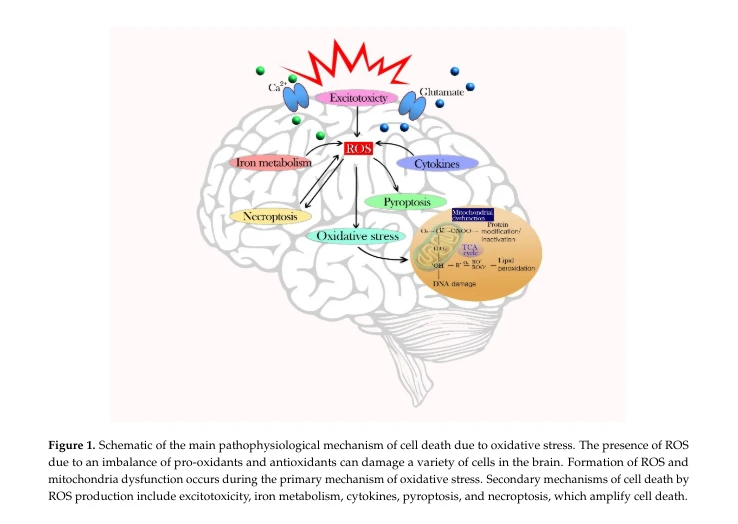
The primary mechanism of oxidative cell death is the formation of ROS and mitochondria dysfunction.
Single-electron reactions produce reactive molecules as undesirable side-products of respiration or as a result of excess defense mechanisms. ROS/RNS include singlet oxygen, superoxide anion radicals, hydroxyl radicals, hydrogen peroxide, nitric oxide, and peroxynitrite anions [16].
These unstable molecules destroy cellular lipids and proteins and consequently activate intracellular ROS production via nicotinamide adenine dinucleotide phosphate (NADPH) and the electron transport chain. Through the cell membrane, NADPH is used as an electron donor for electron transfers and, ultimately, molecular oxygen is reduced to ROS [17].
The mitochondria are the main sites of intracellular ROS production and the targets of ROS-induced injury. Slow electron transfer during the respiratory chain increases ROS production and seriously damages the antioxidant system [18]. Secondary mechanisms of cell death via ROS production are excitotoxicity, iron metabolism, cytokines, pyroptosis, and necroptosis.
The excessive release of glutamate and an influx of Ca2+ causes calcium overload in neurons and a disturbance in intracellular Ca2+ homeostasis, which can intensify excitotoxicity by leading to ROS production [19]. Iron-dependent oxidative stress also causes brain function deterioration. When an overload of iron overwhelms a cell's detoxification systems, iron content (especially Fe2+) increases and promotes the conversion of H2O2 to •OH through the Fenton reaction, thereby amplifying oxidative stress [20].
Inflammatory cells, immune factors, and chemokines can release harmful compounds and cytokines that exacerbate oxidative stress and impair neurons. Microglia, which are important for redox stability, activate NADPH oxidase (NOX) and nitric oxide synthase (NOS) enzymes, leading to an increased production of ROS and RNS [21,22]. Astrocytes stimulate the activation and proliferation of microglia, which produce many inflammatory mediators in the brain. Pyroptosis is another type of inflammatory programmed cell death.
The leucine-rich-repeat (NLR) pyrin-domain-containing 3 (NLRP3) inflammasome signaling pathway that induces cell pyrolysis is triggered by ROS generation during brain injury [23]. NLRP3 inflammasome activation in astrocytes and microglia induces inflammatory responses and neuronal death [24]. Intracellular ROS accumulation can alter proteins, glucose, lipids, and nucleic acids to cause cell dysfunction and death.

Tumor necrosis factor (TNF)-induced necroptosis (programmed necrosis) can also lead to ROS generation [25]. The pathophysiological mechanism of cell death due to oxidative stress is described in Figure 1.
For more information:1950477648nn@gmail.com