Dental Mesenchymal Stem Cell Secretome: An Intriguing Approach For Neuroprotection And Neuroregeneration Part 2
Aug 14, 2024
It is important to notice that donor age and microenvironmental conditions in vitro may also influence secretome composition. DPSC-CM obtained in normoxic conditions was reported to be enriched in molecules with anti-inflammatory, tissue repair, and regenerative properties compared to CM obtained in hypoxic conditions [44].
In human learning, memory, and cognition, the in vitro microenvironment plays a vital role. Living in a good in vitro microenvironment can help us better maintain memory, improve learning effects, and promote overall physical health.
First, a good in vitro microenvironment can promote the formation and maintenance of neuronal connections. Neurons are a type of cell in the brain that are responsible for transmitting signals and forming memories. When we learn new things, the connections between neurons will continue to strengthen, which helps the formation of new memories. A good environment can help neuronal connections remain stable without being disturbed.
Second, the in vitro microenvironment can affect the metabolism and function of brain cells. Sufficient oxygen, nutrition, and water can improve the metabolic level of brain cells, avoid brain cell death and aging, and thus benefit the development of memory and cognitive abilities. At the same time, a quiet or moderately comfortable environment can help people concentrate and promote the improvement of learning and work efficiency.
In addition, a healthy in vitro environment also has a positive impact on other aspects of physical health. Efforts in aspects such as adequate sleep, relying on healthy dietary choices, and moderate exercise can improve memory and cognitive ability. A healthy lifestyle that integrates body and mind can reduce negative emotions such as anxiety, depression, and stress, thereby helping to improve the brain's work efficiency and thinking vitality.
In summary, there is an inseparable connection between the in vitro microenvironment and memory. An optimized environment can help strengthen the connection between neurons and improve the metabolic function of brain cells, thereby promoting the formation and maintenance of memory, and it is also a guarantee of physical and mental health. Let us work together to build a healthy and positive in vitro environment to make better contributions to our health and success. Orange Man:
It can be seen that we need to improve memory, and Cistanche can significantly improve memory, because
Cistanche is a traditional Chinese medicinal material with many unique effects, one of which is to improve memory. The efficacy of Cistanche comes from the various active ingredients it contains, including tannic acid, polysaccharides, flavonoid glycosides, etc. These ingredients can promote brain health in many ways.
Click know 10 ways to improve memory
Moreover, secretome
collected from 5% O2 cultured DPSCs showed higher stimulatory effects on the proliferation
and migration of mouse embryonic fibroblast NIH3T3 cells and neuronal differentiation
of SH-SY5Y cells [45].
The quantity and size of EXOs and their tetraspanin expression may
vary depending on the medium used for culture [46]. The secretome of SHEDs and young
DPSCs contained more growth factors and lower levels of pro-inflammatory cytokines
compared to DPSCs obtained from old subjects.
Differentiation potential was also higher in SHEDs and young DPSCs [47].
CM can be obtained by healthy PDLSCs but also by inflamed PDLSCs. CM obtained by inflamed ones increased the proliferation of both healthy and inflamed PDLSCs but reduced the differentiation toward osteoblasts. Healthy CM rescued the impaired osteogenic differentiation [48].
The treatment with different substances may also influence cell secretome. The treatment of the DPSCs with 2,3,5,40 -tetrahydroxystilbene-2-O-β-D-glucoside (THSG), a bioactive component of Polygonum multiflorum Thunb., induced changes in the secretion of growth-associated proteins in CM, increasing some of them such as AKT2 and NGF receptor [49].
Instead, CM from FGF-2-modified GMSCs contained more VEGF-A, FGF-2, and TGF-β [50]. Ascorbic acid treatment of SHEDs increased the release of growth factors necessary for tissue regeneration and homeostasis, including VEGF, SCF, IGF-1, HGF, bFGF, Ang-1, and EGF, and anti-inflammatory cytokines, such as NO, indoleamine 2,3- dioxygenase (IDO), PGE-2, IL-10, and IL-6.
On the contrary, inflammatory cytokines CCL2 and TGF-β1 were reduced [51].
The exposure to the differentiation medium also could induce changes in non-coding RNA in EVs and EXOs of PDLSCs.
Specifically, 69–557 circular RNA (circRNAs) and 2907–11,581 lncRNAs were found in EVs isolated from PDLSCs and PDLSCs exposed to osteogenic differentiation medium at different time points.
Compared with undifferentiated PDLSCs EVs, 3 circRNAs and 2 lncRNAs were upregulated and 39 circRNAs and 5 lncRNAs were downregulated consistently after 5 and 7 days of exposure to differentiation medium [52].
Moreover, 72 miRNAs were upregulated while 35 were downregulated in PDLSCs EXOs after osteogenic induction [53]. A summary of the main factors found in the secretome of the different dental MSCs can be found in Table 1.
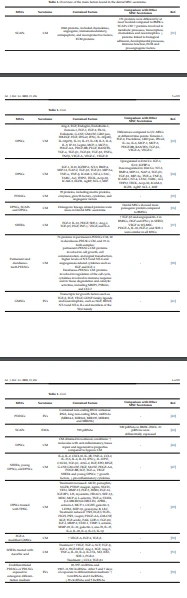
Ang, angiopoietin; BDNF, brain-derived neurotrophic factor; BMP, bone morphogenetic protein; BMSCs, bone marrow MSCs; circRNA, circular RNA; CM, conditioned medium; CUL7, cullin 7; CXCL, C-X-C motif chemokine ligand; DACCs, developing apical complex cells; DFSCs, dental follicle stem cells; DPSCs, dental pulp stem cells; ECM, extracellular matrix; EGF, epidermal growth factor; ECM, extracellular matrix; EVs, extracellular vesicles; EXOs, exosomes; FGF, fibroblast growth factor; G-CSF, granulocyte colony-stimulating factor; GDNF, glial-cell-derived neurotrophic factor; GM-CSF, granulocyte-macrophage colony-stimulating factor; GMSCs, gingival MSCs; HGF, hepatocyte growth factor; ICAM, Intercellular Adhesion Molecule; IDO, indoleamine 2,3-dioxygenase; IFN, interferon; IGF, insulin-like growth factor; IL, interleuchin; lncRNA, long noncoding RNA; MCP, Monocyte Chemoattractant Protein; miRNA, microRNA; MMP, matrix metalloproteinase; NGF, nerve growth factor; NT, neurotrophin; PDGF, platelet-derived growth factor; PDLSCs, periodontal ligament stem cells; piRNA, PIWI-interacting RNAs; PSMA1, Proteasome subunit, alpha type; SCAPs, stem cells from apical papilla; SDF, stromal cell–derived factor; SHEDs, stem cells from human exfoliated deciduous teeth; TGF, transforming growth factor; THSG, 2,3,5,40 -tetrahydroxystilbene-2-O-β-D-glucoside; TIMP, tissue inhibitor of metalloproteinase; TNF, Tumor Necrosis Factor; UC-MSCs, umbilical cord mesenchymal stem cells; VEGF, vascular endothelial growth factor ↑, increase/improvements; ↓, reduction.

3. Dental Stem Cell Secretome Neuroprotective and neuroregenerative Potential in Preclinical Models
To evaluate the neurodegenerative and neuroprotective potential of the dental MSC secretome, the effects of CM and EVs have been evaluated in preclinical models of neurodegenerative and neurological diseases and models of neuronal damage, such as spinal cord injury (SCI).
In addition, secretome-mediated effects on neuronal outgrowth, its capacity to stimulate neuronal differentiation, and its effects on glial cells have also been evaluated.
We performed a PubMed search looking for studies showing the neurodegenerative and neuroprotective potential of dental MSCs secretome in vitro and in vivo models.
3.1. Dental Pulp Stem Cell Secretome
DPSCs secretome was one of the most studied. Different studies evaluated its efficacy in inducing neurite outgrowth. It was reported that DPSC-CM promoted neurite outgrowth in dorsal root ganglion (DRG) neurons.
Specifically, the total length and joint number of neurites increased after treatment with CM. Moreover, DPSC-CM promotes Schwann cell viability and myelin formation [54]. DPSCs-CM enhanced cell survival and induced neurite outgrowth of PC12 cells, as shown by neuronal nuclear protein (NeuN), microtubule-associated protein 2 (MAP-2), and βIII-tubulin.
Specifically, DPSCs-CM was more efficacious in inducing PC12 neurite outgrowth compared to DPSCs/PC12 co-cultures, indicating that cell co-cultures had a delayed lag time in producing efficacious amounts of trophic factors.
DPSCs-CM also enhanced cell migration. Interestingly, the number of surviving PC12 cells was reduced when CM was added with anti-GDNF. Instead, the addition of anti-NGF, anti-GDNF, and anti-BDNF antibodies attenuate PC12 neurite outgrowth.
These data demonstrated that NGF, BDNF, and GDNF are involved in PC12 survival and differentiation [55]. The DPSC secretome shows a chemoattractive effect on SH-SY5Y cells. Moreover, its effect on neural maturation has been evaluated. With this aim, SH-SY5Y cells were induced toward neuronal cells after they were exposed to the DPSC secretome.
SHSY5Y cells subjected to the DPSC secretome showed increased neurite outgrowth, acquired ultrastructural features of neuronal cells, and presented an increased immune reactivity for neuronal markers. Moreover, CM-treated SH-SY5Y cells developed distinct features including Cd2+-sensitive currents, which suggests that CM-DPSC-maturated SH-SY5Y acquired voltage-gated Ca2+ channels [56].
In line with the previous study, CM obtained by DPSC sheet induced the formation and outgrowth of neurites in neuronally differentiated SH-SY5Y neuroblastoma cells. These effects were enhanced when DPSC sheets were cultured with FGF2.
The neurite-promoting effects were abolished when neurotrophic factors were inhibited, suggesting that they are needed for the positive effect of DPSC sheets on neuronal cell activity [57].
Recently, Chouaib et al. evidenced that DPSC-CM enhancement of neurite outgrowth in sensory neurons is concentration-dependent. The authors also found that 48 h of DPSC conditioning was the best option to obtain CM with efficient activity while extending the conditioning time did not improve the effects of DPSC-CM.
Interestingly, the frozen storage did not influence experimental outcomes. The CM contained some factors known for their role in neurogenesis and neuroprotection but also angiogenesis and osteogenesis. Moreover, the conditioning of DPSCs with the B-27 supplement enhanced the neurodegenerative effects of their secretome, inducing a change in its composition in growth factors.
In particular, CM was more efficacious when B-27 was added to DPSCs before conditioning [58]. CM from DPSCs enhanced neuritogenesis and exerted a chemoattractant effect also on neural stem cells (NSCs).
The priming of DPSCs with leukocyte- and platelet-rich fibrin (LPRF) increased BDNF secretion but exerted no additional effects on the paracrine-mediated repair mechanisms [59].
DPSC-derived CM was also shown to be able to protect and regenerate isolated primary trigeminal ganglion neuronal cells (TGNC). Indeed, CM enhanced TGNC survival associated with extensive neurite outgrowth and branching.
In parallel, DPSC-CM significantly upregulated NeuN, βIII-tubulin, and synapsin-I neuronal marker expression as well as TRPV1. Interestingly, DPSC-CM contained NGF, BDNF, NT-3, and GDNF [60].
G-CSF-mobilized DPSCs expressed higher neurotrophic factors compared to basal DPSCs and their secretome showed an enhanced neurite extension potential. Indeed, mobilized DPSC CM had a greater effect on neurite outgrowth in TGW cells [61]. Previously, it was demonstrated that CM from mobilized DPSC enhanced the proliferation and migratory activity of neuronal Schwann RT4-D6P2T cells [62].
Interestingly, CM from SHEDs and DPSCs was shown to be able to promote the regeneration of cerebral granular neurons inhibiting axon growth inhibitor signals by paracrine mechanisms [63]. The DPSCs secretome also shows superior effects compared to other MSCs.

Kumar et al. demonstrated that the secretome derived from DPSCs, SCAPs, and DFSCs induced neural differentiation in IMR-32 cells, a preneuroblastic cell line, more efficiently than BMSCs.
In particular, neurite length was higher when IMR-32 cells were treated with the DPSC secretome. The DPSC secretome contained GCSF, IFN-γ, and TGF-β, which may promote neural differentiation [64].
DPSCs, BMSCs, and AMSCs promoted an increase in the survival of co-cultured retinal ganglion cells. In particular, the increase in survival was enhanced in DPSC-treated retinal cultures.
Interestingly, coculture with DPSC induced a significant increase in both the number of neurite-bearing retinal ganglion cells and neurite length compared with cocultures with BMSCs and AMSCs. However, these effects were blocked using neurotrophic factor receptors Fc-receptor blockers.
The different types of MSCs showed a different pattern of neurotrophic factor expression, and, specifically, DPSCs released higher levels of several growth factors such as NGF, BDNF, and VEGF compared with BMSCs and AMSCs.
In particular, VGF may mediate the neuroprotective effects of DPSCs [65]. CM-DPSCs showed protective effects on oxygen-glucose deprivation (OGD)-induced cytotoxicity in astrocytes in a dose-dependent manner.
Specifically, both pre-and posttreatment with CM-DPSCs, but also CM-BMSCs, attenuated OGD-induced glial fibrillary acidic protein (GFAP), nestin, and musashi-1 expression in astrocytes. The treatment with CM also blocked OGD-induced reactive oxygen species (ROS) production and IL-1β upregulation. Interestingly, CM-DPSCs confer superior cytoprotection against cell death compared with BMSCs [66].
Venugopal et al. compared the neuroprotective potential of EXOs, CM, or neuron-–MSC–co-culture system against kainic-acid-induced excitotoxicity in vitro. Moreover, to identify the most adapted MSC type, EXOs and CM derived from DPSCs and BMSCs were tested.
All three approaches showed neuroprotective potential thanks to the increase of growth factor expressions and the inhibition of apoptosis through the activation of the PI3K-Bcl-2 pathway.
It is important to note that EXOs demonstrated better anti-necrotic properties compared to neuron-MSC co-culture or CM. Regarding CM, only the fraction containing proteins in the range of 3–10 kDa showed neuroprotection and rescued the neurons from excitotoxicity [67].
The secretome of DPSCs also showed beneficial effects in models of neurodegenerative diseases. Treatment with DPSC secretome reduced amyloid β (Aβ) cytotoxicity in an in vitro model of Alzheimer's disease (AD), increasing cell viability and reducing apoptosis.
DPSC secretome was shown to contain elevated levels of VEGF, Fractalkine, RANTES, monocyte chemoattractant protein-1 (MCP-1), and GMCSF compared to BMSCs and AMSCs.
Interestingly, neprilysin, a protease able to degrade Aβ, was also found in the DPSC secretome. DPSC secretome proteolytically degrades Aβ1–42 in vitro, resulting in complete degradation after 12 h [68].

For more information:1950477648nn@gmail.com