Does Cistanche Have Effect On BPH? TCM Natural Prostate Treatment
Jun 23, 2026
Benign Prostatic Hyperplasia (BPH) refers to abnormal proliferation of the prostate gland that compresses the prostatic urethra or obstructs the bladder neck, ranking among the most common urological disorders causing urination dysfunction in middle-aged and elderly men. Its incidence rises sharply with age: over 50% of men aged 60 develop BPH, and the figure exceeds 80% for men aged 80. Clinically, symptoms fall into two categories-obstructive and irritative. Obstructive manifestations include hesitant urination, straining to pee, thin urine stream, interrupted voiding, incomplete bladder emptying, and post-urinary dribbling. Irritative symptoms feature frequent urination, urgent micturition, and nocturia. Secondary local infection often exacerbates the condition severely. Persistent voiding troubles severely impair patients' quality of life.
Traditional Chinese Medicine Cistanche High Content Extract Supplements For Improving Benign Prostatic Hyperplasia (BPH)

Supportive Service Of Wecistanche-For more details about cooperation
Email:wallence.suen@wecistanche.com
Western medicine mainly relies on oral medications or surgical intervention. While these approaches relieve symptoms in the short term, long-term drug use may trigger sexual dysfunction, and post-surgical complications cannot be overlooked. Traditional Chinese Medicine (TCM) treatment addresses not only local glandular lesions but also the restoration of systemic qi transformation. By harmonizing visceral organs and activating blood circulation to eliminate stasis, TCM delivers remarkable advantages in improving patients' daily well-being.
Professor Yuan Changjin, a nationally distinguished TCM physician, chief physician, and tutor for the 4th and 5th National Inheritance Programs for Senior TCM Experts, has dedicated more than 50 years to clinical internal medicine practice and academic research. He boasts profound theoretical foundations and rich clinical experience, excelling at applying classical formulas and flexible modification. Having studied under Professor Yuan, the author systematically sorts out his differentiation and treatment experience for BPH for clinical reference.
1. Core Connotation of the Theory "Smooth Circulation Equals Physical Comfort"
Professor Yuan built his clinical system centered on syndrome differentiation and treatment, guided by four core principles: Smooth Circulation Equals Physical Comfort, Harmony as the Ultimate Goal, Treatment Aligned with Body Rhythms, Patient-Centered Care. He often quotes the ancient wisdom: "Running water never stagnates, a door hinge never rusts." TCM views human life, health and disease through a dynamic lens, as recorded in Suwen · Six Micro-Pivot Treatises: "All gains and losses arise from movement." Healthy bodily functions rely on orderly physiological activities-food intake, respiration, metabolism, as well as the ascent, descent, distribution and transportation of qi, blood and body fluids. The key to sustaining physiological balance lies in unobstructed visceral qi movement, as stated in Synopsis of Prescriptions of the Golden Chamber · Pulse Manifestations of Zang-Fu Organs and Meridians First Chapter: "When genuine primordial qi of the five zang-organs flows freely, people stay peaceful and healthy." Conversely, blocked visceral qi, blood stagnation and disordered fluid transportation trigger all kinds of illnesses, even life-threatening conditions. Suwen · Six Micro-Pivot Treatises warns: "Blocked inward-outward exchanges lead to the collapse of mental vitality; disrupted ascent-descent movement endangers bodily essence." This gives birth to the core logic: Blockage causes illness; smooth circulation brings comfort.
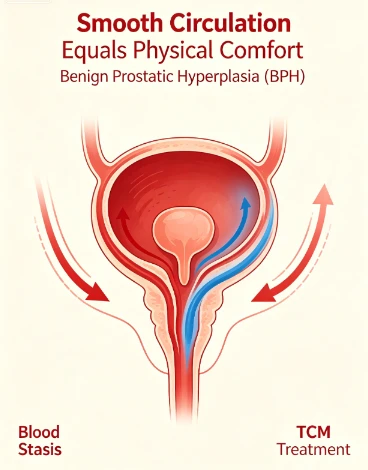
Professor Yuan emphasizes that "smooth circulation" does not mean aggressive purgation or attack therapy, but restoring normal physiological flow; "physical comfort" means more than symptom relief-it hinges on unobstructed functional pivots. When applied to BPH treatment, the core of "smooth circulation" lies in resolving blood stasis blockages and dredging water passages to normalize the circulation of qi, blood and body fluids. This philosophy aligns with modern Western medicine's therapeutic target of eliminating lower urinary tract obstruction and unblocking urinary flow.
Does Cistanche Have Effect on BPH?
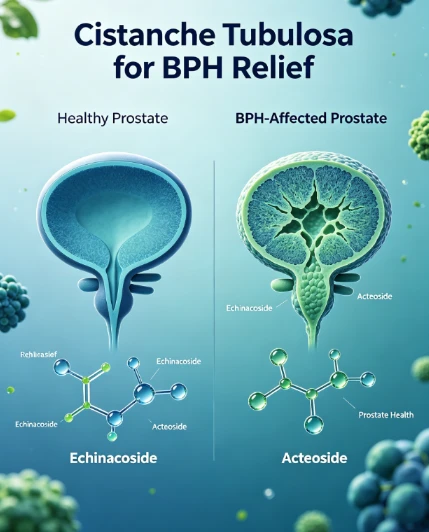
This ancient TCM logic perfectly explains why tubulosa cistanche (the premium desert ginseng we specialize in) delivers targeted relief for BPH. As a top-grade kidney-tonifying herb, authentic Xinjiang Cistanche tubulosa extract contains high-concentration echinacoside and acteoside, two core bioactive compounds proven to ease inflammatory reactions, regulate hormone metabolism and improve microcirculation in the prostate gland, precisely resolving the "blood stasis blocking water passages" core pathology highlighted by Professor Yuan. Our factory, Chengdu Wecistanche Bio-Tech Co., Ltd., operates the world's largest Cistanche tubulosa industrial base with 200,000 acres of standardized cultivation land in Luopu County, Xinjiang, producing high-purity cistanche extracts with far higher active ingredient content than wild or common cultivated cistanche varieties, offering reliable natural support for prostate wellness.
2. Understanding the Etiology and Pathogenesis of BPH
There is no single TCM disease term directly corresponding to BPH, but its core symptom of dysuria falls under the category of "Longbi (dysuria and urinary retention)". A mild condition with dripping urine is called "Long", while complete inability to urinate is defined as "Bi"; the two are distinguished only by severity, hence combined as "Longbi". Early-stage BPH manifests as frequent urination and nocturia, matching TCM descriptions of "frequent voiding"; mid-to-late stage difficulty urinating corresponds to "Long"; complete urinary retention is categorized as "Bi". Cases accompanied by frequent urination and involuntary urine leakage can also draw therapeutic insights from "Lin Syndrome (stranguria)" and "urinary incontinence".
Professor Yuan clarifies that BPH originates from underlying kidney deficiency or spleen deficiency, with blood stasis obstruction as the pivotal pathogenic factor, often complicated by damp-heat accumulation. Its core pathogenesis lies in blood stasis blocking urinary passages and impaired bladder qi transformation, closely linked to dysfunction of the spleen, kidney and triple energizer.
2.1 Blood Stasis Obstructs Urinary Passages
An ancient TCM tenet states: "Stagnant blood disrupts fluid metabolism". Blood and body fluids are interdependent physiologically and mutually influential pathologically. BPH is a chronic progressive disease, and prolonged illness drives pathogenic factors into collateral vessels, making blood stasis a persistent core lesion throughout the whole disease course. Kidney or qi deficiency weakens the driving force of blood circulation; liver qi stagnation evolves into qi stagnation and blood stasis; accumulated damp-heat hinders blood flow; internal phlegm intermingles with static blood-all these conditions trigger blood stasis stagnating in the lower jiao's essence chamber or bladder neck. Static blood acts as a tangible pathogenic mass that narrows urinary tracts. Meanwhile, it obstructs qi movement, further disrupting the triple energizer's fluid regulation and bladder qi transformation, worsening fluid excretion disorders and resulting in dripping urine or complete retention. The intermingling of static blood and damp fluid creates a vicious pathological cycle, the primary driver of intractable voiding difficulty, split urine streams and urinary retention in advanced BPH. Tang Rongchuan also noted in Treatise on Blood Syndromes: "Static blood transforms into fluid stagnation, inducing edema", verifying the pathological link between blood disorders and fluid retention. Professor Yuan stresses that blood stasis blocking urinary passages is the root of BPH's obstructive symptoms, consistent with modern research confirming microcirculation disorders and tissue fibrosis as key pathological foundations of prostate hyperplasia.

2.2 Kidney Essence Depletion Induces Stasis and Urinary Blockage
The kidney is the congenital root governing water metabolism and controlling defecation and urination. Bladder qi transformation relies entirely on warming kidney yang and nourishing kidney yin. Suwen · Linglan Secret Canon records: "The bladder serves as the reservoir of body fluids; urine is discharged only through qi transformation... The triple energizer is the organ regulating fluid pathways." Lingshu · Original Transport adds: "Excess triple energizer pathology causes Longbi; deficiency leads to urinary incontinence." These classics confirm that unobstructed urination fundamentally depends on kidney-bladder qi transformation and free triple energizer fluid passages, both sustained by kidney qi vaporization. Kidney deficiency weakens circulatory propulsion, and long-term illness leads to collateral stasis, forming a mixed deficiency-excess syndrome where static blood blocks essence chamber passages. Kidney deficiency splits into two subtypes, both capable of generating blood stasis:
Declined kidney yang: Elderly patients or those with chronic illness suffer depleted kidney yang and impaired vital gate fire. Insufficient warming power leads to cold coagulation and blood stasis in the lower jiao, triggering dysuria or urinary retention.
Consumed kidney yin: Insufficient kidney yin generates vacuous internal heat, thickening body fluids and slowing blood circulation, resulting in static blood and blocked urinary tracts.

2.3 Middle Qi Insufficiency Causes Intermingled Dampness and Stasis
The spleen-stomach system is the acquired foundation generating qi and blood, governing ascending clear qi and descending turbid waste. Lingshu · Oral Inquiry states directly: "Deficient middle qi disturbs defecation and urination." Li Dongyuan further wrote in Treatise on the Spleen and Stomach: "Spleen-stomach deficiency leads to nine orifices obstruction." Professor Yuan explains that insufficient middle qi weakens lifting and consolidation function, failing to contain body fluids and triggering frequent urination-worse at night or after physical exertion. Moreover, deficient qi loses its power to propel blood, inducing blood stasis. Failed ascending clear qi and descending turbid fluid disrupt middle jiao transportation, accumulating internal dampness that intermingles with static blood and clogs lower jiao urinary passages, causing voiding difficulty. This aligns with the principle: "Qi commands blood movement; deficient qi slows blood circulation to form stasis, while accumulated dampness blocks qi flow and worsens stasis."

2.4 Accumulated Damp-Heat Condenses into Static Blood
Lower jiao damp-heat is a major pathogenic factor behind acute BPH exacerbations and excess symptomatic flare-ups. Prolonged damp-heat accumulation scorches body fluids and thickens blood, creating a complex pattern of intermingled damp-heat and static blood. Damp-heat can arise from external pathogenic invasion, excessive intake of greasy, sweet, spicy and fried foods, impaired kidney qi transformation leading to fluid stagnation and heat generation, or liver channel damp-heat flowing downward to the bladder and essence chamber. Treatise on the Origins and Manifestations of Diseases · Urinary Disorders Chapter notes: "Urinary obstruction arises from simultaneous heat in the bladder and kidney." Secret Records of Orchid Chamber · Stranguria and Urinary Obstruction Chapter adds: "Lower jiao heat blockage originates from the kidney and bladder-yin organs trapped by heat that seal fluid outflow." Damp-heat stagnates the lower jiao, constrains qi and blood circulation, condenses fluids into static blood and severely disrupts qi transformation, presenting scanty dark urine, burning painful voiding, dripping urine and sudden urinary retention.
In summary, BPH stems from complex pathogenic factors, with dysuria as the core manifestation rooted in static blood blocking urinary passages and impaired qi transformation. Normal qi transformation relies on coordinated function of the lung, spleen and kidney; blood stasis acts as the critical pathological factor disrupting this balance. Under physiological conditions, ingested food is processed by the stomach to generate refined essence, transported upward by the spleen to the lung. The lung governs dispersion and descent to regulate fluid passages, transporting water downward to the kidney. The kidney controls fluid metabolism and qi transformation, separating clear essence to ascend and turbid waste to descend into the bladder for excretion. Visceral dysfunction and disrupted blood circulation generate static blood, clog fluid passages and form a self-perpetuating pathological cycle. Based on this mechanism, Professor Yuan established the core therapeutic principle of "Smooth Circulation Equals Physical Comfort" for BPH: activate blood circulation to eliminate stasis and unblock urinary passages, alongside visceral regulation to restore normal qi transformation.
2.5 Integrated Holistic TCM Perspective and Modern Micro-Pathology of "Stasis Elimination Restores Qi Transformation Comfort"
Professor Yuan's theory of "Smooth Circulation Equals Physical Comfort" centers on activating blood circulation to dredge the triple energizer and restore coordinated lung-spleen-kidney qi transformation. Its underlying logic correlates profoundly with modern micro-pathological mechanisms of BPH, converging on blood stasis as the core pathological link. Modern medical research outlines BPH's vicious pathological chain: bladder outlet obstruction → gland ischemia and microcirculation disorder → ischemia-reperfusion injury and chronic inflammation → interstitial fibrosis, forming progressive worsening lesions. This perfectly matches Professor Yuan's definition of "internal blood stasis". In micro-pathological terms, TCM "stasis" integrates local tissue ischemia, sluggish blood flow, accumulated inflammatory metabolites and excessive fibrous tissue proliferation.
Therefore, the "smooth circulation" therapeutic approach-especially blood-activating and stasis-resolving herbal therapy-delivers modern pharmacological benefits by directly targeting the "ischemia-fibrosis" pathological cycle. Blood-activating and hard-mass softening herbs improve prostate microcirculation, mitigate inflammatory responses and inhibit excessive fibrous tissue proliferation to break the self-worsening pathological loop. Meanwhile, holistic triple energizer regulation and visceral conditioning optimize systemic fluid metabolism and qi ascent-descent, creating a balanced internal environment to reverse local glandular lesions. This framework elevates "Smooth Circulation Equals Physical Comfort" from a single therapeutic rule to a bridge connecting TCM holistic qi transformation theory and modern microscopic disease pathology, highlighting TCM's unique advantage of multi-target systematic regulation for chronic complex disorders.
3. Syndrome Differentiation Treatment & Application of the "Smooth Circulation Equals Physical Comfort" Principle
Targeting BPH's core pathogenesis of static blood blocking urinary passages and impaired bladder qi transformation, Professor Yuan strictly follows the "Smooth Circulation Equals Physical Comfort" principle, prioritizing blood activation and stasis resolution to unblock fluid passages. He divides clinical cases into three core syndromes, with a consistent treatment feature: regardless of primary syndrome manifestations, resolving static blood congestion and dredging urinary tracts remain the primary therapeutic focus, realized through carefully paired blood-activating herbs and customized dosage strategies.
3.1 Kidney Deficiency with Blood Stasis Syndrome
This syndrome develops from depleted kidney essence failing to propel blood circulation, leading to long-term illness invading collateral vessels and glandular hyperplasia with static blood blockage. Professor Yuan's treatment logic combines kidney tonification to restore foundational qi transformation and intensive blood activation-mass dissipation-collateral dredging to eliminate tangible obstructive lesions, embodying the therapeutic idea of "stasis resolution to unblock fluid passages".
For predominant kidney yang deficiency: Therapeutic rule – warm kidney yang, activate blood circulation, resolve stasis via warming unblocking; primary formula: modified Shenqi Pill, built on the principle "blood flows freely under warmth" to warm yang and dispel stasis.
For predominant kidney yin deficiency: Therapeutic rule – nourish yin to reduce fire, activate blood circulation, unblock collaterals via moistening unblocking; primary formula: modified Zhibai Dihuang Pill, focused on yin nourishment and blood circulation activation.
Professor Yuan stresses that pure kidney tonification can reinforce the root of qi transformation yet fails to rapidly eliminate tangible static blood blockages. Therefore, all kidney-tonifying formulas incorporate blood-activating, collateral-dredging and hard-mass resolving herbs:
Blood activation and collateral dredging: Angelica sinensis, Salvia miltiorrhiza, Cyathula officinalis (15–20g standard dosage)
Stasis accumulation resolution: stir-fried Endothelium Corneum Gigeriae Galli (15–20g), excellent for dissolving collateral stasis and ideal for hyperplastic gland blockages
Severe glandular hard nodules: Curcuma zedoaria, Persica semen (10–15g) to break blood, move qi and dissipate masses. Modern pharmacological studies confirm Curcuma zedoaria exerts anti-fibrosis effects and inhibits prostate epithelial cell over-proliferation.
Even for kidney yin deficiency cases, Professor Yuan lightly adds Cinnamon twig or Lindera aggregata (6–10g) for acrid-warm yang diffusion to unblock bladder qi transformation, balancing yin nourishment with mild yang activation and maintaining dynamic fluid circulation. He applies combined unblocking and consolidation therapy for nocturia: Fructus Alpiniae Oxyphyllae, Rubus idaeus and Ootheca Mantidis consolidate kidney and reduce frequent urination, paired with Cyathula officinalis and Lycopus lucidus to prevent consolidated herbs from trapping pathogenic stasis and guarantee unobstructed urinary passages.
Professor Yuan adopts layered blood activation strategies based on stasis severity: mild stasis uses blood-nourishing herbs (Salvia miltiorrhiza, Paeonia radix rubra); moderate stasis requires blood-stasis resolving agents (Persica semen, Carthamus tinctorius); severe hardened stasis masses demand blood-breaking mass dissipators (Sparganium stoloniferum, Curcuma zedoaria). For profound static blood blockage, he cautiously applies insect medicinals-Eupolyphaga sinensis (6–10g), Hirudo nipponica (3–5g)-valued for their mobile collateral penetration and potent stasis-dissolving power, always paired with qi and blood tonics to avoid damaging healthy qi via harsh breaking action.
Cistanche Tubulosa for Kidney Deficiency & BPH Stasis Relief
Our premium Xinjiang Cistanche tubulosa extract is perfectly suited for this syndrome, as it uniquely delivers dual kidney-tonifying and blood-activating benefits. Rich in echinacoside and acteoside, it warms kidney yang without dryness, nourishes kidney yin without greasiness, improves prostate microcirculation to dissolve static blood and ease glandular congestion, naturally reducing nocturia, urinary hesitation and incomplete emptying. Unlike regular cistanche varieties, our tubulosa cistanche cultivated on 85,000 acres of standardized Xinjiang base achieves far higher active ingredient concentrations, making it a superior natural ingredient for BPH supplement formulations targeting kidney deficiency and blood stasis.
3.2 Damp-Heat Intermingled with Blood Stasis Syndrome
Typical clinical manifestations: scanty dark urine with burning heat, painful dripping voiding, difficult urine outflow, distended urgent lower abdomen, bitter sticky mouth, red tongue with thick yellow greasy coating, slippery rapid pulse. This syndrome mostly occurs during acute BPH flares or in patients with inherent damp-heat constitution. Damp-heat's viscous nature readily intermingles with static blood and clogs urinary passages to form complex damp-heat stasis lesions. Professor Yuan establishes the therapeutic rule: clear heat and drain dampness, activate blood circulation to resolve stasis via heat-clearing unblocking. He emphasizes that simultaneous blood stasis dispersion is mandatory-standard heat-dampness elimination alone cannot remove persistent congestion and unblock fluid passages permanently.
Formulas modified from Bazheng San or Zhuling Tang integrate targeted herbs:
Polygonum cuspidatum (20–30g): primary herb for combined heat clearing, damp draining, blood activation and toxin resolution
Vaccaria segetalis (10–15g): activates blood circulation, unblocks meridians and promotes diuresis to relieve stranguria
Cyathula officinalis: guides herbal potency downward, activates blood and boosts urination
How to evaluate a high-quality Cistanche extract

Paeonia radix rubra, Moutan cortex: cool blood and disperse stasis
Following the principle "unobstructed intestinal passages facilitate urinary flow", Rhubarb (6–10g, decocted later) is added for sticky unsmooth stool to drain heat via intestinal purgation, resolve static blood and eliminate damp-heat stagnation through a secondary excretion channel. Random controlled clinical trials verify that pairing blood-activating herbs with heat-dampness clearing formulas significantly improves BPH patients' International Prostate Symptom Score (IPSS).
Prolonged damp-heat damages yin fluid; for patients with inherent yin deficiency, Rehmannia glutinosa, Colla Corii Asini or Imperata cylindrica root prevent fluid depletion during diuretic therapy. When damp-heat subsides yet static masses remain, Concha Ostreae and Spina Gleditsiae (replacing expensive Squama Manis, 10–15g) soften nodules and dissipate stasis.
Treatment strategy focuses on creating excretion pathways for pathogenic factors: diuresis via Plantago asiatica and Talc to drain damp-heat through urine; intestinal purgation via Rhubarb and Aurantii Fructus to eliminate heat-stasis through stool; blood activation and mass dispersion via Persica semen and Paeonia radix rubra to dissolve stagnant masses. This multi-path holistic therapy avoids trapped lingering pathogens. Professor Yuan advises discontinuing harsh heat-clearing herbs once symptoms improve to prevent kidney yang damage, and limits long-term blood-breaking agents to avoid blood depletion-treatment targets balanced qi circulation as the ultimate endpoint.
3.3 Qi Deficiency with Intermingled Dampness and Blood Stasis Syndrome
Typical clinical manifestations: frequent urination aggravated after fatigue, weak sluggish voiding, persistent urge to urinate with limited output, distended lower abdomen, shortness of breath, lassitude, poor appetite, pale fat tongue with tooth marks, white greasy coating, deficient sluggish pulse. Pathogenesis centers on deficient spleen middle qi disrupting middle jiao ascent-descent function: weak qi propulsion slows blood circulation to form stasis; impaired clear qi ascent fails to transport dampness, which accumulates and intermingles with static blood to clog lower jiao fluid passages.
Professor Yuan's therapeutic rule: tonify middle qi, activate blood circulation and drain fluid via ascending unblocking. Treatment reinforces middle qi and lifts sunken yang to restore foundational qi transformation, paired with intensive blood activation-fluid drainage to resolve obstructive excess lesions.
Ascending clear qi and resolving turbidity: Acorus tatarinowii (10–15g) harmonizes middle jiao, dissolves turbidity and unblocks orifices to restore normal ascent-descent, combined with Citrus reticulata, Atractylodes rhizome and Magnolia officinalis to dry dampness, activate spleen transportation and regulate qi movement.
Tonify qi, activate blood and drain fluid: Angelica sinensis nourishes blood and unblocks vessels; Lycopus lucidus (15–20g) and Leonurus cardiaca (20–30g) deliver dual blood-activating and diuretic effects, uniquely effective for lower jiao damp-stasis intermingling and qi-deficiency urinary obstruction. Concurrent kidney deficiency with nocturia adds Alpiniae Oxyphyllae and Cuscuta chinensis (15–20g) to warm kidney and consolidate essence, harmonizing spleen-kidney function to revitalize systemic qi transformation.
Qi-blood synergistic pairing represents a core treatment feature: Astragalus membranaceus (30–60g) heavily tonifies lung-spleen qi to propel blood circulation, combined with Angelica sinensis to form Danggui Buxue Decoction for qi reinforcement and blood generation. Ligusticum wallichii and Carthamus tinctorius further activate blood and unblock collaterals, forming a robust qi-tonifying blood-activating formula. Severe qi deficiency and blood stasis adopts modified Buyang Huanwu Decoction, relying on massive Astragalus to command blood movement, paired with Pheretima, Persica semen and Carthamus tinctorius to dredge collaterals and dispel stasis, fully embodying the tenet "qi movement drives blood circulation". Clinical research confirms modified Buyang Huanwu Decoction outperforms standalone Western medicine in alleviating voiding symptoms and boosting urinary flow rate for qi-deficiency blood-stasis BPH patients.
Professor Yuan applies combined tonification and unblocking therapy: Aucklandia lappa and Amomum villosum regulate qi within spleen-tonifying formulas to avoid stagnation from heavy tonics, ensuring balanced qi pivot circulation without pathogenic blockage or healthy qi depletion.
Core Therapeutic System of "Smooth Circulation Equals Physical Comfort"
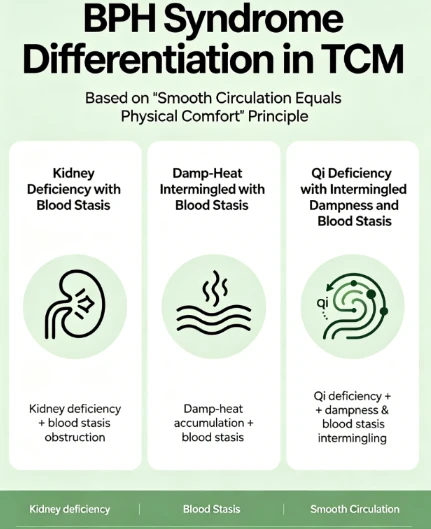
Throughout BPH treatment, Professor Yuan adheres rigidly to the "Smooth Circulation Equals Physical Comfort" core principle, constructing a complete stasis-resolving unblocking therapeutic system centered on blood activation:
Stasis resolution as the key to unblocking: Warming yang, nourishing yin, tonifying qi and clearing heat therapies all integrate blood-activating stasis-resolving herbs to eliminate glandular congestion and restore unobstructed urinary passages.
Blood circulation activation as the primary unblocking pathway: Disperse static blood and dissolve nodules to clear obstructive lesions; tonify deficient spleen-kidney essence to replenish qi origin, balancing root deficiency and branch excess.
Flexible unblocking strategies tailored to pathogenesis: Warming unblocking dispels cold-induced stasis; moistening unblocking nourishes yin and activates collaterals; ascending unblocking tonifies qi, activates blood and drains fluid; heat-clearing unblocking eliminates damp-heat and resolves stasis-all therapies directly target the root pathogenic blockage.
Multi-dimensional physical comfort as the ultimate treatment goal: Short-term blood activation and collateral dredging relieve acute urinary tract obstruction discomfort; mid-term stasis resolution and mass dissipation slow prostate hyperplasia progression and prevent complications; long-term healthy qi consolidation and mild blood harmonization sustain visceral balance and lasting wellness.
This integrated system merges classical TCM theories with proven clinical efficacy, guided by a holistic philosophy of "blood activation resolves branch stasis, healthy qi tonification restores root qi transformation", offering authoritative clinical guidance for TCM BPH diagnosis and treatment.
Clinical Case Record
Male patient, 67 years old, initial consultation: May 15, 2024 Chief complaint: 1-year persistent nocturia, aggravated over the past 2 months Present symptoms: 5–6 nightly urinations, difficult voiding, persistent incomplete emptying sensation, painless clear urine. Secondary symptoms: right ear hearing loss, no bitter dry mouth, normal appetite, sleep and bowel movements. Dark lips, thin white tongue coating, fine slightly sluggish pulse, weak sunken cubit pulses bilaterally. Past medical history: hyperuricemia, hypertension. Western diagnosis: Benign Prostatic Hyperplasia (BPH). TCM diagnosis: Longbi (Kidney Yang Deficiency, Static Blood Blocking Urinary Passages). Therapeutic approach: Warm kidney yang, activate blood circulation to resolve stasis, consolidate lower jiao essence. Formula: Modified Shenqi Pill. Prescription dosages (15 doses, 1 dose daily, decocted in water, taken warm morning and evening): Rehmannia glutinosa 30g, Dioscorea opposita 30g, Cistanche tubulosa 20g, Cornus officinalis 20g, stir-fried Endothelium Corneum Gigeriae Galli 20g, Poria cocos 20g, Rubus idaeus 15g, Cynomorium songaricum 15g, Cuscuta chinensis 15g, Alpiniae Oxyphyllae 15g, Angelica sinensis 12g, Lindera aggregata 10g, Moutan cortex 10g, Aconitum carmichaelii (processed black slice) 8g, Cyathula officinalis 15g.
Second consultation: June 12, 2024
Patient reported significant symptom relief: nightly urinations reduced to 2–3 times, improved voiding smoothness yet lingering incomplete emptying sensation, pale yellow painless urine, normal appetite, sleep and bowel function. Dark tongue with thin white coating and tooth marks, sunken pulse. Prescription adjustment: remove Cynomorium songaricum, processed Aconitum slice and Cuscuta chinensis; add Ootheca Mantidis 15g, Acorus tatarinowii 10g, Lycium barbarum 20g, Salvia miltiorrhiza 15g (15 doses, decocted daily).
Third consultation: July 6, 2024
Symptoms well-controlled: 2–3 nightly urinations, recently reduced to once nightly, occasional urinary hesitation, smooth voiding, fully resolved incomplete emptying sensation, no urgent painful urination or soreness and weakness of lumbar knees, normal appetite, spirit and bowel movements. Dark thin white tongue coating, rapid pulse. Prescription adjustment: remove Acorus tatarinowii and Cistanche tubulosa; add Phellodendron chinense 12g, Eucommia ulmoides 15g, Cynomorium songaricum 15g, Persica semen 10g (15 doses, decocted daily).
One-month follow-up via telephone: patient maintained stable symptoms with only one nightly urination, improved mood and vitality. Advised light dietary intake and consistent lifestyle maintenance.
Case Analysis
This nearly 70-year-old patient suffered natural kidney essence depletion with primary nocturia, voiding difficulty and incomplete emptying-classic BPH manifestations. Combined with dark tongue and weak sunken cubit pulses, the syndrome was confirmed as kidney yang deficiency with static blood blocking urinary passages, matching Professor Yuan's core pathogenesis of stasis-obstructed fluid passages and impaired bladder qi transformation.
Initial treatment prioritized warming kidney yang to address root deficiency and activating blood circulation to resolve branch stasis via modified Shenqi Pill: remove Alisma orientalis to avoid excessive fluid drainage damaging healthy qi, retain Rehmannia glutinosa for yin nourishment to balance yang warming herbs; add Cistanche tubulosa, Cuscuta chinensis and Cynomorium songaricum to reinforce kidney warming and essence consolidation, paired with processed Aconitum to boost qi vaporization; Lindera aggregata, Alpiniae Oxyphyllae and Rubus idaeus reduce frequent urination; Angelica sinensis, Endothelium Corneum Gigeriae Galli and Cyathula officinalis activate blood and dissipate masses, targeting essence chamber congestion to unblock urinary passages.
Second consultation observed recovered kidney yang yet unresolved static blood with concurrent spleen dampness (evident via tongue tooth marks). Warm drying herbs Aconitum and Cynomorium songaricum were reduced to prevent yin fluid depletion; Acorus tatarinowii added to dissolve damp turbidity and harmonize middle jiao qi ascent-descent; Lycium barbarum nourishes yin essence to counteract warm herb dryness, embodying moistening unblocking therapy; Salvia miltiorrhiza strengthens blood stasis resolution, harmonizing spleen and kidney to restore qi transformation pivots.
Third consultation brought smooth voiding and eliminated incomplete emptying, yet rapid pulse hinted accumulated vacuous heat from prolonged yang warming and static blood heat transformation. Treatment shifted to auxiliary heat-clearing unblocking therapy: remove dry Acorus tatarinowii and warm Cistanche tubulosa; Phellodendron chinense clears lower jiao ministerial fire and guides heat downward; Eucommia ulmoides and Cynomorium songaricum balance cold and warm potency; Persica semen intensifies blood stasis resolution to eliminate potential damp-heat congestion without depleting kidney yang vitality, permanently maintaining unobstructed urinary passages.
The entire treatment course dynamically alternates warming unblocking, moistening unblocking and heat-clearing unblocking therapies, consistently centered on blood activation to unblock fluid passages. Treatment avoids rigid pure tonification or excessive consolidation, instead warming kidney yang to restore qi transformation roots, dissipating static masses to eliminate tangible glandular obstruction, and timely clearing latent heat to prevent secondary stagnation-multi-dimensionally recovering bladder qi transformation and fluid circulation, fully demonstrating Professor Yuan's precise integrated TCM diagnosis and treatment system combining disease identification and syndrome differentiation.
Conclusion
Professor Yuan Changjin's "Smooth Circulation Equals Physical Comfort" theory for BPH treatment does not rely solely on harsh purgative attack therapy. Its core lies in activating blood circulation to resolve stasis and unblock urinary passages, integrating warming yang, nourishing yin, tonifying qi and clearing heat therapies with stasis resolution. Treatment simultaneously targets tangible static blood congestion and glandular compression symptoms, while fundamentally restoring coordinated lung-spleen-kidney function and re-establishing balanced bladder-triple energizer qi transformation. His clinical practice prioritizes treating BPH via stasis resolution and blood activation as the central therapeutic thread, fully showcasing TCM's holistic diagnosis and syndrome differentiation advantages.
This clinical experience breaks the narrow localized mindset of "only treating the hyperplastic gland", advocating holistic syndrome differentiation centered on qi transformation and targeting blood stasis as the core pathological link to achieve long-term stable therapeutic effects.
Commercial Supplement Insight – Premium Cistanche Tubulosa Extract for BPH Nutraceuticals
As global demand grows for natural plant-based prostate supplements, many buyers ask: Does Cistanche have effect on BPH? This clinical research from a nationally renowned TCM master provides authoritative evidence supporting tubulosa cistanche as a premium raw material for men's prostate health formulations.
Chengdu Wecistanche Bio-Tech Co., Ltd., the world's largest integrated Cistanche tubulosa manufacturer founded in 2003, owns a complete industrial chain covering 20,000 acres of seed breeding bases, 85,000 acres of standardized cultivation fields in Xinjiang Luopu County, 15,000 tons fresh cistanche storage capacity and GMP-certified 20,000-ton annual processing workshops. Our 100,000-class clean production workshops adopt ultrafiltration and nanofiltration purification technology to produce high-purity tubulosa cistanche extracts with significantly higher echinacoside and acteoside content than deserticola cistanche varieties, delivering stronger anti-inflammatory, anti-fibrosis and hormone-regulating effects for BPH support.
Our factory holds international certifications including SC, HACCP, USDA NOP Organic, IFANCA Halal, Kosher and 14 proprietary cistanche extraction membrane separation technology patents. Backed by chief scientist Professor Pengfei Tu (Peking University School of Pharmacy) and long-term R&D cooperation with top domestic and overseas pharmaceutical universities, we supply standardized cistanche powder, extracts and raw materials to global functional food, dietary supplement, skincare and pharmaceutical manufacturers. Supported by extensive clinical TCM research verifying cistanche's multi-target relief for BPH symptoms (no harsh side effects of synthetic Western drugs), our high-activity tubulosa cistanche extracts serve as an ideal natural ingredient for developing targeted prostate wellness products for European and American consumers.
During the COVID-19 pandemic, our enterprise donated over 1 billion RMB worth of cistanche products for epidemic control work, earning high recognition from Dr. Zhong Nanshan. As a key leading enterprise for desertification control and poverty alleviation in Xinjiang, we maintain stable, traceable, large-scale cistanche raw material supply with consistent high active ingredient levels, making us a reliable long-term partner for global natural health brand operators.
References
[1] Leng Fangnan. Clinical TCM Andrology [M]. Beijing: Science Press, 2022. [2] Ma Dongyue, Yang Jiutian, Zhao Ziwei. Research on the Mechanism of TCM Treating Benign Prostatic Hyperplasia [J]. World Journal of Traditional Chinese Medicine, 2023, 18(3): 435-439. [3] WU Y C, YAO Y Y, ZHOU B X. Histological prostatitis and its influence on benign prostatic hyperplasia: A systematic review and meta-analysis[J]. Transl Androl Urol, 2025, 14(10): 2859-2872. [4] Wang Qi, Qin Guozheng. Wang Qi's Andrology (3rd Edition) [M]. Zhengzhou: Henan Science and Technology Press, 2021. [5] Guo Jun, Wang Fu, Yang Jiutian. Randomized Controlled Trial of Guiyi Tonglong Formula for Moderate BPH with Kidney Deficiency and Blood Stasis Syndrome [J]. Chinese Journal of Integrated Traditional and Western Medicine, 2023, 43(4): 429-434. [6] Guan Pengfei, Lou Huakan, Xu Xinyu. Research Progress of TCM Therapy for Benign Prostatic Hyperplasia [J]. Journal of Hubei Minzu University (Medical Edition), 2021, 38(3): 69-72. [7] Hu Yueqiang. Discussion on "Smooth Genuine Qi of Five Zang-Organs Ensures Human Peace" Based on Yang-Tonifying Theory [J]. Hunan Journal of Traditional Chinese Medicine, 2024, 40(9): 115-118. [8] Zhang Wenwu, Liang Meidan, Li Feng. Research Progress of Integrated TCM-Western Medicine for Benign Prostatic Hyperplasia [J]. Journal of Liaoning University of Traditional Chinese Medicine, 2023, 25(1): 216-220. [9] Yuan Yifeng, Luo Jun, Zhu Wenxiong. He Juqiao's Experience in Treating BPH Based on "Zheng Mass Theory" [J]. Guide of TCM, 2020, 26(10): 191-193. [10] Gong Yingjie, Yu Runze, Zhu Yuxin. Syndrome Differentiation of BPH Based on Collateral Disease Theory [J]. Chinese Journal of Basic Medicine in Traditional Chinese Medicine, 2024, 30(3): 541-544. [11] Tang Zonghai. Treatise on Blood Syndromes [M]. Wei Wuying, Li Wei (Sorting). Beijing: People's Medical Publishing House, 2023. [12] TSUNEMORI H, SUGIMOTO M. Effects of inflammatory prostatitis on the development and progression of benign prostatic hyperplasia: A literature review[J]. Int J Urol, 2021, 28(11): 1086-1092. [13] Wang Hao, Guo Jun, Zhang Jiwei. Medication Insights Based on "Brain-Heart-Kidney-Essence Chamber" Axis for Tuling Formula Treating BPH [J]. Jilin Journal of Traditional Chinese Medicine, 2023, 43(5): 519-523. [14] Chao Yuanfang. Treatise on the Origins and Manifestations of Diseases [M]. Taiyuan: Shanxi Science and Technology Press, 2015. [15] Li Gao. Secret Records of Orchid Chamber [M]. Beijing: China Traditional Chinese Medicine Press, 2019. [16] Xu Xinyu, Peng Yu, Zhu Wenjing. Six Therapeutic Methods for BPH Based on Visceral Qi Transformation by Professor Peng Yu [J]. Shaanxi Journal of Traditional Chinese Medicine, 2025, 46(5): 680-684. [17] ARLANDIS S, FRY C, WYNDAELE M. Think tank 2: How do we precisely define the "high risk bladder" and what are the interrelationships between