Enrichment Of Total Flavonoids From Cistanche Deserticola By MOF Materials Ⅱ
Aug 27, 2024
2 Results and discussion
2.1 Characterization and screening of MOFs materials
2.1.1 XRD and SEM characterization results
Figure 2 shows the XRD and SEM characterization spectra of 5 MOFs materials. From the XRD spectra, it can be seen that the diffraction peaks of the synthesized samples of MIL-101(Fe), MIL-101(Cr), and [Zn(NA)2] are completely consistent with the standard spectra, and it can be considered that they are accurately synthesized; from the XRD spectra, it can be seen that the diffraction peak positions of MIL-53(Fe) and MOF-5 have changed. Combined with the SEM analysis, MIL-53(Fe) may be caused by the preferred orientation of crystal growth, and has a higher purity; the change in the diffraction peak position of MOF-5 is speculated to be due to the uneven size of the crystal particles, incomplete crystal shape, and cracks, which affect the position shift of the diffraction peak; SEM shows The particle sizes of MIL-101 (Cr), MIL-53 (Fe), MOF-5, and [Zn(NA)2] are uniform, and the material morphology is basically the same. The crystals of MIL-53 (Fe) are octahedral, and the crystals of [Zn(NA)2] are spherical, and the particle surface is relatively smooth. In summary, the five MOFs materials selected in this paper were successfully prepared.
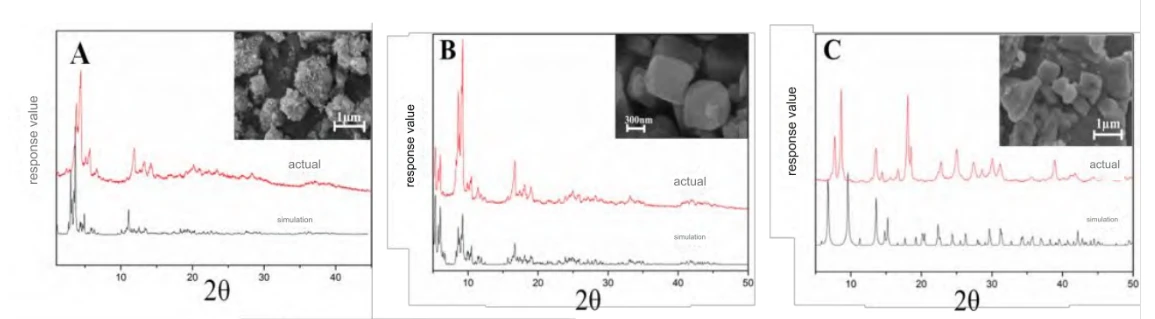

Fig. 2 XRD and SEM characterization results of five MOFs materials (A: MIL-101 (Fe); B: MIL-101 (Cr); C: MOF-5; D: MIL-53 (Fe); E: [Zn(NA)2])
2.1.2 Screening of MOFs materials
The static adsorption amount, desorption amount and desorption rate of five MOFs materials were calculated by formulas 1-2~1-4, and the screening results of MOFs materials are shown in Table 1.
The results in Table 1 show that these five MOFs all have adsorption effects on total flavonoids of Cistanche deserticola, but there are certain differences in adsorption and desorption. Among them, [Zn(NA)2] has the largest static adsorption amount of total flavonoids of Cistanche deserticola. In the static desorption experiment, the desorption rate of [Zn(NA)2] is the highest, which is 57.71%. Therefore, [Zn(NA)2] has the best comprehensive performance, and it can be considered that [Zn(NA)2] is the best choice for the separation and purification of total flavonoids of Cistanche deserticola.

CISTANCHE WITH HIGH CONTENT OF FLAVONOID
2.1.3 FTIR and TG characterization of [Zn(nicotinate)2]n
Figure 3 shows the infrared spectra of the organic ligand nicotinic acid and the synthesized sample [Zn(NA)2]. The absorption peak at 3050 cm-1 originates from the stretching vibration of the C=N bond, which shows the characteristics of a relatively strong and wide peak. In addition, the absorption peak at 1620 cm-1 is caused by the stretching vibration of C=O. The characteristic absorption peak of nicotinic acid, the stretching vibration peak of C=O, is around 1700 cm-1, and the C=O stretching vibration of [Zn(NA)2] is at 1620 cm-1, which is considered to be due to the red shift caused by the coordination between zinc and the oxygen atom on the carboxyl group.
Figure 4 The results of the thermogravimetric analysis show that [Zn(NA)2] has a mass loss of about 68.49% in the temperature range of 411℃ to 500℃, which is due to the decomposition of the organic ligands in the sample and the collapse of the metal organic framework. The results of thermogravimetric analysis prove that the synthesized sample has high thermal stability and remains stable below 411°C. Therefore, it is suitable for the enrichment and separation conditions of total flavonoids in Cistanche deserticola.

2.2 Determination of the optimal adsorption conditions of [Zn(NA)2] on Cistanche deserticola
As shown in Figure 5, Figure A, in the initial stage of adsorption, the adsorption amount of [Zn(NA)2] gradually increases with the passage of time, showing a rapid growth trend. However, after the adsorption time reaches 6 h, the adsorption amount of [Zn(NA)2] tends to stabilize and reaches an adsorption equilibrium state. At this time, the adsorption amount of [Zn(NA)2] is 48.21 mg∙g-1. Therefore, considering various factors, it can be concluded that the optimal adsorption time of [Zn(NA)2] is 6h.
Figure B shows that when the dosage is 100 mg, the adsorption amount is 60.2 mg∙g-1. When the dosage is greater than 100 mg, the adsorption amount does not increase significantly, so the dosage of the adsorbent [Zn(NA)2] is selected as 100 mg.

Figure C shows that when the sample solution concentration is lower than 2.20 mg∙mL-1, the adsorption amount increases with the increase of concentration. However, when the sample solution concentration reaches 2.20 mg∙mL-1, the sample concentration further increases, and the change of the adsorption amount basically tends to be stable. Therefore, it can be concluded that the sample solution concentration of 2.20 mg∙mL-1 has a more suitable adsorption effect.
Figure D shows that as the pH value of the sample solution gradually increases, the adsorption amount of total flavonoids in Cistanche deserticola has undergone significant changes. As the pH value increases, the adsorption capacity gradually increases, reaching the highest value at pH 5.0. Subsequently, when the pH value continues to rise, the adsorption capacity shows a downward trend. pH may affect the state of the total flavonoids of Cistanche deserticola in the solution. It is speculated that at pH=5, the flavonoids transform from the ionic state to the molecular state, the van der Waals force increases, and molecular adsorption occurs with [Zn(NA)2], forming complex, thereby increasing the adsorption capacity; experiments have verified that the adsorption effect is not good in a peracid or overly alkaline environment. In summary, the optimal pH value of Cistanche deserticola sample stock solution is 5.0.
2.3 Determination of the optimal desorption conditions
2.3.1 Effect of desorption performance and different desorption solutions
According to the data in Figure 6, the desorption rate of [Zn(NA)2] in ethanol is 38.79%; the desorption rate in methanol desorption solution is 39.16%. However, ethanol is low in toxicity and economical, so its application in the desorption process not only ensures good desorption performance, but also meets the requirements of safety and economy. From a comprehensive perspective, considering multiple factors such as desorption effect, safety and economic cost, ethanol is identified as the most suitable desorbent.

2.3.2 Effect of desorption effect and different ethanol concentrations
It can be seen from Figure 7 that when the volume fraction of ethanol for [Zn(NA)2] reaches 30%, the desorption rate of total flavonoids in Cistanche deserticola reaches the highest point. When the volume fraction of ethanol exceeds 30%, the desorption amount gradually decreases. According to calculation, the desorption rate of total flavonoids of Cistanche deserticola by 30% ethanol reached 45.52%, and the purity of total flavonoids after desorption increased from 9.33% of crude extract to 48.23%. Based on the above considerations, the best choice of [Zn(NA)2] desorption solution is 30% volume fraction ethanol aqueous solution.
2.3.3 PXRD characterization after [Zn(NA)2] desorption
Figure 8 is a comparison of PXRD spectra before and after [Zn(NA)2] adsorption. According to the peak position and intensity of the PXRD graph, it is believed that the crystal structure of the material remains unchanged during the adsorption and desorption process.

Fig. 8 PXRD of [Zn(NA)2] (a: before adsorption b: after desorption)
3 Conclusions
Five MOFs materials, [Zn(nicotinate)2]n, MIL-101(Cr), MIL-101(Fe), MIL53(Fe), and MOF-5, were successfully prepared by solvent thermal reaction method. After screening the adsorption and desorption effects of total flavonoids from Cistanche deserticola, [Zn(nicotinate)2]n([Zn(NA)2]) was selected as the best choice for enriching and separating total flavonoids from Cistanche deserticola, and it was fully characterized by FT-IR, PXRD, SEM, and TG. The results of FT-IR and PXRD showed that the skeleton structure of the synthesized materials was clearly determined, showing high crystallinity and excellent purity, without the presence of impurity peaks. SEM observations revealed the uniformity and consistency of the material morphology. TG analysis showed that [Zn(NA)2] has excellent thermal stability, which helps it to be used as an adsorption material for total flavonoids in Cistanche deserticola.
In terms of adsorption, the optimal adsorption conditions are: the pH value of the sample solution is 5.0, the concentration of the sample solution is 2.20 mg∙mL-1, and the adsorption time is 6 h. Under these conditions, the adsorption amount of total flavonoids in Cistanche deserticola by [Zn(NA)2] reached 62.91 mg∙g-1. Under the optimal desorption conditions of 30% ethanol aqueous solution by volume, the desorption rate of [Zn(NA)2] was 45.52%. This adsorption and desorption process increased the purity of total flavonoids in Cistanche deserticola from 9.33% of the crude extract to 48.23%, and this process did not significantly affect the crystal structure of [Zn(NA)2].
Based on the above research results, [Zn(NA)2] exhibits excellent adsorption and desorption performance for total flavonoids from Cistanche deserticola, and is suitable for the enrichment and separation of similar compounds. Therefore, MOFs material Zn(nicotinate)2]n has the potential for wide application in the field of enrichment and separation of effective components of traditional Chinese medicine. This study provides new methods and theoretical support for the field of extraction and separation of traditional Chinese medicine, and expands the application field of MOFs materials.

References
[1] National Pharmacopoeia Committee. Chinese Pharmacopoeia [S]. Beijing: China Medical Science and Technology Press, 2020.
[2] National Health Commission. Notice on the pilot management of 9 substances including Codonopsis pilosula as both traditional food and Chinese medicinal materials [EB/OL]. /2023-09-05. http://www.nhc.gov.cn/sps/s7885/202001/1ec2cca04146450d9b14acc2499d854f.shtml.
[3] ZHENG S, JIANG X, WU L, et al. Chemical and Genetic iscrimination of Cistanches Herba Based on UPLC-QTOF/MS and DNA
Barcoding[J]. M. Labra. PLoS ONE, 2014, 9(5): e98061.
[4] Jiangsu New Medical College. Chinese Materia Medica Dictionary (Volume 1)[M]. Shanghai: Shanghai People's Publishing House, 1977.
[5] Institute of Materia Medica, Chinese Academy of Medical Sciences. Chinese Materia Medica (Volume 1)[M]. Beijing: People's Medical Publishing House, 1959.
[6] ZHOU S, FENG D, ZHOU Y, et al. Analysis of the active ingredients and health applications of cistanche[J]. Frontiers in Nutrition, 2023, 10: 1101182. [7] CHOI J G, MOON M, JEONG H U, et al. Cistanches Herba enhances learning and memory by inducing nerve growth factor[J]. Behavioral Brain Research, 2011, 216(2): 652–658. [8] LIAO Y, WANG J, GUO C, et al. Cistanche tubulosa alleviates ischemic stroke-induced blood-brain barrier damage by modulating microglia-mediated neuroinflammation[J]. Journal of Ethnopharmacology, 2023, 309: 116269. [9] WAT E, NG C F, KOON C M, et al. The protective effect of Herba Cistanches on statin-induced myotoxicity in vitro[J]. Journal of
Ethnopharmacology, 2016, 190: 68–73.
[10] Yang Kai, Zhang Guiju, Xu Baocai. Study on the process of surfactant-assisted extraction of total flavonoids from Cistanche deserticola[J]. Daily Chemical Industry, 2015, 45(6): 328-331,
341.
[11] Xiao Xinghui, Zhang Xiangqian, Li Guifang, et al. Aqueous two-phase extraction of total flavonoids from Cistanche deserticola and its antioxidant activity[J]. Food Research and Development, 2017, 38(16): 5-
9.
[12] BOUZAYANI B, KOUBAA I, FRIKHA D, et al. Spectrometric analysis, phytoconstituents isolation and evaluation of in vitro antiox idant and antimicrobial activities of Tunisian Cistanche violacea (Desf)[J]. Chemical Papers, 2022, 76(5): 3031–3050