Evaluation Of The Anti-Aging Effects Of A Probiotic Combination Isolated From Centenarians in A SAMP8 Mouse Model Part 2
May 16, 2022
Please contact oscar.xiao@wecistanche.com for more information
Immunofluorescence and Inflammatory Factor Detection
Brains were fixed in paraformaldehyde and then subjected to dehydration, clearing, wax immersion, and embedding. The embedded tissue was sliced continuously at a thickness of 5 μm. The sections were deparaffinized and equilibrated to water, subjected to antigen retrieval, and incubated in 5% bovine serum albumin(BSA)for 30 min. The sections were then incubated with the appropriate primary and secondary antibodies. The nuclei were then stained with DAPI. After mounting the sections, they were viewed under an upright fluorescence microscope and images were captured. flavonoids The number of NeuN-positive cells was counted by using the Image] software (National Institutes of Health). The average cell number/field of view was used for statistical analysis. To detect inflammatory factors, the protein was extracted from the brains following the same method described for western blot. The following kits were used to evaluate the levels of inflammatory factors in the hippocampus of mice, following the manufacturer's instructions: IL-1β(Proteintech, Cat#KE10003), TNF-α(Proteintech, Cat# KE10002), and IL-6 (Proteintech, Cat# KE10007).

Please click here to know more
Bacterial DNA Extraction
For microbiota analysis, the feces of each group of mice (n=8)were collected. A genomic DNA kit (Qiagen, Cat#51804)was used to extract fecal genomic DNA, following the product instructions. Then the NanoDrop spectrophotometer was used to determine the concentration and quality of the extracted DNA. Genomic DNA was re-extracted for samples that did not meet the quality requirements. The 16S ribosomal DNA (rDNA)V4 region was amplified by using the following primers:515F,5'-GTG CCA GCMGCC GCG GTAA-3;806R,5'-GGA CTA CVSGGG TAT CTAAT-3'.The IlluminaHiSeq2000 platform was used for sequencing. hesperidin uses The sequencing results have been deposited in GenBank(accession number PRJNA768326).
High-Throughput Sequencing The data were subjected to sequence denoising or operational taxonomic unit (OTU) clustering by using the analysis process of the Search software or QIIME2 DADA2 analysis. The Search method (20)mainly includes de-priming, splicing, quality filtering, de-duplication, de-chimerism, clustering, and other steps to obtain OTU. The DADA2 method mainly carries out the steps of depriming, quality filtering, de-noising, splicing, and de-chimerism. Each deduplicated sequence generated after DADA2 quality control is called an amplicon sequence variant (ASV), or feature sequence(corresponding to a representative sequence of OTU).ASV and OTU were then used to analyze the species composition, alpha diversity, beta diversity, species difference analysis and symbol species, etc.
Cistanche can anti-aging
Statistical Analysis
GraphPad Prism 7 was used for statistical analysis. lost empire cistanche The data were expressed as the mean ± standard deviation (SD). One-way analysis of variance(ANOVA) was used to determine a statistically significant difference (p<0.05)
RESULTS
Probiotic Properties
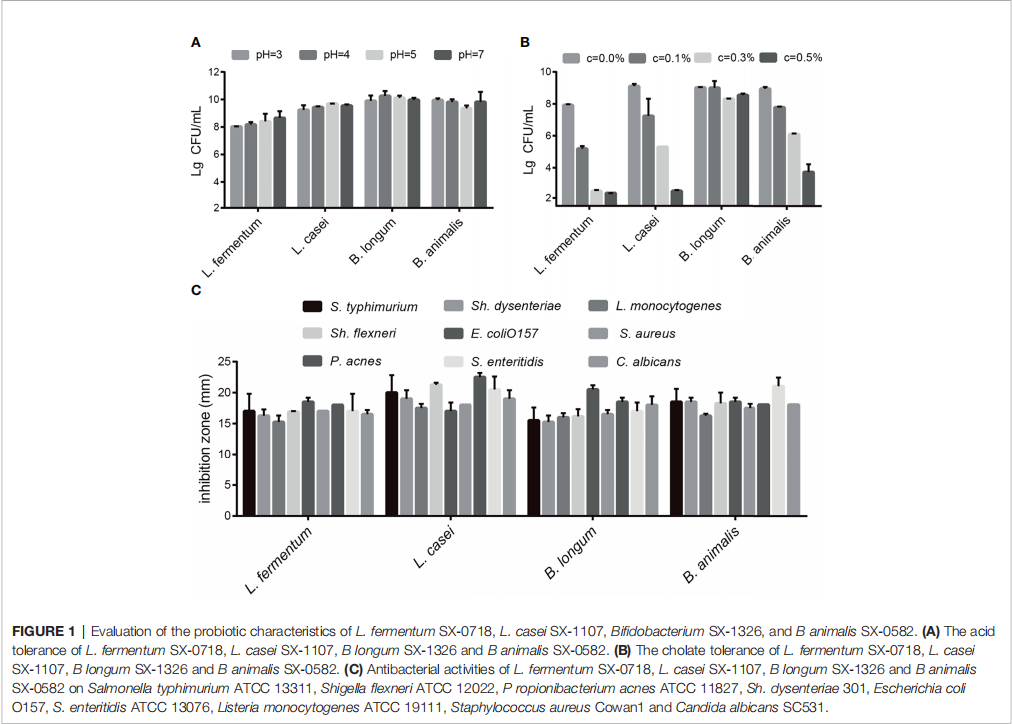
First, we conducted acid tolerance, bile salt tolerance, and antibacterial experiments to evaluate the probiotic characteristics of the selected strains. The four selected probiotics were tolerant to medium-strong acid (Figure 1A)and survived in different bile salt concentrations(Figure 1B). As shown in Figure 1A,after4h in pH3 PBS, the survival rates of L. fermentum SX-0718, L. Casey SX-1107, B. long SX-1326, and B. animalis SX-0582 were 80.2%,92.4%,99.0%,and 99.5%, respectively.As shown in Figure 1B, L fermentum SX-0718 had low tolerance to bile salt.B. micronized purified flavonoid fraction 1000 mg uses longum SX-1326 showed excellent bile salt tolerance: at a concentration of 0.5%, the survival rate was still 85.4%.In addition, the selected probiotics significantly inhibited the growth of the pathogens S. Typhimurium ATCC 1331l, Sh.flexneri ATCC 12022, P.acnes ATCC 11827, Sh.dysenteriae 301, E. coli O157, S. enteritidis ATCC 13076, L. monocytogenes ATCC 19111, Staph. aureus Cowan and C.albicans SC531, with a suppression area from 15.25 mm to 22.5 mm (Figure 1C).
The Probiotic Combination Improved Behaviour in SAMP8 Mice
The Barnes maze test was used to evaluate the effect of the probiotic combination on spatial learning and memory abilities. Compared with the C group, in daily training, mice in group M took a significantly longer time to find the platform, while probiotic combination(group L and H)greatly reduced the escape latency, the latency period of searching for the right foramen. oteflavonoid On the probe test, the latency of the probiotic combination treatment was significantly shorter than that of the M group (L vs.M=27.4svs.48.19s;p<0.001; VHS.M=20.34svs.48.19s;p<0.001), and there was no significant difference between low-dose and high-dose probiotics (Figure 2A).

The pole test was conducted to observe the effect of the probiotic combination on the motor dysfunction of SAMP8 mice. As shown in Figure 2, compared with the C group, the M group showed significant motor retardation(M vs. C=19.46 s vs.8.877 s;p<0.001), and treatment with either low or high concentrations of the probiotic combination significantly alleviated the motor dysfunction of SAMP8 mice(L vs.M=13.78 s vs.19.46 s;p<0.001; VHS.M=10.73s vs.19.46 s;p<0.001).
The open field test was used to detect the behavioral and mental changes of mice to the new environment, such as exploratory behavior and anxiety. Experimental parameters showed that compared with mice in group M(distance =4384 cm, number = 109, distance =574.6), mice in groups C, L, and H had a longer total movement distance(distance =
5505 cm, distance=5474 cm, distance = 5313 cm; C vs M,P<0.05;L vs M,p<0.05;H vs M,p<0.05),more times to enter the central area (number = 59.33, number =91.56, number = 104.8;C vs M,p<0.05;L vs M,p<0.05;H vs M,p<0.05)and longer central movement distance (distance = 1379 cm, distance =1187 cm, distance = 1416 cm; C vs M, p<0.05;L vs M, p<0.05;H vs M,p<0.05).In addition,there was no dose-dependent in probiotics treatment.
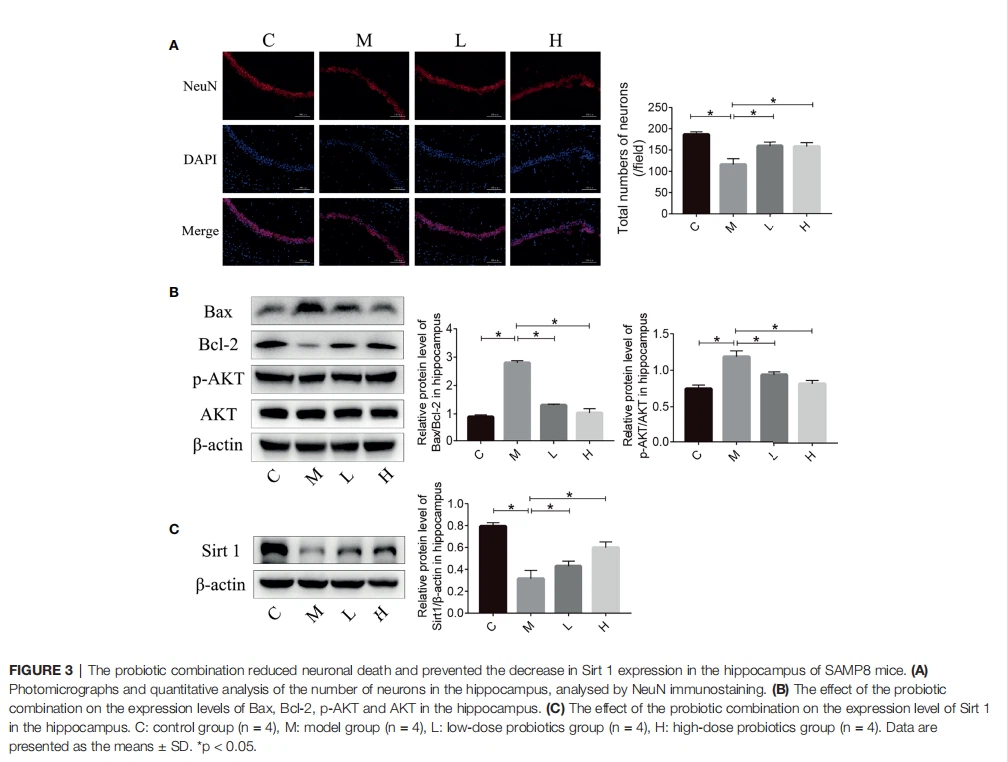
The Probiotic Combination Reduced Neuronal Death and Prevented the Decrease of Sirt 1 Expression in the Hippocampus of SAMP8 Mice The reduction in the number of hippocampal neurons in SAMP8 mice is closely related to the learning and memory declines. Therefore, we detected the number of neurons in the hippocampus of SAMP8 mice through NeuN immunostaining. Compared with the C group, the M group had fewer hippocampal neurons; the probiotic combination protected hippocampal neurons compared with the M group (Figure 3A). Neuronal loss due to apoptosis - regulated by Bax and Bcl-2-plays an important part in the occurrence and development of aging. The p-AKT can modulate apoptosis by regulating Bcl-2/Bax. We evaluated the expression of Bax, Bcl-2, and p-AKT in the hippocampus of mice by using western blot. The results showed that the expression of pro-apoptotic protein Bax in group M mice was significantly higher than that in C mice, and the expression of anti-apoptotic protein Bcl-2 and p-AKT was significantly lower than that of the M group, while the pro-apoptotic protein expression in the L and H groups was significantly lower than that in M group, and the expression of the apoptotic protein was notably higher than that of the M group. In addition, the expression of Sirt l in the C, L, and H groups was prominently higher than that in the M group, indicating that probiotic combination could inhibit the decrease of Sirt 1 expression in aging mice. The Probiotic Combination Inhibited TLR4/NF-B Signaling Pathway and Hippocampal Inflammation in SAMP8 Mice Inflammation plays an important role in maintaining and promoting aging, and the TLR4/NFkB pathway is closely related to inflammation. Hence, we evaluated the expression of proteins involved in the TLR4/NFkB signaling pathway in the hippocampus by using western blot. Compared with the M group, the probiotic combination significantly reduced TLR4,

MyD88 and p-p65/p65 expression (Figure 4A,p<0.01). In addition, the detection of inflammatory factor protein levels showed that the probiotic combination significantly reduced the relative expression of the pro-inflammatory cytokine IL-1β, IL-6, and TNF-α compared with the M group,(Figure 4B; p<0.01). These results suggest that the probiotic combination modulates the upregulation of TLR4/NFkB signaling pathway components to reduce inflammation in SAMP8 mice.
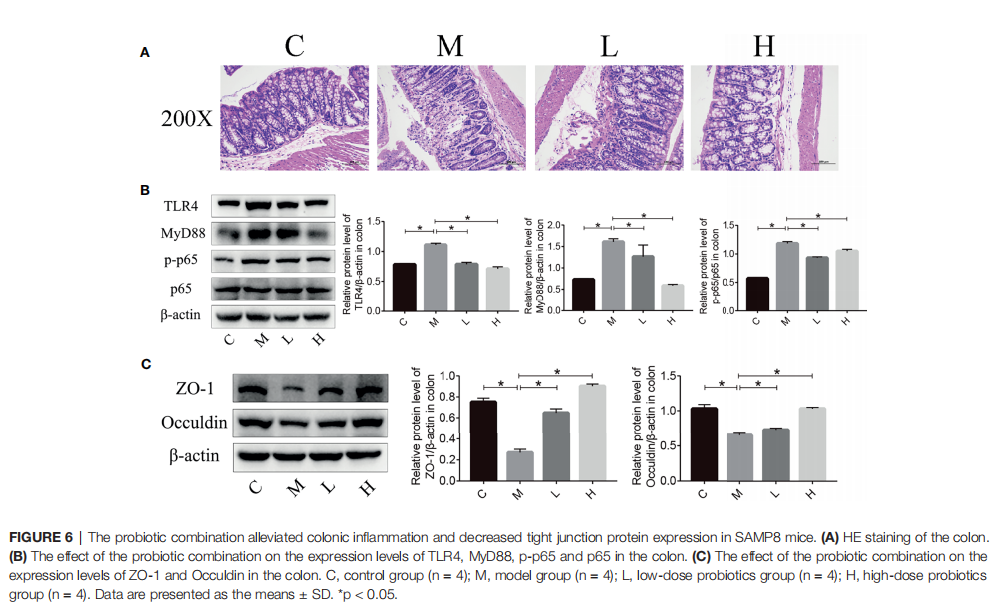
The Probiotic Combination Altered the Gut Microbiota Composition of SAMP8 Mice The intestinal microbiota is closely related to the occurrence and development of senescence. We collected the feces of mice and analyzed their intestinal microbiota changes by using high-throughput sequencing. A total of 1,138,968 valid tags and 10,202 OTUs were obtained, with an average of 2550.25 per group(data not shown).To analyze the influence of the probiotic combination on the intestinal microbiota of SAMP8 mice, we carried out a diversity analysis of the microbiota. The Observed_species index represented the actual observed number of OTU, and the Chaol index indicates the diversity of the microbiota. As shown in Figure 5, the Observed_species index and Chaol indexes of the M group of mice were reduced, while the probiotic combination increased the abundance and diversity of intestinal microbiota, although the changes were not significant (Figures 5A, B). The Venn diagram shows 441 common OTU among all the groups, with 47,42,69, and 57 unique OUT for the C, M, L, and H groups, respectively(Figure 5C). In addition, the principal coordinates analysis(PCoA) used to study the similarity of microbial communities showed that the points of the C group are clustered together, the points of the M group are relatively scattered, and the samples of the C, L, and H groups have high similarity. These findings indicate that the probiotic combination alters the intestinal microbiota of aging mice to a pattern like that of normal mice(Figure 5D). We analyzed the relative abundance of the top 20 bacterial genera among the different groups. There was a notably increased relative abundance of Alisipes, Prevotella, Odoribacter, Lactobacillus, and Oscillibacter, and decreased relative abundance of Alloprevotella, Barnesiella, and Akkermansia. Compared with the M group, the probiotic combination reduced the relative abundance of Alistipes and Prevotella and increased the relative abundance of Alloprevotella, Acetatifactor, and Clostridium XIVa(Figure 5E). The Probiotic Combination Alleviated Colonic Inflammation and Decreased Tight Junction Protein Expression in SAMP8 Mice Intestinal microbiota imbalance and intestinal inflammation can be causally related to each other. Therefore, hematoxylin and eosin(H&E) staining was used to detect the pathological changes in the mice colon, and the western blot was applied to detect the expression of key proteins in the TLR4/NFKB inflammatory pathway and intestinal permeability-related proteins in mouse colon tissue. As shown in Figure 6, mucosal epithelial cells were shed and a small amount of the intestinal gland structure was destroyed in the colon of mice in the M group, while no mucosal epithelial cells were shed and the intestinal gland structure was maintained in the intestinal tissues of the C, L and H groups. In addition, we used western blot to examine the expression of key proteins in the TLR4/NFKB inflammatory pathway as well as
proteins related to intestinal permeability. Compared with the C group, ZO-1 and Occludin expression decreased and TLR4, MyD88, and p-p65 expression increased in the M group. The probiotic combination significantly increased the expression of ZO-1 and Occludin -indicating increased integrity of the intestinal barrier - and reduced the expression of TLR4, MyD88, and p-p65 -indicating a modulation of intestinal inflammation (Figures 6B, C).
DISCUSSION
The aging of the population is a prominent global problem in today's society. Aging can lead to a series of physical changes and abnormal behaviors, such as hair loss, sagging skin, reduced mental ability, decreased memory, and even dementia (21). The health problems caused by aging are major challenges in the field of health care (12). There is currently a no good way to prevent or treat aging. Therefore, research related to anti-aging treatments and aging-related diseases is needed urgently. The SAMP8 mouse exhibits rapid aging that is consistent with what happens in humans. It is mainly characterized by reduced learning and memory, cognitive impairment, and neurodegenerative changes. It is a common natural pathogenesis model for to study of dementia and aging (22). In this research, the SAMP8 mice were used to evaluate the effects of a probiotic combination. First, we identified four probiotics (L. fermentum SX-0718, L. casei SX-1107, B.longum SX-1326, and B.animalis SX-0582; Jiangxi Shanxing Biotechnology Co., Ltd, Nanchang, Jiangxi, PR China) from the feces of centenarians. In vitro experiments verified that they had good acid resistance, bile salt resistance, and antibacterial properties(Figure 1). In addition, the probiotic combination could alleviate weight loss and reduce the aging score of SAMP8 mice (Supplementary Figures 1B, C). In behavioral tests, aging mice showed impaired spatial memory, motor dysfunction, and decreased exploratory behavior (Figure 2). The probiotic combination was able to ameliorate these changes, indicating that it may exert anti-aging effects. Given the promising behavioral data, we studied the possible anti-aging mechanism of the probiotic combination. The hippocampus is involved in learning and memory and damage to this brain region can cause learning and memory impairment and spatial positioning disorders (23). Compared with the C group, there were fewer neurons in the hippocampus of the M group. The probiotic combination could alleviate the loss of neurons in SAMP8 mice(Figure 3A). Many studies have shown that the AKT signaling pathway plays a significant role in the apoptosis and metabolism of neurons. The AKT signaling pathway improves cell survival by regulating forkhead transcription factor (FKHR), as well as mammalian target of rapamycin (mTOR)to increase protein synthesis and affect nerves. The growth of synapses and the development of synaptic plasticity ultimately affect learning and memory
functions (24,25). The p-AKT can directly regulate the formation of the Bcl-2/Bax heterodimer through phosphoinositide 3-kinase (PI3K)-1 (26). Sirt I plays a significant role in the development of the brain and neurons as well as the pathogenesis of AD. Neurodegeneration and cognitive function are significantly improved after the injection of a virus encoding Sirt l into the hippocampus(27). Research by Zhou et al. (28)also showed that blocking Sirt 1 with small interfering RNA (siRNA) can accelerate AD pathology and cognitive impairment. Moreover, there is an interaction between Sirt 1 and AKT. Histone acetyltransferase (HAT) can inhibit AKT phosphorylation, while Sirt l is a histone deacetylase (HDAC) that uses NAD to deacetylate AKT on lysine residues targeted by HAT (29). Sirt 6 is another NAD+ dependent deacetylase, Kawahara et al. (30)found that Sirt 6 can be recruited to the promoters of NFkB downstream genes, reducing the level of promoter acetylation and inhibiting the expression of downstream genes related to apoptosis and cellular senescence. Studies have shown that overexpression of Sirt 6 can increase the healthy lifespan of mice by an average of 30% (31), so Sirt 6 may be another mechanism by which probiotics exert anti-aging effects, although this eventuality requires further study. The detection of NeuN-positive cells, apoptosis, proliferation-related proteins, and Sirt l in the hippocampus demonstrated that the probiotic combination can prevent hippocampal neuronal loss (Figure 3). The neuroprotective effect of the probiotic combination on hippocampal neurons may be through the regulation of the AKT signaling pathway and Sirt 1.
Neuroinflammation plays an important part in aging-related neurological diseases such as AD and PD(32).In these diseases, various inflammatory factors (food antigens, lipopolysaccharides, free fatty acids, reactive oxygen species, etc.) bind to TLR and activate NFkB, an important factor in the immune system and the inflammatory process, after signal transduction. This phenomenon leads to the release of many pro-inflammatory factors(IL-1B, IL-6, TNF-αx, etc.), causing neuroinflammation, damage to the brain, and neuronal death (32,33). Some drugs can alleviate the progression of neurodegenerative diseases such as AD and PD by modulating neuroinflammation (34,35).In this study, compared with the M group, the levels of TLR4, MyD88, p-p65/p65, IL-1β, TNF-α, and IL-6 were significantly reduced in the L and H groups (Figure 4), indicating that the probiotic combination can inhibit neuroinflammation in aging mice and protect neurons.

The intestinal microbiota is closely related to human health. Under normal physiological conditions, the host and the intestinal microbiota maintain an ecological balance through synergistic antagonism. Local and continuous abnormal activities of intestinal microbes can cause inflammation of the intestinal mucosa. However, local inflammatory reactions often lead to the occurrence of chronic low-grade inflammation throughout the body. Chronic low-grade inflammation in the intestinal mucosa will result in the destruction of the intestinal barrier, and many harmful factors (lipopolysaccharides, pathogenic bacteria, etc.) will enter the body to induce neuroinflammation(14,16,32). We detected changes in the intestinal microbes of mice by using high-throughput sequencing. Compared with the C group, the diversity and richness of the intestinal microbiota in the M group were decreased. The probiotic combination counteracted these changes in the intestinal microbiota and promoted the restoration of intestinal homeostasis (Figures 5A, B). Based on PCoA, we found that after treatment with the probiotic combination, the intestinal microbiota of the aging mice aggregated with the intestinal microbiota of the C group (Figure 5D), which indicates that the probiotic combination restores the intestinal microbiota of the aging mice to the composition of normal mice. Consistently with the findings of others, the abundance of Akkermansia muciniphila was decreased and the abundance of Prevotella was increased in aging mice(15). Moreover, the probiotic combination reduced the relative abundance of Alistipes and Prevotella(Figure 5E). Akkermansia can improve metabolism, exerts anti-inflammatory activity, and augments the efficacy of immunotherapy; it is also closely related to intestinal barrier function. The decline in Akkermansia may cause damage to the intestinal barrier and lead to inflammation in the body(36). Alistipes is a gram-negative anaerobe and a facultative pathogen. The abundance of Alistipes increases in patients with depression (37).In the gut microbes of patients with intestinal irritability syndrome, Alistipes tend to increase, and this change may be one of the underlying causes of depression in such patients(38). puritans vitamin c Researchers have found that Alistipes can affect the use of tryptophan, impairing the balance of the serotonergic system in the intestine, and then inhibiting brain electrical activity, which may lead to cognitive dysfunction (37). Prevotella is a genuso fessential bacteria in a healthy intestinal biota. However, studies have shown that Prevotellaceae bacteria increase in the intestinal microbiota of patients with schizophrenia(39). The abundance of Prevotella in the intestinal microbiota of patients with cerebral palsy and children with cerebral palsy and epilepsy increases significantly(40). The increased abundance of Prevotella may be related to diseases such as periodontitis, bacterial vaginosis, rheumatoid arthritis, metabolic disorders, and low-grade systemic inflammation(41-43). This may be due to the intestinal colonization of Prevtella leading to changes in the metabolism of the microbiota, reducing the production of IL-18, which intensifies intestinal inflammation and may lead to systemic autoimmunity (44).
Studies have shown that intestinal barrier dysfunction, and thus chronic inflammation from the intestine, plays an important role in aging(45). Therefore, we examined the pathological changes in the colon in mice and detected the expression of components of the TLR4/NFKB inflammatory pathway (TLR4, MyD88, and p-p65) and tight junction proteins(ZO-1 and Occludin) in the colon. The mucosal epithelial cells in the colon of aging mice were shed and a small amount of intestinal gland structure was destroyed. The probiotic combination counteracted these changes (Figure 6A). Compared with the Cgroup, the TLR4/NFKB signaling pathway was activated in the M group, with increased the expression of the inflammation-related proteins TLR4 and MyD88, which in turn increased the level of p-p65(Figure 6B). At the same time,
the expression of ZO-1 and Occludin decreased significantly (Figure 6C). Treatment with the probiotic combination relieved intestinal inflammation and increased the integrity of the intestinal barrier.
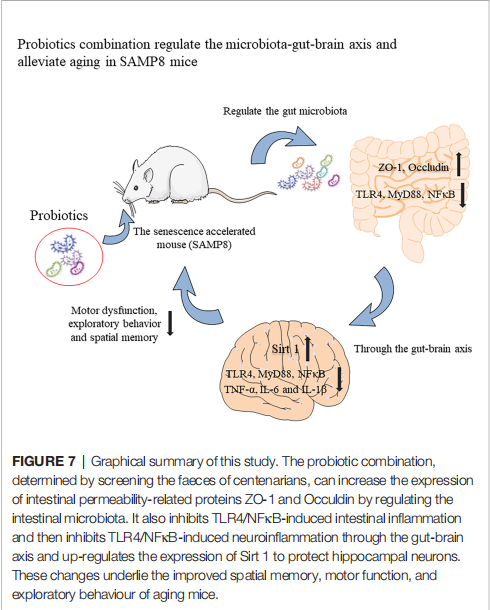
In summary, we have shown that the probiotic combination, developed by screening the feces of centenarians, increases the expression of intestinal permeability-related proteins ZO-1 and Occludin by regulating the intestinal microbiota. It also inhibits TLR4/NFkB-induced intestinal inflammation and consequently, neuroinflammation through the gut-brain axis and upregulates the expression of Sirt 1 to protect hippocampal neurons (Figure 7). These changes underlie improved spatial memory, motor function, and exploratory behavior of aging mice. Our research provides the basis for the probiotic combination to become a dietary supplement for anti-aging.
This article is extracted from Frontiers in Immunology | www.frontiersin.org December 2021 | Volume 12 | Article 792746