Exploration Of The Molecular Mechanisms Of Cistanche Deserticola‑Angelica Sinensis Herbal Pair For Parkinson’s Disease Therapy
Oct 08, 2026
Abstract
Parkinson's disease (PD) represents a progressive neurodegenerative movement‑disorder lacking radical curative therapies. The herbal pair consisting of Cistanche deserticola and Angelica sinensis is a well‑known traditional Chinese medicine (TCM) combination reported to alleviate PD‑associated clinical symptoms. This research integrated network‑pharmacology workflow and deep‑learning prediction model to uncover candidate therapeutic targets and latent molecular mechanisms of this herbal pair against PD.
Active chemical constituents of Cistanche deserticola‑Angelica sinensis were retrieved and filtered via the TCMSP database. PubChem database supplied compound structural information. Intersection analysis identified 131 shared genes between drug‑related targets and PD‑disease‑associated genes. GO functional enrichment and KEGG pathway enrichment were performed for these overlapping genes. The pre‑trained CNN_CNN_BindingDB model embedded in the DeepPurpose deep‑learning toolkit was deployed to quantitatively predict molecular‑protein binding affinity between representative phytochemicals and hub target proteins.
Functional enrichment outputs demonstrated that this herbal mixture intervenes PD pathological progression through biological responses including exogenous‑stimulus reaction, infectious‑related pathways, lipopolysaccharide response and reactive‑oxygen‑species stress response. Dominant KEGG signaling pathways covered chemical‑carcinogenesis‑receptor‑activation pathway as well as AGE‑RAGE signaling cascade. Deep‑learning affinity prediction verified robust binding interaction between major bioactive ingredients (β‑sitosterol, quercetin, arachidonate and other phytochemicals) and core PD‑related hub proteins (HIF1A, TP53, MYC, MAPK1, HSP90AA1, FOS, EGFR, RELA, STAT1, CCND1, AKT1).
Collectively, Cistanche deserticola‑Angelica sinensis herbal pair exerts multi‑component, multi‑target pharmacological effects for PD intervention. Its active substances modulate autophagy, cellular apoptosis, oxidative‑stress homeostasis and neuroinflammatory responses. This computational study provides preliminary theoretical evidence and reference resource for subsequent experimental validation and anti‑PD drug screening derived from TCM herbal combinations.
Keywords: Parkinson's disease; network pharmacology; deep‑learning; Cistanche deserticola; Angelica sinensis; herbal pair; neuroprotection; target prediction
1. Introduction
Parkinson's disease (PD) is a disabling chronic neurodegenerative disorder characterized by progressive degeneration of nigrostriatal dopaminergic neurons. Typical clinical manifestations include resting tremor, muscular rigidity, postural instability, bradykinesia, accompanied by non‑motor symptoms such as sleep disturbance, olfactory dysfunction, constipation and mental‑cognitive impairment Current mainstream clinical interventions are dominated by symptomatic levodopa‑based substitutive treatment, which can relieve motor signs temporarily yet cannot halt or reverse underlying neuronal degenerative progress. Long‑term levodopa administration often generates motor‑complication adverse reactions. Therefore, discovery and development of novel neuroprotective therapeutic agents remain urgent clinical demands.
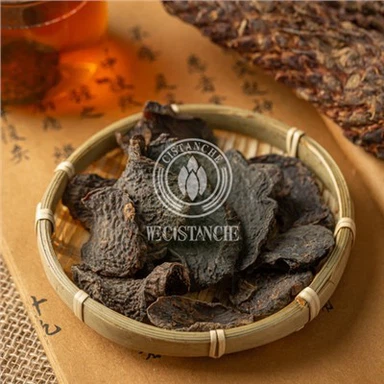
Traditional Chinese herbal medicine provides abundant candidate resources for neurodegenerative‑disease drug exploration. Cistanche deserticola (Rou‑cong‑rong) and Angelica sinensis (Dang‑gui) are frequently‑combined medicinal herbs within TCM clinical practice. Modern pharmacological investigations have validated multiple bio‑functions for these two herbal materials. Cistanche deserticola, the "desert ginseng", possesses neuron‑protective, immunomodulatory, anti‑tumor and gastrointestinal‑regulating activities with favorable biosafety profilesPMC. Its phenylethanoid‑glycoside components such as echinacoside and verbascoside can mitigate oxidative neuronal damage, inhibit dopaminergic‑neuron apoptosis and regulate autophagy flux, showing promising anti‑PD pre‑clinical effects. Angelica sinensis is widely applied for nourishing blood and activating blood circulation in TCM prescriptions; its extracts exhibit anti‑inflammatory performance, reactive‑oxygen‑species scavenging capacity, anti‑aging and neurotrophic propertiesFrontiers. Combined usage of these two herbs is presumed to generate synergistic neuro‑protective benefits for PD patients.

Nevertheless, the holistic molecular mechanism underlying the Cistanche deserticola‑Angelica sinensis herbal pair treating Parkinson's disease remains insufficiently clarified by conventional single‑target laboratory experiments. Network‑pharmacology methodology simulates the "multi‑compound, multi‑target, multi‑pathway" characteristic of TCM formulae, which fits perfectly for mechanism decipherment of herbal combinations. Moreover, deep‑learning‑based drug‑target‑binding‑affinity prediction further supplements traditional molecular‑docking workflow and improves high‑throughput screening efficiency for compound‑target interaction. The DeepPurpose open‑source library supplies multiple pre‑trained neural‑network architectures for drug‑target interaction forecasting; the CNN_CNN_BindingDB model achieves reliable performance for small‑molecule‑protein binding‑score estimation.
In this computational study, we integrated network‑pharmacology analytical pipeline with DeepPurpose deep‑learning model to systematically probe potential targets and signaling cascades modulated by Cistanche deserticola‑Angelica sinensis against PD. We aimed to reveal synergistic molecular mechanism of this herbal pair and lay theoretical groundwork for follow‑up in‑vitro cellular assay and in‑vivo animal‑model verification, accelerating new‑candidate‑drug exploitation for Parkinson's‑disease therapy.
2. Materials and Methods
2.1 Dataset retrieval and compound‑target screening
Bioactive chemical components of Cistanche deserticola and Angelica sinensis were obtained from TCMSP (Traditional Chinese Medicine Systems Pharmacology Database and Analysis Platform). Three filter criteria were applied for candidate‑compound screening: oral bioavailability OB ≥ 30 %; drug‑likeness DL ≥ 0.18; blood‑brain‑barrier permeability BBB ≥ −0.85. The BBB threshold setting guarantees that screened phytochemicals possess theoretical capability to cross blood‑brain barrier and act on central‑nervous‑system lesions related to PD pathology, considering blood‑brain‑barrier impairment frequently occurring among PD patients.
PubChem database was queried for canonical SMILES structural strings of filtered compounds. Disease‑associated target genes for Parkinson's disease were collected from GeneCards, OMIM, PharmGkb, TTD and DrugBank databases. After consolidating and de‑duplicating disease‑related gene entries, intersection analysis was conducted between herbal‑compound predicted targets and PD‑relevant disease genes to acquire shared overlapping target genes of the herbal pair for PD treatment.

2.2 Construction of protein‑protein‑interaction (PPI) network
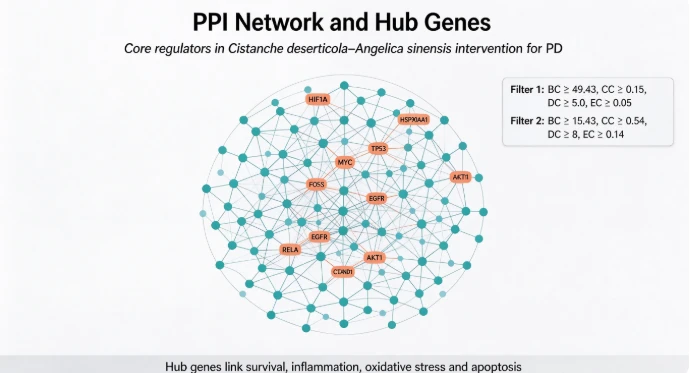
Overlapping common target genes were submitted to STRING database. Species was specified as Homo sapiens, confidence threshold was set to highest‑confidence score > 0.9; other parameters kept as default configuration to build protein‑protein‑interaction network. Network topological parameters including degree‑centrality (DC), betweenness‑centrality (BC), closeness‑centrality (CC), eigenvector‑centrality (EC) were calculated. CytoNCA plugin within Cytoscape software executed twice‑round hub‑gene filtering to identify core hub‑target genes. First filtering criteria: BC ≥ 49.43, CC ≥ 0.15, DC ≥ 5.0, EC ≥ 0.05. Second‑round stricter filtering: BC ≥ 15.43, CC ≥ 0.54, DC ≥ 8, EC ≥ 0.14. Genes satisfying secondary screening thresholds were defined as core hub targets of this herbal pair against PD.
2.3 GO and KEGG enrichment analysis
R‑studio platform with Bioconductor ecosystem packages (clusterProfiler, ggplot2 and auxiliary dependency packages) was adopted for Gene‑Ontology (GO) functional enrichment analysis and Kyoto‑Encyclopedia‑of‑Genes‑and‑Genomes (KEGG) pathway enrichment analysis for 131 shared intersecting targets. GO enrichment analysis covers three categories: biological process (BP), cellular component (CC), molecular function (MF). P‑value < 0.05 was regarded as statistically‑significant enrichment threshold.
2.4 Deep‑learning‑based binding‑affinity prediction
The DeepPurpose open‑source deep‑learning toolkit was used for drug‑target‑binding‑affinity prediction. Pre‑trained CNN_CNN_BindingDB model was selected for calculation. Amino‑acid sequences of core‑target proteins were downloaded from UniProt database; compound SMILES strings were retrieved from PubChem database. This convolutional‑neural‑network hybrid model takes compound SMILES sequence and target‑protein amino‑acid sequence as dual input features and outputs quantitative binding‑strength score matrix for compound‑target pairs. Visualization of binding‑prediction matrix was implemented to exhibit interaction intensity between representative herbal‑pair phytochemicals and hub PD‑related proteins.
3. Results
3.1 Active‑compounds and drug‑target collection
Following TCMSP database retrieval and three‑dimensional filtering criteria (OB ≥ 30 %, DL ≥ 0.18, BBB ≥ −0.85), seven bioactive phytochemicals (including one shared common constituent for both herbs) were obtained from Cistanche deserticola‑Angelica sinensis herbal pair. Strawberry‑Perl script performed target‑ID conversion, UniProt database annotated and standardized gene names; finally total 297 putative drug‑target genes linked with the herbal‑pair compounds were acquired.
3.2 Intersection screening for PD‑relevant therapeutic targets
Multiple disease‑gene databases (GeneCards, OMIM, PharmGkb, TTD, DrugBank) were integrated and de‑duplicated, yielding total 11 208 PD‑related disease genes. Intersection calculation between herbal‑pair target set and PD‑disease‑gene dataset produced 131 common intersecting genes, which constituted potential therapeutic‑target pool mediating anti‑PD pharmacological actions for Cistanche deserticola‑Angelica sinensis.
3.3 Core hub‑target identification from PPI network
The 131 shared targets were imported to STRING to build protein‑protein‑interaction network. Two‑step topological‑parameter filtering by CytoNCA plugin screened out eleven core hub‑genes: HIF1A, TP53, MYC, MAPK1, HSP90AA1, FOS, EGFR, RELA, STAT1, CCND1, AKT1. These hub‑genes occupy central regulatory status within biological network and are speculated to serve as primary action nodes for this herbal pair interfering PD pathological progression.
3.4 GO functional enrichment and KEGG pathway‑enrichment outcomes
GO enrichment results revealed that these shared targets participate in multiple biological‑process responses: exogenous‑stimulus response, infection‑associated reaction, lipopolysaccharide‑mediated inflammatory response, reactive‑oxygen‑species metabolic response. At molecular‑function level, hub‑proteins exert DNA‑binding‑transcription‑factor binding activity, ubiquitin‑like‑protein ligase binding function and nuclear‑receptor‑regulating activity. Corresponding cellular‑component locations involve plasma‑membrane microdomains, membrane rafts and intracellular granule lumens.
KEGG pathway‑enrichment analysis manifested significantly enriched signaling cascades, among which chemical‑carcinogenesis‑receptor‑activation pathway and AGE‑RAGE signaling pathway are representative high‑relevance pathways. Other meaningful cascades include PI3K‑Akt signaling, MAPK signaling, IL‑17 inflammatory‑response pathway and TNF‑mediated‑inflammatory pathway, which are tightly associated with neuronal oxidative stress, neuroinflammation, cell‑apoptosis and autophagy regulatory events during PD pathogenesis.

3.5 Deep‑learning CNN_CNN_BindingDB binding‑affinity prediction
DeepPurpose CNN_CNN_BindingDB model predicted binding‑interaction strength between representative phytochemicals (yangambin, suchilactone, stigmasterol, quercetin, marckine, β‑sitosterol, arachidonate) and eleven core hub‑target proteins. The binding‑score heat‑map matrix illustrated that multiple compounds including β‑sitosterol, quercetin, marckine and arachidonate exhibited strong binding affinity with most hub‑target nodes such as AKT1, TP53, MYC, MAPK1, FOS, HIF1A and STAT1. This deep‑learning computational result supports the hypothesis that active components originating from Cistanche deserticola‑Angelica sinensis herbal pair can directly interact with core PD‑associated proteins and modulate their biological function.
4. Discussion
Parkinson's disease pathogenesis involves complicated crosstalk among oxidative‑stress injury, neuroinflammation, protein‑aggregation, mitochondrial dysfunction, dysregulated autophagy and dopaminergic‑neuron apoptosis. Single‑molecule monotherapy is difficult to reverse multi‑factor‑driven neurodegenerative damage. TCM herbal pair Cistanche deserticola‑Angelica sinensis works via multi‑component synergistic mode, matching multi‑pathological‑feature characteristic of PD. This study combined network‑pharmacology and deep‑learning target‑binding prediction to dissect its potential anti‑PD molecular‑mechanism.
Seven qualified bioactive phytochemicals were screened, including β‑sitosterol, quercetin, arachidonate, stigmasterol and other well‑documented neuro‑protective natural products. Total 131 overlapping genes between herbal targets and PD‑disease genes indicated broad intervention scope of this herbal‑pair for PD pathological network. Eleven hub‑genes (HIF1A, TP53, MYC, MAPK1, HSP90AA1, FOS, EGFR, RELA, STAT1, CCND1, AKT1) were filtered from PPI network. These hub‑genes are central regulators for cell survival, inflammation and oxidative‑stress response. AKT1 belongs to core node of PI3K‑AKT signaling pathway; its phosphorylation status controls cell‑apoptosis and autophagy process in dopaminergic‑neurons. TP53 mediates DNA‑damage‑triggered neuronal apoptosis; MAPK1 participates in stress‑activated mitogen‑activated‑protein‑kinase cascade that facilitates neuron death under oxidative‑stress condition. HIF1A modulates hypoxic‑inflammatory reaction inside central‑nervous‑system micro‑environment. RELA and STAT1 are key transcription‑factor molecules for NF‑κB‑driven neuro‑inflammatory signal transduction.
KEGG enrichment analysis highlighted AGE‑RAGE signaling pathway as critical enriched pathway. Abnormal AGE‑RAGE‑axis activation can trigger NF‑κB‑dependent inflammatory‑factor release, aggravate oxidative‑stress burden of substantia‑nigra neurons and accelerate PD progression, which is consistent with previously published neurodegeneration‑mechanism research甘肃中医药.... Besides, TNF‑inflammatory pathway, IL‑17 pathway and PI3K‑Akt pathway are also significantly enriched. The herbal‑pair ingredients may suppress microglia over‑activation and pro‑inflammatory‑cytokine secretion (TNF‑α, IL‑17 etc.), reduce inflammatory‑mediated neuron injury. GO biological‑process enrichment showed prominent enrichment for reactive‑oxygen‑species response, indicating antioxidant effect constitutes one vital neuro‑protective mechanism of this herbal‑pair.

Different from conventional molecular‑docking simulation, we applied DeepPurpose CNN_CNN_BindingDB deep‑learning model to assess compound‑target‑binding affinity. The convolutional‑neural‑network model learns massive experimental binding‑data from BindingDB database, which provides high‑throughput quantitative prediction for interaction between herbal small‑molecules and target‑proteins. Prediction heat‑map matrix demonstrated β‑sitosterol, quercetin and arachidonate possess excellent binding potential against most hub‑proteins, suggesting these constituents may serve as major effector molecules for anti‑PD activity of Cistanche deserticola‑Angelica sinensis.
This computational research still has inherent limitations. All conclusions are derived from in‑silico prediction; further cellular‑level experiments and PD‑animal‑model validation are indispensable to verify compound‑target interaction and pathway‑regulating effects. Moreover, our screening criteria fixed OB, DL and BBB parameters; some low‑bioavailability constituents may be filtered out, while metabolic transformation products after herbal oral administration were not considered. Subsequent work should integrate serum‑pharmacochemistry to identify actual blood‑brain‑barrier‑penetrating prototype‑compounds and metabolites derived from oral herbal‑pair administration.
From translational‑application perspective, this study supplies candidate‑compound list and core‑target set, supporting follow‑up new‑drug screening, herbal‑extract formulation optimization for PD complementary‑therapy.
5. Conclusion
In summary, this study adopted network‑pharmacology combined with deep‑learning‑prediction workflow to systematically investigate potential therapeutic‑mechanism for Cistanche deserticola‑Angelica sinensis herbal pair against Parkinson's disease.
A total of seven bioactive phytochemicals and 131 intersecting PD‑relevant therapeutic targets were obtained; eleven core hub‑genes were identified: HIF1A, TP53, MYC, MAPK1, HSP90AA1, FOS, EGFR, RELA, STAT1, CCND1, AKT1.
Enrichment‑analysis results indicated that this herbal pair modulates multiple biological events including reactive‑oxygen‑species stress, neuro‑inflammation, autophagy and apoptosis. AGE‑RAGE, PI3K‑Akt, MAPK, TNF and IL‑17 signaling pathways participate in its anti‑PD pharmacological process.
Deep‑learning CNN_CNN_BindingDB binding‑affinity prediction validated that representative phytochemicals such as β‑sitosterol and quercetin exhibit favorable binding capacity to core hub‑target proteins.
The Cistanche deserticola‑Angelica sinensis herbal pair treats PD through multi‑compound‑multi‑target‑multi‑pathway holistic pattern. This in‑silico research offers computational reference for further experimental verification and development of TCM‑origin neuro‑protective agents for Parkinson's‑disease intervention.
References
[1] Pharmacopoeia Commission of People's Republic of China. Chinese Pharmacopoeia (Volume I)[M]. Beijing: China Medical Science Press, 2020.
[2] Jenkins H E, Tolman A W, Yuen C M, et al. Incidence of multidrug‑resistant tuberculosis disease in children: systematic review and global estimates[J]. Lancet, 2014, 383(9928):1572‑1579.
[3] Donovan J T, Thu D D A, Phu N H, et al. Xpert MTB/RIF Ultra versus Xpert MTB/RIF for the diagnosis of tuberculous meningitis: a prospective, randomised, diagnostic accuracy study[J]. Lancet Infectious Diseases, 2020, 20(3):299‑307.
[4] Wang L J, Yi H Y, Liang X J, et al. Plasma TNF‑α and phosphorylated α‑syn are associated with fatigue in patients with Parkinson's disease[J]. Journal of Neuroimmunology, 2023, 385:578222.
[5] Chen J, Zheng Z W, Li M Q, et al. Design, synthesis and evaluation of monoketene compounds as novel potential Parkinson's disease agents by suppressing ER stress via AKT[J]. Bioorganic Chemistry, 2023,136:106543.
[6] Wang Z F, Huang P E, Wang N B, et al. β‑asarone inhibits autophagy by activating the PI3K/Akt/mTOR pathway in a rat model of depression in Parkinson's disease[J]. Behavioural Brain Research, 2024,465:114966.