Geo-Elemental Profiling Of Cistanche Deserticola From Gansu, China: A Multivariate ICP-MS Analysis For Quality Evaluation And Supplement Development
Aug 18, 2025
2. Results and Analysis
2.1 Regional Distribution of Elemental Contents in Cistanche deserticola
Using ICP-MS with collision/reaction cell (CRC) technology and interference correction, 20 elements were quantitatively analyzed from 54 Cistanche deserticola samples collected across 8 regions in Gansu Province. The total elemental content varied significantly among regions, ranked as follows:
Dunhuang > Jinta > Minqin > Guazhou > Gulang > Jingtai > Jingyuan > Linze
This variation is attributable to multiple factors:
Geographic and climatic conditions: Dunhuang's arid desert environment, high diurnal temperature variation, and alkaline sandy soils are ideal for Cistanche growth and nutrient uptake.
Host plant diversity: Cistanche in Dunhuang parasitizes Haloxylon ammodendron and Tamarix, which provide optimal water and nutrient support, unlike less favorable host conditions in Linze.
Key Elemental Findings (μg/kg):
| Element | Highest Region | Lowest Region | Range Observed |
|---|---|---|---|
| Ca | Dunhuang (15,961) | Minqin (5,787) | 5,846 – 10,576 |
| Mg | Minqin (9,190) | Jingtai (2,107) | 2,107 – 9,190 |
| Al | Dunhuang (1,803) | Minqin (403) | 403 – 1,803 |
| Fe | Dunhuang (1,934) | Jingyuan (413) | 501 – 1,141 |
| Mn | Jinta (97.3) | Jingtai (30.2) | 40.7 – 87.7 |
| Zn | Jingtai (990.9) | Minqin (54.4) | 54 – 990 |
| Cu | Jingtai (1,378) | Other regions (~50) | 31 – 1,378 |
| As | Minqin (3.97) | Linze (1.09) | 1.09 – 3.97 |
| Pb | Jingtai (42.6) | Others (<5) | <5 – 42.6 |
| Hg | Gulang (0.85) | Jingtai (0.08) | 0.08 – 1.50 |
Note: All samples meet the safety limits defined by the Chinese Pharmacopoeia (2020):
Pb ≤ 5 mg/kg, Cu ≤ 20 mg/kg, As ≤ 2 mg/kg, Hg ≤ 0.2 mg/kg.
These differences highlight the region-specific capacity of Cistanche to absorb and accumulate nutrients, which is crucial for supplement formulation.

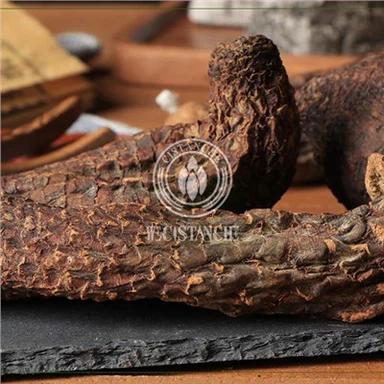
cistanche lives in the Xinjiang Desert in China
2.2 Correlation Analysis of Element Contents
A correlation heatmap was generated to assess potential interactions among the 20 elements. Significant positive correlations (P < 0.05 or P < 0.001) were observed:
Synergistic Uptake:
Li ↔ Al, Cr, Ba, Mn, Fe, Co, As, Sr
Be ↔ Sn, Pb, Co, Zn, As
Mg ↔ Mn, Cr
Ca ↔ Mn, Fe
Cr ↔ Mn, Fe, Sr
Sn ↔ Cu, Zn
Ba ↔ Mn, Fe
Co/Ni ↔ Cu/Zn
Antagonistic Relationships:
Mg ↔ Sn, Pb
Sr ↔ Cu, Sn
Hg ↔ Cu
Pb ↔ Sr
Sr ↔ Mo
These findings suggest that certain elements co-accumulate, while others exhibit mutual inhibition, reflecting complex nutrient dynamics in desert plants.
Real Cistanche Extract Benefits


Supportive Service Of Wecistanche-The largest cistanche exporter in the China:
Email:wallence.suen@wecistanche.com
Whatsapp/Tel:+86 15292862950

2.3 Principal Component Analysis (PCA)
To reduce dimensionality and identify key contributors to regional differences, PCA was conducted on the elemental dataset. Results:
PCA Suitability (Tab. 4):
| Metric | Value |
|---|---|
| KMO Value | 0.710 |
| Bartlett's Test (χ²) | 1668.854 |
| Degrees of Freedom | 190 |
| Significance (P-value) | < 0.001 |
Principal Component Summary (Tab. 4):
| Component | Eigenvalue | Variance (%) | Cumulative (%) |
|---|---|---|---|
| PC1 | 6.007 | 30.035 | 30.035 |
| PC2 | 5.258 | 26.291 | 56.326 |
| PC3 | 2.166 | 10.831 | 67.157 |
| PC4 | 1.238 | 6.189 | 73.346 |
| PC5 | 1.122 | 5.612 | 78.958 |
Element Loadings for Each Principal Component (Tab. 5):
| Element | PC1 | PC2 | PC3 | PC4 | PC5 |
|---|---|---|---|---|---|
| Li | 0.667 | 0.492 | -0.115 | -0.210 | 0.141 |
| Be | -0.109 | 0.684 | -0.521 | 0.036 | 0.288 |
| B | -0.172 | -0.168 | 0.309 | -0.467 | 0.431 |
| Mg | 0.579 | -0.199 | -0.027 | 0.614 | 0.212 |
| Al | 0.836 | 0.323 | 0.121 | -0.303 | -0.119 |
| Ca | 0.665 | 0.050 | 0.321 | 0.186 | -0.052 |
| Cr | 0.667 | 0.330 | -0.022 | 0.118 | -0.141 |
| Mn | 0.821 | 0.145 | 0.040 | 0.273 | -0.034 |
| Fe | 0.848 | 0.325 | 0.135 | -0.292 | -0.108 |
| Co | 0.163 | 0.829 | -0.365 | -0.094 | 0.136 |
| Ni | -0.263 | 0.302 | 0.532 | -0.031 | -0.351 |
| Cu | -0.451 | 0.823 | 0.275 | 0.121 | 0.066 |
| Zn | -0.440 | 0.822 | 0.281 | 0.140 | 0.081 |
| As | 0.245 | 0.678 | -0.502 | -0.027 | -0.009 |
| Sr | 0.673 | -0.129 | 0.281 | 0.383 | 0.244 |
| Mo | -0.196 | 0.143 | -0.744 | 0.121 | -0.310 |
| Sn | -0.433 | 0.831 | 0.238 | 0.131 | 0.088 |
| Ba | 0.868 | 0.342 | 0.157 | -0.227 | -0.075 |
| Hg | 0.160 | -0.280 | -0.092 | -0.083 | 0.642 |
| Pb | -0.443 | 0.790 | 0.319 | 0.121 | 0.079 |
Comprehensive Regional Ranking Based on PCA (Tab. 7)
Using the formula:
Y = 0.380Y₁ + 0.333Y₂ + 0.137Y₃ + 0.078Y₄ + 0.071Y₅
| Region | Score | Rank |
|---|---|---|
| Dunhuang | 1.390 | 🥇 1st |
| Guazhou | -0.124 | 🥈 2nd |
| Gulang | -0.075 | 🥉 3rd |
| Jingtai | 0.089 | 4th |
| Jingyuan | -0.466 | 5th |
| Jinta | 0.203 | 6th |
| Linze | -0.314 | 7th |
| Minqin | -0.247 | 8th |

3. Discussion
3.1 Elemental Safety and Quality Insights
All samples met safety guidelines set by the 2020 Chinese Pharmacopoeia. Notably:
Pb, Cu, As, and Hg were all below maximum allowable limits
High levels of Ca, Mg, Fe, Al suggest excellent mineral density
Be, Sn, Cr, Co, Mo, Hg were all present at trace levels
These findings validate the safety and nutritional value of Cistanche deserticola as a functional food ingredient and nutraceutical component.
3.2 Pharmacological Relevance of Trace Elements
Cistanche deserticola is known for its adaptogenic, neuroprotective, anti-inflammatory, and immunomodulatory effects. These therapeutic benefits are closely linked to its mineral composition, which includes:
Fe, Zn, Mn, Cu – Enzyme cofactors, antioxidant defense
K, Na – Osmoregulation, nutrient transport
B, Mg – Bone health, metabolic balance
3.3 Implications for Sustainable Cultivation and Regional Branding
Given overharvesting and ecological pressures, this study provides a framework for eco-conscious cultivation, geo-authenticated product labeling, and region-specific marketing. The data supports:
Dunhuang and Guazhou as priority sourcing regions
The use of elemental fingerprinting for origin traceability
Informed development of Cistanche-based dietary supplements

4. Conclusion
This study confirms that elemental profiling via ICP-MS and PCA is a powerful tool for evaluating Cistanche deserticola quality. These findings provide:
A scientific foundation for supplement formulation
A traceability mechanism for geo-authenticated sourcing
Guidelines for sustainable production in Gansu's herbal industry