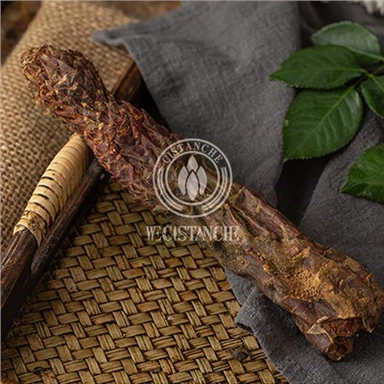
Ginseng in The Desert
Oct 25, 2022
We were on a business trip in Taklimakan. Our mission was to find out the future fate of the Chinese soldiers who went from this region as part of the Soviet army during the 1962 Caribbean crisis.
In the process of searching and questioning, we found three such people. While we were returning to the hotel after talking with them and their descendants, Mukan Sabyrov, the chairman of the rural veterans' council, brought up the following interesting topic.
"There is a man named Sergazy Kylyshbaev here," our guide began. - A pharmacist by profession, he noticed the medicinal properties of a plant called cistanche in the Moyinkum field and opened a special workshop. The beta is not bad. Participates in regional and regional exhibitions of entrepreneurs and receives good reviews.

- Does it have a patent?
- Yes. If you want to try it, go for it. I'll take it. His office is on that cape.
... When we arrived, the businessman was looking at the computer and was searching for something. After learning about the condition of our farmer, he stopped his work and took him to the yard. It turned out to be an open and closed warehouse complex where he received raw materials from the country, washed, dried and stored them. After seeing it, we entered the adjacent building. Here there is an apparatus for harvesting the roots of the cistanche plant, which has been completely cleaned and selected. After that, the crushed and ground raw material was transferred to a machine with a mesh sieve. After this process, small products such as flour are packed in 100-gram standard bags and go to special cardboard boxes on a conveyor.
"You see, this is my farm shop," said Sergazy, taking us back to his room. - What influenced me to do this? Now let me say that. When we were children, adults used to tell us that there is a plant called "wolf feed" in the sand between the sex trees in this region. It grows quickly in the spring and dries up in the summer. It is surrounded by turtles, hedgehogs, wolves, and hawks. According to the people of the village, they seem to dig and gnaw the roots of this plant.
After graduating from the school in the district center, I entered Almaty State Medical University named after S. Asfendiyarov. Having received the profession of a pharmacist, I worked in the pharmacy system there for many years. What I noticed while working in this field was that all foreign medicines are directly dependent on plant raw materials. At that moment, I had a vision of the wild nature of the Moyinkum steppe?! It has everything. For example, the "wolf feed" plant we mentioned above...

When I came to the village on vacation in 2010, I decided to go and see this gift of nature. Surprisingly, the height of its trunk on the ground does not exceed 40-50 centimeters, and the length of its roots under the sand is up to 1.2 meters. Ants and mosquitoes are crawling on the leaves of the plant near the ground. Therefore, there was salt, the vitamin necessary for living things! After seeing and noticing this, I started to find out the circumstances of cistanche - "wolf feed" from the elders in the region. Unfortunately, his real name is Sungila. Tursynbek Aydynbekov, an agronomist from Moynkhum, said it.
Saying this, Sergazy remained silent for a while and resumed his conversation. What we learned from his words is that cistanche, i.e., the root of sycamore has been known for its healing properties in oriental medicine since ancient times. In particular, it was used in people's kidney and bladder for colds even in those days. So, in the language of modern medicine, healers used it against cystitis and pelionephritis. Today's pharmaceutical science says that preparations made from the roots of this plant have a very high antioxidant activity. This means that it protects the brain, as well as the nervous system that drives the body, from all harmful factors. This is because cistanche contains a set of active substances other than those mentioned above. Due to these features, it has a wide pharmacological spectrum. It is for these reasons that the Chinese state, which plays a leading role in the production of medicines based on plant raw materials in the world, is very interested in obtaining it in any way.
- I learned about these properties of cistanche from many scientific works and conducted some research in the Moyinkum field, - said Sergazy. - Then I left my job as a pharmacist in Almaty and moved to the village to do this work. So I bought a plot of land in the district center and started building the shop building and warehouse that you see. My goal was to produce phytotea based on the grass of the desert we are talking about - cistanche. With this in mind, is there any chance that the project developed in 2013 will be supported by the "Development" fund for supporting entrepreneurship?! I bought a device for grinding plant roots and equipment for putting the product in a filter bag with the grant money in the amount of 3 million tenge. That's it
"Sergazy," said Oleg Fessel, a customer in his letter. - Do you still have the product I asked for? I mean, without bothering you, I wish I could buy it from the specialized pharmacies in our region. Where can it be found on the territory of Russia?". Our compatriot Bakhyt Kariboz said, "The most important thing is that it strengthens immunity. That's why I drink it instead of regular tea," he said. Makhambet Kurysh, a resident of Astana, said: "I took 2 tablespoons of the phytoproduct in boiling water in a 1.5-liter glass jar and added a little honey to it, and it refreshed my body. "When I used it as a drink substitute for three months, my kidney pain, which hurts when the sun is cloudy, disappeared," he expressed his opinion.
- Are there so many sungyla in the Moyinkum field? - I said next to our hero. - What I'm asking is that when you collect it in the spring, you dig it up by the roots and dig it up whole. If this happens, won't it disappear from this region later?
- No, - said the owner of the story. - This is a wild plant. A weed with a strong character and structure. If only a thin strand of hair remains in the dug-up area, it crawls back to the surface. In other words, it's soulful. It happens that the necessary prerequisite for the growth of other plants - the structure of photosynthesis is not here. That's why Sungila is looking for a partner who can feed him from underground. That is the reason why the roots are long. After instinctively reaching such a sponsor, he relies on him and continues to grow "without worries". And what do you think of his support there? Sex and swimming. He "communicates" with them, takes the necessary water and other nutrients from them and sits.

- It is clear. Now tell me this. When do you collect and prepare Sungila? How many kilograms or centners of roots are needed for the end of summer and autumn and winter seasons so that the rhythm of work in your workshop does not stop?
- Trekking to Cistanche is usually done in spring, i.e. in mid-April, during 10-15 days when it is blooming. Villagers are the ones who dig the sand between the Sekseul groves and bring it to them. The raw material purchased from them is cut and processed, and then it is spread out on the open space covered with lime in this yard. Lime is necessary to prevent mosquitoes and ants from entering. Then the roots are cleaned, washed and dried here. When all this heat treatment is done, the weight and volume of the raw material is significantly reduced. If, on average, I collect 4.5 tons of acorns in one season, then in the "dried form" it will decrease by about 700-800 kilograms. The rest is enough for me.
The conversation was coming to an end. At that time, we decided to ask Sergazy two more things. The first of them was the question of whether there is a private team or a research center in the country that is dealing with the problem of Sungyla of our hero. And the second one was what kind of problems the entrepreneur was waiting to solve in relation to this business he had undertaken. Regarding the first question, Sergazy told about the thoughts of the scientists of LN Gumilev National University in the capital on obtaining an extract from sungyla, that it is an interesting endeavor. According to this idea, one kilogram of extracted salt should be produced from one ton of raw materials. If it is enriched with other reagents and produced in small bottles, the cost of transportation of the product in the regions of the country will decrease and it will spread very quickly in the republic, says the entrepreneur. He also informed us that the scientists of the medical academy in Astana are also interested in the subject of cistanche. According to their research, the antioxidative and refreshing properties of the tea are 10 times higher than those of the green tea.

Cistanche Raw Material Come From Chengdu Wecistanche Bio-tech
Click here link to get more info:https://www.xjcistanche.com/
"Now let's talk about the problem that is waiting for a solution," said Sergazy. - If the state has an additional tax-free quota for products from 1 to 5 tons...". Then he told another story. His future dream is to look at, study and obtain vitamin substances from the sand plant, licorice, and duzgen in the sand. A decade-long idea. Everything is a search. Fantastic fun. Thinking: "Let the people of the country imitate the owner of innovation like Sergazy. Let what we write be an advertisement for our boyfriend," we created this world.